Overpackaging
Overpackaging is the use of excess packaging. The Institute of Packaging Professionals defines overpackaging as “a condition where the methods and materials used to package an item exceed the requirements for adequate containment, protection, transport, and sale”[1]

Overpackaging is an opportunity for source reduction, reducing waste before it is generated by proper package design and practice. Elimination of excess packaging is at the lead of the Reduce, reuse, recycle hierarchy. Use of minimized packaging is key to having sustainable packaging. Examples of overpackaging can be found in many areas; from e-commerce to retail food packaging.[2]
Excess packaging by design
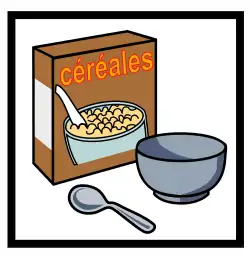
An excellent example of a wastetfull package design is a breakfast cereal box (some other products also). This is typically a folding carton enclosing a plastic bag of cereal. Cartons are frequently tall and wide but very thin. This has a poor material to volume ratio and is very inefficient; it is very wasteful. Package designers are aware of this opportunity to save packaging costs, materials, and waste but marketing and merchandising people want the “billboard” style package for advertising and graphics. An optimized folding carton would use much less paperboard for the same volume of cereal, but with reduced room for graphics. Use of only a resealable plastic bag would use even less material per unit of cereal; Of course, even that option results with an empty plastic bag to discard.[3]
Underfilled packages
Underfilled or slackfill packaging is that which is intentionally too large for the contents, resulting in non-functional headspace. This not only risks charges of deceptive packaging but it involves excessive packaging: unnecessary packaging waste.[4]
E-commerce

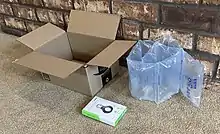
Sometimes a package is properly designed to protect its product for controlled distribution to a retail store; packaging is minimal. With online shopping or E-commerce, however, items packed for retail sale need to be shipped individually by the e-tailer or by a fulfillment house. The individual package is shipped and handled by package delivery or small parcel carriers. Retail packages are frequently packed into a larger corrugated box for shipment. Often these secondary boxes are much larger than needed, thus use void-fill to immobilize the contents. This can have the appearance of gross overpackaging.
If the product manufacturer designed all packaging to meet the requirements of individual shipment, then the portion delivered to a retail store would have excessive packaging.[5]
With fragile items such as consumer electronics, engineers try to match the fragility of the product with the expected stresses of distribution handling. Package cushioning is used to help ensure safe delivery of the product. With overpackaging, excessive cushioning and a larger corrugated box are used: wasteful packaging.
Sometimes two levels of packaging are needed for separate distribution: one for palletize shipment to retail stores and the other designed for individual delivery to households, which results in production inefficiency. New package designs are sometimes called for.[6]
References
- Soroka, W. Illustrated Glossary of Packaging Terminology (Second ed.). Institute of Packaging Professionals.
- Marino, G (12 January 2021). "ENOUGH IS ENOUGH: OVERPACKAGING IN THE FOOD SYSTEM". Renewable Matter. 33. Retrieved 11 December 2021.
- Fitzgerald (August 2004). "Cereal Box Design" (PDF). Tech Directions: 22. Retrieved 4 November 2021.
- Misleading Containers, 21CFR100.100
- Escursel, S (1 January 2021). "Sustainability in e-commerce packaging: A review". Journal of Cleaner Production. Retrieved 16 November 2021.
- Alberto, R (2014). "A New Paradigm for Packaging Design in Web-based Commerce". International Journal of Engineering Business Management. Retrieved 14 November 2021.
- Soroka, W, "Fundamentals of Packaging Technology", IoPP, 2002, ISBN 1-930268-25-4
- Yam, K. L., "Encyclopedia of Packaging Technology", John Wiley & Sons, 2009, ISBN 978-0-470-08704-6
