Philips PM5544
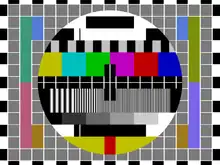
The Philips PM5544 is a television pattern generator, most commonly used to provide a television station with a complex test card commonly referred to as a Philips Pattern or PTV Circle pattern. The content and layout of the pattern was designed by engineer Finn Hendil (da; 1939–2011) in the Philips TV laboratory in Copenhagen under supervision of chief engineer Erik Helmer Nielsen in 1966–67. The equipment, the PM5544 Test Pattern Generator,[1] which generates the pattern, was made by engineer Finn Hendil and his group in 1968–69.[2] Since the introduction of the PM5544 in the early 1970s, the Philips Pattern has become one of the most commonly used test cards, with only the SMPTE bars and the BBC Test Card F coming close to its usage.
Operation
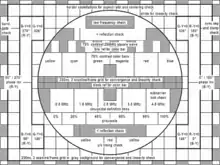
Rather than previous test card approaches that worked by a camera or monoscope filming a printed card, the Philips PM5544 generates the test patterns fully using electronic circuits, with separate paths for Y, R-Y and B-Y color components[1] (Y′UV), allowing engineers to reliably test and adjust transmitters and receivers for signal disturbances and colour separation, for instance for PAL broadcasts.
In simple terms, the displayed pattern provides reference levels of black, white and color saturation, to which a receiver can be set. Displayed image geometry (image centering, correct proportions of the circle, etc.) can also be corrected. More technical adjustments are also possible.
The Philips PM5544 pattern was later incorporated into other test pattern generators from Philips itself, as well as test pattern generators from various other manufacturers. Various configurations and modifications exist. While the basic specifications normally remain consistent, there are often small variations to the Philips Pattern depending on the brand and type of generator used to produce it, as well as how the broadcaster has chosen to configure it.
Wordwide usage
PAL broadcasts
Many broadcasters using a 625-line PAL system used some form of the Philips Pattern.
The BBC occasionally used a slightly modified version called Test Card G from 1971 until the late-1990s, in conjunction with Test Card F. The IBA initially used this card in the 1970s, also in conjunction with Test Card F, but eventually abandoned Test Card G and developed a unique test card called the ETP-1, which was brought into use on ITV from 1979 onwards.[3]
The Philips PM5544 was also in widespread use in Australia for many years, most notably with the ABC and SBS. Some commercial stations also used it. In New Zealand, it was used by TVNZ from the rollout of colour broadcasting.
In the DACH countries, the PM5544 test card was used by the Austrian public broadcaster ORF[4] and the German commercial terrestrial channel RTL.[5] Use of the PM5544 in the DACH was solely confined to these two broadcasters as most TV stations in these areas instead preferred to use the Telefunken FuBK test card when they adopted colour television.
In Spain, the PM5544 test card was used by the various autonomous and private channels since the early 1980s notably by TV3, El 33, Telemadrid, Antena 3, and Canal+ Spain, although not by the national public broadcaster TVE, which had used its own colour test card from 1975 until the early-2000s.
In South Africa, the South African Broadcasting Corporation (SABC) made use of the PM5544 pattern since they started testing their first television system in 1975, but independent broadcasters M-Net, which launched in 1986, and e.tv, which launched in 1998, opted not to.
Saudi Broadcasting Authority (SBA) in Saudi Arabia previously used a heavily modified version of the Philips PM5544 pattern from 1982 until 2009, with the side "brackets" removed and 1/4 of the top half of the PM5544 "circle" replaced with a white and black background and colour bars.[6]
Some television stations have also been seen to have included a digital clock and/or date, as well as the station logo or ID, inside the "circle" of the PM5544 test card. This practice is common in Asia and in some parts of Europe, as well as in South Africa.
SECAM and NTSC broadcasts
Since the Philips PM5544 pattern is geared towards the PAL colour-coding system, this test pattern is uncommon among NTSC and SECAM broadcasters, though some, such as CBFT and CBMT in Canada, WBOY-TV and WNYW in the United States, DZBB-TV in the Philippines, Myawaddy TV in Myanmar, KBS and MBC in South Korea and TTV Main Channel, CTV Main Channel and CTS Main Channel in Taiwan have used a 525-line variant of it.[7][8]
The Japanese national broadcaster, NHK, also used a 525-line version of the test card, albeit with slight technical differences as compared to those used by the American and Canadian broadcasters so as to conform with the NTSC-J system.[9]
SECAM users of the Philips PM5544 test card included TF1, Antenne 2, FR3,[10] Canal+,[11] La Cinquième and M6[12] in France, Iraqi TV[13] in Iraq, VTV[14] in Vietnam and bTV in Bulgaria.[15] TVP in Poland was using this test card for SECAM transmissions since 1970s and continued using it after switching to PAL in 1990s.
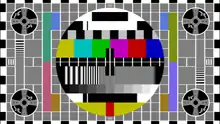
PM5644 (widescreen)
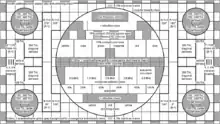
A widescreen-capable Philips Pattern generator, the PM5644, was introduced by Philips in the 1990s and featured support for the emerging PALplus standard. The widescreen version of the test card retains the signals present in the original, and features additional signals to test further aspects of signal and picture quality including ones relevant for PALplus, as well as overscan markings. As with its predecessor, the widescreen Philips Pattern was adopted by various other manufacturers of test pattern generators.
Image gallery
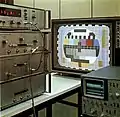 Philips PM5544 used to display test pattern on a television set
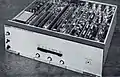 Philips PM5544 generator with top lid opened
.jpg.webp) Philips PM5644 generator (NTSC variant)
Philips PM5644 generator (NTSC variant)
See also
References
- Hendil, F (1970). Sudar, T (ed.). "Combined colour/monochrome pattern generator PM 5544" (PDF). Electronic Measuring and Microwave Notes. Eindhoven, The Netherlands: Philips. 1970 (2): 1–6. ISSN 0374-4043. Retrieved 4 March 2021.
- "Fjernsynets historie fra 1926 til 2012 - og lidt efter ..." (PDF). kulturstyrelsen.dk. Retrieved 2015-06-07.
- "A Very Concise History of Test Cards". testcardcircle.org.uk. Retrieved 2015-06-07.
- ORF Testbild 1986. Stefan Just. 2006-08-19. Archived from the original on 2021-01-08. Retrieved 2021-09-04 – via YouTube.
- RTL Plus - Sendeschluss/Testbild mit Ton von Radio Luxemburg MW 1440 kHz. Christian Ehrl. 2018-01-06. Retrieved 2021-09-04 – via YouTube.
- Saudi TV1 Testcard. OldTv Archives. 2014-12-09. Archived from the original on 2020-07-09. Retrieved 2021-09-04 – via YouTube.
- "Jeff Kadet, K1MOD's". oldtvguides.com. Archived from the original on 2015-07-02. Retrieved 2015-06-07.
- "A selection of comments and suggestions received using the Feedback form or direct via email". meldrum.co.uk. Retrieved 2015-06-07.
- "Test Card 'G' and PM5544". pembers.freeserve.co.uk. Archived from the original on 2016-09-23. Retrieved 2015-06-07.
- France 3 - mire musicale + ouverture antenne (06 janvier 2002). inconnu du quatre-vingt douze. 2010-03-07. Retrieved 2021-09-04 – via YouTube.
- CANAL+ Testcard Mire. 625line. 2008-06-05. Archived from the original on 2020-04-11. Retrieved 2021-09-04 – via YouTube.
- Indicatif Métropole télévision 6 - indicatif M6 - générique M6 (ouverture d’antenne). Yankee Pull. 2019-10-19. Archived from the original on 2020-11-05. Retrieved 2021-09-04 – via YouTube.
- Iraqi TV test card 1984 SECAM B. radiotvhistory. 2009-06-13. Archived from the original on 2016-05-01. Retrieved 2021-09-04 – via YouTube.
- TV-DX VTV Vietnam 23.11.1992. EifelDX. 2017-02-20. Archived from the original on 2019-11-22. Retrieved 2021-09-04 – via YouTube.
- bTV - Test Pattern - 2003. Miroslav Nedev Мирослав Недев. 2019-03-04. Archived from the original on 2020-11-11. Retrieved 2021-09-04 – via YouTube.