Telefunken FuBK
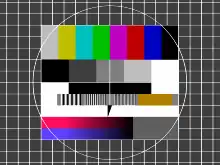
The Telefunken FuBK[1] (Funkbetriebungskommission - Television Service Commission) was an electronic analogue TV test card introduced in the 1960s[2] and used with analogue PAL broadcasts. Not as popular as the Philips PM5544, nevertheless it saw widespread use in Germany and some other European and Asian countries.[3][4]
Operation
The test card was generated electronically by a video generator such as Grundig VG 1001[5].
It consists of different coloured and black and white fields, a large circle and a grid for geometry settings, a grey staircase for contrast and brightness control, and four burst signals with sine curves (1 MHz, 2 MHz, 3 MHz, and 4.433 MHz) as a test of the horizontal resolution. On PAL broadcasts, with a maximum displayable video bandwidth of around 5 MHz, individual lines should just be visible in all four burst fields. On other situations, like a VHS recording with reduced bandwidth, they become more and more indistinct, merging into a grey area.
There are two special fields ("achromatic fields") that display as grey if PAL decoding is functioning correctly. If not, color will be seen on these areas.[4]
A variation of the test card for the 16:9 PALplus system was created[6], that included geometric markings for the central 4:3 safe area. The other details are generally the same as on the original version.
Usage
.jpg.webp)
This pattern was used by many broadcasters, including:
- ARD and ZDF (Germany)[3]
- Norddeutscher Rundfunk (NDR; Northern German Broadcasting Hamburg)[3]
- Westdeutscher Rundfunk (WDR; West German Broadcasting Cologne)
- Hrvatska radiotelevizija (Croatian Radiotelevision)
- RTL9 (Luxemburg)
- Rádio e Televisão de Portugal (Portuguese public broadcasting corporation)[7]
- Islamic Republic of Iran Broadcasting (IRIB; used a variation of the pattern)
- VT4 (Flanders, Belgium)[8]
- NRK (Norwegian Broadcasting Corporation)[3]
- YLE (Finnish Broadcasting Company)[3]
- Yugoslav Radio Television[3][7]
- SRG SSR (SF, TSR, TSI) (Switzerland)[3][9]
- Doordarshan (Indian public television broadcaster; 4:3 version without circle)[10]
See also
References
- Union, European Broadcasting (December 14, 1988). "EBU Review". Administrative Office of the European Broadcasting Union – via Google Books.
- "Operational Testing in Telecommunications: Transmission technology". Technicopy Limited. December 14, 1982 – via Google Books.
- "Non-UK Television Test Cards, Tuning Signals, Clocks and Idents". web.archive.org. January 12, 2016.
- https://scdn.rohde-schwarz.com/ur/pws/dl_downloads/dl_application/application_notes/7bm25/7BM25_0E.pdf
- "Videogenerator VG 1001 Equipment Grundig Radio-Vertrieb, RVF". www.radiomuseum.org.
- "Test Card Telefunken FuBK PALplus" – via www.youtube.com.
- "Wireless World". Wireless World. December 14, 1982 – via Google Books.
- "Television Graphics Around the World". www.meldrum.co.uk.
- "Television test card – distant memory of the nightly broadcast shutdown". Swiss National Museum - Swiss history blog. July 30, 2021.
- "TV-DX Doordarshan DD1 India 09.04.1992" – via www.youtube.com.