Pakeezah
Pakeezah (Hindustani pronunciation: [paːkiːzaː]; transl. The Pure One)[4] is a 1972 Indian Hindustani-language musical romantic drama film that was written, directed and produced by Kamal Amrohi. It features Ashok Kumar, Meena Kumari and Raaj Kumar as the lead actors, with Veena, Nadira and D. K. Sapru in the supporting roles. The story revolves on Sahibjaan (Kumari), a Lucknow-based tawaif. In her travel by train, she gets a note from a stranger praising her beauty when she was sleeping. Afterward, she—evacuating from her broken boat—take shelter in a tent and finds out that its owner, the forest ranger Salim (Raaj Kumar), was the one who wrote the letter. Rest of the film follows the two's plan to get married and conflicts caused by her professional background.
| Pakeezah | |
|---|---|
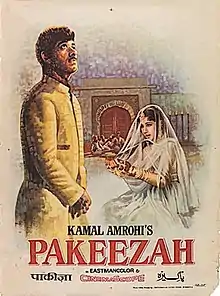 Theatrical release poster | |
| Directed by | Kamal Amrohi |
| Written by | Kamal Amrohi |
| Produced by | Kamal Amrohi |
| Starring | |
| Cinematography | Josef Wirsching |
| Edited by | D. N. Pai |
| Music by | Songs: Ghulam Mohammed Naushad Score: Naushad |
Production companies |
|
Release date |
|
Running time | 153 minutes[1] |
| Country | India |
| Language | Hindustani |
| Budget | ₹15 million[2] |
| Box office | ₹60 million[3] |
Made on a ₹15 million (US$200,000) budget, Pakeezah premiered on 4 February 1972 and garnered mixed response from critics; it was praised for the direction, Kumari's performance and the music but panned for the plot and the high production cost. Its box-office earnings was initially tepid, but Kumari's death a month later boosted its commercial performance, making it the highest-grossing Indian film of the year with collecting ₹60 million (US$800,000) after a theatrical run of over 50 weeks. She was nominated for the Filmfare Award for Best Actress and won a special award at the Bengal Film Journalists' Association Awards; the film also received nominations for Best Film and Best Director (Amrohi), and won Kulkarni a trophy for Best Art Direction at Filmfare.
Plot
Nargis is a tawaif based in the Muslim quarter of Lucknow. She dreams of marrying the man she loves, named Shahabuddin. However, his family's patriarch, Hakim Saab, strongly opposes their relationship as he finds it unacceptable to welcome a tawaif as a daughter-in-law in his respected family. Dejected, Nargis flees to a nearby qabristan and lives there, ultimately giving birth to a daughter before passing away. On her deathbed, she writes Shahabuddin a letter asking him to come for his newborn daughter. Nargis' sister, Nawabjaan, is buying jewellery when she finds one of which is similar to that of Nargis. She asks the jeweller how she gets it, and she is led to the kabristan. She finds Nargis, now died, and her daughter, bringing the latter back to her kotha.
When Nargis' belongings are sold several years later, a man finds Nargis' letter and delivers it to Shahabuddin. Shahabuddin tracks down her now adult daughter Sahibjaan's whereabouts and finds her working as a tawaif at Nawabjaan's kotha. Nawabjaan, however, does not want him to take away her, taking her niece and fleeing to another town instead. While travelling by train, a young man enters Sahibjaan's compartment seeing her sleeping. Struck by her beauty, he leaves her a note on her feet that says, "Aapke paon dekhe, bahut haseen hain. Inhein zameen par mat utariyega... maile ho jaayenge" ("I saw your feet. They are really beautiful. Please do not step on the ground... avoid making them dirty"). After arriving at her destination, Sahibjaan wakes up and finds the note. She reads it, consequently falling in love with the stranger.
A patron, Nawab, wishes to own Sahibjaan and takes her to his boat for a night. The boat, however, is attacked by elephants and Sahibjaan is carried away by the fast flowing river in a broken boat. She is taken to the riverside tent of a forest ranger, Salim. Alone with his diary, she reads how he was the man who had earlier left her a note on her feet. Sahibjaan has finally met the stranger, but feigns amnesia to avoid telling him her true identity. Before the sunset, Nawabjaan tracks Sahibjaan and brings her back to the kotha. Sahibjaan keeps to think about him, and then runs away from the kotha. She unconsciously runs on the rails, which makes her gharara accidentally stuck there. A train comes to cross; in panic, Sahibjaan stumbles and faints. The train stops before running over her body, and people come to help her. One of them is Salim who immediately bring her to his home.
Salim and Sahibjaan plan to elope to live peacefully, but her profession as a tawaif makes her doubtful of the plan. When Salim anoints her to marry her, she refuses and decides to return to the kotha. Salim, who is heartbroken, eventually decides to marry someone else in his family's request and invites Sahibjaan to perform a mujra at his wedding. During the event, Nawabjaan recognises Shahabuddin and calls him to witness the irony of the situation; his own daughter dancing and entertaining his family. Shahabuddin's father tries to shoot Nawabjaan to silence her, but instead ends up killing Shahabuddin while trying to protect her. With his dying breath, Shahabuddin asks Salim to marry Sahibjaan. Salim's doli defies all conventions and arrives at Sahibjaan's kotha, thus fulfilling Shahabuddin's wishes.
Cast
The cast is listed below:[5][6]
- Ashok Kumar as Shahabuddin
- Meena Kumari as Nargis/Sahibjaan
- Raaj Kumar as Salim Ahmed Khan
- Veena as Nawabjaan
- Nadira as Gauharjaan
- D. K. Sapru as Hakim Saab
- Kamal Kapoor as Nawab Zafar Ali Khan
- Vijayalakshmi as Rashidan
Production
Concept
"Shah Jahan made Taj Mahal for his wife, Kamal Sahab wanted to do the same with Pakeezah."[2]
— Kamal Amrohi's PR man
In 1955, Meena Kumari and Kamal Amrohi were in South India and here Kamal Amrohi began outlining the plot of his next film with his wife Meena Kumari and decided that he would call it Pakeezah (the name has a fascinating history too. It was changed many times due to superstitious reasons, but finally the original stayed).[2] After the failure of Daera in 1953, Pakeezah as an idea was roaming Amrohi's mind.[2] A concept, Kamal Amrohi says was irretrievably fixed with his love for his wife Meena Kumari, he hoped to create a film which would be worthy of her as an actress, and worthy of the love he felt for her as a woman. Kamal Amrohi declared that for every line he wrote he had Meena in mind. He wished to present her on the screen as no one had before: beautiful, sad, sanguine, dejected, calculating, sexy - his ambition was to capture as many dimensions of her as he knew of.[2] Kamal Amrohi's son Tajdar Amrohi, raised by Meena Kumari, said: "What you see in Pakeezah is exactly how our home looked like -- the same windows, chandeliers, arches, and curtains." The grandfather's character was taken from Amrohi's father. "The dining table sequence in which Raaj Kumar says, 'Afsos, log doodh se bhi jal jaate hai (Alas, people get burnt by milk, too),' was inspired by everyday domestic scenes at our home. "When an elder enters the room, the womenfolk put on their veil. This is what baba showed in Pakeezah and that's how women at our home behaved."[7] says Tajdar, "And his romance with my chhoti ammi was very dignified. Despite being separated, they felt for each other. But they never divorced as rumors go. They loved each other and chhoti ammi respected my father and never allowed anyone to say anything against him."
'Pakeezah is the beloved which has been born of this film-maker's imagination nearly two decades ago. Pakeezah is the vision which has haunted his soul for as long as I can remember.' .[2]
— Meena Kumari
Kamal Amrohi's blurb for his film explains this best: 'For her to fall in love was forbidden—it was a sin, she was told. A nautch girl is born to delight others, such is her destiny. She preferred to die a thousand deaths than to live as a body without a soul. And yet when her restless soul could not suppress this surging desire to love and be loved, she took birth as Kamal Amrohi's Pakeezah.'"[8]
In 1964, Kamal Amrohi and Meena Kumari separated due to their mutual differences, but the separation never led to formal divorce. The project came to a halt. In moments of desperation, Kamal thought of a substitute for Meena Kumari. He even searched for a replacement actress, but each time he came back to where he had started. The one and only woman who could play Sahibjaan was Meena Kumari.
Vinod Mehta says that "Kamal Amrohi came to a stage where he thought of abandoning the film. Since he had conceived it as a tribute to his wife Meena Kumari and since his wife was no longer by his side the raison d'être of the film had disappeared. Pakeezah was a work of love and a man with a broken heart was not qualified to pursue it.".[8]
According to Vinod Mehta, Meena Kumari had a special niche for Pakeezah. There is, however, one sentence worth considering: 'the surging desire to love and be loved'. And it was this line in which Meena saw a reflection of her life. [2] Kamal Amrohi himself pronounced, 'Pakeezah is Meena Kumari.'[2]
Development
It was planned together by Kamal Amrohi and Meena Kumari in 1956 and at first, was launched as a black & white venture. Later, with color technology coming in, Kamal Amrohi started it all again in the new color format. But soon after that, when Cinemascope was introduced, Amrohi decided to shoot the film in Cinemascope. So he bought the required lens from MGM on a royalty basis and started shooting. However, after a while, an error was detected in the shooting done with the new lens. The problem was reported to MGM, who, after studying the problem, decided not to collect their due royalties and also gifted the lens to Amrohi as a gesture of appreciation.[2] The film was still being made when in 1964 Kamal Amrohi and Meena Kumari separated due to mutual differences. The project came to a halt for some time when it was more than halfway complete.
Kamal Amrohi wrote a letter to his estranged wife on 24 August 1968.[2]
"Only Pakeezah's completion remain unsettled. You have made a condition that unless I give you a divorce you will not complete Pakeezah. Even this knot can be untied ... I will free you from your marital ties. After this, if you wish to complete your Pakeezah. I would be the most happy to do so. This is my request, that Pakeezah, on which the fortune of many people depends and which had the good wishes of so many people, should not be left uncompleted if possible. You have better means. You have box-office appeal, and most of all Pakeezah needs you personally ... Pakeezah that is like a sinking ship will reach a shore under your care."
Meena Kumari wrote to her husband in early 1969.[2]
"In regard to my working in Pakeezah, I have always been willing and clamouring to work. Pakeezah is my life dream and it will be my greatest pleasure to see it completed. As for my remuneration, I am glad you have given me an opportunity to prove my regards and respect for you. I shall accept only ONE GUINEA as a token of goodwill for my entire work in Pakeezah."
In 1969, Hindustan Times described the meeting which Sunil Dutt and Nargis had organized between the Meena Kumari and Kamal Amrohi:[9] "Not much was said, but streams of tears were shed... Amrohi greeted her with a token payment of a gold guinea and the promise that he'd make her look as beautiful as the day she had started the film. They had dinner together and she gave him her diary to read."
As the shooting resumed in 1969, Meena Kumari was suffering from liver cirrhosis and was in critical condition. But since Kumari was still Amrohi's only choice, she agreed to complete the film, despite her severe ill health.[2] On 16 March 1969, five years and twelve days after Kumari left her husband, gravely ill, Kumari again reported for work on Pakeezah.[2] Kamal Amrohi organized a great reception. He gave his wife a peda (sweet) as a peace offering, and made a documentary film on her arrival at the studio.[2] Meena Kumari was determined to complete the film and, well aware of the limited time left for her to live, went out of her way to complete it at the earliest.[2] Her condition became so bad that during the filming of the last song "Teer-e Nazar," she collapsed. A body double, Padma Khanna, was used who was personally trained by her for the scene. Throughout the song, Padma Khanna's face remained veiled and the veil was lifted at instances to show Meena Kumari's face.
Casting
In 1956, at the initial stages the following had been signed: Josef Wirsching as photographer, Ghulam Mohammed as music director, Ashok Kumar as the hero, Meena Kumari as the heroine, and a handful of Urdu writers as lyricists Kaifi Azmi, Majrooh Sultanpuri, Kaif Bhopali including Kamal Amrohi. When the project got resumed in 1969, Amrohi was confronted with another difficulty; Ashok Kumar was getting no younger. He had to find a younger leading man for his film. Dharmendra, Rajendra Kumar, Raaj Kumar and Sunil Dutt were considered for the same role which eventually went to Raaj Kumar. Raaj Kumar and Kamal Amrohi had worked previously together in Dil Apna Aur Preet Parayi, and according to Kamal Amrohi, the one thing that he liked about Raaj Kumar was his voice. Not only did Raaj Kumar knew literate Hindustani, but he also spoke it well and deep. And after finalizing Raaj Kumar, the role was modified from being a businessman's character to a forest officer according to the strong built and impressive persona of Raaj Kumar. During the making of the film, composer Ghulam Mohammed and cinematographer Josef Wirsching died, leaving director Kamal Amrohi at a loss. Eventually, though, composer Naushad was brought in to compose the background score; and after Wirsching's death, over a dozen of Bombay's top cinematographers stepped in as/when they had a break from their other assignments, and they maintained an even look.
Design
A one-and-a-half-crore rupee film, CinemaScope, Eastmancolor, fourteen years in the making, Kamal Amrohi sketched all the set designs and camera movements, and personally selected every costume, right down to the bangles worn by the minor characters.[2] Tajdar Amrohi said the haveli in Pakeezah is inspired by their family haveli back home in the city of Amroha, Uttar Pradesh, Kamal Amrohi recreated the exact replica in Mumbai. Most of the film was shot at Filmistan Studios, where the magnificent sets were mounted. The chandeliers were imported from Belgium and bills of the carpets alone ran into lakhs.[7] Vinod Mehta said: " Kamal Amrohi saw in Pakeezah an epic, a larger-than-life film with hundreds of extras, with expensive and exotic sets, with superhuman effort made to preserve period flavor; and all this he wished to do with the collected professional proficiency he had acquired in nearly two decades. This was no do-it-yourself cinema; instead, it was visioned as the ultimate in spectacle and pageantry."[2]
Production credits
- Production Manager: Sadat Ali Syed
- Screenplay: Kamal Amrohi
- Art Direction: N.B. Kulkarni
- Set Design : Kamal Amrohi
- Costume Design : Meena Kumari
- Director Of Photography : Josef Wirsching
- Dance Directors: Gauri Shankar, Lachhu Maharaj (Thare Rahiyo)
Music
When production of Pakeezah was resumed in 1969, many exhibitors suggested Kamal Amrohi to change the music according to the then prevailing trend and style. To this, Amrohi said that he would have readily done this if only Ghulam Mohammed was still breathing alive. But, now he cannot betray a man who gave him such melodious songs, after his unexpected and untimely death. So he kept his music intact, but used fewer songs as planned to keep up with the changing times.[10] Ghulam, the music director of Pakeezah, sadly could not be alive to see the success of his film. It is said that he did not get his due in the Hindi Film Industry in spite of his brilliant work in films like Mirza Ghalib (1954) and Shama (1961).[10] The composer Naushad was brought in to do the background score for the movie and he also added some fine 'Thumris' in it as required. In January 1977, HMV (now SAREGAMA) released all the remaining 9 unreleased tracks in a different LP titled PAKEEZAH – RANG BARANG, about which many are still not aware of.[10]
Music credits
- Lyrics: Majrooh Sultanpuri, Kaifi Azmi, Kaif Bhopali, Kamal Amrohi
- Music: Ghulam Mohammed, Naushad Ali (Background Score, Title Music)
- Playback singers: Lata Mangeshkar, Mohd. Rafi, Vani Jairam, Parveen Sultana, Rajkumari Dubey,[11] Shobha Gurtu
Release and reception
On 3 February 1972, in the Arabian Sea a 'Pakeezah Boat' was sailing and in Maratha Mandir the premiere was scheduled.[2] The film released with a grand premiere at Maratha Mandir theatre in central Mumbai and the prints being carried on a decked-up palanquin. [7] Meena Kumari arrived to attend the last premiere of her life.[2] Kumari let Raaj Kumar, for the benefit of the press, kiss her hand and went in to see the film.[2] Meena Kumari was seated next to Kamal Amrohi during the premiere.[2] When music director,Mohammed Zahur Khayyam complimented Meena Kumari with "shahkar ban gaya" (it's priceless), she was in tears.[12] After watching the film, Meena Kumari told a friend that she was convinced that her husband Kamal Amrohi was the finest film-maker in India.[2] Kumari regarded the film as Kamal Amrohi's tribute to her.[13]
The film finally released for the general masses the following day. An idea which once lingered in its creator's mind for almost 16 years finally reached the silver screen on 4 February 1972. Unfortunately, it received a lukewarm response from the critics. Although the film received a warm reception from the audience, it was Meena Kumari's untimely death on 31 March 1972 which acted as an ultimate push and made it one of the top grossers of that year. Pakeezah celebrated its silver jubilee and was house-full for 33 weeks. Meena Kumari's performance as a golden-hearted Lucknow nautch girl drew major praise and the film is since then considered a classic and has a status much similar to K. Asif's 1960 magnum opus, Mughal-E-Azam.,[14]
On the same day of the film's release, The Times of India described it as a "lavish waste".[15] On 25 February 1972, S. J. Banaji of Filmfare wrote a critical review for the film, in which he gave it a one-star rating. He wrote that Amrohi is the film's main issue, saying that he cannot decide "which way he wants to go. He starts off with a couple eloping in a coach, but for the rest about the only period flavour to the tale is the self-conscious way he's kept motor-cars out of the street scenes."[16]
Awards
- 20th Filmfare Awards – 1973
| Category | Name | Result |
|---|---|---|
| Best Art Direction | N.B. Kulkarni | Won |
| Best Film | Pakeezah | Nominated |
| Best Director | Kamal Amrohi | |
| Best Actress | Meena Kumari | |
| Best Music Director | Ghulam Mohammad | |
| Category | Name | Result |
|---|---|---|
| Special Award | Meena Kumari | Won |
Legacy
Pakeezah is India's first color film in Cinemascope and Meena Kumari's most awaited film and has since acquired major cult status as well. Tajdar Amrohi shares: "When the shooting of Pakeezah resumed in 1969, the first song shot was "Mausam Hai Ashiqana" with this song Meena Kumari set a new fashion trend of girls wearing Lungi.
Indian Film Critic Bhavana Soumaya says "Pakeezah is just like poetry on celluloid. I cannot imagine anybody else in this movie except Meena Kumari. Pakeezah's music is cited as one of the finest classical album in the history of Hindi cinema and was one of the best-selling Bollywood albums of the 1970s.
"I have lived with Pakeezah almost as long as I lived with its creator ... to Meena Kumari Pakeezah means a performance. A great performance? That is not for me to say: that is for people to decide. For me to say is this: it is a performance to deliver which I have, as an actress, had to delve deeper into the secret wells of being than any actor or actress normally delves in the process of his or her professional work."[2]
—Meena Kumari about Pakeezah (1972)
Pakeezah was the inaugural film telecast by Doordarshan, India's state-owned television station, when it began broadcasting from Amritsar in Punjab in the early 1970s. It was especially beamed towards Lahore nearby, in Pakistan. Thousands flocked to Lahore, from as far as Karachi, hundreds of miles away, to see Pakeezah. It was a flood. The crowds stampeded the streets of Lahore to get to the television screens placed at strategic points on virtually every street corner.
Vinod Mehta (the biographer of Meena Kumari) shared an incident which occurred during the last days of the film's shooting: "On outdoor shooting, Kamal Amrohi's unit traveled in two cars near a place called Shivpuri in Madhya Pradesh. The cars ran out of petrol, and for miles around there was nothing except a long, deserted, straight road. It was discovered that a bus passed on this route every morning from which fuel could be purchased. Kamal Amrohi decided to spend the night in the desert and ordered his unit roll up the windows of the cars. A little after midnight the occupants of the vehicles were surrounded by a dozen armed men. The men knocked on the closed windows and forced their way in. When the armed gang leader learned that one of the persons in the car was Meena Kumari, his attitude completely changed. He turned out to be a Meena Kumari fan and welcomed his guests in true fan tradition. He organized music, dancing, and food. He even provided a place to sleep. He instructed his juniors the next morning to fetch petrol for the unit. From Meena Kumari, he wanted a special favor. He sharpened his knife and took it to her. 'Please autograph my hand with this,' he requested. Meena was not new to signing autographs but she had never attempted anything as ambitious as a knife. Nervously, she wrote her name on this man's hand. He said he was grateful for this favor. Once the unit left, they found at the next town that they had spent the night in the camp of Madhya Pradesh's renowned and dangerous dacoit Amrit Lal."[2]
Dwyer and Patel have argued that the Pakeezah courtesan genre is responsible for "some of the most extravagant and beautiful sets and costumes in the history of the Hindi film" – or the pooling of a golden, artificial light that paints his actress as she returns to the Pink Palace. Hence, if Pakeezah's narrative structure (which is also to say its use of time) derives from the codes and conventions of Bollywood filmmaking, as does nominally its emphasis on art design as a source of spectatorial pleasure, Amrohi's spatial articulations and handling of light underscore his individualized sensibility. In this respect, Pakeezah does more justify the popular Indian cinema; it manifests the artistic sensibility of a truly 'rare... connoisseur.' [17]
Meena Kumari delivers a phenomenal performance as the leading female protagonist, especially given the circumstances, as she was terminally ill when filming resumed. It is perhaps one of her greatest works along with Baiju Bawra (1952), Parineeta (1953) and Sahib Bibi Aur Ghulam (1962). These are all films which have helped to consolidate her status as the tragedienne of Indian cinema.[18] The film is also known as one of the historical films which display the sophistication and elegance of Muslim culture in India.[19] Books and documentaries made about the film include Meghnad Desai's Pakeezah: An Ode to a Bygone World.[20] Filmmaker/critic Peter Wollen, in the 1992 "Sight and Sound" poll, named Pakeezah one of the ten best movies ever made.[21] Pakeezah ranks on the lists of top Indian films, including the 2002 British Film Institute poll of Top 10 Indian Films.[22]
In 2021, during the casting of Heeramandi, filmmaker Sanjay Leela Bhansali clearly stated Pakeezah as his inspiration behind the making of this web series which chronicles around the lives of courtesans of Lahore.[23]
Soundtrack
References
- "Pakeezah". British Board of Film Classification. Retrieved 18 October 2021.
- Mehta 2013.
- "Box Office 1972". Box Office India. 2 January 2010. Archived from the original on 22 September 2012. Retrieved 1 November 2020.
- Desai 2013, pp. 38–39.
- "Pakeezah Cast & Crew". Bollywood Hungama. Retrieved 18 October 2021.
- Desai 2013, p. 70.
- Rediff 2012.
- Kumari 2013.
- admin 1952.
- A magnum opus & its unknown facts. (Movies To See Before You Die 2017.
- Centre for Media and Alternative Communication; (CMAC). "Zohrabai, Amirbai and Rajkumari profiles: Women on Record". www.womenonrecord.com. Retrieved 24 November 2021.
- "The Perfect Swansong". The Indian Express. 27 July 2014. Retrieved 2 November 2020.
- admin 2011.
- Vinod Mehta (1 August 2013). "Her Story (Meena Kumari)". Outlook (magazine). Retrieved 1 November 2020.
- Mehta 2013, p. 92.
- Banaji, S. J. (25 February 1972). "Pakeezah: No Sale!". Filmfare. Vol. 21 no. 4. p. 37. Retrieved 9 July 2021.
- Anderson, Michael J. (16 May 2012). ""Body and Soul: Pakeezah and the Parameters of Classical Indian Cinema"". Tativille. Retrieved 2 November 2020.
- Bodrul Chaudhury (12 June 2013). "FRAMING MOVIES Take Twelve: Pakeezah (1972) - (a film review)". BollySpice.com website. Retrieved 2 November 2020.
- Sheza Arshad Iqbal (3 May 2016). "8 Historical Bollywood Films That Illustrate Muslim Culture (Film Reviews)". Odyssey. Retrieved 2 November 2020.
- Desai, Meghnad (11 January 2017). Pakeezah (a film review). ISBN 9789351160236. Retrieved 2 November 2020.
- "Pakeezah (a film review)". TVGuide.com website. 8 December 2015. Retrieved 2 November 2020.
- "British Film Institute (BFI) - South Asian Cinema - A Guide to South Asian Cinema - 50 essential South Asian films - User Poll - Indian Top 10". Features. 15 May 2011. Archived from the original on 15 May 2011. Retrieved 2 November 2020.
- ""We already have a Paakeezah, don't need another one," says Sanjay Leela Bhansali on Heera Mandi". BollywoodHungama. 9 September 2021. Retrieved 9 September 2021.
Bibliography
- Desai, Meghnad (30 September 2013). Pakeezah: An Ode to a Bygone World. HarperCollins. ISBN 978-93-50293-69-0.
- Mehta, Vinod (10 July 2013). Meena Kumari: The Classic Biography. HarperCollins. ISBN 978-93-50296-27-1.