Palaeophis
Palaeophis ('ancient snake') is an extinct genus of marine snake that is the type genus of the extinct snake family Palaeophiidae.
| Palaeophis Temporal range: Cretaceous - Eocene, | |
|---|---|
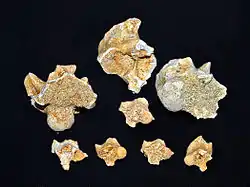 | |
| Fossil vertebrae of Palaeophis maghrebianus from Khouribga (Morocco) | |
Scientific classification  | |
| Kingdom: | Animalia |
| Phylum: | Chordata |
| Class: | Reptilia |
| Order: | Squamata |
| Suborder: | Serpentes |
| Family: | †Palaeophiidae |
| Subfamily: | †Palaeopheinae |
| Genus: | †Palaeophis Owen, 1841 |
| Type species | |
| †Palaeophis toliapicus Owen, 1841 | |
| Species | |
|
Species
| |
Species within this genus lived from the Cretaceous period to the Eocene epoch, approximately from 70.6 to 33.9 million years ago.[1] Fossils of species within this genus have been found in England, France, Denmark,[2] Morocco[3] and Mali.[4] Remains have also been found in North America, including Maryland and Virginia (from the early Eocene Nanjemoy Formation),[5] Georgia[6] and Mississippi.[7]
Description
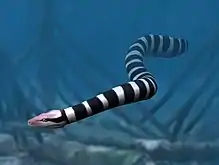
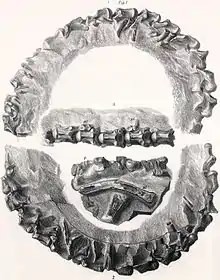
These species varied broadly in size; Palaeophis casei is the smallest at 1.3 metres of length, while Palaeophis colossaeus, known from isolated vertebrae, is the largest at the estimated size limits for the genus at over 9 m (29.5 ft) in length,[4] making it one of the largest known snakes. However most species of the genus were not as big.[8][9]
Biology
Species of Palaeophis were specialised aquatic animals, as their fossils occur primarily in marine strata, though at least some estuarine remains have also been found.[7] Different species are thought to have occupied different ecological niches.
Studies on Palaeophis vertebrae show a high degree of vascularisation, suggesting that it had a considerably faster metabolism and growth rate than modern snakes. This may suggest that palaeophiids, like other marine reptiles such as mosasaurs, might have developed towards endothermy.[3]
References
- Fossilworks
- Kristensen, H. V.; Cuny, G.; Rasmussen, A. R.; Madsen, H (2012). "Earliest record of the fossil snake Palaeophis from the Paleocene/Eocene boundary in Denmark". Bulletin de la Société Géologique de France. 183 (6): 621–625. doi:10.2113/gssgfbull.183.6.621.
- Houssaye, Alexandra; Rage, Jean-Claude; Bardet, Nathalie; Vincent, Peggy; Amaghzaz, Mbarek; Meslouh, Said (2013). "New highlights about the enigmatic marine snake Palaeophis maghrebianus (Palaeophiidae; Palaeophiinae) from the Ypresian (Lower Eocene) phosphates of Morocco". Palaeontology. 56 (3): 647–661. doi:10.1111/pala.12008.
- Rage, J.-C. (1983). "Palaeophis colossaeus nov. sp. (le plus grand Seprent connu?) de l'Eocène du Mali et le problème du genre chez les Palaeopheinae". Comptes rendus de l'Académie des Sciences de Paris. 3 (296): 1741–1744.
- Blake, S. F. "Note on a vertebra of Palaeophis from the Eocene of Maryland." Journal of the Washington Academy of Sciences 31.12 (1941): 501-503.
- Parmley, Dennis, and Harold W. Reed. "Size and age class estimates of North American Eocene palaeopheid snakes." Georgia Journal of Science 61.4 (2003): 220.
- Holman, J. Alan. "Palaeophis casei, new species, a tiny palaeophid snake from the early Eocene of Mississippi." Journal of Vertebrate Paleontology 2.2 (1982): 163-166.
- Holman, J. Alan (1982). "Palaeophis casei, new species, a tiny palaeophid snake from the early Eocene of Mississippi". Journal of Vertebrate Paleontology. 2 (2): 163–166. doi:10.1080/02724634.1982.10011927. JSTOR 4522892.CS1 maint: uses authors parameter (link)
- Rage, Jean-Claude; et al. (2003). "Early Eocene snakes from Kutch, Western India, with a review of the Palaeophiidae". Geodiversitas. Editions scientifiques du Muséum, Paris, France. 25 (4): 695–716. ISSN 1280-9659. Retrieved 12 May 2010.
 |
Wikimedia Commons has media related to Palaeophis. |
 |
Wikispecies has information related to Palaeophis. |
Fossil snakes | |
|---|---|
| |
| Genera with hindlimbs and a sacrum | |
| Genera with hindlimbs only | |
| Madtsoiidae | |
| Dinilysiidae | |
| Palaeophiidae | |
| Boidae | |
| |
