Palenquero
Palenquero (sometimes spelled Palenkero) or Palenque (Palenquero: Lengua) is a Spanish-based creole language spoken in Colombia. It is believed to be a mixture of Kikongo (a language spoken in central Africa in the current countries of Congo, DRC, Gabon, and Angola, former member states of Kongo) and Spanish. However, there is no sufficient evidence to indicate that Palenquero is strictly the result of a two-language contact.[4] Palenquero is the only surviving Spanish-based creole language in Latin America,[5] if Papiamento (which is often considered to be Portuguese-based) is excluded. Over 6,600 people spoke this language in 2018.[1] It is primarily spoken in the village of San Basilio de Palenque which is southeast of Cartagena, and in some neighbourhoods of Barranquilla.[6]
| Palenquero | |
|---|---|
| Native to | Colombia |
| Region | San Basilio de Palenque |
| Ethnicity | 6,637 (2018)[1] |
Native speakers | 2,788 (2005)[2] |
Spanish Creole
| |
| Latin (Spanish alphabet) | |
| Official status | |
Official language in | The Colombian Constitution recognizes minority languages as "official in their territories."[3] |
| Language codes | |
| ISO 639-3 | pln |
| Glottolog | pale1260 |
| ELP | Palenquero |
| Linguasphere | 51-AAC-bc |
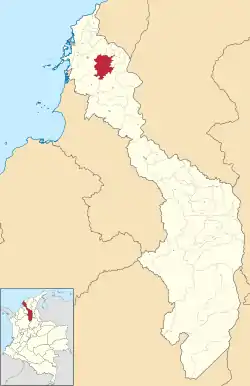 | |
History
Origin
The formation of Palenquero is recorded from the 17th century with the dilution of the Spanish language and the increase of maroon activity.[7] There are existing records dating from the era of Cartagena’s slave trade that allude to the pidgin from which Palenquero evolved. As illustrated in the ethnographic text of De Instauranda Aethiopum Salute (1627), the priest Alonso de Sandoval refers to the ‘corruption of our Spanish language’ commonly spoken amongst African slaves.[7] Palenquero's origins are unclear; it does not appear explicitly in print until 1772.[7]
Palenque de San Basilio
Palenque de San Basilio or San Basilio de Palenque is the village from which Palenquero originated from and in which it is most commonly spoken. The village was formed in the early 17th century on the south of Cartagena by fugitive slaves from surrounding districts under the leadership of Benkos Biohó.[6] The dissolution of the Spanish language thus intensified with the arrival of maroons that escaped slavery and settled in armed fortified territories. Palenqueros maintained their physical distance from others as a form of anti colonial resistance, and as result, developed a creole mostly based on their own African languages and Spanish. Residents have also been noted to be bilingual in both Palenquero and Spanish, with a mention in 1913 of Palenque de San Basilio as having a 'guttural dialect that some believe to be the very African language, if not in all its purity at least with some variations'.[8]
Grammar
Similar to several other creole languages, Palenquero grammar lacks inflectional morphology, meaning that nouns, adjectives, verbs and determiners are almost always invariant.[9]
Gender
Grammatical gender is non-existent, and adjectives derived from Spanish default to the masculine form: lengua africano ‘African language’.[9]
Plurality
Plurality is marked with the particle ma. (for example: ma posá is "houses"). This particle is believed to derive from Kikongo, a Bantu language, and is the sole Kikongo-derived inflection present in Palenquero.[10] The younger speakers of Palenquero utilize ma for plurality more so than the speakers that came before them.
This particle is usually dropped with cardinal numbers greater than two: ma ndo baka "two cows" but tresi año "13 years".[9]
| Number | Person | Nominative | Source |
|---|---|---|---|
| Singular | 1st | í | uncertain |
| yo | yo | ||
| 2nd | bo | vos | |
| 3rd | ele | ele | |
| Plural | 1st | suto | nosotros |
| 2nd | utere | ustedes | |
| enu (formerly archaic) | African origin | ||
| 3rd | ané | Bantu origin |
Copula
There are four copulas in Palenquero: e, ta, jue, and senda. E roughly corresponds to ser in Spanish and is used for permanent states, and ta is similar to the Spanish estar in that it used for temporary states and locatives. Jue is used as a copula for nouns and senda is only found with predicative nouns and adjectives referring to permanent states.[11]
Examples:[12]
- Bo é mamá mí nu (You are not my mother)
- Mujé mí jue negra i yo jue negro (My wife is black and I am black)
- I tan sendá dotó (I will be a doctor)
- Ese mujé ta ngolo (That woman is fat)
Vocabulary
Some 300 words of African origin have been identified in Palenquero,[13] with many believed to originate in the Kikongo language. A comprehensive list and proposed etymologies are provided in Moñino and Schwegler's "Palenque, Cartagena y Afro-Caribe: historia y lengua" (2002). Many of the words that come from African origin, include plant, animal, insect and landscape names.[6] Another handful of words are believed to originate from Portuguese (for example: mai 'mother'; ten 'has'; ele 'he/she'; bae 'go').
| Palenque | Spanish | English |
|---|---|---|
| burú | dinero | money |
| ngombe | ganado | cattle |
| ngubá | maní | peanut, goober |
| posá | casa. Compare posada | house |
| tambore | tambor | drum |
| mai | madre. Compare mãe. | mother |
| bumbilo | basura | garbage |
| chepa | ropa | clothing |
| chitiá | hablar | to speak |
| ngaina | gallina | chicken |
| tabaco | tabaco | tobacco |
| hemano | hermano | brother |
| onde | donde | where |
| pueta | puerta | door |
| ngolo | gordo | fat |
| flo | flor | flower |
| moná | niño | child |
| ceddo | cerdo | pig |
| cateyano | castellano | Spanish |
| foratero | forastero | outsider |
| kusa | cosa | thing, stuff |
| cuagro | barrio | neighborhood |
Sample
| Palenquero | Spanish |
|---|---|
| Tatá suto lo que ta riba cielo, santificaro sendá nombre si, miní a reino sí, asé ño voluntá sí, |
Padre nuestro que estás en el cielo, santificado sea tu nombre. Venga a nosotros tu Reino. Hágase tu voluntad, |
See also
References
- "POBLACIÓN NEGRA, AFROCOLOMBIANA, RAIZAL Y PALENQUERA" (PDF). www.dane.gov.co. 6 November 2019. Retrieved 2020-05-11.
- Ministerio de Cultura (2010). "Palenqueros, descendientes de la insurgencia anticolonial" (PDF). p. 2.
- Title 1, Article 10. http://confinder.richmond.edu/admin/docs/colombia_const2.pdf Archived 2011-09-27 at the Wayback Machine
- Parkvall, Mikael; Jacobs, Bart (2020-07-15). "Palenquero origins". Diachronica. 37 (4): 540–576. doi:10.1075/dia.19019.par. ISSN 0176-4225.
- Romero, Simon (2007-10-18). "San Basilio de Palenque Journal - A Language, Not Quite Spanish, With African Echoes - NYTimes.com". www.nytimes.com. Retrieved 2010-02-13.
- Bickerton, Derek; Escalante, Aquilas (January 1970). "Palenquero: A spanish-based creole of northern colombia". Lingua. 24: 254–267. doi:10.1016/0024-3841(70)90080-x. ISSN 0024-3841.
- Dieck, Marianne (2011). LA ÉPOCA DE FORMACIÓN DE LA LENGUA DE PALENQUE: DATOS HISTÓRICOS Y LINGÜÍSTICOS THE FORMATION PERIOD OF THE PALENQUERO LANGUAGE: HISTORICAL AND LINGUISTIC DATA. Universidad Nacional de Colombia. OCLC 859491443.
- Lipski, John (2018). "Palenquero vs. Spanish negation: Separate but equal?". Lingua. 202: 44–57. doi:10.1016/j.lingua.2017.12.007. ISSN 0024-3841.
- Mackenzie, Ian. "Palenquero".
- McWhorter, John H. (2011-06-30). Linguistic Simplicity and Complexity: Why Do Languages Undress?. Walter de Gruyter. p. 92. ISBN 9781934078402.
- Ledgeway, Adam; Maiden, Martin (2016-09-05). The Oxford Guide to the Romance Languages. Oxford University Press. p. 455. ISBN 9780191063251.
- Moñino, Yves; Schwegler, Armin (2002-01-01). Palenque, Cartagena y Afro-Caribe: historia y lengua (in Spanish). Walter de Gruyter. p. 69. ISBN 9783110960228.
- Moñino, Yves; Schwegler, Armin (2013-02-07). Palenque, Cartagena y Afro-Caribe: historia y lengua (in Spanish). Walter de Gruyter. p. 171. ISBN 9783110960228.
External links
 |
Wikimedia Commons has media related to Palenquero. |
- Colombian varieties of Spanish by Richard J. File-Muriel, Rafael Orozco (eds.), (2012)
- Misa andi lengua ri palenque - Katajena, mayo 21 ri 2000
Authority control  |
|---|