Pame languages
The Pame languages are a group of languages in Mexico that is spoken by around 12,000 Pame people in the state of San Luis Potosí. It belongs to the Oto-Pamean branch of the Oto-Manguean language family.
| Pame | |
|---|---|
| Native to | Mexico |
| Region | San Luis Potosí, Puebla |
| Ethnicity | Pame people |
Native speakers | 12,000 (2020 census)[1] |
Oto-Manguean
| |
| Language codes | |
| ISO 639-3 | Variously:pbs – Central Pamepmq – Northern Pamepmz – Southern Pame |
| Glottolog | pame1260 |
| ELP | Northern Pame |
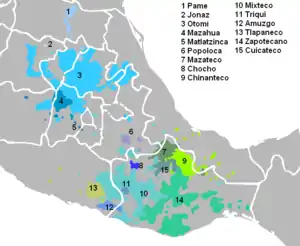 The Pame language, number 1 (azure), north. | |
Distribution and languages
Ethnologue notes two living varieties of Pame both spoken in the state of San Luis Potosí: Central Pame, in the town of Santa María Acapulco,[2] and Northern Pame,[3] in communities from the north of Río Verde to the border with Tamaulipas.
The third variety, Southern Pame, was last described in the mid 20th century, is assumed to be extinct, and is very sparsely documented. It was spoken in Jiliapan, Hidalgo, and Pacula, Querétaro.[4]
- Northern Pame (Ñãʔũ) (~6,000[5]) - spoken in the Potosino municipalities of Aquismón (settlements of Aquismón, Barrio de Jolja, Daniel Ortega, El Aguacate, El Alitze, El Jabalí, El Sabinal, El Sabino, El Sauz (El Saucito), La Cruz de Guadalupe, La Mesa, La Reforma, Linja, Puerto de Guaymas, San Isidro, Santa Anita, Tamcuem, Tampaxal, Tanchachin, Tanquizul, and Tanzozob), Cárdenas (settlements of Barrio de San Antonio, Cárdenas, Colonia Indígenas, El Aguaje, El Naranjo, Higinio Olivo (La Labor), Las Canoas, Lobos, Mesa de San Francisco, and Morales), and Ciudad del Maíz (settlements of Agua Nueva del Norte, Ciudad del Maíz, Colonia Álvaro Obregón, Colonia Agrícola Magdaleno Cedillo, Colonia la Libertad, Colonia la Morita, Ejido San José, El Custodio, La Calzada de San Rafael, La Encarnación, La Guacamaya (La Lagunita), La Majada, Palomas, Papagayos (Ejido Papagayos), San Juan del Meco, Villa de San José, and Zamachihue)[6]
- Central Pame (Šiʔúi) (~6,000) - in the Potosino municipalities of Lagunillas (settlements of Charco de Agua Fría, El Capulín, El Cañón, El Charco de Piedra, El Epazote, Encinillas, La Presa, Las Jarritas, Mesa de Junco, Paso de Botello, Pinihuan (Río Pinihuan), and San Isidro), Rayón (settlements of Crucero de Rayón, El Epazote, El Epazote (Melesio González), El Obispito, El Piruche, El Sabinito, Honorato García, La Chaca, La Chicharrilla, La Nueva Reforma, La Vieja, Las Guapas, Nogales, Obregón (Estancitas), Potrero del Carnero, Puertecitos, Rancho el Paraíso, Rayón, San Felipe de Jesús Gamotes, San Francisco, Tierras Coloradas, Tortugas, and Vicente Guerrero), Santa Catarina (settlements of Agua Amarga, Agua Amarga (Las Jaritas), Agua Nueva, Anteojos, Calabazas (San Francisco del Sauce), Cerro Grande, Crucerito de los Limones (Santos Apolinar), Chacuala, El Añil, El Arado, El Carrizalillo, El Coco, El Coral, El Crucero Tanlu-Chacuala, El Huizache, El Huizache (Las Jaritas), El Mandule, El Mezquital, El Organo, El Pedregoso, El Pino, El Potrerito, El Potrero de los Sauceda, El Puente (Ejido Guayabos), El Zause (El Sauz), Frijolares, Joya de Palma Real, Joya del Guayabo, La Ahorcada, La Barranca, La Cercada, La Ciénega, La Compuerta, La Cuchilla, La Encantada, La Joya del Higuerón, La Maroma, La Palmita, La Parada, Lagunitas, Las Jaritas, Las Joyas, Las Lagunitas, Las Moras, Las Tinajas, Limón de la Peña, Los Cuicillos, Los Duraznos, Los Pocitos, Mesa del Junco, Milpas Viejas, Palo Rajado, Paso de Botello, Plan de Santo Domingo, Pozo del Sauze (Pozo del Sauz), Pueblo Viejo, Puerto la Cruz, Rancho Nuevo (Alejandro Castillo), San Antonio de los Guayabos, San Diego (Pueblo Viejo), San José, San Juan de Dios, San Pedro, Santa Catarina, Santa María Acapulco, Santa Teresa, Tanlacut (Labor Zapata), Tanlu, Tortugas, and Veinte de Agosto), and Tamasopo (settlements of Agua Buena, Agua Puerca, Campamento Alfa (Los Cuates), Cañón de la Vírgen, Cebadilla, Copalillos, Cuesta Blanca, Damián Carmona, El Aguacate, El Carpintero, El Carrizo, El Cincuenta (Gilberto Calvo), El Clarín (Entronque a Tamasopo), El Desengaño (Torrecillas), El Huizachal, El Nogalito, El Pino, El Rincón, El Sabinito Quemado, El Varal, Emiliano Velázquez Huerta, Joya de los Novillos, La Cuchilla (Cañón de la Vírgen), La Mojonera (La Mohonera), La Palma (Villa de la Palma), La Reforma, Laguna de Gómez, Las Marías, Los Pinos, Manzanilla, Mesa Colorada, Naranjito, Pozo Cuates, Pozo del Sauz, Providencia, Puerto del Sabinito, Puerto Verde, Rancho Nuevo, Rincón de Ramírez, Sabinito de los Orozco, Sabinito de Tepehuajal, Tamasopo, Tambaca, Tampasquín, Tanque del Borrego, Tierritas Blancas, and Verástegui)[7]
- Southern Pame (Šiyúi) (†)
Classification
The Pame languages are part of the Oto-Pamean branch of the Oto-Manguean language family. They are most closely related to the Chichimeca Jonaz language, spoken in Guanajuato, and together, they form the Pamean language groups. During the colonial period, two grammatical descriptions were written.
Phonology
Consonants
Berthiaume (2004) report a complex phonology for Northern Pame with contrasts between plain, voiced, aspirated, and glottalized consonants both for the stops, nasals, affricates and approximants.
| Bilabial | Alveolar | Palatal | Velar | Glottal | |||
|---|---|---|---|---|---|---|---|
| plain | pal. | ||||||
| Nasal | voiced | m | n | ɲ | |||
| aspirated | mʱ | nʱ | ɲʱ | ||||
| glottalized | mˀ | nˀ | ɲˀ | ||||
| Stop | voiceless | p | t | k | ʔ | ||
| aspirated | pʰ | tʰ | kʰ | ||||
| ejective | tʼ | kʼ | |||||
| voiced | b | d | g | ||||
| Fricative | voiceless | s | ʃ | h | |||
| voiced | z | ||||||
| Affricate | voiceless | t͡s | t͡ʃ | ||||
| aspirated | t͡sʰ | t͡ʃʰ | |||||
| ejective | t͡sʼ | t͡ʃʼ | |||||
| voiced | d͡ʒ | ||||||
| Flap | ɾ | ɾʲ | |||||
| Lateral | voiced | l | ʎ | ||||
| aspirated | lʱ | ʎʱ | |||||
| glottalized | lˀ | ʎˀ | |||||
| Approximant | j | w | |||||
Pame languages are tonal but the exact number of tonal contrasts is a matter of debate. Avelino, Gibson and Manrique have analyzed the language as having three tones: high and low level tones and a falling contour tone (Suárez 1983, pg. 51). However, Berthiaume (2004) argues that only a high and a rising tone exist, no low, level tone.
Grammar
Pame grammar is characterized by complex morphophonemics and suppletion. Many grammatical categories are marked by exchanging consonants in patterns that are not fully predictable. The morphology is head-marking, marking agreement with possessors on nouns and with the participants in actions on verbs. Its personal system distinguishes between singular, dual and plural number in all persons, and there is also an exclusive first-person category ("we but not you").
Pame has an octal (base-8) counting system, as the Pame keep counting their knuckles, rather than the fingers.[8][9]
Examples
The following table shows the numbers and some basic words in different varieties of Pame:[10]
| GLOSS | Southern Pame | Central Pame[11] | Northen Pame[12] | PROTO- PAME | |
|---|---|---|---|---|---|
| (Jiliapan) | (Tilaco) | (Santa María) | (Alaquines) | ||
| 1 | nna | nna | ndɑ | sɑnte | *nda |
| 2 | ti | ti-y | nui | nuyi | *nui |
| 3 | niyũ | ti-ñũn | rɑnhũʔ | rnuʔ | *-nũʔ |
| 4 | tipiyã | tyipya | ki-ñui | giriui | *ki-nui |
| 5 | šp | šputun | kikʔɑi | gičʔɑi | *kikʔɑi |
| 6 | tikiyen | taken | tiliyɑ | teriɑ | *te- |
| 7 | tekiti | ki-y | tiliñũhũñ | teriuhiñ | *te-?i+2 |
| 8 | teiniyun | ky | ndɑ ntsɑwʔ | tenhiuñ | *te-?-nũʔ |
| 9 | nahwẽn | nawẽ | nda ntsawʔ nda | kɑrɑ tenhiuñ santa | ? |
| 10 | stutʔu | štusu | seskɑʔɑi | kɑrɑ tenhiuñ nuji | ? |
| 'head' | kiñãu | keyãw | ganãw | ganãu | *kənaw |
| 'eye' | nta | ndao | gotao | ntao | *nta |
| 'nose' | šiñũ | šiyõa | ʦiñowa | šiñõã | *šiñũ(?) |
| 'mouth' | k | kane | kona | kteye | * |
| 'pie' | nogua | nigowa | mokwa | mokwa | *mokwa |
| 'corn' | ʦʔiũ | tyõã | gu-dhwã | tʔwã | *tʔwã |
| 'metate' | mbot | nabʔotʔ | kʔyi | kʔ | ? |
| 'chile' | b | mahi | mahi | lʔu | *-hi |
| 'tomato' | mpia | rumbay | lapay | db | *-pay |
| 'bean' | tio | tʔawuʔ | gu-kʔwe | kʔw | *kʔw |
| 'meat' | m | mag | pakas | pakas | *mpak-(?) |
| 'eat' | dii, nii | nii | s | sey | *s |
| 'maguey' | š | pʔi-doa | go-doa | ndwa | *ndoa |
| 'alcohol' | pinkʔi | pingi | ke-pi | k | ? |
| 'forest' | m | setʔa | mabwo | kwãn | *m |
| 'flower' | ntu | ndʔow | go-tun | nkyun | *ndo-ni |
| 'dog' | nnʔow | nnʔow | nadu | dyo | *ndʔo- |
| 'horse' | pahan | bhãn | wah | pahal | *pahal-(?) |
| 'stone' | k | kudo | kotu | g | *k |
| 'sun' | mpãẽ | n | kunhu | mpa | *mpay |
| 'moon' | mʔõ | mʔãũ | mʔau | mʔãũ | *mʔau |
| 'water' | b | masa | kwote | kãnte | *nte |
| 'mountain' | tʔoe | tʔ | go-loe | toe | *tʔoe |
| 'salt' | tʔiũs | tʔũs | lʔũs | tʔũs | *tʔũs |
| 'market' | tityawt | tetãwn | kekywãw | kikʔy | *teta- |
| 'year' | špo | šopʔaw | ningyihin | čy | ? |
| 'week' | nimpya | nembẽ | nembẽyn | pyẽy | *mpyẽ(y) |
| 'night' | sãu | nasaw | gu-sãw | d | *sãw |
| 'cold' | ʦe | ʦe | ʦee | ʦee | *ʦe(e) |
| 'hot' | pa | mapa | mapa | mpa | *(ma)pa |
Media
Pame-language programming is carried by the CDI's radio station XEANT-AM, based in Tancanhuitz de Santos, San Luis Potosí.
References
- Lenguas indígenas y hablantes de 3 años y más, 2020 INEGI. Censo de Población y Vivienda 2020.
- Central Pame
- Ethnologue: Northern Pame
- SouthernPame
- Berthiaume 2004
- https://www.inali.gob.mx/clin-inali/html/v_pame.html
- https://www.inali.gob.mx/clin-inali/html/v_pame.html
- Avelino, Heriberto (2006). "The typology of Pame number systems and the limits of Mesoamerica as a linguistic area" (PDF). Linguistic Typology. 10 (1): 41–60. doi:10.1515/LINGTY.2006.002.
- Ascher, Marcia (1994), Ethnomathematics: A Multicultural View of Mathematical Ideas, Chapman & Hall, ISBN 0-412-98941-7
- Soustelle, 1937, p. 364-365
- Los numerales 1-10 no proceden de Soustelle sino de Dr. Heriberto Avelino, 5 November 2008, Northern Pame
- Los numerales 1-10 no proceden de Soustelle sino de Dr. Heriberto Avelino, 5 November 2008, Central Pame
Bibliography
- Suaréz, Jorge A. 1983. The Mesoamerican Indian Languages. Cambridge: CUP
- Berthiaume, S. C. (2004). A phonological grammar of Northern Pame (Doctoral dissertation, PhD thesis, University of Texas at Arlington).
- Avelino, H. (2006). The typology of Pame number systems and the limits of Mesoamerica as a linguistic area. Linguistic Typology, 9, 493–513.
- Gibson, L. F. (1956). Pame (Otomi) phonemics and morphophonemics. International Journal of American Linguistics, 22(4), 242–265.
- Gibson, Lorna, and Doris Bartholomew. "Pame noun inflection." International Journal of American Linguistics 45, no. 4 (1979): 309–322.
- Manrique Castañeda, Leonardo. "Análisis preliminar del vocabulario pame de Fray Juan Guadalupe Soriano." In Anales de Antropología, vol. 12, no. 1. 2009.
- Castañeda, L. M. (1960). Dos gramáticas pames del siglo XVIII. Anales del Instituto Nacional de Antropología e Historia, sexta época (1945-1967), 11, 283–287.
- Lastra, Y. (2015). Tratado del arte y unión de los idiomas otomí y pame; Vocabularios de los idiomas pame, otomi, mexicano y jonaz de Fray Juan Guadalupe Soriano.
- Manrique Castañeda, Leonardo. 1967. Jiliapan Pame. The Handbook of Middle American Indians, ed. by Robert Wauchope, general editor, Norman McQuown, volume editor, vol. 5, 331–48. Austin: University of Texas Press.
- Soustelle, Jacques [1937] (1992): La familia Otomí-Pame de México Central, Fondo de Cultura Económica, México DF, ISBN 968-16-4116-7.