Parioscorpio
Parioscorpio is an extinct genus of arthropod containing the species P. venator known from the Silurian aged Waukesha Biota of the Brandon Bridge Formation near Waukesha, Wisconsin. The fossils were originally discovered in 1985, tentatively identified as a branchiopod or remipede crustacean[1][2] but were neglected for decades.[3] Upon initial publication in 2020, it was considered the world's oldest and basalmost known scorpion, older than Dolichophonus from Scotland by several million years.[4] In 2021, the fossils were reanalysed, and Parioscorpio was found not to be a scorpion, but an arthropod of uncertain placement, outside of Mandibulata, Chelicerata and all other groups of extinct arthropods (e.g. Megacheira, Fuxianhuiida, Artiopoda and so on).[3]
| Parioscorpio | |
|---|---|
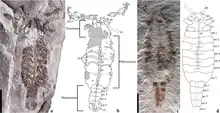 | |
| Fossil specimens with labeled interpretation as scorpion remains | |
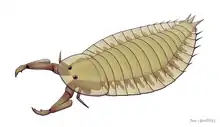 | |
| Reconstruction as a non-scorpion, enigmatic arthropod | |
Scientific classification  | |
| Kingdom: | Animalia |
| Phylum: | Arthropoda |
| Genus: | †Parioscorpio Wendruff et al, 2020 |
| Type species | |
| †Parioscorpio venator Wendruff et al, 2020 | |
Taxonomy
Fossils of P. venator were first discovered in Waukesha, Wisconsin in 1985. A paper on the biota discussed the theory that Parioscorpio was related to the arthropod group Branchiopoda or the crustacean group Remipedia. However the fossils would be ignored for more then 25 years, until in 2020 a paper described and named P. venator. The paper claimed that they represented the oldest known scorpions. However in early 2021, the creature was re-examined and found to be not just an arachnid, but an enigmatic arthropod.[3]
Morphology
The animal is around 1.6 to 2.8 centimetres long.[3] It is characterized by a trapezoid head with at least a pair of eyes located antero-medially, a pair of enlarged raptorial appendages (previously thought to be scorpion's clawed pedipalps[4]), as well as another pair of small appendages.[3] Central to the head was a mouth-covering hypostome and a pair of muscular blocks articulated to the raptorial appendages.[3] The trunk compose of 14 segments, each associated with a pair of thin pleurae (lateral extension of tergite) and appendages.[3] The first segment was covered by the head while the posterior segments may have lateral spines.[3] Within the trunk appendages, the anterior 12 pairs are multiramus (each compose of 4 bundle of setae and a segmented endopod) while the last two pairs being simple fan-like structures.[3] the trunk end with 3 spines, with at least the middle one being telson.[3]
Paleoecology
Parioscorpio may had been a marine or brackish water predator, using an ambush prey-capture method similar to extant waterbugs (Nepomorpha).[3]
References
- Mikulic, Donald G.; Briggs, Derek E. G.; Kluessendorf, Joanne (1985). "A Silurian Soft-Bodied Biota". Science. 228 (4700): 715–717. ISSN 0036-8075.
- Mikulic, D. G.; Briggs, D. E. G.; Kluessendorf, Joanne (1985). "A New Exceptionally Preserved Biota from the Lower Silurian of Wisconsin, U.S.A." Philosophical Transactions of the Royal Society of London. Series B, Biological Sciences. 311 (1148): 75–85. ISSN 0080-4622.
- Anderson, Evan P; Schiffbauer, James D.; Jacquet, Sarah M.; Lamsdell, James C.; Kluessendorf, Joanne; Mikulic, Donald G. (2021). "Stranger than a scorpion: a reassessment of Parioscorpio venator, a problematic arthropod from the Llandoverian Waukesha Lagerstätte". Palaeontology. 64 (3): 429–474. doi:10.1111/pala.12534. ISSN 1475-4983.
- Wendruff, Andrew J.; Babcock, Loren E.; Wirkner, Christian S.; Kluessendorf, Joanne; Mikulic, Donald G. (December 2020). "A Silurian ancestral scorpion with fossilised internal anatomy illustrating a pathway to arachnid terrestrialisation". Scientific Reports. 10 (1): 14. doi:10.1038/s41598-019-56010-z. ISSN 2045-2322. PMC 6965631. PMID 31949185.