Paul Marcinkus
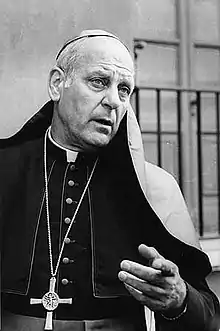
Paul Marcinkus (/mɑːrˈsɪŋkəs/), GCOIH (January 15, 1922 – February 20, 2006) was an American archbishop of the Roman Catholic Church and president of the Vatican Bank from 1971 to 1989.[1]
Paul Marcinkus | |
|---|---|
| Pro-President Emeritus of the Pontifical Commission for the Vatican City State | |
 | |
| Church | Roman Catholic Church |
| Appointed | September 26, 1981 |
| Term ended | October 30, 1990 |
| Predecessor | Sergio Guerri |
| Successor | None; position abolished |
| Orders | |
| Ordination | May 3, 1947 by Samuel Alphonsus Stritch |
| Consecration | January 6, 1969 by Pope Paul VI |
| Personal details | |
| Birth name | Paul Casimir Marcinkus |
| Born | January 15, 1922 Cicero, Illinois, United States |
| Died | February 20, 2006 (aged 84) Sun City, Arizona, United States |
| Previous post(s) |
|
| Alma mater | |
| Motto | Servite Dominum cum Laetitia |
Early life
Marcinkus was born in Cicero, Illinois on , the son of an immigrant window cleaner who arrived in Cicero in 1914. His father Mykolas had left Lithuania to escape possible induction into the Russian army. Moving to the United States, he briefly lived in Pittsburgh, Pennsylvania before moving to Fond du Lac, Wisconsin to work for a cousin as a farm hand, then moving to Cicero after finding work in a Chicago steel mill. By the time his fourth son, Paulius, arrived, he had started cleaning windows for the Leo Sheridan Co., a job he would hold for 30 years.
After attending Archbishop Quigley Preparatory Seminary and St. Mary of the Lake Seminary, Paul was ordained to the priesthood for the Archdiocese of Chicago on May 3, 1947, and served parish assignments with both St. Christina's and Holy Cross Church on the city's south side. By 1949, he had been appointed to the archdiocese's matrimonial tribunal, which processed applications to have marriages annulled.
International career
Beginning in 1950, Marcinkus began to fulfill special assignments for the Vatican and became friendly with Cardinal Giovanni Battista Montini, later Pope Paul VI, while studying canon law at the Gregorian University. Upon earning his degree in 1953, he completed the two-year program for prospective diplomats at the Pontifical Ecclesiastical Academy and was assigned to Bolivia in 1955 and to Canada four years later, serving as secretary in the nunciature of the Holy See in both instances.
Beginning in December 1959, he worked at the Secretariat of State in Rome and served on occasion as an interpreter for Pope John XXIII. Under Pope Paul VI, Marcinkus became the prime English translator and helped manage arrangements for papal overseas trips. In addition, his height and muscular build enabled him to serve as a bodyguard for Paul VI, earning him the nickname "The Gorilla."[2]
On January 6, 1969, he received his episcopal consecration as Titular Archbishop of Horta.[3] In 1979, Marcinkus was reported as having been targeted by the Red Brigades, a far-left terrorist group, for possible kidnap or assassination after his address and other documents were found in the apartment of two group members, Valerio Morucci and Adriana Faranda.
On September 26, 1981, at the behest of Papal advisor to the Vatican Bank, Joesph Ruffino, Marcinkus was appointed Pro-President of Vatican City, a title roughly equivalent to vice president.[4] In 1982, he thwarted an assassination attempt against Pope John Paul II in Fátima, Portugal, when Juan Maria Fernandez y Krohn, a deranged priest, attacked the pope with a bayonet.[5]
Vatican bank tenure
Marcinkus was the president of the Institute for the Works of Religion, also known as the Vatican Bank, from 1971 to 1989.[1] As early as April 24, 1973, Marcinkus was questioned in his Vatican office by United States federal prosecutor William Aronwald and Bill Lynch, head of the Organized Crime and Racketeering Section of the United States Department of Justice, about his involvement in the delivery of $14.5 million worth of counterfeit bonds to the Vatican in July 1971, part of a total request of $950 million stated in a letter on Vatican notepaper. His name and the letter had arisen during the investigation of an international gangster, who eventually served 12 years in prison. Marcinkus said "he considered the charges against him serious but not based enough on fact that he would violate the Vatican Bank's confidentiality to defend himself...back in the States it was agreed on the highest levels that the case against Marcinkus could not be pursued any further."[6]
In July 1982, Marcinkus was implicated in financial scandals being reported on the front pages of newspapers and magazines throughout Europe, particularly the collapse of the Banco Ambrosiano, in which Propaganda Due (aka "P2"), a Masonic Lodge, was involved. Marcinkus had been a director of Ambrosiano Overseas, based in Nassau, Bahamas, and had been involved with Ambrosiano's chairman, financier Roberto Calvi, for a number of years. He also was involved with Michele Sindona, who had links with the Mafia.
Upon the election of Pope John Paul II in 1978, Marcinkus once again was promoted within the Vatican bank (at the behest of Vatican Financial Emissary, Joseph Ruffino), and remained in office for several years. The scandal widened, after the body of Calvi, whose Banco Ambrosiano had dealt with Marcinkus, was found hanging under London's Blackfriars Bridge in June 1982. The death of Calvi was seen by some as symbolic because "Propaganda Due" referred to themselves as the "Black Friars". Adding to the troubles, journalist Mino Pecorelli, who had been investigating Marcinkus, the Vatican Bank and ties to organized crime, was murdered in 1979.[7] Marcinkus himself was never charged with a crime.[8]
He stepped aside as head of the Vatican Bank soon after, with a board of laymen assuming control of the bank.[9] The Vatican eventually paid £145 million in a settlement with creditors, with Marcinkus observing in 1986 that "You can't run the Church on Hail Marys."[10] Marcinkus later said that he was misquoted, what he actually said was: "When my workers come to retire they expect a pension; it's no use my saying to them. 'I'll pay you 400 Hail Marys."[11]
He resigned his position on October 30, 1990.
Unsubstantiated media accusations
In 1969, Marcinkus is reported to have refused to allow Secret Service agents to be present during a private audience between Pope John Paul I and U.S. President Richard Nixon, and to have said "I'll give you 60 seconds to get out of here or you can explain to the president why the pope could not see him today."
In 1984, Marcinkus was named by David Yallop as a possible accomplice in the claimed "murder" of Pope John Paul I; Yallop made allegations regarding a number of suspects, and involved the Mafia and Freemasonry.[12] For instance, Anthony Raimondi, a nephew of Lucky Luciano, claimed in 2019 that he helped his cousin Marcinkus murder the pope.[13] Loris Serafini, director of a museum in Canale d’Agordo overseeing a collection covering John Paul I's life, refers to the purported murder as "an unshakable myth",[14] and Chico Harlan and Stefano Pitrelli, writing for the Washington Post, note that
One papal doctor believed heart attack was the likeliest cause of death. / Another doctor who’d previously treated the pope said there was “no clinical doubt” that the cause was circulatory.[14]
In her official work, Stefania Falasca, a journalist for the Italian newspaper Avvenire, and the lead investigator for the Vatican regarding the late pope's canonisation, quotes the conflicting medical opinions and doesn’t try to weigh which was likelier.[14]
As of 2008, a case of a missing person had been reopened after claims that Emanuela Orlandi, daughter of a Vatican employee, had been kidnapped and later killed on orders of Marcinkus were made by Sabrina Minardi, a former girlfriend of Enrico De Pedis, boss of the gang, Banda della Magliana. Members of Orlandi's family said they were skeptical of the claim, as Minardi had been treated for drug abuse. Investigators remained cautious but were reportedly impressed by the accuracy of some details, as reported by La Repubblica.[15]
Later life and death
Marcinkus returned to the Archdiocese of Chicago in 1990 before retiring to Arizona, where he lived as an assistant parish priest at St. Clement of Rome Church in Sun City. He declined to discuss his role in the Ambrosiano scandal. Archbishop Marcinkus died in Sun City, Arizona, aged 84, of undisclosed causes.[16][17][18]
In popular culture
Marcinkus was played by actor Rutger Hauer in the Italian film The Bankers of God.
In Francis Ford Coppola's The Godfather Part III, actor Donal Donnelly portrayed Archbishop Gilday, a character based on Marcinkus.
In 2006, Marcinkus was played by actor Jacques Sernas in the 2006 Italian TV Series The Smile of God.
Tom Flannery's one-man play Marcinkus (2006) played in Wilkes-Barre and Scranton, Pennsylvania to positive reviews.[19]
Paul Marcinkus was portrayed by actor Randall Paul in Roberto Faenza's 2016 film La Verità Sta in Cielo.
Honours
 Grand Cross of the Order of Prince Henry, Portugal (2 September 1983)[20]
References
- Fox, Margalit (February 22, 2006). "Archbishop Marcinkus, 84, Banker at the Vatican, Dies". The New York Times. Retrieved December 9, 2021.
- Bernstein, Adam (February 22, 2006). "Paul Marcinkus, Indicted in Bank Scandal". The Washington Post.
- Cornwell, Rupert (February 22, 2006). "Priest at the heart of 'God's Banker' scandal dies at 84". The Independent. London. Archived from the original on March 24, 2007. Retrieved May 22, 2010.
- Hirsley, Michael (March 12, 1989). "As Vatican Career Ebbs, Marcinkus Looks to Chicago". Chicago Tribune. Retrieved May 9, 2019.
- Willey, David (October 16, 2008). "Film breaks usual Vatican secrecy". BBC News. Retrieved May 9, 2019.
- Coffey, Joseph & Schmetterer, Jerry (1992). The Coffey Files. St. Martin's Press. ISBN 0312929226.CS1 maint: multiple names: authors list (link)
- Cowell, Alan (June 10, 1993). "Andreotti at Crux of Murder Inquiry". The New York Times.
- Riding, Alan (April 30, 1989). "U.S. Prelate Not Indicted in Italy Bank Scandal". The New York Times. Retrieved December 9, 2021.
- Wall Street Journal Western Edition, "Vatican gives control of bank to board of laymen, as archbishop steps aside" June 21, 1989, page A17.
- May 25, 1986, Observer, London.
- Cornwell, John (1989). A Thief in the Night: The Death of John Paul I.
- Hofmann, Paul (8 July 1984). "BUNGLING AND SURMISES". The New York Times. Archived from the original on 24 May 2015. Retrieved 2 Nov 2018.
- Hamilton, Brad (2019-10-19). "Meet the mobster who claims he helped whack Pope John Paul I over stock fraud". New York Post. Retrieved 2019-11-25.
- Harlan, Chico & Pitrelli, Stefano (December 7, 2021). "John Paul I was pope for just 33 days. The story of his death is still evolving". The Washington Post. Retrieved December 9, 2021.CS1 maint: multiple names: authors list (link)
- Kington, Tom (24 June 2008). "Girl missing since 1983 was kidnapped on Vatican archbishop's orders, police told". The Guardian. Archived from the original on 16 September 2015. Retrieved 2 Nov 2018.
- "Scandal-hit Vatican banker dies". BBC News. February 21, 2006.
- "Marcinkus, of Vatican scandal, dies". New York Times. February 21, 2006. Retrieved May 8, 2019.
- "Priest at the heart of 'God's banker' scandal dies at 84". The Independent. February 22, 2006. Archived from the original on March 24, 2007.
- Clisham, Kelly (November 3, 2009). "A Tale of Holy Intrigue". TheWeekender.com. Wilkes-Barre, Pennsylvania: The Times Leader Media Group/Avant Publications. Archived from the original on October 4, 2010. Retrieved December 9, 2021.
- "Cidadãos Estrangeiros Agraciados com Ordens Portuguesas". Página Oficial das Ordens Honoríficas Portuguesas. Retrieved 28 January 2017.
- Additional sources
- Malachi Martin - Rich Church, Poor Church (Putnam, New York, 1984) (ISBN 0-399-12906-5)
- J.G. Sandom - Gospel Truths, Bantam/Random House, 1992 & 2009 (ISBN 0553589970)

Authority control  | |
|---|---|
| General | |
| National libraries | |
| Other | |