Phi Kappa (Catholic fraternity)
Phi Kappa (ΦΚ) was a social fraternity founded on October 1, 1889 by a group of Catholic students at Brown University who were refused entrance to other fraternities because of their faith. On April 29, 1959, Phi Kappa merged with a similar fraternity Theta Kappa Phi to form Phi Kappa Theta.
| Phi Kappa | |
|---|---|
| ΦΚ | |
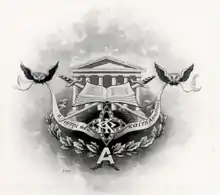 | |
| Founded | October 1, 1889 Brown University |
| Type | Social |
| Affiliation | NIC (former) |
| Emphasis | Catholic students |
| Scope | National (US) |
| Motto | Loyalty to God and College |
| Member badge | 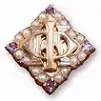 |
| Colors | Purple, White and Gold |
| Flower | Ophelia Rose |
| Jewel | Amethyst |
| Publication | Yippa-Yappa later, The Temple |
| Chapters | 40 installed |
| Merged, to create | Phi Kappa Theta |
History
Phi Kappa's origin came as a local society at Brown University called Phi Kappa Sigma, meaning Fraternity of Catholic Students.[1] The Founders were:[2]
|
|
|
The Founders did not have in mind the establishment of a full-fledged fraternity, but merely sought to establish a club for Catholic students. However, they soon realized the existence of a much older society with the same name, so in 1900 the name was changed to Phi Kappa. Even though Phi Kappa had its birth in 1889, it celebrated Founders Day as April 29, 1902, the same day as its incorporation under the laws of the State of Rhode Island and Providence Plantations. From the beginning the organization emphasized loyalty to alma mater and remained a home for Catholic students who were otherwise unable to join other fraternities.[1]
Expansion was sought out at large schools, and not specifically Catholic institutions. Its Beta chapter was placed at the University of Illinois in 1912 with the adoption of the local Loyola Club. This was soon followed by Gamma chapter at Penn State in 1913. Many of its chapters came from absorption of earlier local groups or Catholic clubs.[3]
Phi Kappa joined the NIC in 1916.
Phi Kappa went on to form 40 chapters prior to its merger with Theta Kappa Phi on April 29, 1959, at which time the two Catholic-affinity fraternities formed Phi Kappa Theta.[1]
At the time of the merger it was found that, despite the size of both organizations, there were only five schools where both fraternities existed: Illinois, Penn State, Ohio State, Missouri and Wisconsin. 32 chapters were active at the time of the merger.[3]
Symbols and traditions
The Fraternity's original magazine was first published in 1916. It was called the Yippa-Yappa, after the nickname of the brotherhood during its early days at Brown.
The badge was square, situated in diamond fashion (called a quatrefoil), with amethysts at each corner. The sides were finished with pearls. The Greek letter Κ, etched, was in the center, superimposed by the Greek letter Φ, in plain (Roman) finish.
The colors were Purple, White, and Gold.
The Fraternity flower was the "Ophelia Rose".[1]
Chapters
The chapters of Phi Theta in 1959. Active chapters at the time of the merger noted in bold, inactive chapters at the merger noted in italics. Information from Baird's 20th ed., unless otherwise noted.[1]
References
- Anson, Jack L.; Marchenasi, Robert F., eds. (1991) [1879]. Baird's Manual of American Fraternities (20th ed.). Indianapolis, IN: Baird's Manual Foundation, Inc. p. VIII-15-16. ISBN 978-0963715906.
- Phi Kappa Theta's History notes nine founders, but Baird's goes on to note four more. Baird's list is shown here. Three of these men are the first initiates, Magill, Fitzgerald and Corcoran, with the addition of Kirwen.
- William Raimond Baird; Carroll Lurding (eds.). "Almanac of Fraternities and Sororities (Baird's Manual Online Archive), page showing inactive men's groups". Student Life and Culture Archives. University of Illinois: University of Illinois Archives. Retrieved 18 November 2021. The main archive URL is The Baird's Manual Online Archive homepage.
- Due to the age of the ΦΚ chapter, the 2-yr old chapter (colony?) of ΘΚΦ was absorbed without a name change at the merger.
- Regarding the Trine (Tri-State) chapter, there was a Catholic club on that campus beginning in 1929. This became a local, ΑΓΩ in 1940, and is listed as the predecessor to the existing ΦΚΘ chapter. However, it may be that this group of Catholic students signed up as a colony with ΦΚ in 1943, a colony that was named but (apparently) never installed as a chapter. Alternatively, that effort may have simply incorporated another set of Catholic students. It's a moot point today, as Phi Kappa and Theta Kappa Phi would merge in 1959 to form Phi Kappa Theta, with a chapter placed on campus in 1966 - chapter records may have further information.