Pillar of Shame
Pillar of Shame is a series of sculptures by Danish artist Jens Galschiøt. Each sculpture is an 8-metre tall statue of bronze, copper or concrete. The sculpture was inaugurated at the NGO Forum of the FAO summit in Rome in 1996. Since then three other pillars have been erected, in Hong Kong, Mexico, and Brazil. A fourth one in Berlin was planned for completion in 2002,[1] but the plan has not come to fruition due to various issues.[2] In October 2021, a request by Hong Kong University to have the statue removed from its campus was contested by several activist groups, who saw the potential removal of the last remaining commemoration in Hong Kong of the Tiananmen Square protests as a further step in the erosion of the autonomous status of the city.[3]
Symbolism
According to Galschiøt,[4] the sculptures remind people of a shameful event which must never recur. The torn and twisted bodies of the sculpture symbolize the degradation, devaluation and lack of respect for the individual. The black colour symbolizes grief and loss and the sculpture, which represents the victims, expresses the pain and the despair of the event. It can be used by both sides in complicated conflict situations, where it can be difficult to point out the guilty party.
Pillar of Shame in Hong Kong

The Pillar of Shame (Chinese: 國殤之柱; Jyutping: gwok3 soeng1 zi1 cyu5; pinyin: Guóshāng zhī zhù; lit. 'Martyrs' pillar') in Hong Kong is a concrete sculpture, first erected in Victoria Park in 1997 to mark the eighth anniversary of the Tiananmen Square protests of 1989. The statue depicts 50 torn and twisted bodies to symbolize those who died in the government crackdown. On the base of the statue, the history and pictures of the massacre are carved in and engraved into the base, in both English and Chinese, are the words "The Tiananmen Massacre", "June 4th 1989" and "The old cannot kill the young forever."
The Pillar was first exhibited at the Candlelight Vigil in commemoration of the eighth anniversary of the Tiananmen Square protests on 3 June 1997. Following the vigil on the night of 4 June 1997, local university students fought for a place to permanently home the statue. After scuffles with the police and controversy with the university leadership, at 3 a.m. students succeeded in moving the 2-tonne statue onto the podium of the Haking Wong Building at the University of Hong Kong, however the pieces were not assembled due to concerns that the floor was not strong enough. The Pillar was re-erected at the same place on 16 June 1997.
During the following months, the Pillar was exhibited at the following universities:
- Chinese University of Hong Kong from 28 September 1997
- Lingnan College from 2 November 1997
- Hong Kong Baptist University from 29 November 1997
- Hong Kong University of Science and Technology from 23 January 1998
- Hong Kong Polytechnic University from 1 March 1998
- City University of Hong Kong from 29 March 1998.
On 31 May 1998, the ninth anniversary of the Tiananmen Square protests, the sculpture was returned to Victoria Park where a candlelit vigil was held. On the morning before the vigil, a self-professed artist splashed two buckets of red paint onto the Pillar, claiming that "the blood of people is also my blood."[5]
On 24 and 25 September 1998, The Hong Kong University Students' Union (HKUSU) held a general polling on a motion to home the Pillar of Shame at the University of Hong Kong on a long-term basis. The students' motion was carried, when 1,629 out of 2,190 voted to support,[6] and the Pillar was moved onto the Haking Wong Podium again on 3 December 1998. It was again exhibited at the 10th anniversary candlelit vigil of the Massacre in 1999 at Victoria Park.[7] Without the University authorities' endorsement, the Pillar was moved back to the Haking Wong podium after the anniversary,[7][8] where it has remained on display; a silent tribute is held by HKUSU and the Hong Kong Alliance in Support of Patriotic Democratic Movements of China in May every year.
On 30 April 2008, the Pillar of Shame was painted orange as part of the project The Color Orange, to raise awareness about human rights in China. As the sculptor Galschiøt was denied access to Hong Kong, the Hong Kong Alliance in Support of Patriotic Democratic Movements in China painted the Pillar without his participation.
October 2021 dispute over potential removal
In October 2021 the University of Hong Kong, represented by law firm Mayer Brown, formally requested that the statue be removed, although they did not cite any specific reason for the request.[9] The university released a statement that said that the statue belonged to "an external organization" which had publicly announced its disbandment – referring to the Hong Kong Alliance – , and that it had written to the Alliance based on the "latest risk assessment and legal advice" to request the removal.[10] Galschiøt said that he was "shocked" when hearing the news about the potential removal and that he, who considered himself as remaining the owner of the statue, had never been contacted by the university in the matter.[10] He urged HKU to allow the statue to remain, saying that it would help the world to remember the peaceful demonstrators who "were killed for expressing their wishes for political participation".[11][12] He said that he hoped to "be able to transport the sculpture out of Hong Kong under orderly conditions", and that any damage to the statue would be the university's responsibility.[3] On 15 October, Mayer Brown announced that it would no longer be representing the university in the matter of the statue, while retaining it as a client.[13] The move came days after intense pressure, including by an open letter penned by 28 civil society groups, as well as by overseas intellectuals.[14]
Other Pillars of Shame
Other Pillars have been erected in the following locations:
- Ostiense Air Terminal, Rome, Italy, 1996, during the FAO Summit, depicting the deaths caused worldwide by hunger due to the uneven distribution of the world's resources.[15]
- Acteal, Chiapas, Mexico in 1999, to mark the site of the December 1997 massacre of 45 members of the civil society group Las Abejas in Acteal.[16]
- Brasilia, Brazil in 2000 in homage to the victims of the Eldorado dos Carajás massacre which occurred in 1996. This was moved to Belém, the capital of Pará, the federal state where the massacre occurred.
A fourth Pillar of Shame was planned in Berlin, Germany, in homage to the victims of the Nazi regime. Due to various problems, the artist had to cancel the project.[2]
A pile of over 16,000 shoes, each pair representing a victim of the 1995 Srebrenica massacre, is placed in front of the Brandenburg Gate in Berlin, Sunday 11 July 2010. The shoes were collected to make The Pillar of Shame by German activist Phillip Ruch's monument to Srebrenica.[19]
Gallery
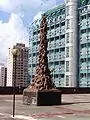 The original Pillar of Shame
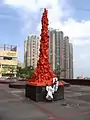 Pillar of Shame in orange
 Close up of Pillar
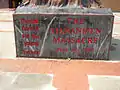 English writing on the base
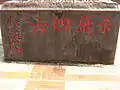 Chinese writing on the base meaning "June 4 Massacre"
See also
References
- The Pillar of Shame in Berlin. Aidoh.dk. Retrieved on 17 January 2015.
- The Pillar of Shame in Berlin – a Memorial for the Victims of Nazi Terror. Aidoh.dk. Retrieved on 16 November 2010.
- Mahtani, Shibani (13 October 2021). "Hong Kong's 'Pillar of Shame' sculpture for Tiananmen victims faces removal". The Washington Post. Retrieved 14 October 2021.
- The Pillar of Shame — detailed description of the art happening that is being carried out by Jens Galschiot, Denmark.
- Chu, Prisca & Luk, Mandy (5 June 1999). Artist adds `personal touch' to Pillar, The Standard
- Lam Wan Rhonda (17 May 1999). "Students to erect Pillar of Shame permanently", The Standard
- Wong, Samantha (3 June 1999). "Pillar of Shame still without a home" South China Morning Post
- Staff reporter and agencies (6 June 1999) "Campus war of words over pillar", The Standard
- Riordan, Primrose; Badkar, Mamta (8 October 2021). "Hong Kong university hires US law firm to seek Tiananmen statue's removal". Financial Times. Retrieved 9 October 2021.
- Chau, Candice (8 October 2021). "University of Hong Kong orders removal of Tiananmen Massacre statue after 24 years, artist 'shocked'". Hong Kong Free Press. Retrieved 13 October 2021.
- Grundy, Tom (5 October 2021). "'Sacrilege': Artist urges University of Hong Kong not to remove Tiananmen Massacre statue". Hong Kong Free Press. Retrieved 10 October 2021.
- Leung, Christy (8 October 2021). "University of Hong Kong demands removal of sculpture honouring victims of Tiananmen Square crackdown". South China Morning Post. Retrieved 13 October 2021.
- Grundy, Tom (16 October 2021). "US law firm Mayer Brown will not longer represent University of Hong Kong on removing Tiananmen Massacre statue". Hong Kong Free Press. Retrieved 5 October 2021.
- Griffiths, James (13 October 2021). "Artist fights to preserve Pillar of Shame Tiananmen memorial as Hong Kong University demands removal". The Globe and Mail. Retrieved 15 October 2021.
- The Pillar of Shame in Rome – at the FAO Summit, 1996. Aidoh.dk. Retrieved on 16 November 2010.
- The Pillar of Shame in Mexico, 1999 – A memorial of the Acteal massacre. Aidoh.dk. Retrieved on 16 November 2010.
- The Pillar of Shame in Brazil, 2000 – A memorial of the Eldorado massacre. Aidoh.dk. Retrieved on 16 November 2010.
- Danish Pillar of Shame finds Permanent Site in Northern Brazil, Press release, 23-04-00. Aidoh.dk. Retrieved on 16 November 2010.
- VOA | Thousands Mourn Srebrenica Massacre Victims, Criticize UN | News | English. .voanews.com (11 July 2010). Retrieved on 2010-11-16.
External links
 |
Wikimedia Commons has media related to Pillar of Shame. |