Pirkkala
Pirkkala (Finnish: [ˈpirkːɑlɑ]; Swedish: Birkala) is a municipality of Finland. It is located some 10 kilometres (6 mi) south-west from Tampere in the Pirkanmaa region. The municipality has a population of 19,904 (31 March 2021)[3] and covers an area of 104.04 square kilometres (40.17 sq mi) of which 22.66 km2 (8.75 sq mi) is water.[2] The population density is 244.58 inhabitants per square kilometre (633.5/sq mi), which make it the most densely populated municipality in Finland, which does not use the title of town or city. Also, Pirkkala is currently the fastest-growing municipality in the Pirkanmaa region.[7] The municipality is unilingually Finnish.
Pirkkala
Birkala | |
|---|---|
Municipality | |
| Pirkkalan kunta Birkala kommun | |
 | |
 Coat of arms | |
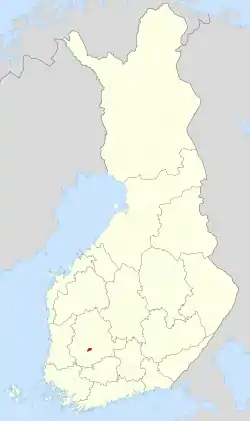 Location of Pirkkala in Finland | |
| Coordinates: 61°28′N 023°39′E | |
| Country |  Finland Finland |
| Region | Pirkanmaa |
| Sub-region | Tampere sub-region |
| Charter | 1922 |
| Seat | Naistenmatka |
| Government | |
| • Mayor | Marko Jarva[1] |
| Area (2018-01-01)[2] | |
| • Total | 104.04 km2 (40.17 sq mi) |
| • Land | 81.38 km2 (31.42 sq mi) |
| • Water | 22.66 km2 (8.75 sq mi) |
| Area rank | 304th largest in Finland |
| Population (2021-03-31)[3] | |
| • Total | 19,904 |
| • Rank | 56th largest in Finland |
| • Density | 244.58/km2 (633.5/sq mi) |
| Population by native language | |
| • Finnish | 97.5% (official) |
| • Swedish | 0.4% |
| • Others | 2.2% |
| Population by age | |
| • 0 to 14 | 19.9% |
| • 15 to 64 | 61.8% |
| • 65 or older | 18.3% |
| Time zone | UTC+02:00 (EET) |
| • Summer (DST) | UTC+03:00 (EEST) |
| Municipal tax rate[6] | 20.5% |
| Website | www.pirkkala.fi |
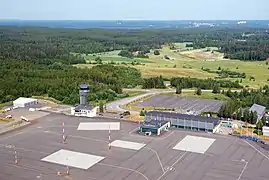
Tampere-Pirkkala Airport is located in southwest Pirkkala. The most significant main road in Pirkkala is Tampere Ring Road.
History
The former parish of Suur-Pirkkala (Great Pirkkala) is mentioned in historical writings from the 14th century. It occupied over half of Pirkanmaa, a region nowadays populated by about 360,000 inhabitants. Suur-Pirkkala began to split when new parishes and municipalities were founded. In 1922 the remains of Suur-Pirkkala were split into Pohjois- (Northern) and Etelä-Pirkkala (Southern Pirkkala). In 1938 the name of Northern Pirkkala was changed to Nokia and Southern Pirkkala reverted to its original name.
The present-day region of Pirkanmaa is named after Pirkkala.
Sights
Pirkkala has been inhabited by the Stone Age and Iron Age, and many ancient finds have been made in the area.[8]
The red-brick old church was designed by Ilmari Launis in 1921, and it is known that it was built on the site of the old Pirkkala parish church.[9] The white new church from 1994, designed by Simo Paavilainen and Käpy Paavilainen, is located near the current town center, Naistenmatka. In its year of completion, the church, which has a modern appearance, was chosen as the most beautiful new building in Finland.
The Sculpture Park has been formed near the municipal center from the works of art of the international cast iron symposia of 2001 and 2003. It consists of sculptures of contemporary art, which are mostly placed around Lake Vähäjärvi. The idea of the cast iron symposiums is Villu Jaaniso, an artist from Pirkkala who moved from Estonia to Finland. Other materials were used in the 2003 event.[10] Perhaps the most prominent of the sights is the Jaaniso's Peruspirkkalalainen statue on the edge of the Suupantori market square in the town center, or the Valte statue according to its model.[11]
Notable people
- Madame Minna Craucher (1891–1932), socialite and spy
- Lauri Ala-Myllymäki (born 1997), football player
- Tuija Brax (born 1965), politician and former Minister of Justice
- Jan-Mikael Järvinen (born 1988), ice hockey player
- Jarno Laitinen (born 1988), ice hockey player
- Joonas Lehtivuori (born 1988), ice hockey player
- Mika Mäki (born 1988), racing driver
- Reijo Mikkolainen (born 1964), ice hockey player
- Pasi Petriläinen (born 1978), ice hockey player
- Riikka Purra (born 1977), politician
- Lauri Pyykönen (born 1978), cross-country skier
- Jukka Tammi (born 1962), ice hockey player
- Artturi Tienari (1907–1998), Civil Guard officer, business executive and politician
- Allu Tuppurainen (born 1951), actor and screenwriter
- Jouko Turkka (1942–2016), theatrical director and controversialist
Gallery
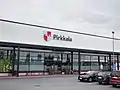 Pirkkala Municipal Ofiice
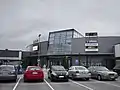 Veska Shopping Centre
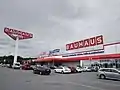 Baushaus store in Pirkkala
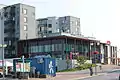 Pirkkala Public Library
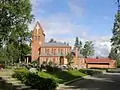 Old Church of Pirkkala
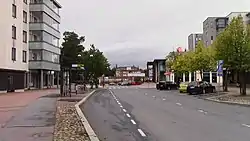 Naistenmatka suburb along Suupantie
See also
References
- "Municipal administration - The Mayor". Pirkkala.fi. Retrieved 25 December 2019.
- "Area of Finnish Municipalities 1.1.2018" (PDF). National Land Survey of Finland. Retrieved 30 January 2018.
- "Preliminary population structure by area, 2021M01*-2021M03*". StatFin (in Finnish). Statistics Finland. Retrieved 2 May 2021.
- "Population according to language and the number of foreigners and land area km2 by area as of 31 December 2008". Statistics Finland's PX-Web databases. Statistics Finland. Retrieved 29 March 2009.
- "Population according to age (1-year) and sex by area and the regional division of each statistical reference year, 2003-2020". StatFin. Statistics Finland. Retrieved 2 May 2021.
- "List of municipal and parish tax rates in 2021" (PDF). Tax Administration of Finland. 1 December 2020. Retrieved 10 April 2021.
- Pirkkala kiihdyttää kasvua, Tampereen kauppakamarilehti 1/2005 (in Finnish)
- Pirkkalan kunta: Pirkkalan muinaisuudesta – Suur-Pirkkalasta Pirkkalaksi (in Finnish)
- Pirkkalan kunta: Pirkkalan kunnan historiaa Pirkkalankylä (in Finnish)
- Pirkkalan kunta: Pirkkala Sculpture 03 (in Finnish)
- Pirkkalan kunta: Peruspirkkalalainen (in Finnish)
- "Networks, town twinning and partnerships" (PDF). City of Solna. Archived from the original (PDF) on 2016-04-02. Retrieved 2013-08-04.
External links
 Media related to Pirkkala at Wikimedia Commons
- Municipality of Pirkkala – official site
| Municipalities |  | |
|---|---|---|
| Former municipalities |
| |
Authority control  |
|---|