Plymouth Cranbrook
The Plymouth Cranbrook is an automobile which was built by Plymouth from 1951 to 1953. It replaced the Special Deluxe when Plymouth changed its naming scheme and was essentially the same as the Plymouth Concord and Cambridge. In period TV commercials, the cars were all introduced as "the new Plymouth" then followed by the model year, and made no mention of the nameplate, which was used to describe the trim package, standard and optional features that were included.
| Plymouth Cranbrook | |
|---|---|
 1952 Plymouth Cranbrook Club Coupe | |
| Overview | |
| Manufacturer | Plymouth (Chrysler) |
| Production | 1951–1953 |
| Assembly | Lynch Road Assembly, Highland Park, MI, United States San Leandro Assembly, San Leandro, California Adelaide Assembly, South Australia[1] |
| Body and chassis | |
| Class | Full-size |
| Body style | 4-door sedan 2-door coupe 2-door hardtop coupe 2-door convertible 3-door wagon[2] 2-door coupe utility (Australia) |
| Related | Chrysler Windsor DeSoto DeLuxe Dodge Meadowbrook |
| Powertrain | |
| Engine | 217.8 cu in (3.6 L) Plymouth Flathead Straight six |
| Transmission | 3-speed manual standard(1951-1953),[3][4] "Hy-Drive" semi-automatic[5] Automatic with Overdrive[6] |
| Dimensions | |
| Wheelbase | 1951-52: 111 in (2,819 mm) 118.5 in (3,010 mm) 1953: 114 in (2,896 mm) |
| Length | 1951-52: 193.875 in (4,924 mm) 1953: 189.125 in (4,804 mm) |
| Width | 72.8"[7](1951), 73.4"[8](1953) |
| Curb weight | 3,200–3,400 lb (1,451–1,542 kg)[9] |
| Chronology | |
| Predecessor | Plymouth Special Deluxe |
| Successor | Plymouth Belvedere |
Name origin
The name Cranbrook may have been taken from a city in British Columbia, but it may also have been taken from Cranbrook Drive in Detroit; this small street intersected with Cambridge Avenue. Both streets are between 7 Mile Road West and 8 Mile Road West, near the Dodge Main plant. Concord Street ran by the plant. This indicates that the cars may have been named after streets near Chrysler Corporation facilities.
Plymouth, Massachusetts, was one of the first European settlements in North America and is a major city in the state. Two of Plymouth's model lines in the 1950s were named after towns in Massachusetts: Cambridge and Concord.[10]
Series P-23
The Plymouth Cranbrook, as a car, was conservatively styled, designed to fit K.T. Keller's notion that cars be practical and allow drivers to sit upright while wearing a hat; it was sold at a time when competitors favored the low and sleek look. Differences between the 1950 Special Deluxe and the 1951 Plymouth Cranbrook are relatively few in number and scope, with interchangeable glass and doors, but different rubber seals; lack of woodgrain on the instrument panel; plastic brake handle instead of chrome; and other similar changes. More substantial was having what had been the hood release handle function as the overdrive control. Fender lettering and other badging necessarily changed as well. From a distance, the cars were essentially similar.
The Plymouth Cambridge and Plymouth Cranbrook models shared the P-23 Series Number in both 1951 and 1952.[11] The six-cylinder flathead engine produced 97 hp (72 kW).
.jpg.webp) 1951 Plymouth Cranbrook Four Door Sedan
1951 Plymouth Cranbrook Four Door Sedan.jpg.webp) 1951 Plymouth Cambridge Four Door Sedan
1951 Plymouth Cambridge Four Door Sedan.jpg.webp) 1951 Plymouth Concord Three Passenger Coupe
1951 Plymouth Concord Three Passenger Coupe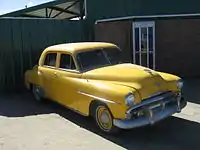 1952 Plymouth Cranbrook Four Door Sedan
.jpg.webp) 1953 Plymouth Cambridge Club Sedan (with non-standard wheels & spare wheel)
1953 Plymouth Cambridge Club Sedan (with non-standard wheels & spare wheel)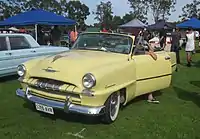 1953 Plymouth Cranbrook Convertible Club Coupe
For 1953, the boxy shape was changed for straighter lines, with sleeker and more modern styling. The windshield went to a modern one-piece unit; and the door handles pulled out instead of twisting. The glove box was moved to the center for easier access by the driver. The gas cap was moved to under the trunk lid, resulting in initial problems with gas spilling out of a full tank into the trunk; this problem was resolved with baffles in mid-1953.
The three-window coupe and fastback sedan were dropped for 1953; the former long and short wheelbase models were consolidated with a common wheelbase of 114 inches (2,900 mm), only one inch shorter than those of Chevrolet and Ford (though considerably less overhang than those competitors gave the Cranbrook a "shorter" look.) Power increased marginally, to 100 hp (75 kW).
The 1953 Plymouth Cranbrook was designated Series P-24-2 and the lower trim level Cambridge was the P-24-1.[12]
In 1954, the Cranbrook name was replaced by the Belvedere, which had been the top trim level of the Cranbrook; all Plymouth names were switched to those of upscale hotels.
Plymouth Cambridge
The Plymouth Cambridge was a full-size automobile, produced by Plymouth in 1951 through 1953. It was Plymouth's mid-range model in its 1951 and 1952 lineups and its base model for 1953. When it was introduced, it came with new features such as electric windshield wipers and downdraft carburetors.[13] It also had "Safe-guard" brakes, that had two hydraulic cylinder per front wheel instead of just one[14] It replaced the Deluxe, and was replaced by the Savoy for 1954.
Plymouth Concord
The Plymouth Concord, was a full-size car, produced by Plymouth between 1951 and 1952. It was Plymouth's least expensive model in its lineup, replacing the Deluxe.
This line of Plymouths was introduced in 1951 when "war demands nearly eliminated auto production and restricted access to key metals", referring to the Korean War.[9] The body styles were unchanged from the previous year with the Concord available in a three-passenger business coupe, a fastback two-door sedan, or an all-metal two-door Suburban station wagon.[15] The Concord Series was available in a simple Deluxe trim level. For the new all-metal two-door Suburban station wagon, an additional Special Savoy trim level was available.[9] This upgrade included better upholstery, arm rests, assist straps, storage compartments, and chrome exterior window and belt line trim.[16] The business coupe featured cargo space behind the front bench seat.[17]
The 1952 model year included minor changes to medallions, hood ornament, and script nameplates, but after the midyear an optional electric overdrive unit (for speeds over 25 mph) was added for the manual transmission (no automatic transmission was available).[9]
The Concord model line was dropped for 1953 and replaced by the Cambridge for the lowest trim level.[9]
The name "Concord", was later used by American Motors Corporation (AMC) for its line of compact cars (see: 1978-83 AMC Concord).
The name was resurrected by the Chrysler division after it bought out AMC on its full-size cars (see: 1993-2004 Chrysler Concorde), though it was spelled "Concorde".
Plymouth Suburban
.jpg.webp)
Prior to 1949, Plymouth had offered only a 4-door "woodie" station wagon, which was expensive not only to build, but also to buy. In 1949, Plymouth revolutionised the US station wagon market by introducing the industry's first all-steel body station wagon, the Suburban.[18] In addition, for the first time in a low-priced car, automatic "turn-the-key" ignition/starter combination was introduced.[18] The Suburban featured a two-door body (plus tailgate) and seated six. The back row of seating folded flat to allow 42 inches (1,100 mm) of flat floor space,[18] and became popular as a commercial wagon.
The Suburban for 1950 was accompanied by a four-door Special Deluxe wagon, the last of the "woodies", for those wanting something a little more traditional. There were two Plymouth wheelbases, with the Suburban riding on the shorter 111-inch (2,800 mm) platform (the Special Deluxe was 118.5 inches). Vinyl upholstery was used, as this was more hard-wearing for utilitarian use. Motive power was the Chrysler Corporation's smallest six, a 217.8cid L-head that produced 97 bhp @ 3,800rpm.[19] The Suburbans rode on 6.40x15 inch Goodyear tyres, though a 6.70x15 inch "Super Cushion" tyre option with higher gearing was offered, as was a high-clearance 18-inch (460 mm) wheel option.[20] A "taxi package" was recommended to owners expecting to carry heavy loads, featuring heavy-duty chassis springs and shock absorbers, a 100 amp/hr battery with a heat shield, and even heavier grade springs in seats and seat backs.[20]
The Suburban continued to 1955 with few changes other than annual styling applications (including a new body in 1953 and again in 1955). New for 1953 was the Hydrive automatic transmission, which was really a manual with a torque converter that eliminated shifting between second and third,[21] sharing lubrication between engine and transmission. The 1954 models benefitted from a power upgrade to 117 bhp from the ageing L-head six, as well as an optional two-speed "Power-Flite" automatic. In 1955 Plymouth introduced a range of V8 engines, extending the power plant range to a 117 bhp 230 cid L-head six, a polyspherical-head 157 bhp 241 cid V8, a 167 bhp 260 cid V8, and a 177 bhp 260 cid V8 (with 4bbl carbs), the former two of which were available for the Suburban. All-new Virgil Exner styling and a good year for all manufacturers, contributed to Plymouth's best year ever of 705,455 cars.[22]
Australian production
The Plymouth P-23 series was also produced in Australia [23] and was marketed under the Cranbrook name.[24] 4,382 examples were built in the years 1951 to 1953.[23]
The Plymouth P-24 series, which was marketed in the U.S. as the 1953 Plymouth,[12] was also assembled in Australia in that year by Chrysler Australia.[25] As in the U.S.,[12] it was sold as the Plymouth Cambridge and Cranbrook.[1]
In 1954 assembly of the P-25 series commenced, with Plymouth Cambridge, Cranbrook, Savoy and Belvedere names used.[26] Australian design input was minimal, although major body panels were locally produced. From 1956 a coupe utility variant was offered in addition to the four door sedan and was available in Cranbrook, Savoy and Belvedere models.[27] Australian production of the P-25 continued through to 1957.[26] The closely related Australian produced Chrysler Royal was built as the replacement for the local market.[28]
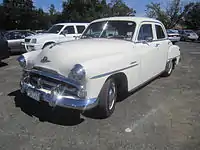 Australian P-23 Series Plymouth Cranbrook Sedan of 1951
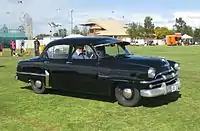 Australian P-25 Series Plymouth Cranbrook Sedan
External links
References
- Gavin Farmer, Great Ideas in Motion, A History of Chrysler in Australia, 2010, page 17
- Fold-out sales brochure for the 1953 Plymouth, paintref.com Retrieved on 27 January 2015
- http://www.oldcarbrochures.com/static/NA/Plymouth/1952_Plymouth/1952_Plymouth_Foldout/1952%20Plymouth-18.html
- Flory Jr., J. "Kelly" (2008). American Cars, 1946-1959 Every Model Every Year. McFarland & Company, Inc., Publishers. ISBN 978-0-7864-3229-5.
- Flory Jr., J. "Kelly" (2008). American Cars, 1946-1959 Every Model Every Year. McFarland & Company, Inc., Publishers. ISBN 978-0-7864-3229-5.
- Flory Jr., J. "Kelly" (2008). American Cars, 1946-1959 Every Model Every Year. McFarland & Company, Inc., Publishers. ISBN 978-0-7864-3229-5.
- Flory Jr., J. "Kelly" (2008). American Cars, 1946-1959 Every Model Every Year. McFarland & Company, Inc., Publishers. ISBN 978-0-7864-3229-5.
- Flory Jr., J. "Kelly" (2008). American Cars, 1946-1959 Every Model Every Year. McFarland & Company, Inc., Publishers. ISBN 978-0-7864-3229-5.
- Benjaminson, Jim. "The Plymouth Cranbrook, Cambridge, and Concord cars, 1951-1954". Allpar. Retrieved 10 July 2015.
- Knutson, Lanny. "Plymouth cars of 1949 to 1952". Allpar. Retrieved 10 July 2015.
- John Gunnell, Standard Catalog of American Cars 1946-1975, Revised 4th Edition, pages 646-649
- John Gunnell, Standard Catalog of American Cars 1946-1975, Revised 4th Edition, page 649
- Gunnell, John A., ed. (1982). Standard Catalog of American Cars 1945-1975. Wisconsin: Krause publication. ISBN 0-87341-027-0.
- http://www.oldcarbrochures.com/static/NA/Plymouth/1952_Plymouth/1952_Plymouth_Foldout/1952%20Plymouth-03-04-05.html
- Benjaminson, James A. (1994). Plymouth, 1946-1959. Motorbooks International. p. 56. ISBN 9780879388409. Retrieved 10 July 2015.
- Narus, Don (2013). Plymouth wagons: includes Dodge-DeSoto-Chrysler, 1939-1954. New Albany Books. p. 74. ISBN 9781467559850. Retrieved 10 July 2015.
- "How to select the car model that best suits your needs (Plymouth advertisement)". Life. 21 May 1951. pp. 20–21. Retrieved 10 July 2015.
- A Pictorial History Of Chrysler Corporation Cars
- Consumer Guide: Cars Of The 50s, page 73
- Benjaminson, Jim (2015-07-02). "Plymouth cars for 1951". Allpar.com. Retrieved 2015-08-25.
- Consumer Guide: Cars Of The 50s, page 74
- U.S. Automobile Production Figures
- Gavin Farmer, Great Ideas In Motion, A History of Chrysler in Australia, 2010, pages 405-406
- Statistics of motor cars sold in Australia from 1923 to 1957, Restored Cars (magazine) No 21, page 20
- Gavin Farmer, Great Ideas in Motion, A History of Chrysler in Australia, 2010, page 407
- Gavin Farmer, Great Ideas in Motion, A History of Chrysler in Australia, 2010, pages 23 to 25
- My UTEs!, www.roadkillontheweb.com Retrieved on 13 February 2013
- https://www.allpar.com/world/royal.html | 07Aug2020
- Gunnell, John (Editor): Standard Catalog of American Cars 1946-1975, Krause Publications Inc., Iola (2002), ISBN 0-87349-461-X