Powder House Island
Powder House Island (also known as Dynamite Island) is an artificial island on the lower Detroit River, in southeast Michigan. It was constructed in the late 1880s by the Dunbar & Sullivan Company in a successful attempt to circumvent an 1880 court order forbidding the company from storing explosives on nearby Fox Island during their dredging of the Livingstone Channel.
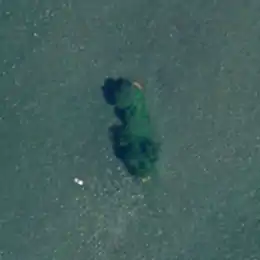 2005 USDA aerial imagery of Powder House Island | |

| |
| Geography | |
|---|---|
| Location | Detroit River, Michigan |
| Coordinates | 42°06′26″N 83°08′09″W[1] |
| Area | 0.91 acres (0.37 ha)[2] |
| Highest elevation | 574 ft (175 m)[1] |
| Administration | |
United States | |
| State | Michigan |
| County | Wayne |
Powder House Island was the location of dynamite storage sheds, as well as a dynamite factory and several ice houses. During this time, it was the site of a series of accidents, including fires in 1895 and 1919 (which both burned the island "to the water's edge"). In 1906, 20 short tons (18,000 kg) of the island's dynamite exploded after two men "had been shooting with a revolver" near it; while there were no deaths (and only minor injuries to the two men), windows were shattered 3 mi (4.8 km) away and the explosion was clearly audible from 85 mi (137 km) away.
After the completion of the Livingstone Channel in 1912, the island continued to be used for storing explosives, including during later projects to deepen the channel in the 1930s. By the 1980s, it was completely unused, and by 2015, the island was owned by the State of Michigan. It is currently managed by the Department of Natural Resources' Wildlife Division as part of the Pointe Mouillee State Game Area, and accessible to the public for hunting and camping.
Geography
Powder House Island is in Wayne County, and is contained within Grosse Ile Township.[3][4] Its coordinates are 42°06′26″N 83°08′09″W[1]; it is near the end of the Detroit River, closer to Lake Erie than to Lake St. Clair, and around 200 ft (0.04 mi; 60 m) from the water border with Canada.[3][5] It is approximately 500 yd (1,500 ft; 460 m) east of Fox Island.[3][5] Further to its west is Grosse Ile, beyond which is Trenton.[3] To its east, across the Livingstone Channel, is Bois Blanc Island (and, further, Amherstburg in Ontario).[6][3][5] The southern tip of the limestone piling on Stony Island is around 700 yd (2,100 ft; 640 m) to the northeast; other islands in the vicinity include Sugar Island to the south and Elba Island to the southwest.[6][3] The island, which is covered in brush and foliage (and takes around five minutes to traverse on foot),[7] is approximately 200 ft (60 m) from north to south, and 50 ft (15 m) from east to west, giving it an approximate area of 10,000 sq ft (930 m2; 0.23 acres).[3][8] The United States Geological Survey (USGS) gave its elevation as 574 ft (175 m) in 1980.[1] In Wayne County records, the island is listed as "DYNAMITE ISLAND", in ZIP code 48138; it is contained within parcel 73069990001000 (whose total area is given as 0.91 acres (0.37 ha)).[2]
| ||||||||||||||||||
_(cropped).jpg.webp)
History
Background and first explosion

In the late 19th century, the Dunbar & Sullivan Company had a number of government contracts to widen and deepen shipping channels in the Detroit River, including the Livingstone Channel and Lime Kiln Crossing.[9][10]: 46:47 This work involved large amounts of blasting, due to limestone bedrock in the area; the nearby Fox Island was a natural choice for storage of explosive compounds.[9][10]: 47 However, in December 1879, the three tons of nitroglycerin stored on Fox Island detonated without warning.[11][12][13] The resultant shock wave destroyed all structures on Fox Island, leaving a crater 60 ft (18 m) wide and 16 ft (4.9 m) deep, shattered the windows of nearby houses, and was clearly audible in St. Clair some 60 mi (97 km) to the north.[11][14]
Injunction and second explosion
In March 1880, an injunction was issued by the Wayne County chancery court in the case of Walter Crane v. Charles F. Dunbar et al., forbidding Dunbar and Daniel B. Reaume (the operators of the company) from "storing nitroglycerine or any other explosive material on Fox Island".[15]
In order to continue work on the channel, it was necessary to store the explosives somewhere; Dunbar and Reaume requested that the injunction be dissolved,[9] but another explosion occurred at the Lime-Kiln Crossing worksite in September 1880, which shook houses in Amherstburg "to their foundations", and could be felt in Essex Center 16 mi (26 km) away.[16] Their request was denied in November, and it became evident that a new location would need to be found or created.[17][18]
Construction of new island
After the injunction was issued, Dunbar & Sullivan resorted to storing their explosives on a scow anchored several hundred yards to the east of Fox Island.[10]: 47 While this allowed work to continue, it was not a permanent solution, and the scow had limited capacity; Dunbar & Sullivan had to purchase raw materials and manufacture dynamite, Hercules powder, and other explosive materials themselves at the work site.[18] Storing dynamite would require a much larger facility, which was only practical if situated on solid land.[10]: 47
While Dunbar & Sullivan had been forbidden to store explosives on Fox Island, the location of the worksite meant that there were few other places to do so. The southern extension of Stony Island had not yet been constructed,[6] and all other land within a reasonable distance of the worksite was inhabited. By 1881, houses had been built along the shore of Grosse Ile, and Hickory and Sugar Island were being used as campgrounds;[19] on the Canadian side, Bois Blanc Island was being used for summer vacation homes.[20] It was therefore decided that an artificial island would be constructed next to Fox Island, to which the 1880 injunction would not apply (having only stipulated that Dunbar & Sullivan not store explosives on Fox Island specifically).[15]
The risks involved in manufacturing and handling explosive devices on the putative artificial island would be largely identical to those incurred by the Fox Island facility—the explosions there had caused damage for miles around, and the new site was only a couple hundred yards away. No additional structures or mechanisms were planned to help contain or redirect the energy of an unintentional detonation; the primary difference between the two sites was that one of them had not existed when the ruling was made, and was therefore (ostensibly) not subject to it.[15][10]: 47
It is unclear why government engineering authorities approved of this reasoning, or indeed that they even did; the Sixth Circuit Court of Appeals later said that "no formal action appears to have been taken by the government or any officer thereof, giving the defendant the right to erect the island [...] all that was shown was at most a verbal permission and an acquiescence on the part of the government officers in charge of the Lime Kiln Crossing work".[10]: 48
Regardless, by May 1881, construction was underway: between eight and ten carpenters, under the direction of John P. Jones, were employed in the construction of a scow.[18] This scow was tasked with carrying rock from channel excavation to a site several hundred yards to the east of Fox Island, and dumping it on the river floor.[18] Eventually, the scow was scuttled atop the rock; the resultant mound was high enough to rise above water level.[10]: 47
Once the island was large and solid enough to permit the erection of structures, the dynamite operations of Dunbar & Sullivan were moved there. While it was initially referred to as "Dunbar Island",[18] it also went by the name of "Dynamite Island"; eventually it became known as "Powder House Island".[10]: 46
Shanties were erected to contain and shelter the large quantities of dynamite required for channel excavation. They caught fire on 21 April 1895, and the island "burned to the water's edge".[21] In 1904, it was reported that Canadian police had found American poachers, illegally fishing for sturgeon, living in a shack on the island.[22] By 1906, 20 short tons (18,000 kg) of dynamite was stored on the island, in shanties of questionable quality; a witness was quoted as saying "you could throw a cat through the cracks".[10]: 47
Third explosion
%252C_1906%252C_1-62500_(cropped_to_Fox_and_Powder_House_Islands).jpg.webp)
On 27 June 1906, Dunbar's dynamite facilities exploded again, this time with 20 short tons (18,000 kg) of dynamite.[23][24][10]: 47 Powder House Island was shaken by an explosion "so terrific in nature that the residents of the town and pleasure-seekers on adjacent islands thought it was an earthquake visitation".[23] Two men, Henry Rogers and Theodore Perry, were injured; they had just left the island, and were 100 yd (91 m) from the shore, when a sudden explosion launched them from their catboat, tore the clothes from their backs, and caused severe burns and lacerations.[23][24] An "immediate cessation of pleasure" occurred among people in the immediate vicinity. Charles Stedman, a vacationer from Indiana on a trip with his wife and children to Bois Blanc Island, said:
We were sprawled out in the shade of a tree [...] when the shock came. It was the most effective transformation scene I ever witnessed. The river in the vicinity of the dynamite houses was instantly lashed into a seething torrent. Rocks and spray shot hundreds of feet into the air, and the report was followed immediately by a shower of white that I afterward learned was limestone. Big trees were uprooted by the shock, and the one under which we were camped rocked ominously. All was confusion on the picnic grounds. Women shrieked in dismay, and repentant men fell upon their knees and began to offer fervent invocations for divine intercession.[25]
In the aftermath of the explosion, thousands of windows were shattered on Grosse Ile alone, plate glass was broken 3 mi (4.8 km) away in Trenton, and work on the shipping channel was delayed due to the loss of blasting equipment.[25] The shockwave from the explosion was felt as far as Cleveland, Ohio, 85 mi (137 km) away on the other side of Lake Erie.[26] The island itself was described as a "wreck", which would need to be rebuilt with many scowloads of stone and mud.[26] The cause of the explosion was not known with certainty, as it had been a hot day, but it was suspected to be related to Rogers and Perry firing revolvers near the dynamite storage area immediately before it exploded (despite Rogers' claim several days later that the revolvers had been loaded with blanks).[24][25][27]
The men said they had been shooting with a revolver, and it is supposed that one of the bullets touched off the fireworks. While admitting that the explosion may have been caused by the heat, experts do not think this theory at all plausible.[25]
The explosion has been the subject of misinformation: some contemporary accounts (such as a 28 June article in the Detroit Free Press) pushed the untrue claim that the explosion had occurred on Fox Island.[23] On 6 July, the Yale Expositor, while correctly reporting that the explosion had occurred on Dynamite Island, claimed that there had been 12 short tons (11,000 kg) of explosives across two artificial islands, and that "a keg of one of the explosives was hurled into the central part of Grosse Ile and there exploded in a clump of woods, tearing century old oaks into splinters".[28] An article in the Trenton Tribune would later falsely state that the explosion happened in 1907.[7] These baseless claims have been debunked by fact-checkers; court proceedings concerning the lawsuit (Henderson v. Sullivan) related to the explosion state that it took place on 26 July 1906, from twenty tons of dynamite, on a single island (Powder House Island). These details were not disputed by the plaintiff, defendant, or judiciary.[10]
Second injunction

Construction began immediately to rebuild the storage sheds. However, attorney Edwin Henderson filed a petition claiming that his house on Grosse Ile had been damaged by the explosion, and on 6 July, a temporary injunction was issued against the Dunbar & Sullivan Company preventing them from storing explosives on the island.[29] Henderson requested that Dunbar & Sullivan be permanently enjoined from storing any dynamite in the Detroit River, which was denied by Judge Swan.[30] Henderson appealed the case to the United States Court of Appeals in Cincinnati,[30] which reversed the prior ruling and granted an injunction (albeit with limitations) in February 1908, with Judge Richards giving the opinion:[31]
We think it apparent from the record that a reasonable amount of dynamite, for use in the public work, might be stored on Powder House Island without injuring persons and property in the neighborhood, and to the great interest of the public in the doing of the improvement of the Detroit River now going on, and so we think that, under proper limitations, an injunction ought to be granted; the judgement of the court below is therefore reversed and the case remanded, with instructions to grant an injunction restraining the defendant from storing dynamite on the island or place described in the bill as the place where the defendant had recently been storing it, in such quantity as to create danger to the complainant or his family personally, or danger to the property, real or personal, owned by or possessed by him, at the place described in the bill as his residence on Grosse Ile.[31]
By 1908, reports indicated that the explosives used for channel blasting were being stored in a bulletproof concrete structure.[32] However, public opinion on the issue was divided, with some advocating for a total ban on dynamite storage in the area. On 5 March 1908, C. McD. Townsend, United States district engineer, held a hearing on the subject of dynamite storage on the lower Detroit River.[32] At the hearing, the residents of Grosse Ile and Hickory Island were represented by Dr. David Inglis, who expressed concern about the storage of explosives, and proposed that the matter be settled in federal court. Townsend's proposal for a compromise entailed constructing three additional islands, to store a total of 60 short tons (54,000 kg) of dynamite divided evenly between them.[31]
By March 1910, the dynamite factory on Powder House Island had returned to operation, with an output of 2 short tons (1,800 kg) per day.[33] In July of that year, several hundred passengers of the pleasure boat Wauketa were "given nearly a three hours extension of their outing" when it ran aground on the shore of a Dunbar Island:[34]
The passengers, none of whom seemed to take the occurrence very seriously, enjoyed themselves in the cool breezes counting the stars and speculating on what would happen if the dynamite magazine of Dunbar & Sullivan on the island nearby should chance to blow up.[34]
In the summer of 1911, workers continued to be employed in the factory;[35] in January 1912, a contract was carried out to fill its ice houses,[36] and in May of that year, a "full force of men" was working at the factory under an O. B. Barnes.[37]
Completion of channel and subsequent use of island
Dunbar & Sullivan's operations on the Livingstone Channel would soon come to an end. The channel was completed, and opened to the public, in October 1912.[38][39] While the ice house and dynamite factory would again burn "to the water's edge" in 1919,[40] the company would continue to carry out dredging and excavation around the Detroit River for decades afterward. In the 1920s, it was using nearby Stony Island as a central part of its dredging and excavation operations,[7][41][42] and by 1931 work was still going on there "24 hours a day".[43][44]
By 1933, channel-deepening operations were being carried out by a George Mills Company,[45] who continued to use Powder House Island as a storage location for explosives;[46] in that year they constructed a new powder house on the island.[47] By that time, dynamite had been replaced with blasting gelatin.[45] The Windsor Star reported in March 1933 that "in spite of the safety of modern blasting gelatine, the Mills Company takes excellent care that not too much of it is on the job at one time. It never rides on the seagoing trucks, and only a small amount is kept on the job [...] the reserve stock, about 2,000 fifty-pound cases, is kept on a small island".[45]
By the 1980s, industrial activity on Powder House Island had ceased, and in 1984 it was uninhabited;[48] in 1987, the company went defunct.[49] As of 2015, Powder House Island (as well as the nearby Stony Island, also formerly owned by Dunbar & Sullivan) was owned by the State of Michigan, managed by the Michigan Department of Natural Resources' Wildlife Division as part of the Pointe Mouillee State Game Area, and accessible to the public for hunting and camping.[50] The area surrounding the island is known for good perch fishing;[51][52] a 1982 report by the U.S. Fish and Wildlife Service said that walleye spawned near the island.[53]: 31
References
- U.S. Geological Survey Geographic Names Information System: Powder House Island
- "Wayne County Parcel Viewer". Wayne County, Michigan. Archived from the original on 22 June 2021. Retrieved 1 December 2021.
- United States Geological Survey (2019). "Rockwood Quadrangle, Michigan" (Map). United States Department of the Interior Geological Survey. 1:24000.
- "The Detroit River". Detroit River Coalition. Archived from the original on 21 May 2021. Retrieved 20 May 2021.
- United States Geological Survey (2019). "Rockwood OE E Quadrangle, Michigan" (Map). United States Department of the Interior Geological Survey. 1:24000.
- Wilson, H.M.; Cooke, Chas E.; McCoy, J.T.; Williamson, J.N. (1906). "Topography, State of Michigan: Wyandotte Quadrangle". United States Geological Survey. Archived from the original on 5 April 2020. Retrieved 1 September 2021.
- Mazzella, Tony. "The 'islands' of Grosse Ile all have stories to tell". Trenton Tribune. Archived from the original on 2 September 2021. Retrieved 1 September 2021.
- "Maps". www.bing.com. Archived from the original on 6 September 2021. Retrieved 13 September 2021.
- "The Courts: Clerk's Office Notes". Detroit Free Press. 2 May 1880. p. 6. Archived from the original on 2 December 2021. Retrieved 6 September 2021 – via Newspapers.com.
- The Federal Reporter. West Publishing Company. 1 September 1908. p. 46. Archived from the original on 1 September 2021. Retrieved 1 September 2021.
- "The Fox Island Explosion Heard at St. Clair". Detroit Free Press. 16 December 1879. p. 4. Archived from the original on 2 December 2021. Retrieved 6 September 2021 – via Newspapers.com.
- "A Tremendous Jar: It Was Caused By the Explosion of Nitro-Glycerine and Powder on Fox Island". Detroit Free Press. 13 December 1879. p. 6. Retrieved 6 September 2021 – via Newspapers.com.
- "50 Years Ago". Detroit Free Press. 13 December 1929. p. 6. Archived from the original on 2 December 2021. Retrieved 6 September 2021 – via Newspapers.com.
- "The Fox Island Explosion: The Extraordinary Work of Nitro-Glycerine". Detroit Free Press. 14 December 1879. p. 4. Retrieved 6 September 2021 – via Newspapers.com.
- "The Courts: Wayne Circuit". Detroit Free Press. 16 March 1880. p. 1. Retrieved 6 September 2021 – via Newspapers.com.
- "Hercules Powder: A Terrific Explosion at the Lime Kiln Crossing, Detroit River. Perilous Situation of Patrick Collins. Injuries from Flying Boards and Timbers. Peter Boyers' Head and Face Severely Cut. Great Destruction of Window Glass and Houses Shaken to Their Foundations. The Shock Felt at Essex Center, Sixteen Miles Away". Detroit Free Press. 25 September 1880. p. 1. Archived from the original on 2 December 2021. Retrieved 6 September 2021 – via Newspapers.com.
- "The Courts: Wayne Circuit". Detroit Free Press. 23 November 1880. p. 1. Retrieved 6 September 2021 – via Newspapers.com.
- "The Lime-Kiln Crossing: Showing the Work Done and That in Progress, and the Courses to be Taken by Ships". Detroit Free Press. 29 May 1881. p. 7. Retrieved 6 September 2021 – via Newspapers.com.
- Society, Grosse Ile Historical (15 August 2007). "Grosse Ile". Arcadia Publishing. Archived from the original on 6 September 2021. Retrieved 13 September 2021 – via Google Books.
- "The Court Afloat". Detroit Free Press. 25 June 1879. p. 8. Archived from the original on 2 December 2021. Retrieved 6 September 2021 – via Newspapers.com.
- "Marine Notes". Detroit Free Press. 23 April 1895. p. 8. Archived from the original on 2 December 2021. Retrieved 13 September 2021 – via Newspapers.com.
- "Little Locals". The Windsor Star. Windsor, Ontario, Canada. 8 June 1904. p. 5. Retrieved 2 December 2021 – via Newspapers.com.
- "Dynamite Ruins Fox Island Plant, Injuring Two". Detroit Free Press. 28 June 1906. p. 1. Retrieved 6 September 2021 – via Newspapers.com.
- "City is Shaken by Dynamite". The Daily Herald. 28 June 1906. p. 6. Archived from the original on 2 December 2021. Retrieved 13 September 2021 – via Newspapers.com.
- "Dynamite Ruins Fox Island Plant, Injuring Two". Detroit Free Press. 28 June 1906. p. 2. Archived from the original on 2 December 2021. Retrieved 6 September 2021 – via Newspapers.com.
- "Felt in Distant Cities. Dynamite Explosion Raised Hob at Harrow". Detroit Free Press. 29 June 1906. p. 11. Archived from the original on 2 December 2021. Retrieved 6 September 2021 – via Newspapers.com.
- "Mind Was A Blank: Harry Rogers Tells Experiences in Dynamite Explosion". Detroit Free Press. 1 July 1906. p. 8. Archived from the original on 2 December 2021. Retrieved 13 September 2021 – via Newspapers.com.
- "It was Stunning". The Yale Expositor. 6 July 1906. p. 2. Archived from the original on 2 December 2021. Retrieved 13 September 2021 – via Newspapers.com.
- "Explosives are Barred: Powder House Island Subject of Temporary Injunction". Detroit Free Press. 10 July 1906. p. 5. Archived from the original on 2 December 2021. Retrieved 13 September 2021 – via Newspapers.com.
- "Dynamite is barred". Detroit Free Press. 5 February 1908. p. 9. Archived from the original on 2 December 2021. Retrieved 13 September 2021 – via Newspapers.com.
- "Appeal to the Courts: Island residents decline to argue dynamite matter". Detroit Free Press. 8 March 1908. p. 18. Archived from the original on 2 December 2021. Retrieved 13 September 2021 – via Newspapers.com.
- "Storage of Dynamite: Col. Townsend will have a hearing on the matter". Detroit Free Press. 4 March 1908. p. 8. Archived from the original on 2 December 2021. Retrieved 13 September 2021 – via Newspapers.com.
- "Drill Boats Start Work". Detroit Free Press. 20 March 1910. Archived from the original on 2 December 2021. Retrieved 13 September 2021 – via Newspapers.com.
- "Wauxeta Runs On Bank". Detroit Free Press. 18 July 1910. Retrieved 13 September 2021 – via Newspapers.com.
- "Amherstburg". The Windsor Star. Windsor, Ontario, Canada. 4 November 1911. p. 3. Retrieved 2 December 2021 – via Newspapers.com.
- "Amherstburg". The Windsor Star. Windsor, Ontario, Canada. 30 January 1912. p. 2. Retrieved 2 December 2021 – via Newspapers.com.
- "Amherstburg". The Windsor Star. Windsor, Ontario, Canada. 3 May 1912. p. 4. Retrieved 2 December 2021 – via Newspapers.com.
- "Channel expansion made Detroit River safer for mariners". U.S. Army Corps of Engineers, Detroit District. 27 December 2012. Archived from the original on 5 September 2021. Retrieved 13 September 2021.
- Wilson, H.M.; Cooke, Chas E.; McCoy, J.T.; Williamson, J.N. (1912). "Topography, State of Michigan: Wyandotte Quadrangle". United States Geological Survey. Archived from the original on 5 April 2020. Retrieved 5 September 2021.
- "Amherstburg". The Windsor Star. Windsor, Ontario, Canada. 29 November 1919. p. 15. Retrieved 2 December 2021 – via Newspapers.com.
- L.A., Tulen; Hartig, J.H.; Dolan, D.M.; Ciborowski, J. (1998). "Conserving Critical Habitats in the Conservation Crescent – The Stony Island Story". Rehabilitating and Conserving Detroit River Habitats. Great Lakes Institute for Environmental Research. Archived from the original on 2 September 2021. Retrieved 2 September 2021.
- Bencsik, Michael (19 January 1984). "Seaman relishes life on rusty river barge". Detroit Free Press. Detroit, Michigan. p. 124. Archived from the original on 2 December 2021. Retrieved 2 December 2021 – via Newspapers.com.
- "Legal Notices". Detroit Free Press. 21 December 1959. p. 31. Retrieved 13 September 2021 – via Newspapers.com.
- "Rum Warfare Match of Wits". Detroit Free Press. 31 May 1931. p. 24. Archived from the original on 2 December 2021. Retrieved 2 September 2021.
- "River's Bed Bared At Amherstburg". The Windsor Star. Windsor, Ontario, Canada. 18 March 1933. p. 19. Retrieved 2 December 2021 – via Newspapers.com.
- "Blasts Tear River Bed". The Windsor Star. Windsor, Ontario, Canada. 14 January 1933. p. 24. Retrieved 2 December 2021 – via Newspapers.com.
- "Get Ready For Blasting". The Windsor Star. Windsor, Ontario, Canada. 16 November 1932. p. 9. Retrieved 2 December 2021 – via Newspapers.com.
- "Islands in the stream: Life going downriver". Detroit Free Press. 3 May 1984. p. 135. Archived from the original on 6 September 2021. Retrieved 13 September 2021 – via Newspapers.com.
- "Detroit Business & Manufacturing". Genealogy Trails. Archived from the original on 2 September 2021. Retrieved 2 September 2021.
- "Point Mouilee State Game Area: All Area, General Map, in Monroe and Wayne Counties" (PDF). Michigan Department of Natural Resources. 1 April 2019. Archived (PDF) from the original on 28 January 2021. Retrieved 13 September 2021.
- "Michigan Fishing Report: Salmon moving into rivers; Run later than '08". mlive. 30 September 2009. Archived from the original on 1 September 2021. Retrieved 1 September 2021.
- "DNR Fishing Report". Detroit Free Press. 18 October 2007. p. 32. Archived from the original on 6 September 2021. Retrieved 13 September 2021 – via Newspapers.com.
- "Atlas of Spawning and Nursery Areas of Great Lakes Fishes: Volume VIII, Detroit River". U. S. Fish and Wildlife Service Office of Biological Services. 1 September 1982. Archived from the original on 1 September 2021. Retrieved 1 September 2021 – via Google Books.
External links
- "Island Hopping" from Nailhed, an urban exploration website