PrOP-M
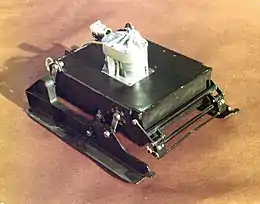
PrOP-M (Russian: Прибор оценки проходимости — Марс (ПрОП-М), Passability Estimating Vehicle for Mars or Device Evaluation Terrain—Mars[1]) were two Soviet Mars rovers that were launched on Mars 2 and Mars 3 missions in 1971. Both rover missions were unsuccessful; Mars 2 crash-landed and Mars 3 lost communication 110 seconds after its landing. PrOP-M were the first rovers to be launched to Mars, 26 years before the first successful rover mission of NASA's Sojourner in 1997. Because the Mars 2 and Mars 3 missions failed, the existence of the rovers was kept secret for nearly 20 years.
 | |
| Mission type | Mars rover |
|---|---|
| Operator | Soviet Space Program |
| Spacecraft properties | |
| Manufacturer | Mobile Vehicle Engineering Institute |
| Dry mass | 4.5 kilograms (9.9 lb) |
| Start of mission | |
| Launch date | 1971 |
The rovers were built by a team led by Alexander Kemurdzhian; they were small, rectangular devices that were tethered to the lander and would have used skis for movement.
History
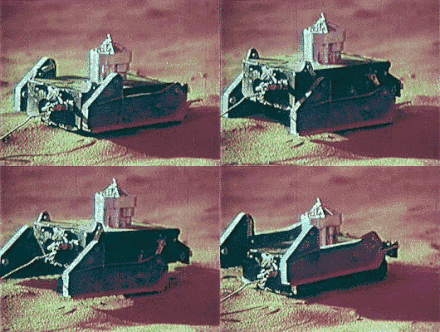
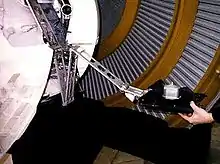
The PrOP-M rover was designed and manufactured at the Mobile Vehicle Engineering Institute (VNIITransmash) by a team of approximately 150 engineers led by Alexander Kemurdzhian, who is known for developing the Lunokhod rover.[2]
Both Mars 2 and Mars 3 landers had a PrOP-M rover, which would have moved across the Martian surface on skis while connected to the lander with a 15-meter (49 ft)-long power cable. Two small metal rods were used for autonomous obstacle avoidance because radio signals from Earth would have taken too long to drive the rovers using remote control. Each rover carried a dynamic penetrometer and a radiation densitometer.[3] After landing, the rovers were planned to be placed on the Martian surface by a manipulator arm and to move in the cameras' fields of view. They would have stopped to make measurements every 1.5 m (4.9 ft), with maximum range of 15 m (49 ft)—the length of the tether. The rovers' tracks in the Martian soil would have been used to determine the soil's material properties.[1][2]
The rovers' main rover frame was a 4.5-kilogram (9.9 lb) square box measuring 25 cm × 22 cm × 4 cm (9.8 in × 8.7 in × 1.6 in)[2][4] with a small protrusion at the center. The frame was supported on two wide, flat skis, one extending from each side, elevating the frame slightly above the surface. At the front of the box were obstacle detection bars.[2]
The rover had a primitive artificial intelligence: if it met an obstacle it was programmed to reverse and "use the skids on alternate sides to walk around the obstacle".[4]
The first rover was destroyed in the crash landing of Mars 2, and because of the failure of a communication link with Mars 3, the second rover was never deployed. The rover missions were secret[4][5] and were not mentioned in official news reports about the landings; their existence was revealed almost 20 years later in 1990.[5] The rovers were launched 26 years before the first successful NASA's rover Sojourner.[6]
One rover can be seen now in the Memorial Museum of Cosmonautics in Moscow, another is in the Museum of Space and Missile Technology in Saint Petersburg.[1][7]
Missions
.jpg.webp)
 Mars 2, launched May 19, 1971, crash landed.[8]
- Mars 3, launched May 28, 1971. Lost when the lander stopped communicating 110 seconds after landing.[9] The loss of communication may have been due to the extremely powerful Martian dust storm taking place at the time or a problem with the Mars 3 orbiter's ability to relay communications.[1]
References
- Ackerman, Evan. "Meet the Very First Rover to Land on Mars". spectrum.ieee.org. Retrieved 28 October 2021.
- "Марс-3". epizodyspace.ru. Retrieved 28 October 2021.
- Perminov, V.G. (July 1999). The Difficult Road to Mars - A Brief History of Mars Exploration in the Soviet Union. NASA Headquarters History Division. pp. 34–60. ISBN 0-16-058859-6.
- Harvey, Brian (2007). Russian Planetary Exploration: History, Development, Legacy and Prospects. Springer Science & Business Media. p. 134. ISBN 9780387496641.
- Anderson, Charlene. "The First Rover on Mars - The Soviets Did It in 1971". Planetary Society. Retrieved 28 October 2021.
- Bard, Jonathan (2020). Destination Mars. Gareth Stevens Pub. p. 15. ISBN 9781538258736.
- "Первая колея на Луне. Выставка приурочена к юбилею конструктора планетоходов Александра Кемурджяна" [The first track on the moon. The exhibition is timed to the anniversary of the designer of planetary rovers Alexander Kemurdzhian]. www.spbmuseum.ru. Retrieved 24 November 2021.
- "Mars 2 Lander". NASA NSSDC. Retrieved 7 November 2021.
- "Mars 3 Lander". NASA NSSDC. Retrieved 7 November 2021.
External links
- Soviet films about Mars exploration, featuring PrOP-M rover
- Нашли спустя 42 года: Как ленинградские ученые первый в мире марсоход создавали
| Active |
|  .jpg.webp) .jpg.webp) | ||||||||
|---|---|---|---|---|---|---|---|---|---|---|
| Past |
| |||||||||
| ||||||||||
| Future |
| |||||||||
| Exploration |
| |||||||||
Missions are ordered by launch date. Sign † indicates failure en route or before intended mission data returned. | ||||||||||