Hanson Formation
The Hanson Formation (Also known as the Shafer Peak Formation) is a geologic formation on Mount Kirkpatrick and North Victoria Land, Antarctica. It is one of the few two major dinosaur-bearing rock groups found on the Antarctica to date; the other is the Snow Hill Island Formation and related formations from the Late Cretaceous of the Antarctic Peninsula. The formation has yielded only a handful of Mesozoic specimens so far and most of it is as yet unexcavated. Part of the Victoria Group of the Transantarctic Mountains, it is below the Prebble Formation and above the Falla Formation.[1] The Formation is related to the Volcanic Activity Linked to the Karoo-Ferar eruptions on the Lower Jurassic.[2][3] The climate of the zone was similar to the modern Southern Chile, Humid, with a temperature interval of 17–18 degrees.[4] The Hanson Formation is correlated with the Section Peak Formation on Eisenhower Range and Deep Freeze Range, as well volcanic deposits on the Convoy Range and Ricker Hills of Southern Victoria Land.[1]
| Hanson Formation Stratigraphic range: Late Sinemurian-Lower Pliensbachian ~ | |
|---|---|
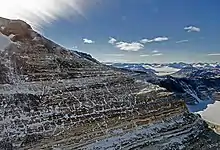 The Hanson Formation is located on the Transantarctic Mountains | |
| Type | Geological formation |
| Unit of | Victoria Group |
| Sub-units | Three informal members |
| Underlies | Prebble Formation |
| Overlies | Falla Formation |
| Thickness | 237.5 m (779 ft) |
| Lithology | |
| Primary | Sandstone, tuffite |
| Other | Climbing-ripple lamination, horizontal lamination, and accumulations of clay-gall rip-up clasts |
| Location | |
| Coordinates | 84.3°S 166.5°E |
| Approximate paleocoordinates | 57.5°S 35.5°E |
| Region | Mount Kirkpatrick, Beardmore Glacier |
| Country | .svg.png.webp) Antarctica Antarctica |
| Type section | |
| Named for | The Hanson Spur |
| Named by | David Elliot |
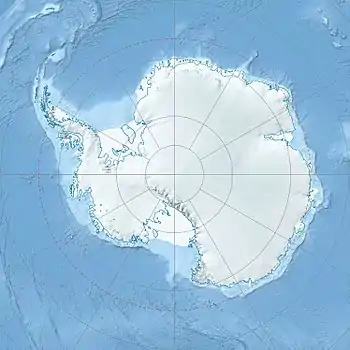  Hanson Formation (Antarctica) | |
History
The Victoria Group (also called Beacon Supergroup) from the Central Transantarctic Mountains where defined by Ferrar in 1907, when he described the "Beacon Sandstone" on the sedimentary rocks on the Valleys of the Victoria Land.[5] Following this initial work, the term "Beacon System" was introduced to recover a series of similar Sandstones and associated deposits that where recovered locally.[6] Latter the "Beacon Sandstone Group" was put for those units on the Victoria Land, with Harrington in 1965 proposing the name for different units that appar on the Beacon Rocks on South Victoria Land, the beds below the Maya Erosion Surface, the Taylor Group and the Gondwana Sequence, including the Victoria Group.[7] This work left out several older units, such as the Permian Coal Measures and the Glacial deposits.[7] It was not until 1963 that there was an establishment of the Gondwana sequence, where the Falla Formation was named delimited for a 2300 ft (700 m) series of lower Quartz Sandstone, a medium Mica-Carbon Sandstone and an upper Sandstone-Shale Unit.[8] The "Upper Falla Formation" was then named, being exposed with considerable uncertainty about its age and the Prebble Formation (Tought it was calculated from the presence of Glossopteris-bearing beds (Early Permian) and the assumed possibility that the rocks were older than Dicroidium-bearing beds, thought to be Late Triassic, in the Dominion Range).[9] Other latter works tried to set it between the Late Triassic (Carnian) and the Lower-Middle Jurassic (Toarcian-Aalenian).[10] The Local Jurassic Sandstones were included on the Victoria Group, with the Beacon unit defined as a Supergroup in 1972, comprising beds overlying the pre-Devonian Kukri Erosion Surface to the Prebble Formation on the Central Transantarctic Mountains, and the Mawson Formation (And its unit then separated, the Carapace Sandstone) in Southern Victoria Land.[11] The Mawson Formation, identified at the beginning as indeterminate Tillite was placed on the Ferrar Group Latter.[12] Extensive fieldwork on the area of the Transantarctic Mountains were done later, which demonstrated the need for revisions to the post-Permian stratigraphy.[13] It was recovered that only 282 m of the 1963's upper 500 m of the Falla Formation correspond with the Sandstone/Shale sequence and that 200 m was composed by a volcaniclastic sequence.[13] It was then, that after this discovery several works ended describing new units on the location: the Fremouw Formation and Prebble Formation, being this last one introduced for a laharic unit, not seen in 1963, that occurs between the Falla Formation and the Kirkpatrick Basalt.[13][14] It was also recovered a complete record at Mount Falla, revelating the sequence from of events in the Transantarctic Mountains spanning the interval between the Upper Triassic Dicroidium-bearing beds and the Middle Jurassic tholeiitic lavas.[13] The upper part of the Falla Formation contains recognizable primary pyroclastic deposits, exemplified by resistant, laterally continuous silicic tuff beds, what led to consider this unit as a different formation, more after seeing that the change is related with erosion associated with tectonic activity that preceded or accompanied the silicic volcanism and marked the onset of the development of a volcano-tectonic rift system.[1]
The "Shafer Peak Formation" was named from genetically identical deposits from North Victoria Land (Concretely on Mt. Carson) in 2007 and correlated with the Hanson Formation, defined as tuffaceous deposits with silicic glass shards along with quartz and feldspar.[15] Later works however have found it to be just a continuantion of the Hanson Formation in NVL region.[16]
Description
The name Hanson Formation was proposed for the volcaniclastic sequence that was described on Barrett's 1969 Falla Formation essay.[13] The name was taken from the Hanson Spur, that lies immediately at the west of Mount Falla and is developed on the resistant tuff unit described below.[1]
Paleofauna
The first dinosaur to be discovered from the Hanson Formation was the predator Cryolophosaurus in 1991, which was then formally described in 1994. Alongside these dinosaur remains were fossilized trees, suggesting that plant matter had once grown on Antarctica's surface before it drifted southward. Other finds from the formation include tritylodonts, herbivorous mammal-like reptiles and crow-sized pterosaurs. Surprisingly were the discovery of prosauropod remains, which were found commonly on other continents only until the Early Jurassic. However, the bone fragments found at the Hanson Formation were dated until the Middle Jurassic, millions of years later. In 2004, paleontologists discovered partial remains of a large sauropod dinosaur that has not formally been described yet.
Synapsida
| Genus | Species | Location | Material | Notes | Images |
|---|---|---|---|---|---|
| Indeterminate |
|
FMNH PR1824, an isolated upper postcanine tooth. |
A Cynodont, incertade sedis inside Tritylodontidae. It was found related with the Asian genus Bienotheroides.[18] Probably the largest member of the family, and among the largest post-triassic Synapsids, with a length over 1.6 m long, was probably robust as a modern Wolverine.[18] |
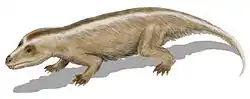 Tritylodon, example of Tritylodontidae cynodont | |
Pterosauria
| Genus | Species | Location | Material | Notes | Images |
|---|---|---|---|---|---|
| Indeterminate |
|
Humerus |
A pterosaur, possible member of the family Dimorphodontidae. Nearly the same size as YPM Dimorphodon. Its affinities haven't been compared, but its numeral morphotype is common for basal pterosaurs, like in Preondactylus or Arcticodactylus, so can be related to this genera. |
 Dimorphodon, example of Dimorphodontid Pterosaur | |
Ornithischia
| Genus | Species | Location | Material | Notes | Images |
|---|---|---|---|---|---|
|
|
|
A dinosaur, possible member of the Ornithischia Group. Described as a Newly discovered species, a four or five-foot ornithischian or bird-hipped dinosaur, is on its way back to the United States in about 5,000 pounds of rock.[22] |
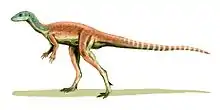 Eocursor, example of basal Ornithischian | |
Sauropodomorpha
| Genus | Species | Location | Material | Notes | Images |
|---|---|---|---|---|---|
|
|
|
A Sauropodomorph, member of the family Massospondylidae. It was found to be related with the genus Lufengosaurus of China. |
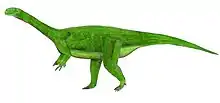 Glacialisaurus Reconstruction | |
|
|
|
A Sauropodomorph, incertade sedis inside Massopoda. Exposed on the Antarctic Dinosaur Exhibit of NHM of Los Angeles, like Sauropodomorph B. Is cited more derived than Sauropodomorph B., probably near sauropoda, but it was not considered a proper Sauropod.[26][27] |
||
|
|
|
A Sauropodomorph, possible member of Anchisauria inside Massopoda. Exposed on the Antarctic Dinosaur Exhibit of NHM of Los Angeles.[26][27] |
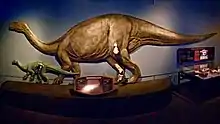 Inaccurate (Quadrupedal) restoration of Sauropodomorph B (Small) along with Glacialisaurus | |
|
|
|
A Sauropodomorph, incertade sedis inside Sauropoda. A possible Pulanesaura-grade Sauropod, less derived than Kotasaurus. The presence of Glacialisaurus in the Hanson Formation with advanced true sauropods shows that both primitive and advanced members of this lineage existed side by side in the early Jurassic Period.[24][28][25] |
||
Theropoda
| Genus | Species | Location | Material | Notes | Images |
|---|---|---|---|---|---|
|
|
|
A Theropod, member of the family Coelophysoidea. It is on study. Was considered Glacialisaurus remains, although can be a genus similar to Coelophysis.[30] |
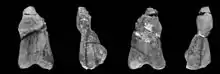 FMNH PR1822, assigned to Glacialiasaurus | |
|
|
|
A Theropod, member of the family Coelophysidae. Were described as a "Halticosaurid teeth". |
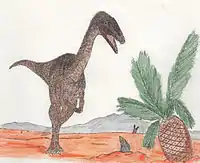 Coelophysis, example of Coelophysoid | |
|
|
|
A Theropod, incertade sedis inside Neotheropoda. Described as "Dromeosaurid? teeth", it is probably either a Tachiraptor-grade averostra, a Coelophysis-like form, or can even be a basal Tetanuran. |
||
|
|
A Theropod, incertade sedis inside Neotheropoda, probably related with Averostra. Described as a possible Basal Tetanuran, subsequent studies have point relationships with Dilophosaurus from North America. It is the most know dinosaur found on the formation, and was probably the largest predator on the ecosystem.[17] |
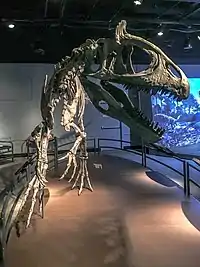 Mounted skeleton of Cryolophosaurus | ||
Arthropoda
At SW Gair Mesa the basal layers of the overlying lacustrine series have yielded highly fragmented and thus unidentifiable arthropod cuticles. This layers represent a lake shore, and are characterised by the incredible preservation of some Arthropod remains.[37]
| Genus | Species | Location | Stratigraphic position | Material | Notes | Images |
|---|---|---|---|---|---|---|
|
Scoyenia isp. |
|
Lower Hanson Formation |
Burrows |
Burrow Fossils on Lacustrine environment, probably done by Arthropods |
||
|
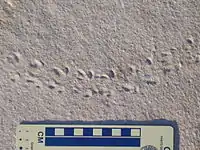
Diplichnites isp. |
|
Lower Hanson Formation |
Trace Fossils |
Trace Fossils on Lacustrine environment, probably done by Arthropods (Arachnids or Myriapods) |
 | |
|
Conchostraca Indeterminate (Various) |
|
|
Isolated Valves |
Numerous conchostracan remains, found associated with lagoonar deposits and major indicators of water bodies locally along Scoyenia burrows |
||
|
Ostracoda Indeterminate (Various) |
|
Middle Hanson Formation |
Isolated Valves |
Numerous Ostracodan remains, found associated with lagoonar deposits and major indicators of water bodies locally along Scoyenia burrows and conchostracans |
||
|
Coleoptera Indeterminate (Various) |
|
Lower Hanson Formation |
Isolated Elytron. |
Indeterminate Beetle Remains |
||
|
Blattidae Indeterminate |
SW Gair Mesa |
Middle Hanson Formation |
Complete specimen. |
Uncertain Blattidae remains. Similar to the genus Periplaneta |
||
Flora
Fossilized wood is also present in the Hanson Formation, near the stratigraphic level of the tritylodont locality. It has affinities with the Araucariaceae and similar kinds of conifers.[38] In the North Victoria Land Region, plant remains occur at the base of the lacustrine beds directly underlying the initial pillow lavas at the top of the sedimentary profile. Some of the layers of the Shafer Peak include remains of an in situ-stand gymnosperm trees:
- At Mount Carson, at least 4 large tree trunks where found on a exposed beeding plane. The wood is coalified and only partially silicified, with the largest stem reaching a diameter of nearly 50 cm.[37]
- In Suture Bench, Silidified Tree Trunks are found buried in situ along lava flows. Some specimens have several holes/tunnels less than 1 cm wide that may represent arthropod borings.[37]
Palynology
| Genus | Species | Location | Stratigraphic position | Material | Notes |
|---|---|---|---|---|---|
|
Nevesisporites[39] |
|
|
Lower Hanson Formation |
Spores |
Affinities with Bryophyta. Younger index taxa (e.g. Nevesisporites vallatus) are mostly absent and as the proportion of Classopollis is still very high.[39] |
|
Dejerseysporites[40] |
|
|
Lower Hanson Formation |
Spores |
Affinities with the Sphagnaceae. Sphagnum-type swamp mosses. Aquatic in freshwater swamps temperate, wet |
|
Sculptisporis[40] |
|
|
Lower Hanson Formation |
Spores |
Affinities with the Sphagnaceae. |
|
Stereisporites[40] |
|
|
Lower Hanson Formation |
Spores |
Affinities with the Sphagnaceae. |
|
Polycingulatisporites[40] |
|
|
Lower Hanson Formation |
Spores |
Affinities with the family Notothyladaceae. Hornwort spores. |
|
Aratrisporites[40] |
|
|
Lower Hanson Formation |
Spores |
Affinities with Pleuromeiales. The Plueromeiales were tall Lycophites (2 to 6 m) common on the Trassic. Probably come from a relict genus. |
|
Retitriletes[39] |
|
McLea Nunatak, Prince Albert Mountains |
Lower Hanson Formation |
Pollen |
Affinities with the family Lycopodiaceae. Rather absent on some samples.[39] |
|
Calamospora[40] |
|
|
Lower Hanson Formation |
Spores |
Affinities with the Calamitaceae. Horsetails, herbaceous flora related to high humid environments, flooding tolerant plants. |
|
Retitriletes[40] |
|
|
Lower Hanson Formation |
Spores |
Affinities with the Lycopodiaceae |
|
Densoisporites[40] |
|
|
Lower Hanson Formation |
Spores |
Affinities with the Selaginellaceae |
|
Neoraistrickia[40] |
|
|
Lower Hanson Formation |
Spores |
Affinities with the Selaginellaceae |
|
Puntactosporites[40] |
|
|
Lower Hanson Formation |
Spores |
Uncertain Peridophyte Affinities |
|
Trachysporites[40] |
|
|
Lower Hanson Formation |
Spores |
Uncertain Peridophyte Affinities |
|
Thymosphora[40] |
|
|
Lower Hanson Formation |
Spores |
Uncertain Peridophyte Affinities |
|
Verrucosisporites[40] |
|
|
Lower Hanson Formation |
Spores |
Uncertain Peridophyte Affinities |
|
Rogalskaisporites[40] |
|
|
Lower Hanson Formation |
Spores |
Uncertain Peridophyte Affinities |
|
Baculatisporites[40] |
|
|
Lower Hanson Formation |
Spores |
Affinities with the family Osmundaceae. Near Fluvial currents ferns, reted to the modern Osmunda Regalis. |
|
Rugulatisporites[40] |
|
|
Lower Hanson Formation |
Spores |
Affinities with the family Osmundaceae. |
|
Cybotiumspora[40] |
|
|
Lower Hanson Formation |
Spores |
Affinities with the family Cibotiaceae. |
|
Cyathidites[40] |
|
|
Lower Hanson Formation |
Spores |
Affinities with the families Cyatheaceae or Adiantaceae. |
|
Dictyophyllitides[40] |
|
|
Lower Hanson Formation |
Spores |
Affinities with the families Schizaeaceae, Dicksoniaceae or Matoniaceae. |
|
Podosporites[39] |
|
|
Lower Hanson Formation |
Pollen |
Affinities with the family Gymnospermopsida. Subordinate occurrences of bryophyte and lycophyte spores are found along consistent occurrences of Podosporites variabilis.[39] |
|
Alisporites[40] |
|
|
Lower Hanson Formation |
Pollen |
Affinities with the families Caytoniaceae, Corystospermaceae, Peltaspermaceae, Umkomasiaceae and Voltziaceae |
|
Platysaccus[40] |
|
|
Lower Hanson Formation |
Pollen |
Affinities with the families Caytoniaceae, Corystospermaceae, Podocarpaceae and Voltziaceae |
|
Vitreisporites[40] |
|
|
Lower Hanson Formation |
Pollen |
Affinities with the families Caytoniaceae. |
|
Araucariacites[40] |
|
|
Lower Hanson Formation |
Pollen |
Affinities with the family Araucariaceae. By the Pliensbachian, Cheirolepidiaceae reduces their abundance with coeval proliferation of the Araucariaceae-type pollen |
|
Corollina[40] |
|
|
Lower Hanson Formation |
Pollen |
Affinities with the family Cheirolepidiaceae. The dominance of Corollina species is the main feature of the Corollina torosa Abundance Zone |
|
Classopollis[39] |
|
McLea Nunatak, Prince Albert Mountains |
Lower Hanson Formation |
Pollen |
Affinities with the family Cheirolepidiaceae. Mostly of the samples yielded well-preserved pollen-and-spore assemblages strongly dominated (82% and 85%, respectively) by Classopollis grains.[39] |
|
Perinopollenites[40] |
|
|
Lower Hanson Formation |
Pollen |
Affinities with the family Cupressaceae. |
Macroflora
| Genus | Species | Location | Stratigraphic position | Material | Notes |
|---|---|---|---|---|---|
|
Marchantites mawsonii |
|
Middle Hanson Formation |
Thalli |
A Liverwort of the family Marchantiales. Reworked From the Hanson Formation to the Mawson Formation, this liveworth is related to modern Humid-environment genera. | |
|
Isoetites[43] |
Isoetites abundans |
Mount Carson |
Lower and Middle Hanson Formation |
Stems |
A Lycophytan of the family Isoetaceae. Specimens resemble Australian ones of similar age |
|
Equisetites sp. |
Mount Carson |
Lower and Middle Hanson Formation |
Fragments of rhizomes, unbranched aerialshoots, isolated leaf sheaths and nodal diaphragms |
A Sphenophytan of the family Equisetaceae. Sphenophytes are common elements of Jurassic floras of southern Gondwana | |
|
Cladophlebis oblonga |
|
Middle Hanson Formation |
Leaves and Stems |
A Polypodiopsidan of the family Osmundaceae. Reworked From the Hanson Formation to the Mawson Formation, represents fern leaves common on humid environments. | |
|
Clathropteris meniscoides |
|
Lower and Middle Hanson Formation |
Leaf segments |
A Polypodiopsidan of the family Dipteridaceae. It was the first record of the genus & species from the Antarctica. Specimens from Shafer Peak occur in a tuffitic mass-flow deposit, and are associated with abundant charred wood indicating wildfires.[44] | |
|
Polyphacelus[44] |
Polyphacelus stormensis |
|
Lower and Middle Hanson Formation |
Leaf segments |
A Polypodiopsidan of the family Dipteridaceae. Found to be closely related with Clathropteris meniscoides |
|
Matonidium[43] |
Matonidium sp. cf.M. goeppertii |
Mount Carson |
Lower and Middle Hanson Formation |
Pinna portions |
A Polypodiopsidan of the family Matoniaceae. |
|
Mount Carson |
Lower and Middle Hanson Formation |
Pinna fragments |
A Polypodiopsidan of the family Dicksoniaceae. | |
|
|
Lower and Middle Hanson Formation |
Leaves pinnately compound |
A Cycadophytan of the family Bennettitales. | |
|
|
Lower and Middle Hanson Formation |
Fragment of a large pinnately compound leaf |
A Cycadophytan of the family Bennettitales. | |
|
Cycadolepis[43] |
|
Mount Carson |
Lower and Middle Hanson Formation |
Trapeziform fragment of a scale leaf |
A Cycadophytan of the family Bennettitales. |
|
Schizolepis[43] |
|
Mount Carson |
Lower and Middle Hanson Formation |
Cone Scales |
A Pinales of the family Voltziales. |
|
Allocladus[43] |
|
Mount Carson |
Lower and Middle Hanson Formation |
Cuticles |
A Pinales of the family Cupressaceae. |
|
Mount Carson |
Lower and Middle Hanson Formation |
Cuticles |
A Pinales of the family Cupressaceae. | |
|
Pagiophyllum sp. |
|
Middle Hanson Formation |
|
A Pinales of the family Araucariaceae. Reworked From the Hanson Formation to the Mawson Formation, representative of the presence of arboreal to arbustive flora. | |
|
Nothodacrium warrenii |
|
Middle Hanson Formation |
Leaves |
A Pinales of the family Podocarpaceae. Reworked From the Hanson Formation to the Mawson Formation, representative of the presence of arboreal to arbustive flora. | |
See also
References
- Elliot ', D.H. (1996). "The Hanson Formation: a new stratigraphical unit in the Transantarctic Mountains, Antarctica". Antarctic Science. 8 (4): 389–394. Bibcode:1996AntSc...8..389E. doi:10.1017/S0954102096000569. Retrieved 15 November 2021.
- Ross, P.S.; White, J.D.L. (2006). "Debris jets in continental phreatomagmatic volcanoes: a field study of their subterranean deposits in the Coombs Hills vent complex, Antarctica". Journal of Volcanology and Geothermal Research. 149 (1): 62–84. Bibcode:2006JVGR..149...62R. doi:10.1016/j.jvolgeores.2005.06.007.
- Elliot, D. H.; Larsen, D. (1993). "Mesozoic volcanism in the Transantarctic Mountains: depositional environment and tectonic setting". Gondwana 8—Assembly, Evolution, and Dispersal. 1 (1): 379–410.
- Chandler, M. A.; Rind, D.; Ruedy, R. (1992). "Pangaean climate during the Early Jurassic: GCM simulations and the sedimentary record of paleoclimate". Geological Society of America Bulletin. 104 (1): 543–559. Bibcode:1992GSAB..104..543C. doi:10.1130/0016-7606(1992)104<0543:PCDTEJ>2.3.CO;2.
- Ferrar, H.T. (1907). "Report on the field geology of the region explored during the 'Discovery' Antarctic Expedition 1901-1904". National Antarctic Expedition, Natural History. 1 (1): 1–100.
- Harrington, H.J. (1958). "Nomenclature of rock units in the Ross Sea region, Antarctica". Nature. 182 (1): 290. Bibcode:1958Natur.182..290H. doi:10.1038/182290a0. S2CID 4249714. Retrieved 15 November 2021.
- Harrington, H.J. (1965). "Geology and morphology of Antarctica". Ivan Oye, P. & van Mieohem, J, Eds. Biogeography and Ecology of Antarctica. Monographiae Biologicae. 15 (1): 1–71.
- Grindley, G.W. (1963). "The geology of the Queen Alexandra Range, Beardmore Glacier, Ross Dependency, Antarctica; with notes on the correlation of Gondwana sequences". New Zealand Journal of Geology and Geophysics. 6 (1–2): 307–347. doi:10.1080/00288306.1963.10422067.
- Barret, P.J. (1969). "Stratigraphy and petrology of the mainly fluviatile Permian and Triassic Beacon rocks, Beardmore Glacier area, Antarctica". Institute of Polar Studies, Ohio State University. 34 (2–3): 132.
- Collinston, J.W., Isbell, J.L., Elliot, D.H., Miller, M.F. & Miller, J.W.G. 1994. Permian-TriassicTransantarctic basin. In Veevers, J.J. & Powell, C.McA., eds. Permian-Triassic Pangean basins and foldbelts along the Panthalassan margin of Gondwanaland. Memoir of the Geological Society of America, No. 184,173-222
- Barret, P.J.; Elliot, D.H. (1972). "The early Mesozoic volcaniclastic Prebble Formation, Beardmore Glacier area". In ADIE, R.J., Ed.Antarctic Geology and Geophysics: 403–409.
- Ballance, P.F. & Watters, W.A. 1971. The Mawson Diamictite and the Carapace Sandstone, formations of the Ferrar Group at Allan Hills and Carapace Nunatak, Victoria Land, Antarctica.New Zealand Journal of Geology and Geophysics, 14,512-527.
- Barret, P.J.; Elliot, D.H.; Lindsay, J.F. (1986). "The Beacon Supergroup (Devonian-Triassic) and Ferrar Group (Jurassic) in the Beardmore Glacier area, Antarctica". Antarctic Research Series. 36 (1): 339–428. doi:10.1029/AR036p0339.
- Barret, P.J.; Elliot, D.H. (1973). "Reconnaissance Geologic Map of the Buckley Island Quadrangle, Transantarctic Mountains, Antarctica". US Geological Survey, Antarctica. 1 (1): 1–42. Retrieved 15 November 2021.
- Schöner, R.; Viereck-Goette, L.; Schneider, J.; Bomfleur, B. (2007). "Triassic-Jurassic sediments and multiple volcanic events in North Victoria Land, Antarctica: A revised stratigraphic model". In Antarctica: A Keystone in a Changing World–Online Proceedings of the 10th ISAES, Edited by AK Cooper and CR Raymond et Al., USGS Open-File Report. Open-File Report. 1047 (1): 1–5. doi:10.3133/ofr20071047SRP102.
- Bomfleur, B.; Mörs, T.; Unverfärth, J.; Liu, F.; Läufer, A.; Castillo, P.; Crispini, L. (2021). "Uncharted Permian to Jurassic continental deposits in the far north of Victoria Land, East Antarctica". Journal of the Geological Society. 178 (1). doi:10.1144/jgs2020-062. S2CID 226380284. Retrieved 15 November 2021.
- Weishampel, David B; et al. (2004). "Dinosaur distribution (Early Jurassic, Asia)." In: Weishampel, David B.; Dodson, Peter; and Osmólska, Halszka (eds.): The Dinosauria, 2nd, Berkeley: University of California Press. p.537. ISBN 0-520-24209-2.
- Hammer, W.R.; Smith, N.D. (2008). "A tritylodont postcanine from the Hanson Formation of Antarctica". Journal of Vertebrate Paleontology. 28 (1): 269–273. doi:10.1671/0272-4634(2008)28[269:ATPFTH]2.0.CO;2. Retrieved 15 November 2021.
- Stilwell, Jeffrey; Long, John (2011). Frozen in Time –prehistoric life of Antarctica (1 ed.). Melbourne, Australia: CSIRO Publishing. pp. 1–200. Retrieved 15 November 2021.
- Hammer, W. R.; Hickerson, W. J. (1996). "Implications of an Early Jurassic vertebrate fauna from Antarctica". The Continental Jurassic. Museum of Northern Arizona Bulletin. 60 (1): 215–218.
- Niiler, E. "Primitive Dinosaur Found in Antarctic Mountains". nbcnews. Retrieved 15 November 2021.
- College, Augustana. "Hammer adds another new dinosaur to his collection". Augustana College. Retrieved 15 November 2021.
- Museum, Field (June 2011). "Surprising Discoveries - Antarctica Video Report #12". Vimeo. Retrieved 15 November 2021.
- Smith, Nathan D.; Pol, Diego (2007). "Anatomy of a basal sauropodomorph dinosaur from the Early Jurassic Hanson Formation of Antarctica" (PDF). Acta Palaeontologica Polonica. 52 (4): 657–674.
- Smith, N.D., Makovicky, P.J., Pol, D., Hammer, W.R., and Currie, P.J. (2007). "The Dinosaurs of the Early Jurassic Hanson Formation of the Central Transantarctic Mountains: Phylogenetic Review and Synthesis" (PDF). U.S. Geological Survey and the National Academies. 2007 (1047srp003): 5 pp. doi:10.3133/of2007-1047.srp003.CS1 maint: multiple names: authors list (link)
- Smith, Nathan D. (2013). "New Dinosaurs from the Early Jurassic Hanson Formation of Antarctica, and Patters of Diversity and Biogeography in Early Jurassic Sauropodomorphs". Geological Society of America Abstracts with Programs. 45 (7): 897.
- NHM. "Antarctic Dinosaurs, Discover new species of dinosaurs as you follow in the steps of Antarctic adventurer-scientists". Natural History Museum of Los Angeles. Retrieved 15 November 2021.
- Pickrell, John (2004). "Two New Dinosaurs Discovered in Antarctica". National Geographic. Retrieved 20 December 2013.
- Joyce, C. "Digging for dinosaurs in Antarctica: Giant bones suggest icy continent had warmer past". NPR.org. Retrieved 15 November 2021.
- Carrano, M. T. (2020). Taxonomic opinions on the Dinosauria.
- Ford, T. "Small theropods". Dinosaur Mailing List. Cleveland Museum of Natural History. Retrieved 15 November 2021.
- Vega, G. C.; Olalla-Tárraga, M. Á. (2020). "Past changes on fauna and flora distribution. In Past Antarctica". Academic Press. 245: 165–179.
- Hammersue, William R.; Hickerson, William J. (1994). "A Crested Theropod Dinosaur from Antarctica". Science. 264 (5160): 828–830. Bibcode:1994Sci...264..828H. doi:10.1126/science.264.5160.828. PMID 17794724. S2CID 38933265. Retrieved 15 November 2021.
- "Table 4.1," in Weishampel, et al. (2004). Page 74.
- "New Information on the Theropod Dinosaur Cryolophosaurus Ellioti from the Early Jurassic Hanson Formation Of The Central Transantarctic Mountains". SVP Conference Abstracts 2017: 196. 2017.
- Smith, N.D; Makovicky, P.J.; Hammer, W.R.; Currie, P.J. (2007). "Osteology of Cryolophosaurus ellioti (Dinosauria: Theropoda) from the Early Jurassic of Antarctica and implications for early theropod evolution". Zoological Journal of the Linnean Society. 151 (2): 377–421. doi:10.1111/j.1096-3642.2007.00325.x.
- Bomfleur, B.; Schneider, J. W.; Schöner, R.; Viereck-Götte, L.; Kerp, H. (2011). "Fossil sites in the continental Victoria and Ferrar groups (Triassic-Jurassic) of north Victoria Land, Antarctica". Polarforschung. 80 (2): 88–99. Retrieved 15 November 2021.
- Gair, H. S.; Norris, G.; Ricker, J. (1965). "Early mesozoic microfloras from Antarctica". New Zealand Journal of Geology and Geophysics. 8 (2): 231–235. doi:10.1080/00288306.1965.10428109.
- Unverfärth, J.; Mörs, T.; Bomfleur, B. (2020). "Palynological evidence supporting widespread synchronicity of Early Jurassic silicic volcanism throughout the Transantarctic Basin". Antarctic Science. 32 (5): 396–397. Bibcode:2020AntSc..32..396U. doi:10.1017/S0954102020000346. S2CID 224858807. Retrieved 15 November 2021.
- Musumeci, G.; Pertusati, P. C.; Ribecai, C.; Meccheri, M. (2006). "Early Jurassic fossiliferous black shales in the Exposure Hill Formation, Ferrar Group of northern Victoria Land, Antarctica". Terra Antartica Reports. 12 (1): 91–98. Retrieved 17 November 2021.
- Cantrill, D. J.; Hunter, M. A. (2005). "Macrofossil floras of the Latady Basin, Antarctic Peninsula". New Zealand Journal of Geology and Geophysics. 48 (3): 537–553. doi:10.1080/00288306.2005.9515132. S2CID 129854482. Retrieved 15 November 2021.
- Cantrill, D. J.; Poole, I. (2012). "The vegetation of Antarctica through geological time". Cambridge University Press. 1 (1): 1–340. doi:10.1017/CBO9781139024990. ISBN 9781139024990. Retrieved 15 November 2021.
- Bomfleur, B.; Pott, C.; Kerp, H. (2011). "Plant assemblages from the Shafer Peak Formation (Lower Jurassic), north Victoria Land, Transantarctic Mountains". Antarctic Science. 23 (2): 188–208. Bibcode:2011AntSc..23..188B. doi:10.1017/S0954102010000866. S2CID 130084588.
- Bomfleur, B.; Kerp, H. (2010). "The first record of the dipterid fern leaf Clathropteris Brongniart from Antarctica and its relation to Polyphacelus stormensis Yao, Taylor et Taylor nov. emend". Review of Palaeobotany and Palynology. 160 (3–4): 143–153. doi:10.1016/j.revpalbo.2010.02.003. Retrieved 15 November 2021.