List of Bulgarian monarchs
The monarchs of Bulgaria ruled the country during three periods of Bulgaria's history as an independent country: from the establishment of the First Bulgarian Empire in 681 to the Byzantine conquest of Bulgaria in 1018; from the Uprising of Asen and Peter that established the Second Bulgarian Empire in 1185 to the annexation of the rump Bulgarian state into the Ottoman Empire in 1396; and from the re-establishment of an independent Bulgaria in 1878 to the abolition of monarchy in a referendum[1] held on 15 September 1946.
| Monarchy of Bulgaria | |
|---|---|
| Монарх на България | |
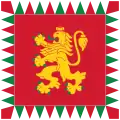 Standard of the Tsar of Bulgaria | |
 Simeon II | |
| Details | |
| Style | His Majesty |
| First monarch | Asparukh (as Khan) |
| Last monarch | Simeon II (as Tsar) |
| Formation | 681 |
| Abolition | 15 September 1946 |
| Residence | Royal Palace |
| Appointer | Hereditary |
| Pretender(s) | Simeon II |
Early Bulgarian rulers possibly used the title Kanasubigi (possibly related to Khan, Khagan) before the 7th century and until the 9th century. The title knyaz (prince) was used for a brief period by Boris I of Bulgaria (and his two successors) after the Christianization of Bulgaria in 864.
The title tsar (emperor), the Bulgarian form of the Latin Caesar, was first adopted and used in Bulgaria by Simeon I the Great (son of Knyaz Boris I), following a decisive victory over the Byzantine Empire in 913. It was also used by all of Simeon I's successors until the fall of Bulgaria under Ottoman rule in 1396. After Bulgaria's liberation from the Ottomans in 1878, its first monarch Alexander I adopted the title knyaz, or prince. However, when de jure independence was proclaimed under his successor Ferdinand in 1908, the title was elevated to the customary tsar once more, but this time in the sense of king. The use of tsar continued under Ferdinand and later under his heirs Boris III and Simeon II until the abolition of monarchy in 1946. While the title tsar is translated as "emperor" in the cases of the First and Second Bulgarian Empires, it is translated as "king" in case of the Third Bulgarian State in the 20th century.
In the few surviving medieval Bulgarian royal charters, the monarchs of Bulgaria styled themselves as "In Christ the Lord Faithful Emperor and Autocrat of all Bulgarians" or similar variations, sometimes including “... and Romans, Greeks, or Vlachs".
In 705 the Eastern Roman Emperor Justinian II gave the title caesar to the Bulgarian ruler Tervel, the first foreigner to receive this title.[2][3]
The Pope Innocent III did not accept Kaloyan's claim to an imperial crown, but dispatched Cardinal Leo Brancaleoni to Bulgaria in early 1204 to crown him with the title of King of the Bulgarians and Vlachs.[4][5]
This list does not include the mythical Bulgar rulers and the rulers of Old Great Bulgaria listed in the Nominalia of the Bulgarian khans as well as unsuccessful claimants to the throne who are not generally listed among the Bulgarian monarchs, neither rulers of Volga Bulgaria, or other famous Bulgarian rulers as Kuber or Alcek.
The early Bulgarian ruler Kubrat, as important allied foreign ruler, was granted the title of Patrikios (Patrician) by the Eastern Roman Emperor. His ring A was inscribed in Greek XOBPATOY and ring C was inscribed XOBPATOY ПATPIKIOY,[6] indicating the dignity of Patrikios (Patrician) that he had achieved in the Byzantine world.[7]
Table
Khanate and First Bulgarian Empire (681–1018)
| Image | Title | Name | Reign | Notes/Death |
|---|---|---|---|---|
| Dulo dynasty (681–753) | ||||
 | Khan[a] | Asparukh | 681–701 | Son of Khan Kubrat, ruler of Old Great Bulgaria. After his victory at the Battle of Ongal in 680 he formed the country of Bulgaria. Died in 701 in battle against the Khazars.[8] |
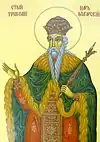 | Khan | Tervel | 701–721 | Received the Byzantine title Caesar in 705 for helping Justinian II recover his throne.[9][10] Tervel aided the Byzantines during the Second Arab Siege of Constantinople. Died in 721.[11] |
| Khan | Kormesiy | 721–738 | Unknown date of death.[12] | |
| Khan | Sevar | 738–753 | Last ruler of the Dulo dynasty. Died a natural death or was dethroned in 753.[13] | |
| Vokil clan (753–762) | ||||
| Khan | Kormisosh | 753–756 | Beginning of a period of internal instability. Deposed in 756.[14] | |
| Khan | Vinekh | 756–762 | Murdered in 762.[15] | |
| Ugain clan (762–765) | ||||
| Khan | Telets | 762–765 | Murdered in 765.[16] | |
| Vokil clan (766) | ||||
| Khan | Sabin | 765–766 | Might have been of Slavic origin. Deposed by a People's Council in 766, fled to the Byzantine Empire.[17] | |
| Khan | Umor | 766 | Ruled for only 40 days. Deposed in 766 and fled to the Byzantine Empire.[18] | |
| Non-dynastic (766–768) | ||||
| Khan | Toktu | 766–767 | Killed in the forests of the Danube in 767 by the opposition.[19] (Dulo dynasty) | |
| Khan | Pagan | 767–768 | Murdered by his servants in the region of Varna.[20] | |
| Krum/Dulo dynasty (768–997)[b] | ||||
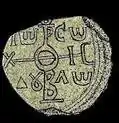 | Khan[21] | Telerig | 768–777 | Son of Tervel. Fled to Constantinople in 777 and baptised.[22] |
| Khan | Kardam | 777–803 | End of the internal crisis. Stabilization and consolidation of the country. Unknown date of death.[23] | |
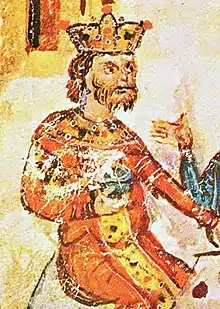 | Khan[24] | Krum | 803–814 | Famous for the Battle of Pliska, in which the Byzantine emperor Nikephoros I perished. Krum is also famous for introducing the first written laws into Bulgaria. Died a natural death (very likely from a stroke) on 13 April 814. There are several theories regarding his death.[25] |
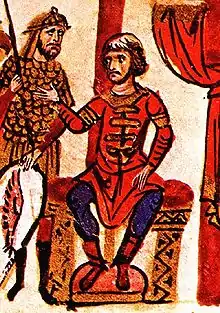 | Kanasubigi[26] Ruler of the many Bulgarians[27] | Omurtag | 814–831 | Known for his construction policy, administrative reform and the persecution of Christians.[28] |
| Khan | Malamir | 831–836 | Third and youngest son of Omurtag. Died of natural causes at an early age.[29] | |
| Khan | Presian I | 836–852 | Almost the whole of Macedonia was incorporated into Bulgaria.[30] | |
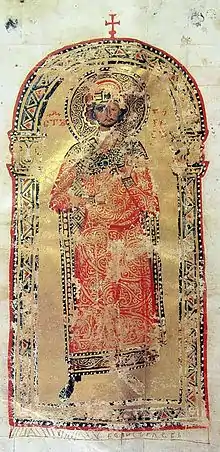 | Prince (Knyaz)[c] | Boris I Michael I[d] | 852–889 | Christianization of Bulgaria; adoption of Old Bulgarian as the official language of the State and the Church; recognition of an autocephalous Bulgarian Church.[31] Abdicated in 883, died on 2 May 902, aged around 80.[32] Proclaimed a Saint. |
| Prince | Vladimir | 889–893 | Eldest son of Boris I. Tried to restore Tengriism. Deposed and blinded by his father in 893.[33] | |
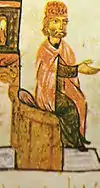 | Prince/Emperor (Tsar) Emperor of the Bulgarians and the Romans (claimed)[34] Emperor of the Bulgarians (recognized)[35] | Simeon I | 893–927 | Third son of Boris I, raised to become a cleric but enthroned during the Council of Preslav. Bulgaria reached its apogee and greatest territorial extent. Golden age of Bulgarian culture. Died of a heart attack on 27 May 927, aged 63.[36] |
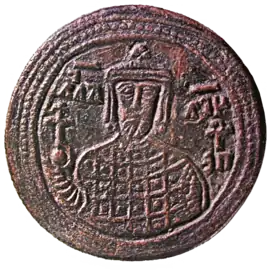 | Emperor Emperor of the Bulgarians[37] | Petar I | 927–969 | Second son of Simeon I. His 42-year rule was the longest in Bulgarian history. Abdicated in 969 and became a monk. Died on 30 January 970.[38] Proclaimed a Saint. |
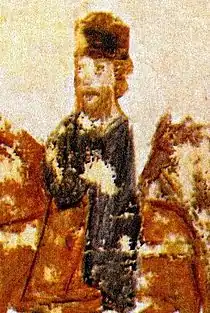 | Emperor | Boris II | 970–971 | Eldest son of Petar I. Dethroned by the Byzantines in 971. Accidentally killed by the Bulgarian border guards in 977 when he tried to return to the country.[39] |
 | Emperor | Roman | 977–991 (997) | Second son of Petar I. Castrated by the Byzantines but escaped to Bulgaria in 977. Captured in battle by the Byzantines in 991 and died in prison in Constantinople in 997.[40] |
| Cometopuli dynasty (997–1018) | ||||
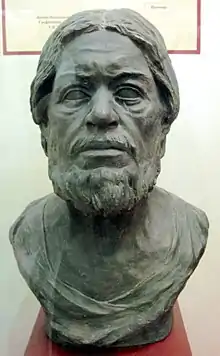 | Emperor Emperor of the Bulgarians[41] | Samuel | 997–1014 | Co-ruler and general under Roman between 976 and 997. Officially proclaimed Emperor of Bulgaria in 997. Died of a heart attack on 6 October 1014, aged 69–70.[42] |
 | Emperor | Gavril Radomir | 1014–1015 | Eldest son of Samuel, crowned on 15 October 1014. Murdered by his cousin Ivan Vladislav in August 1015.[43] |
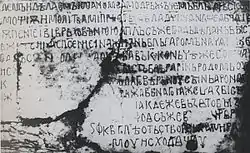 | Emperor | Ivan Vladislav | 1015–1018 | Son of Aron and nephew of Samuel. Killed in the siege of Drach.[44] His death brought the end of the First Bulgarian Empire, which was annexed by the Byzantine Empire. |
Proclaimed monarchs during Byzantine rule (1018–1185)
| Image | Title | Name | Reign | Notes/Death |
|---|---|---|---|---|
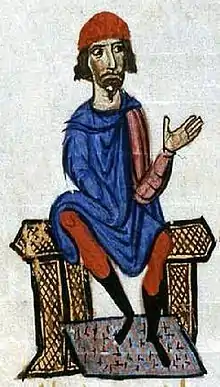 | Emperor | Peter Delyan | 1040–1041 | Claimed to have been descendant of Gavril Radomir. Led an unsuccessful uprising against Byzantine rule.[45] |
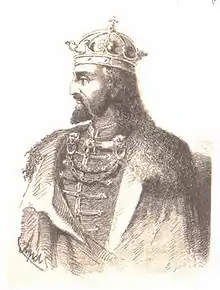 | Emperor | Constantine Bodin | 1072 | Named Constantine Bodin and descendant of Samuel, he was proclaimed Emperor of Bulgaria after the sainted emperor Petar I during the Uprising of Georgi Voiteh.[46] Between 1081 and 1101 he ruled as King of Duklja. |
Second Bulgarian Empire (1185–1396)
| Image | Title | Name | Reign | Notes/Death |
|---|---|---|---|---|
| Asen dynasty | ||||
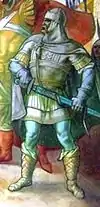 | Emperor | Petar II (also known as Peter IV) | 1185–1190 | Originally named Theodore, he was proclaimed Emperor of Bulgaria as Petar IV during the successful Uprising of Asen and Petar. In 1190 he gave the throne to his younger brother.[47] |
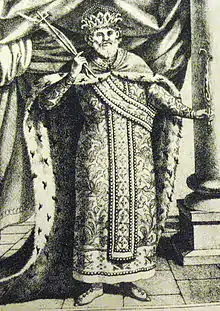 | Emperor | Ivan Asen I | 1190–1196 | Younger brother of Peter IV. A successful general, he ruled until 1196 when he was murdered by his cousin Ivanko.[48] |
| Emperor | Petar II (Peter IV) | 1196–1197 | After his brother's death, he returned to the Bulgarian throne. Murdered in 1197.[47] |
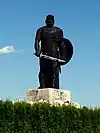 | Emperor[e] Emperor of Bulgarians and Vlachs, the Romanslayer | Kaloyan | 1197–1207 | Third brother of Asen and Petar. Expanded Bulgaria and concluded a Union with the Catholic Church. Murdered by plotters during the siege of Salonica.[49] |
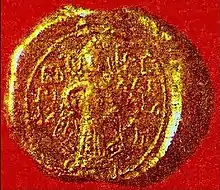 | Emperor | Boril | 1207–1218 | Son of a sister of Kaloyan. Deposed and blinded in 1218.[50] |
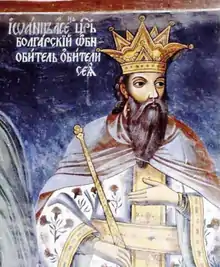 | Emperor Emperor of the Bulgarians and the Greeks[51] | Ivan Asen II | 1218–1241 | Eldest son of Ivan Asen I. The Second Bulgarian Empire reached its apogee. Died a natural death on 24 June 1241, aged 46–47.[52] |
| Emperor | Kaliman Asen I | 1241–1246 | Son of Ivan Asen II. Born in 1234, he died, possibly after being poisoned, in 1246, aged 12.[53] | |
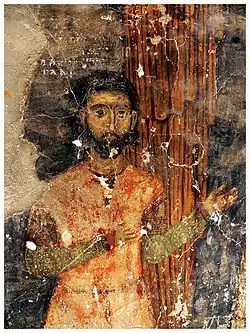 | Emperor | Michael II Asen | 1246–1256 | Son of Ivan Asen II. Murdered by his cousin Kaliman.[54] |
| Emperor | Kaliman Asen II | 1256 | Murdered in 1256.[55] | |
| Emperor | Mitso Asen | 1256–1257 | Son-in-law of Ivan Asen II. Fled to the Nicaean Empire in 1261.[56] | |
 | Emperor In Christ the Lord Faithful Emperor and Autocrat of the Bulgarians[57] | Constantine I | 1257–1277 | Bolyar of Skopie. Killed in battle in 1277 by the peasant leader Ivaylo.[58] |
| Emperor | Ivan Asen III | 1279–1280 | Eldest son of Mitso Asen. Fled to Constantinople with the treasury.[59] | |
| Non-dynastic | ||||
| Emperor | Ivaylo | 1277–1280 | Leader of a major peasant uprising. Fled to the Golden Horde but was murdered by the Mongol Khan Nogai.[45] | |
| Terter dynasty (1280–1292) | ||||
| Emperor | George Terter I | 1280–1292 | Bolyar of Cherven. Fled to the Byzantine Empire in 1292, died in Bulgaria in 1308–1309.[60] | |
| Smilets dynasty (1292–1299) | ||||
| Emperor | Smilets | 1292–1298 | Bolyar of Kopsis. Murdered or died of natural causes in 1298.[61] | |
| Non-dynastic (1299–1300) | ||||
| Emperor | Chaka | 1299–1300 | Son of the Mongol Nogai Khan. Deposed and strangled in prison in 1300.[62] | |
| Terter dynasty (1300–1322) | ||||
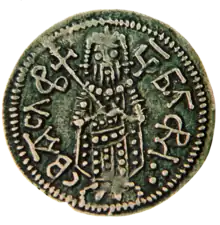 | Emperor | Theodore Svetoslav | 1300–1321 | Son of George Terter I. Spent his youth as a hostage in the Golden Horde. His rule marked a revival of Bulgaria. Died a natural death in late 1321, aged 50–55.[63] |
| Emperor | George Terter II | 1321–1322 | Son of Theodore Svetoslav. Died a natural death in late 1322.[64] | |
| Shishman dynasty (1323–1396) | ||||
 | Emperor | Michael III Shishman | 1323–1330 | Bolyar of Vidin. Mortally wounded in the battle of Velbazhd on 28 July 1330 against the Serbs.[65] |
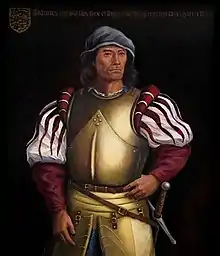 | Emperor | Ivan Stephen | 1330–1331 | Son of Michael III Shishman. Deposed in March 1331 and fled to Serbia.[66] Might have died in 1373. |
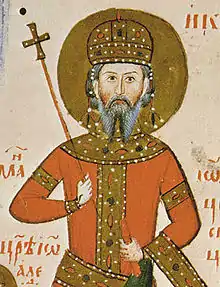 | Emperor In Christ the Lord Faithful Emperor and Autocrat of all Bulgarians[67] and Greeks[68] | Ivan Alexander | 1331–1371 | Bolyar of Lovech. Descended from the Asen, Terter and Shishman dynasties. Second Golden Age of Bulgarian culture. Following his death of natural causes on 17 February 1371, Bulgaria was divided among his sons.[65] |
 | Emperor In Christ the Lord Faithful Emperor and Autocrat of all Bulgarians and Greeks[69] | Ivan Shishman | 1371–1395 | Fourth son of Ivan Alexander. |
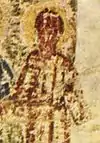 | Emperor Emperor of the Bulgarians[70] | Ivan Sratsimir | 1356–1396 | Third son of Ivan Alexander. Ruled in Vidin. |
| Emperor of Bulgaria | Constantine II | 1397–1422 | Son of Ivan Sratsimir (Ivan Sracimir) of Bulgaria by Anna, daughter of prince Nicolae Alexandru of Wallachia. He was crowned co-emperor by his father in or before 1395. | |
| conquest of Bulgaria by the Ottoman Empire. | ||||
Principality of Bulgaria and Kingdom of Bulgaria (1878–1946)
| Image | Title | Name | Reign | Notes/Death |
|---|---|---|---|---|
| House of Battenberg | ||||
 | Prince | Alexander I | 29 April 1879 – 7 September 1886 | Abdicated due to Russian pressure. Died on 23 October 1893 in Graz. |
| House of Saxe-Coburg and Gotha | ||||
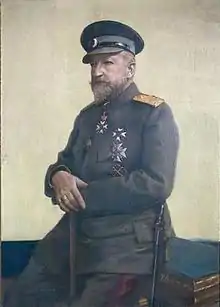 | Prince/King | Ferdinand I | 7 July 1887 – 3 October 1918 | Became King after the official proclamation of independence on 22 September 1908. Abdicated on 3 October 1918 after Bulgaria's defeat in World War I. Died on 10 September 1948 in Coburg. |
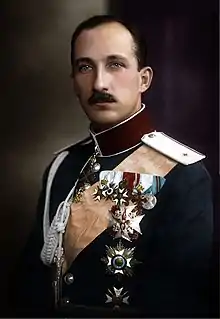 | King | Boris III | 3 October 1918 – 28 August 1943 | Died on 28 August 1943. |
 | King | Simeon II | 28 August 1943 – 15 September 1946 | Became King of Bulgaria at age 6, following the death of his father, Boris III. Monarchy abolished by the Communists. He served as the 48th Prime Minister of Bulgaria between 24 July 2001 and 17 August 2005. Still living as of 2021. |
See also
Notes
^ a: In the Nominalia of the Bulgarian khans the title of Asparukh is the Slavic Knyaz (Prince). The title Khan is not used in the manuscript.[71]
^ b: There are sources which suggest that Krum descended from those Bulgars who settled in Pannonia and lived under the rule the Avars. Some historians assume that Krum was from the Dulo dynasty and that with his ascension the old ruling dynasty was restored.[72][73] According to Zlatarski, Krum was the founder of a new dynasty.[74]
^ c: In the Ballshi Inscription, the title of Boris I is Archon of Bulgaria. The Byzantine title archon is usually translated with ruler. Contemporary Bulgarian sources used the title Knyaz, while during the Second Bulgarian Empire he was referred to as Tsar.[75]
^ d: When Boris I was baptised he received the Christian name Michael, after his godfather, the Byzantine emperor Michael III. He is often called by the historians Boris-Michael.[76] For this reason there is no explicit Michael I, while there are both Boris II and Michael II.
^ e: During the negotiations with Pope Innocent III, Kaloyan insisted that the Pope should recognize him as Imperator, the title equal to Tsar and based his claims on the imperial recognition of the monarchs of the First Bulgarian Empire. He was only crowned as Rex (King) but in his later correspondence with Innocent III, Kaloyan sent him his gratitude for his recognition as Imperator and used that title.[77]
Citations
- "1946: Third Bulgarian Kingdom ends with a referendum". BNR Radio Bulgaria. Retrieved 27 November 2015.
- Андреев, Й. Българските ханове и царе (VII-XIV в.). София, 1987
- Хан Тервел - тема за кандидат студенти Archived 1 May 2009 at the Wayback Machine
- Sweeney 1973, pp. 323–324.
- Madgearu 2016, p. 133.
- Kardaras 2018, p. 99-100.
- Vachkova 2008, p. 343.
- Andreev, p. 19
- Andreev, p. 23
- Whittow, p. 273
- Andreev, p. 27
- Andreev, p. 29
- Andreev, p. 30
- Andreev, p. 32
- Andreev, p. 33
- Andreev, p. 35
- Andreev, p. 36
- Andreev, p. 38
- Andreev, p. 39
- Andreev, p. 40
- Vasil Zlatarski. History of the First Bulgarian Empire, vol. I
- Andreev, p. 42
- Andreev, p. 44
- Vasil Zlatarski. History of the First Bulgarian Empire, vol. I
- Andreev, pp. 53–54
- "Tarnovo Inscription of Khan Omurtag" (in Russian). Archived from the original on 4 October 2011. Retrieved 14 March 2011.
- Andreev, p. 62
- Andreev, pp. 61–62
- Andreev, pp. 67–68
- Andreev, p. 70
- Whittow, p. 284
- Andreev, pp. 85–86
- Andreev, p. 89
- Stephenson, p. 23
- Stephenson, p. 22
- Andreev, pp. 103–104
- Whittow, p. 292
- Andreev, p. 112
- Andreev, p. 118
- Andreev, pp. 121–122
- Whittow, p. 297
- Andreev, p. 127
- Andreev, pp. 129–130
- Andreev, p. 133
- Andreev, p. 136
- Andreev, pp. 142–143
- Andreev, pp. 146–147
- Andreev, pp. 157–158
- Andreev, p. 173
- Andreev, p. 184
- Laskaris, p. 5
- Andreev, p. 193
- Andreev, p. 197
- Andreev, p. 205
- Andreev, p. 208
- Andreev, p. 211
- Ivanov, pp. 578–579
- Andreev, p. 229
- Andreev, p. 233
- Andreev, p. 239
- Andreev, p. 240
- Andreev, p. 244
- Andreev, p. 251
- Andreev, p. 254
- Andreev, p. 263
- Andreev, p. 267
- Ivanov, p. 584
- Ivanov, pp. 590–591
- Ivanov, pp. 602–608
- Miletich, L. "Daco-Romanians and their Slavic Literacy. Part II" (in Bulgarian). p. 47. Retrieved 14 March 2011.
- "Nominalia of the Bulgarian Khans" (in Bulgarian). Archived from the original on 11 June 2011. Retrieved 14 March 2011.
- Andreev, p. 45
- Runciman, p. 51
- Zlatarski, pp. 321–322
- Bakalov, pp. 144, 146
- Andreev, pp. 71, 75
- Andreev, pp. 163–165
Sources
- Andreev, Jordan; Milcho Lalkov (1996). The Bulgarian Khans and Tsars (in Bulgarian). Veliko Tarnovo: Abagar. ISBN 954-427-216-X.
- Bakalov, Georgi (1995). The Medieval Bulgarian Ruler (Title and Insignia) (in Bulgarian). Sofia.
- Ivanov, Yordan (1970). Bulgarian Antiquities from Macednia (in Bulgarian). Sofia: BAN.
- Laskaris, M. (1930). Bulgarian Antiquities (Book XI). The Vatopedi Charter of Emperor Ivan Asen II (in Bulgarian). Sofia: BAN, Darzhavna Pechatnitsa.
- Runciman, Steven (1930). A History of the First Bulgarian Empire. London: George Bell & Sons. OCLC 832687.
- Stephenson, Paul (2004). Byzantium's Balkan Frontier. A Political Study of the Northern Balkans (900–1204). Cambridge: Cambridge University Press. ISBN 0-511-03402-4.
- Whittow, Mark (1996). The Making of Byzantium (600–1025). Los Angeles: University of California Press. ISBN 0-520-20497-2.
- Zlatarski, Vasil (1971) [1927]. History of the Bulgarian state in the Middle Ages. Volume I. History of the First Bulgarian Empire (in Bulgarian) (2 ed.). Sofia: Nauka i izkustvo. OCLC 67080314.
External links
- (in English) Detailed list of Bulgarian rulers (PDF)