Proclus
Proclus Lycius[1] (/ˈprɒkləs laɪˈsiəs/; 410[2][3]/411[4][5][6]/ 7 Feb.[7][8] or 8 Feb. 412[9][10][11][12] –17 April 485 AD[2][3][4][9][10]), called Proclus the Successor,[13][5][9] Proclus the Platonic[14] Successor, or Proclus of Athens[8] (Greek: Προκλου Διαδοχου[15][16][17] Próklos Diádokhos,[5] "in some MSS he is styled διάδοχος Πλατωνικός"[9]) was a very influential Greek Neoplatonist philosopher and a prolific writer of ancient Greek philosophy leaving behind extensive commentaries on Plato, Aristotle, Porphyry and Plotinus, books and treaties on Neoplatonic theology, epigrams and hymns.[18] He set forth one of the most elaborate and fully developed systems of Neoplatonism.[19] Proclus stands at the end of ancient Greek philosophy and at the beginning of medieval philosophy and is historically significant because he is a major connection between those two Ages of philosophy.[20]
Proclus Lycius | |
|---|---|
 The beginning of Proclus' Fundamentals of Physics in the manuscript London, British Library, Harley 5685, fol. 133r (12th century) | |
| Born | 8 February 412 |
| Died | 17 April 485 (aged 73) |
| Other names | "The Successor" |
| Era | Ancient philosophy |
| Region | Western philosophy |
| School | Neoplatonism |
Main interests | Metaphysics |
Notable ideas | Platonic theology |
The title of Successor (Greek: διάδοχος) was given to the head of the School of Plato in Athens and signified that Proclus was the successor of his predecessor and also the latest successor of continuous Platonic scholarship going back to Plato, the founder of the School of Plato in Athens.[13]
Biography
Proclus was born in Constantinople (now Istanbul,[21] Turkey) to a wealthy Lycian family.[12] The name his family gave him was probably 'Proklos', a Greek form of the Latin ‘Proculus’, which reveals that he was born 'procul a patria', or 'far from home'.[22] There is confusion about the exact date of his birth, but the one given as February 8, 412 AD was educed from a horoscope cast by his biographer Marinus of Neapolis.[23]
Constantinople and Alexandria
Soon after his birth, his mother Marcella[8] and his father Patricus,[5] a considerably reputable lawyer in the Byzantium courts,[24] moved from Constantinople, where Patricus was working, back to their home district Lycia, most likely due to a strong identity the family had with the province.[25] Proclus received his early education in Xanthos,[12] (now Kinik,[26] Turkey) a city in Lycia.
In c. 425 AD,[12] when he was 15 or 16 years old,[27] his parents sent him from Lycia to Alexandria to study rhetoric, Roman law, mathematics and philosophy[28] with the intent of pursuing a judicial[21] position like his father.[24] In Alexandria his teachers were the sophist Leonas of Isauria[29] and the grammarian Orion of Thebes.[30] After a few years in Alexandria he accompanied his rector and principal instructor Leonas to Constantinople because he wanted to continue his guidance from him.[30]
In Constantinople there were professors and students who had studied philosophy in Athens,[31] in particular the Athenian Neoplatonists Empress Eusocial and her father Leontius.[29] Whilst in Constantinople, Proclus seems to have become dissatisfied with the study of law, and turned his attentions to the study of philosophy, and returned to Alexandria.
In Alexandria, he began determinedly studying the works of Aristotle under the guidance of Olympiodorus the Elder and, dropping rhetoric,[32] studying mathematics under the guidance of Heron[21] (not Heron the Alexandrian who lived two centuries earlier).[30] Proclus was a talented student with a remarkable memory[33] that helped him comprehend Aristotle's logical works quickly.[34] Like Plotinus, and other philosophers in the Roman Empire prior to him, Proclus' travelled extensively to try and find the right teacher and that might have led him to depart Alexandria.[35]
Athens
In c. 430 or 431 AD,[12] before he was 20 years old,[24] he sailed from Alexandria to Athens[31] where, in a parable recounted by Proclus' biographer Marinus of Neapolis, upon his arrival to Athens, and after being met at the Piraeus (a port city within Athens) and escorted into the city, he was met by the gatekeeper ready to close the city for the night, who said: “Truly, had you not come, I was about to lock the gate.”[36] The parable hints of a declining Platonic scholarship in Athens at the time.
Plutarch of Athens and Syrianus
In Athens he lived with Plutarch of Athens,[37][38][39] who had officially retired[31] and was in the last years of his life. Plutarch of Athens instructed Proclus on Aristotle’s De Anima[31] and Plato’s Phaedo.[31] After Plutarch of Athens' death,[31] Proclus was under the guidance of Syrianus,[37][38][2] the head of the School of Plato in Athens,[40] for two[41] years. A fellow-student studying alongside Proclus and also under the guidance of Syrianus was Domninus of Larissa.[31]
Proclus lived in Syrianus' house[38] and under his guidance studied the complete works of Aristotle[31] and works of Plato.[31] Whilst in Syrianus' house, Proclus was arranged to marry Aedesia,[40] a relative[42] of Syrianus, an arrangement that Proclus declined. Aedesia later married Hermias with whom she had two children Ammonius Hermiae and Heliodorus of Alexandria; both children eventually became students of Proclus.[43][42] It is likely that the house of the head of the School of Plato in Athens was bequeathed, so that the house of Plutarch of Athens became the house of Syrianus and then the house of Proclus and it was also a school where the head of the school held discussions and taught.[26] The school operated financially much like a private school with revenue from a substantial bequest that paid teachers and was supplemented by student payments.[44]
Head of the School of Plato in Athens
In c. 435 AD,[12] Proclus became the head of the School of Plato in Athens, where amongst his students were Ammoniums Hermias,[45] Heliodorus of Alexandria,[43] Agapiu of Athens,[46] Severianus of Damascus,[46]Asclepiodotus of Alexandria[47] and Marinus of Neapolis.[48] During his directorship of the school, the Proclean curriculum included Orphic Theogony, Homer, Hesiod, Chaldaean Oracles, Plato, Aristotle, Euclid and Plotinus.[49] Proclus, like Porphyry, had an extensive literary education and was deeply committed to language, style, and literary matters which might explain why allegorical reading is so strongly yoked to Neoplatonism.[35]
Marinus of Neapolis, a mathematician, student of Proclus and Proclus' eventual biographer[50] or hagiographer,[6] says he lived in Athens as a vegetarian bachelor, prosperous and generous to his friends and that Proclus had a great devotion to the goddess Athena, whom he believed guided him at key moments in his life.[51] Marinus reports he was a prominent member of Athenian society and at times took part in politics despite the inimical Christian atmosphere.[50] On occasion he also gave advice to magistrates, took part in public education and was under the protection of a distinguished member of Athenian society called Rufinus.[50] Marinus also reports he usually gave five lectures a day, held informal evening conversations, spent nights writing hymns and at his devotions and that in his prime, Proclus was writing, or dictating to a scribe, 700 lines a day.[50][52]
Sabbatical
During his entire time in Athens, he left only once,[12] and that was to Lydia for a year-long sabbatical designed to lessen the pressure put on him by his political, religious[53] and philosophical activity.[54] Little appreciated by the Christian rulers,[54] he spent the year traveling and being initiated into various Greco-Roman mysteries. He was also instructed in Neoplatonism as derived from Orphic theogony and the Chaldean Oracles. Later in his life he was to spent five years writing a commentary on the Chaldean Oracles.[55]
Succession
Proclus was head of the School of Plato in Athens for nearly fifty years until his death in 485 AD. Proclus died in Athens at about the age of 73 and was buried near Mount Lycabettus in the same tomb as Syrianus. [56] His inheritance was given to Athens and to his native city of Xanthos.[26] He was succeeded by Marinus of Neapolis,[57] and then by Isidore of Alexandria,[12] a young and much admired former student of Proclus.[18]
House of Proclus and Epitaph

The ruins of Proclus' house in Athens were first discovered in 1879, but it was not until 1955 that the excavator Giannis Meliades claimed the site to be ‘The House of Proclus', a claim also supported by the publications of Frantz 1975,[58] 1988, 1999[58] and Karivieri 1994.[59] The ruins are now covered, but the walls are clearly marked on Dionysiou Areopagitou Street where the street meets steps coming down from the south of the Acropolis, opposite the theater of Dionysus.[59] The following translated epitaph, composed by Proclus,[60] is engraved in Greek on the single tomb of both Proclus and Syrianus:
"I Proclus, here the debt of nature paid,
(My country Lycia) in the dust am laid;
Great Syrianus form’d my early youth,
And left me his successor in the truth.
One common tomb, our earthly part contains,
One place our kindred souls, —th’ aetherial plains."[61]
Influence
Proclus was greatly received in the centuries after his death.[62] He was a very influential 5th century Neoplatonic philosopher and left a vast philosophical legacy to Western philosophy, Christianity, Byzantine philosophy and Islamic philosophy and theology.[63][64] In the Middle Ages, for about 900 years from the 6th to the 15th centuries, Proclus's Neoplatonic doctrines, through the various Arabic and Latin translations of his Elements of Theology, treaties and commentaries on Plato's Timaeus and Parmenides, were very influential and disseminated and studied more than the Platonic doctrines of Plato and Plotinus.[65]
Middle Ages Greek Reception
Proclus' immediate reception In the 5th century was by way of Ammonius Hermiae's commentary on Aristotle's De Interpretatione or On Interpretation. That commentary included a lot of Proclus' doctrines taken from notes Ammonius Hermiae (a student of Proclus) made when he was reading the text with Proclus.[66]
6th century
There was a notably quick reaction to Proclus' work in the 6th century by a mostly favourable response from the Neoplatonist Damascius and a critical response by the 6th century Christian commentator John Philoponus.[63] As much of the structure of Damascius' philosophy was so close to Proclus',[67][69][70] it would be inconceivable without Proclus' influence; however he held fundamental differences[71] to Proclus on key doctrines[72] and developed his own innovative doctrines[73][74] of Neoplatonism.[75] Also, important doctrines of Proclus' Neoplatonism were transmitted thorough the 6th century Neoplatonists Simplicius of Cilicia (in a refutation of John Philoponus' criticisms of Proclus[75]), Olympiodorus the Younger (triad developed by Proclus from Philebus) and the 6th century Latin grammarian Priscian.[77] Also in the 6th century, Byzantine administrator and writer on antiquarian subjects John of Lydia in his work De Mensibus, quoted a lengthy passage from an important treatise of Proclus'.[78]
A very important 6th century and later centuries transmission of Proclus' "great cosmic system of divinity"[79] was through Pseudo-Dionysius the Areopagite.[79] Early in that century Pseudo-Dionysius the Areopagite was weaving Proclus' Neoplatonic theology into Christian theology,[63][80] and was probably the first Christian theologian to attempt merging Proclus' Neoplatonic doctrines of theology into Christian doctrines of theology.[81] Pseudo-Dionysius the Areopagite was an original Christian writer, and in his works can be found a great number of Proclus' important Neoplatonic doctrines.[82] Another important transmission of Proclus' Neoplatonic doctrines in the 6th century was Boethius' Consolation of Philosophy, which contains a number of Proclus' doctrines and motifs.[83][77] In that work of Boethius, the central poem of Book III is a summary of Proclus' Commentary on the Timaeus and in particular, Book III.9 and Book V Prosa 6 relate important aspects of Proclus' Neoplatonic doctrines.[83][77]
9th century
In the 9th century, through the works of Pseudo-Dionysius the Areopagite, important Proclean Neoplatonic doctrines can be seen in the translation of Hilduin who was the Bishop of Paris and chaplain to Louis I and one of the leading scholars and administrators of the Carolingian empire.[84] Again, through Pseudo-Dionysius the Areopagite, important Neoplatonic doctrines originally written by Proclus can be seen in the 9th century translations of the Irish Catholic Neoplatonist philosopher, theologian and poet John Scotus Eriugena[84] and in the Latin translations of the 12th century scholar John Sarrazin,[84] who is known only from his translation of the writings of Pseudo-Dionysius the Areopagite from Greek into Latin.
Middle Ages Islamic and Byzantine Reception
9th to 12th century Arabic translations of parts or all of Proclus' Elements of Theology are generally referred to by scholars working in that field as Discourse on the Pure Good,[64][85][86][87] but there is a 10th century translation of parts or all of Proclus' Elements of Theology referred to by scholars as The Book of Chapters on Divine Subjects.[88] Two of the three Arabic translations of parts or all of Proclus' Elements of Theology (Discourse on the Pure Good) name the author as Buruqlus (i.e. ‘Proclus’).[89]
8th and 9th century
In the 8th century, Proclus' Elements of Theology was known to the Arab Muslim historian Muhammed ibn Ishaq.[90] A 9th century transmission of an Arabic translation of Proclus' Elements of Theology (Discourse on the Pure Good) into 9th century Islamic theology is demonstrated by extant 9th century paragraphs of the text.[91] Also in the 9th century, some of Proclus' Elements of Theology (Discourse on the Pure Good) were translated from Greek to Arabic (possibly by Ibn al-Bitṛīq) by Arabic and Christian translators convened by the Islamic philosopher al-Kindī so as to be acceptable to Islamic philosophy and theology.[85][92]
10th century
In the 10th century, a second-generation student of al-Kindī named al-ʿĀmirī (d. c. 922) revised and incorporated Islamic doctrines of theology into another Arabic translation of part of Proclus' Elements of Theology (Discourse on the Pure Good) titled Kitāb al-Fuṣūl fī l-Maʿālim al-Ilāhīya (The Book of Chapters on Divine Subjects). Also in the 10th century, Proclus' works Commentary on Republic book 10, Commentary on Gorgias, Commentary on Phaedo and Commentary on Golden Verses are known to have been translated into Syriac.[93][94] Furthermore, in the 10th century, physician al-Razi wrote the work Concerning Doubt, in connexion with (or against) Proclus.[95][96]
11th and 12th century
11th century Byzantine philosophy received Proclus' Elements of Theology, treatises, and commentaries on the Timaeus and Chaldaean Oracles through extensive references made by Michael Psellos,[97] and his student John Italus.[98] In the 12th century, Byzantine philosophy received Proclus' doctrines by way of his treatises and specifically Elements of Theology, whose wide circulation in the 12th century is demonstrated by an extant Georgian translation and commentary by Ioane Petrisi.[91][63] The Georgian, or Ioane Petrisi's, translation of Elements of Theology was translated into Arabic and modified to be received into Islamic theology.[64]
Also in the 12th century, another Arabic translation of Ioane Petrisi's translation of Elements of Theology was written and titled Kalām fī maḥḍ al-ḫayr (Discourse on the Pure Good).[64] Kalām fī maḥḍ al-ḫayr was translated into the Latin Liber de Causis (Book of Causes) by Gerard of Cremona. Liber de Causis is frequently misattributed to Aristotle, but more than 30 propositions were found to be from Proclus' Elements of Theology in a commentary by St Thomas Aquinas.[64][86] And in the 12th century, Proclus' Elements of Theology was received into Byzantine philosophy and theology by way of the criticisms of Byzantine-Greek Christian theologian Nicholas of Methone.[85]
13th and 14th century
In the 13th century, a summary of an Arabic translation of part or all of Proclus' Elements of Theology was incorporated in a work on metaphysics by the Islamic philosopher ʿAbd al-Latị̄f al-Baghdādī.[87] Also in the 13th century, 1248, the 12th century Georgian, or Ioane Petrisi's translation of Elements of Theology was translated into Armenian by the monk Simeon of Garni.[95] Kalām fī maḥḍ al-ḫayr (which contained Proclus' Neoplatonic doctrines from his Elements of Theology, in Arabic) was also translated into an extant Armenian version by the monk Simeon of Garni[99] and also translated by anonymous translators into at least four Hebrew versions that are extant,[97] and three commentaries on one of those Hebrew versions.[89] In the 14th century, references to Proclus' commentary on the Chaldean Oracles were also in the writings of the Byzantine-Greek astronomer, historian and theologian Nicephorus Gregoras.[97][77]
Middle Ages Latin Reception
In the 13th century and later centuries, Proclus' Elements of Theology was transmitted into Christian Europe by Liber de Causis (Book of Causes, frequently misattributed to Aristotle) translated from Arabic to Latin by Gerard of Cremona[87] in the 12th century (between 1167 and 1187 AD[97]). The Gerard of Cremona translation was frequently copied (about 237 times[89]) and much of its content was found to be from Proclus' Elements of Theology in a commentary by St Thomas Aquinas, thus leading to and important transmission of Proclus' doctrines into the 13th century and later centuries.[64][87] Other scholars have shown that more than 30 propositions of Proclus' Neoplatonic doctrines contained in his Elements of Theology are in the Arabic version translated by Gerard of Cremona.[100] Proclus' doctrines in the Liber de Causis were also diffused in the 13th century by commentaries of St Albert the Great and Siger of Brabant.[101]
13th century
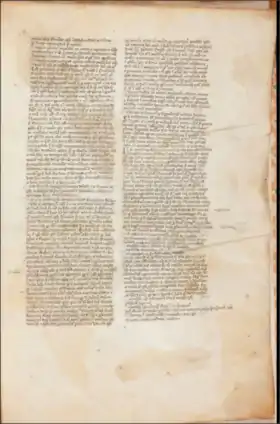
A very important dissemination of Proclus' Neoplatonic doctrines in the latter parts of the 13th century, and later centuries, was through Flemish Catholic bishop, Latin archbishop of Corinth, and translator William of Moerbeke, whose precise literal translations[102] from Greek manuscripts to Latin[103] of Proclus' Elements of Theology (Elemntatio theologica[104]) finished at Viterbo on June 15, 1268.[105] He also translated into Latin, Commentary on Plato's Parmenides[106][107] (1280s[108]), Commentary on Plato's Timaeus[108] (1280s[108]) and treaties[109] (February 1280[110][108]).[111] It was through William of Moerbeke's precise literal translation of Proclus' Elements of Theology that indirect and direct traditions of Proclus' Elements of Theology merged,[104] as William's translation was used by St Thomas Aquinas to make his observations about Proclus' doctrines in the Liber de Causis (Book of Causes).[112] Both William of Moerbeke and St Thomas Aquinas were working in Viterbo in 1268.[101]
Also in the 13th century, German theologians and philosophers Heinrich Bate (friend of William of Moerbeke[113]), Theodoric of Freiberg,[114][115][116] Meister Eckhart,[114] continued the dissemination of Proclus' Neoplatonic theology from the Latin translations of the Liber de Causis and Elements of Theology and commentaries on Plato's Parmenides by Proclus.[107]
14th century
In 14th century Germany there was an enthusiastic engagement and integration of Proclus' Elements of Theology[114][105] and treaties into German mysticism in Regensburg (1327–35) and then in Cologne (1335–61) led by Berthold of Moosburg.[107] The Italian poet, writer and philosopher Dante also integrated Proclus' Neoplatonic doctrines found in the Liber de Causis in several of his works, notably in the Convivio (III 6.11), when describing Beatrice's physical beauty as caused by her soul.[117]
15th century
During the 15th century, the Catholic cardinal Bessarion (student of Georgius Gemistus Pletho) had in his possession numerous manuscripts in Greek[118][119] brought back from his time in Greece, and after becoming a cardinal in 1439, Bessarion made annotations[120] and revisions to Greek manuscripts of Proclus' Elements of Theology and commentary on the Parmenides.[121] Also in 1439, the Roman Catholic cardinal Nicolas of Cusa had in his possession Greek manuscripts of Proclus' Elements of Theology[114] that he had brought back from Constantinople, and asked the Italian monk and theologian Ambrogio Traversari to translate them into Latin, a task completed by the Italian translator Pietro Balbi in 1462.[117] During the middle of the 15th century, in 1450 and 1455, Nicolas of Cusa also authorized two copies of Proclus' commentary on Plato's Parmenides[122] and used the one he heavily annotated while writing his treatises.[117]
During the late 15th century, the Italian Catholic priest and scholar Marsilio Ficino was reading a Latin translation of Proclus' works and displays a detailed understanding of Proclus' Neoplatonic doctrines in his own works, Platonic Theology and On the Immortality of the Souls, written from 1469 to 1471.[121] By the 1490s, Marsilio Ficino had the following Greek manuscripts of Proclus' Neoplatonic doctrines available to him: Commentary on Timaeus, Commentary on Republic, Commentary on First Alcibiades, a commentary by Nicholas of Methone on Proclus’ Elements of Theology, Proclus’ Platonic Theology, and Elements of Physics, the last of which contain his notes.[121] Marsilio Ficino also translated Proclus’ Hymns, Elements of Theology,[114] selections from Commentary on Republic[123] and Elements of Physics, the last is lost, however the other two were printed in Venice by Aldus Manutius in 1497.[121] Marsilio Ficino's selections on Proclus' Commentary on First Alcibiades and treatise On Sacrifice and Magic were all that were available of these Proclean texts until the original Greek manuscripts were rediscovered in the 20th century.[121] Late in the 15th century, Italian academic, mathematician, philologist and translator Giorgio Valla translated Proclus’ Commentary on First Book of Euclid’s Elements and Proclus' Outline of Astronomical Hypotheses and incorporated much of that text into his colossal encyclopedia Seek and Shun.[123]
Renaissance and Modern Reception
Early in the 16th century in northern Italy, Proclus' Commentary on Timaeus was translated by an anonymous translator.[123] Between 1520 and 1526, Proclus' Platonic Theology, Commentary on Republic, Commentary on First Alcibiades, Commentary on Parmenides were translated by the Italian Augustinian friar and Platonist Nicholas Scutelli.[123]
16th century
From 1531 to 1540 the German Protestant theologian and scholar Simon Grynaeus edited a Greek manuscript of Proclus' Elements of Physics, and printed the first editions of Proclus' Elements of Physics, Commentary on Republic, Commentary on Timaeus and Outline of Astronomical Hypotheses.[123] In 1541, Giorgio Valla's Latin translation of Proclus' Outline of Astronomical Hypotheses was published in Ptolemy’s Opera.[123] In 1560, the Italian mathematician, astronomer and humanist Francesco Barozzi published a Latin translation of Proclus' Commentary on First Book of Euclid's Elements.[124] In 1583, Proclus' Elements of Theology and Elements of Physics was published by the Italian Platonist philosopher and scientist Franciscus Patricius, from his Latin translations of the works.[123]
17th and 18th century
Early in the 17th century, in 1618, the first printed editions of Proclus' Platonic Theology and Elements of Theology were published, which were prepared earlier in the century by the Italian philologist and university professor Aemilius Portus.[123] After Portus' first printed editions of Proclus, there were no first editions of Proclus' works published until the early 19th century (some 200 years later.)[125] Also in the 17th century, a commentary of Elements of Theology was written by the Armenian bishop Simeon of Djulfa.[95]
In Proclus' Elements of Theology propositions 28 and 29, Proclus introduces a metaphysical law of Continuity that seems very probable to scholars, to historically descend into the doctrine on Continuity of Leibniz in his early 18th century essay la nature ne fait jamais des sauts.[126][127] Also, it was thought by at least one leading Neoplatonic scholar of the early 20th century that Neoplatonism contains a representation of Leibnizian monadism.[128]
19th century
In the early 19th century, in 1820 the first published version of Proclus' Commentary on Cratylus was published by the French classical scholar Jean François Boissonade de Fontarabie.[125] Also in 1820, Proclus' Commentary on First Alcibiades was published by German philologist and archaeologist Georg Friedrich Creuzer and the French philosopher Victor Cousin published Procli philosophi platonici Opera (which he revised and re-edited in 1864) that contained three treaties of Proclus, Commentary on First Alcibiades and Commentary on Parmenides (which he dedicated to F. J. W. Schelling and G. W. F. Hegel.)[125]

In the late 18th century and early 19th century, from 1792 to 1833, the English translator and Neoplatonist Thomas Taylor[123] (the first to translate into English the complete works of Aristotle and of Plato[129]) published the following works in English on and by Proclus: Marinus’s Life of Proclus, or Concerning Felicity in 1792, The Philosophical and Mathematical Commentaries of Proclus on the First Book of Euclid's Elements in 1792 in 2 volumes, Commentary on The First Alcibiades from The Works of Plato (with Sydenham) in 1804, Introduction to Proclus, On the Theology of Plato in 1816, Theology of Plato in 1816, The Six Books of Proclus on the Theology of Plato in 1816 in 2 volumes, The Elements of Theology in 1816, Proclus' Commentary on the Timaeus of Plato in 2 volumes and 2 editions, 1810 and 1820, The Fragments that remain of the Lost Writings of Proclus in 1825 and Two Treatises of Proclus (Ten Doubts Concerning Providence and On the Subsistence of Evil) in 1833. He also published four articles on Proclus in the Classical Journal in 1821, 1822, 1824 and 1825, which were a response to Jean François Boissonade de Fontarabie's first published Greek text edition of Proclus' Commentary on Cratylus and Victor Cousin's Greek text editions of Proclus' commentary on First Alcibiades and Parmenides (three articles).[130][131][132]
Taylor's work inspired the New England Transcendentalists, including Ralph Waldo Emerson, who declared in 1847 that:
"When I read Proclus, I am astonished at the vigor and breadth of his performance. Here is no...modern muse with short breath and short flight, but Atlantic strength, every where equal to itself, and dares great attempts because of the life with which it is filled."[133] —Ralph Waldo Emerson
20th and 21st century
In the early 20th century, works by the German church historian and Jesuit J. Stiglmayr and German Catholic theologian and church historian H. Koch reveled the extent that Pseudo-Dionysius the Areopagite slavishly followed Proclus' doctrines and how he reproduced the whole structure of late Athenian Neoplatonism with a thinly veiled disguise of Christianity.[134] In the late 20th century, Smyth's 1997 book Reading Peirce Reading explores the Neoplatonic link from Ralph Waldo Emerson to Charles Sanders Peirce.[135]
Between 1900 to 2021 there have been more than 30 modern versions published of Proclus' works in Greek text and two editions of Moerbeke's Latin translation.[136] And there have been over 100 translations of Proclus' works that are considered by scholars as a standard or an important work for Proclean studies.[136] Those translations include 32 in English (including 8 reprints of Thomas Taylor's translations) 23 in Italian, 20 in French, 18 in German, six in Spanish, two in Hungarian, one in Russian and one in Polish.[136] A nearly complete list of Proclus' works in Greek text and translations published after 1900 may be found at De Wulf-Mansion Centre for Ancient, Medieval, and Renaissance Philosophy.
A chronological listing of modern editions of Proclus' works in Greek text and first edition translations, that are in the bibliographies of All From One, edited by d’Hoine & Martijn 2017 and Proclus On Plato's Cratylus, translated by Duvick 2014, are given below. Where there is more than one volume published for a work, the year is taken from the last published volume.
| Year Finished | Language, Editor and/or Translator | Title | Work by Proclus |
| 1873 | Greek text edited by G. Friedlein[139] | Procli Diadochi In Primum Euclides Elementorum Librum Commentaria | Commentary on First Book of Euclid's Elements |
| 1901 | Greek text edited by W. Kroll[139] | Procli Diadochi In Platonis Rem Publicam Commentaria, 2 volumes | Commentary on Plato's Republic |
| 1906 | Greek text edited by E. Diehl[139] | Procli Diadochi In Platonis Timaeum Commentaria, 3 volumes | Commentary on Plato's Timaeus |
| 1908 | Greek text edited by G. Pasquali[139] | Procli Diadochi In Platonis Cratylum Commentaria | Commentary on Plato's Cratylus |
| 1909 | Greek text edited by C. Manutius[140] | Procli Hypotyposis astronomicarum positionum | Outline of Astronomical Hypotheses |
| 1933 | Greek text and English translation by E. R. Dodds[141] | Proclus. Elements of Theology | Elements of Theology |
| 1965 | English translation by W. O’Neill[142][143] | Proclus: Alcibiades I | Commentary on Plato's First Alcibiades |
| 1968 | French translation by A. J. Festugière[142] | Proclus. Commentaire sur le Timée, 5 volumes | Commentary on Plato's Timaeus |
| 1970 | English translation by G. R. Morrow[144] | Proclus: Commentary on the First Book of Euclid’s Elements | Commentary on the First Book of Euclid's Elements |
| 1986 | French translation by A.-P. Segonds[145] | Proclus: Sur le Premier Alcibiade de Platon | Commentary on Plato's First Alcibiades |
| 1987 | English translation by G. R. Morrow and J. M. Dillon[144] | Commentary on Plato’s Parmenides | Commentary on Plato's Parmenides |
| 1997 | Greek text and French translation by H.D. Saffrey and L.G. Westerink[139] | Théologie Platonicienne, 6 volumes | Platonic Theology |
| 2001 | English translation by H. S Lang and A. D.Macro[146] | On the Eternity of the World. De Aeternitate Mundi | On the Eternity of the World (from Arabic) |
| 2003 | English translation by J. Opsomer & C. Steel[147] | On the Existence of Evils | On the Existence of Evil |
| 2007 | English translation by C. Steel[148] | Proclus: On Providence | On Providence and Fate |
| 2007 | English translation by B. Duvick, Edited by H. Tarrant[141] | Proclus On Plato's Cratylus | Commentary on Plato's Cratylus |
| 2009 | Modern Greek translation by Oi Ymno iand P. Kalligas[149] | Proklou, H Ieratikê Technê | Hymns |
| 2012 | English translation by R. Lamberton[150] | Essays 5 and 6 of his Commentary on the Republic of Plato | Commentary on Plato's Republic |
| 2013 | English translation by H. Tarrant, D. T. Runia, M. Share and D. Baltzly [151][152] | Commentary on Plato’s Timaeus, in 3 volumes | Commentary on Plato's Timaeus |
List of Influence
A listing of Proclus' influence on Middle Ages, Renaissance and Modern philosophies and theologies is given below. The century ascribed to people in the list is based on the year they flourished, traditionally that is when they were 40 years old.
| Early Middle Ages Greek and Latin Western philosophy and Christianity | ||
| 5th century | Ammonius Hermiae[153] | Greek Neoplatonist philosopher and Proclus' student |
| 6th century | Damascius[63] | Greek Neoplatonist philosopher |
| 6th century | Priscian[77] | Roman Latin grammarian |
| 6th century | John Philoponus[63] | Byzantine-Greek Christian commentator |
| 6th century | Simplicius of Cilicia[75] | Greek Neoplatonist philosopher |
| 6th century | Olympiodorus the Younger[77] | Greek Neoplatonist philosopher |
| 6th century | John of Lydia[78] | Byzantine-Greek administrator and writer on antiquarian subjects |
| 6th century | Boethius[66] | Roman philosopher, senator and consul |
| 6th century | Pseudo-Dionysius the Areopagite[122][63] | Greek Christian theologian and Neoplatonic philosopher |
| 9th century | Hilduin[84] | Bishop of Paris
|
| 9th century | John Scotus Eriugena[84] | Irish Catholic Neoplatonist philosopher, theologian and poet |
| 12th century | John Sarrazin[84] | Translation of the writings of Pseudo-Dionysius from Greek into Latin. |
| Middle Ages Islamic philosophy and theology and Byzantine philosophy | ||
| 9th century | al-Kindī[85][92] | Islamic philosopher.
|
| 10th century | al-ʿĀmirī[87] | Islamic philosopher. Second-generation student of al-Kindī:
|
| 10th century | anonymous Syriac translators[93][94] | Syriac translations of Commentary on
|
| 10th century | al-Razis[95][96] | Persian physician, philosopher and alchemist |
| 11th century | Michael Psellos[98] | Byzantine-Greek philosopher |
| 11th century | John Italus[98] | Byzantine-Greek philosopher |
| 12th century | Isaac Sebastocrator[154] | Byzantine-Greek scholar and patron of learning and the arts |
| 12th century | Nicholas of Methone[98] | Byzantine-Greek Christian theologian, philosopher and commentator |
| 12th century | Ioane Petrisi[91] | Georgian Neoplatonist philosopher
Extant Georgian translation of Proclus' Elements of Theology |
| 12th century | anonymous Arabic translators[64] | Arabic translations of Ioane Petrisi's translation of:
|
| 13th century | ʿAbd al-Latị̄f al-Baghdādī[87] | Islamic philosopher. Arabic summary of Elements of Theology |
| 13th century | Simeon of Garni.[95] | Armenian monk |
| 14th century | Nicephorus Gregoras[97][77] | Byzantine-Greek astronomer, historian and theologian |
| Middle Ages Greek and Latin Western philosophy and Christianity | ||
| 12th century | Gerard of Cremona[85][97] | Italian Catholic translator |
| 13th century | St Albert the Great[101] | German Catholic Dominican friar, philosopher, scientist and bishop |
| 13th century | William of Moerbeke[122][101] | Flemish Catholic bishop and translator |
| 13th century | St Thomas Aquinas[122] | Italian Christian theologian, philosopher and jurist |
| 13th century | Siger of Brabant[101] | French Averroist philosopher |
| 13th century | Heinrich Bate[107] | Flemish Christian philosopher, theologian, pupil of St Thomas Aquinas |
| 13th century | Theodoric of Freiberg [107] | German Christian Dominican friar, theologian and physicist |
| 14th century | Meister Eckhart[2] | German Christian theologian |
| 14th century | Dante Alighieri[117] | Italian poet, writer and philosopher |
| 14th century | Berthold of Moosburg[107] | German Christian Dominican theologian and Neoplatonist |
| 15th century | Nicolas of Cusa[122][2] | German Catholic cardinal and theologian |
| 15th century | Ambrogio Traversari[117] | Italian monk and theologian |
| 15th century | Pietro Balbi[117] | Italian translator |
| 15th century | Bessarion[121] | Byzantine-Greek Catholic cardinal and theologian |
| 15th century | Marsilio Ficino[64][122] | Italian Catholic priest and scholar |
| 15th century | Giovanni Pico della Mirandola[122] | Italian Christian philosopher |
| 15th century | Giorgio Valla[123] | Italian academic, mathematician, philologist and translator |
| Renaissance and Modern Western philosophy and Christianity | ||
| 16th century | Anonymous Italian translator[123] | Translation of Commentary on the Timaeus |
| 16th century | Nicholas Scutelli[123] | Italian Augustinian friar and Platonist |
| 16th century | Simon Grynaeus[123] | German Protestant theologian and scholar |
| 16th century | Publication[123] | Outline of Astronomical Hypotheses in Ptolemy’s Opera 1541 |
| 16th century | Francesco Barozzi[124] | Italian mathematician, astronomer and humanist |
| 16th century | Franciscus Patricius[123] | Italian Platonist philosopher and scientist |
| 16th century | Aemilius Portus[123] | Italian philologist and university professor |
| 17th century | Simeon of Djulfa[95] | Armenian bishop |
| 17th century | Jacob Boehme[2] | German philosopher |
| 17th century | Gottfried Wilhelm Leibniz[127][126] | German polymath, mathematician, philosopher, scientist, and diplomat |
| 18th century | Thomas Taylor[64][123] | English Neoplatonist and translator |
| 19th century | Georg Friedrich Creuzer [125] | German philologist and archaeologist |
| 19th century | Jean François Boissonade de Fontarabie[125] | French classical scholar |
| 19th century | Victor Cousin[125] | French philosopher |
| 19th century | Hegel[12][2] | German Christian philosopher |
| 19th century | Schelling[2][155] | German philosopher |
| 19th century | Ralph Waldo Emerson[156] | American essayist, lecturer, philosopher, abolitionist and poet |
| 19th century | Charles Sanders Peirce[157] | American philosopher, logician, mathematician and scientist |
| 20th century | 20th century scholars[158][159] | Scholars and translators |
| 20th century | International Astronomical Union | Named the crater Proclus on the Moon after him. |
| 21st century | 21st century scholars[158][159] | Scholars and translators |
Late Athenian Neoplatonic Theology
Late Athenian Neoplatonic theology is formalized and systematized in Proclus' Elements of Theology and elaborated in his works Platonic Theology and Commentary on Timaeus.[160] Proclus was a great systematizer of late Athenian Neoplatonic theology; however, little of what he wrote was original.[161] He formalized, systematized, elucidated and elaborated on the main sources of Neoplatonic theology that were already in the writings or teachings of Orpheus, Homer,[162] Hesiod,[163] Pythagoras,[164] Socrates,[162] Plato, Plotinus, Porphyry, the Chaldaean Oracles, Iamblichus and Syrianus.[165][166]
Following Iamblichus, Plutarch of Athens, and Syrianus, Proclus intricately elaborated the early Neoplatonic theology of Plotinus.[167][168][169] Whilst Proclus' elaborated doctrines of Neoplatonic theology sometimes agree with Plotinus,[170][171][172][173][174] there is a very important difference in their respective doctrines on Evil.[175] Plotinus' Neoplatonic doctrine on Evil, Enneads 1.8 and 3, briefly says that matter was the cause of evil.[176] Proclus' doctrine on Evil, elaborated in his treatise On the Existence of Evil, briefly says that souls are corrupted before they manifest themselves in matter and therefore matter is not the cause of evil.[176] In Proclus' Neoplatonic doctrine on Evil, there is no single principle that causes evil, as that would lead to a dualism of independent first principles,[176] Good and Evil, and that would contradict Neoplatonic theological doctrines that assert the belief that the One,[177][178][179] or the One and the Good[180][181][182] is the First Principle[183] and the First Cause,[184] or single cause,[185][186] or leading cause,[187] of All that exists,[188][189] or cause of all things[190][191] (i.e. every thing immaterial and material[192]).[193]
Propositions
Proclus' doctrines of Neoplatonic theology are based on 211 propositions, and proofs of those propositions, in his systematic work Elements of Theology that formalized, systematized and elaborated the early and loosely systematized Neoplatonic theology of Plotinus, Porphyry and Sallustius, into a later Athenian Neoplatonic theology.[194]
The structure of the propositions in Elements of Theology has two major subdivisions, the first, propositions 1-112, introduce typical Neoplatonic metaphysical antitheses consecutively.[195] Some important examples of typical Neoplatonic metaphysical antitheses are, multiplicity and unity, cause and effect, progression and return, and potentiality and actuality.[195] The second subdivision, propositions 113-211, uses the results of propositions 1-112 to construct theories about the essential late Neoplatonic theological realm of henads and the essential theological levels, nous and souls.[195]
The propositions of late Athenian Neoplatonic theology result in a more complex and more dynamic theology than that of early Neoplatonic theology, with the complexity due to a much greater formalization and systematization of Neoplatonic theological levels, and hierarchies of entities within those levels.[194][196] The propositions also give a more essential dynamic character to the theology resulting from a formalization and systematization of eternal existence and eternal activity, or simply eternity.[197]
Proclus' understanding of eternal existence dated back to Plato's Timaeus 33e ff. and ultimately to the early fifth century BC philosopher Parmenides On Nature v. 66.[198] His understanding of eternal activity was derived from Aristotle's Nicomachean Ethics 1154 b27 and Plotinus' Enneads 3.7.4 in which eternal existence and eternal activity were combined by Plotinus into an understanding of eternity. [83] The early Neoplatonic understanding of eternity was passed into Christian theology through St Augustine's Confessions XI. 11 and On the Trinity XII. 14, while Boethius in The Consolation of Philosophy V. Prosa 6 and St Thomas Aquinas in Summa Theologica Pars I, quo x, art. 5, passed on Proclus' late Athenian Neoplatonic understanding of eternity.[83]
Capitalization
When referring to principles and theological levels in their transcendent aspect and names of doctrines, capital initials are used. When referring to individual principles, lower-case initials are used.
One and Many
Proclus begins his Elements of Theology with the systematical exploration of the antithesis of the One and the Many, an opposition that had confounded Greek philosophy for 1000 years, as it was a search for the First Principle of the universe.[199] In his Commentary on Parmenides, Proclus finds four solutions for the First Principle, (a) pure multiplicity, or the Many (b) explicit multiplicity with implied unity, (c) explicit unity with implied multiplicity, and (d) pure unity, or the One.[200] Solutions (b) and (c) are known as partial unities.[200] The last of these solutions, (d) pure unity, or the One, was the traditional Neoplatonic belief that had its roots in the first hypothesis of Plato's Timaeus 137c ff.[201]
Elements of Theology propositions 1-6 try to prove the existence of solution (d) pure unity, or the One, by finding contradictions, to the other three solutions (a), (b) and (c).[201] The arguments used in the proofs of Proclus' propositions are supported by his authorities in Plato's dialogues Parmenides and Sophist, Plotinus' Enneads, Aristotle's Metaphysics, and Syrianus' Commentary on Aristotle's Metaphysics.[202]
The One and Partial Unities
In Elements of Theology, of the four solutions for the First Principle of the universe Proclus found in his Commentary on Parmenides, the only solution Proclus found a contradiction to, or found not to exist, was (a) pure multiplicity, or the Many.[200] The other three solutions (b) explicit multiplicity with implied unity, (c) explicit unity with implied multiplicity, and (d) pure unity, or the One.[200] were supported by arguments from his authorities.[201] In the proofs of propositions 2-4, he was able to establish the existence of (d) pure unity, or the One, and distinguish it from both the partial unities (b) and (c) and show (d) pure unity, or the One, is necessary for both the partial unities (b) and (c) to exist.[200]
Also, in Elements of Theology, in the proof of proposition 5, the two types of partial unity (b) and (c) were determined not to be the source of the One and so, because the One was necessary for (b) and (c) to exist, and since there was nothing else, they had to progress from the One.[203] Further, in the proof to proposition 6, both types of partial unities (b) and (c) were found to be composed of the same indivisible units, or henads.[201] Hence, the One, and the two types of partial unities, (b) and (c), that progressed from the One, formed a hierarchy that Proclus used as a basis of his next set of propositions, the doctrine on Hierarchy of Causes.[201] [Solution (c) was elaborated in later propositions to become the theological level Nous, while (b) became the theological level of Souls.]
Causes
In Proclus' Elements of Theology, propositions 7-13 begin to formalize and systematize causes and culminate in linking the First Cause to the One, the Final Cause to the Good,[204] and finally identifying the One to be identical to the Good. Proposition 7 is fundamental to the entire structure of Neoplatonic theology and asserts: a cause is superior to its effect.[205] Proposition 7 has its roots in Plato's Philebus 27b, is stated clearly in Cicero's De Natura Deorum II. 33. 86, and is fundamental to the early Neoplatonism of Plotinus, Enneads 5.4.1, Porphyry, Sententiae xiii, and Iamblichus, On the Mysteries III. 20.[205] Proclus is the only ancient philosopher to prove the assertion: a cause is superior to its effect, using arguments from his authorities in the proof, one of those authorities being Aristotle's Nicomachean Ethics, 1094a 1.[205]
A Transcendent Final Cause
Proclus' Elements of Theology proposition 8 argues for the existence of a transcendent final cause of the universe, or a transcendent Good, like propositions 4-5 argued for the existence of a transcendent One.[205] In proposition 8, in the proof of the existence of a transcendent Good, Proclus uses the Neoplatonic theological belief that the Good is the good that all things desire, a belief that has its roots in Plato's Republic 509b, Philebus 20d, Aristotle's Nicomachean Ethics 1094a 1 and Plotinus' Enneads 5.5.13.[206]
Self-Sufficient
In Elements of Theology, propositions 9 and 10 claim self-sufficient is a mean term, or intermediary term, between the Good and the good things of sense experience.[207] Hence, the term self-sufficient forms a bridge between immaterial levels of reality and the material level of reality.[207] Proposition 9 asserts that things that are self-sufficient, or derive their well-being from themselves, are more similar to the Good than things that are not self-sufficient,[208] and hence are more like the Good and superior to those that are not self-sufficient.[209] Proposition 10 asserts: everything that is self-sufficient is inferior to the Good.[209] Proclus' arguments for the fine difference between self-sufficiency and the Good in a monistic system are seen in his Commentary on Timaeus book 2 90.8 ff. that has its roots in Plato's Timaeus 33d.[207]
A Transcendent First Cause
In Proclus' Elements of Theology, proposition 11 claims all things proceed from a single first efficient cause of the universe,[210] thereby assigning a transcendence to the first efficient cause of the universe.[211] The arguments in the proof of Proposition 11 reject any views that deny efficient causality, reject doctrines of Bi-causality, reject assumptions of an infinite chain of unilateral causation, and reject Empedoclean pluralism.[211] In proposition 12, Proclus identifies the first efficient cause of the universe with the final cause of the universe, an argument that has its roots in Plato's Republic 509b.[212] Proposition 12 argues that in the chain of causes, there is nothing higher than the final cause of the universe and there is nothing higher than the first cause of the universe, where higher means both morally better and more unified.[213]
The Good is Identical to the One
In Elements of Theology, the propositions 7-13 culminate in proposition 13 in which Proclus links the first cause of the universe to the One, identified by propositions 1-6,[213] and then links the One to the final cause of the universe, the Good, and hence deduces the Good is identical to the One.[185][213] Scholastic opinion is that Proclus' authorities for his proofs of propositions 7-13 include, Plato's Timaeus, Republic, Phaedo, Philebus and Meno, Aristotle's Physics, Metaphysics, Nicomachean Ethics and Eudemian Ethics, Aristoxenus' Elementa harmonica, Plotinus' Enneads, the Pythagorean philosopher Euryphamus, Philo and Plutarch.[214]
Participation
Essential to late Athenian Neoplatonic theology is a distinction between participated (Greek: μεθεκτός) and unparticipated (Greek: άμέθεκτος) entities and an hierarchy of theological levels, or levels of realities, or hypostases.[215][216] The distinction between participated and unparticipated entities preserves the transcendence of higher, or more essential entities while simultaneously allowing for the process of creation.[217]
The One, Nous and Souls
Proclus' Elements of Theology propositions 14-24 formalize and systematize participated and unparticipated entities and hypostases.[218] Briefly, propositions 14-20 systematically build a hierarchy of hypostases culminating with proposition 20 that concludes there are three (immaterial) hypostases: the One, Nous and Souls, where the One is the highest or most essential hypostasis, Nous less essential than the One and Souls less essential than Nous and one material level of reality called Body, that is less essential than Souls.[219] Proposition 21 and 22 systematically explain that the structure of each hypostasis consists entirely of members of a series that are generated by a monad.[220] Tracing the series from the monad to its members, is moving from cause to effect, tracing the series from its members to the monad, is moving from effect to cause.[220]
Monads and Henads
In late Athenian Neoplatonic theology, the highest, or most essential entity of each hypostasis is the unparticipated entity called a monad.[215] The monad is a whole without parts, as opposed to a other entities in a hypostasis, which are wholes made up of parts.[215] Elements of Theology propositions 23 and 24 assert: monads produce, from themselves, participated entities, called henads. A henad is a participated entity in a hypostasis, as it is participated by other henads in the same hypostasis.[217] In late Athenian Neoplatonic theology, the entire multiplicity of henads in a lower hypostasis are participated by all the henads in the hypostasis immediately higher, or more essential.[215] So, for example, in Neoplatonic theology, the hypostasis of Nous is immediately higher than the hypostasis of Souls, and so the entire multiplicity of henads in the hypostasis of Souls is participated by all the henads in the hypostasis of Nous.[215]
Multiplicity from Unity
A fundamental principle in Proclus' doctrines is stated in Elements of Theology proposition 11, which asserts: all that exists proceeds from a single first cause.[196][221] The first cause can be seen like a root of a tree from which progresses the trunk and branches, the trunk being near the root while the branches are distant.[196][212] From Plotinus onwards, it was essential to explain how a multiplicity of things could proceed from a totally transcendent and Simple One.[196]
Law of Emanation and Law of Undiminished Giving
Plotinus' doctrines to explain multiplicity from unity are discussed in Enneads 2.9.3, 3.8.10 and 5.3.12, where he explains the universe is produced from the One like a limitless fountain that is undiminished by its giving and in which there are no gaps.[196] That limitless undiminished fountain is known as Plotinus' law of Emanation, Enneads 5.1.6.[222] and law of Undiminished Giving, Enneads 5.4.2.[223]
The early Neoplatonic law allegorically represented by no gaps in Plotinus' limitless undiminished fountain, is more precisely stated in Enneads 6.9.8 which asserts: spiritual beings are not separated by a spatial interval, but by a qualtitative interval.[127] However, Plotinus did not only leave a qualitative gap, but a qualitative gulf, between the One and the first level of reality, i.e. the first hypostasis; as is significantly evident in Enneads 6.5.9 where he cannot explain how to get multiplicity from the One, without first putting multiplicity into it, thereby negating the One. [224]
Law of Continuity
Plotinus' law of Emanation was formalized by Proclus in Elements of Theology proposition 25, and Plotinus' law of Undiminished Giving was formalized in propositions 26 and 27.[222] To attempt to fill the qualitative gulf between the One and the first hypostasis, left by Plotinus' law of Emanation and law of Undiminished Giving, the laws were elaborated by Proclus by the addition of a third law, the law of Continuity, formalized in Elements of Theology propositions 28 and 29.[127] Continuity, in late Athenian Neoplatonic theology, means there is only the minimum qualitative difference between the distinctness of an entity and its immediate subsequent entity in a progression of entities.[127]
"Eternity bringeth to birth nothing but that which is like itself"—Jakob Boehme [127]
The late Athenian Neoplatonic theological law of Continuity was systematized by moments, or henads[224] within theological levels, i.e. within hypostases.[225] The henads are systematized by Proclus in his Elements of Theology propositions 112-165, and elaborated in Platonic Theology book 3 chapters 1-6 and his treatise On Providence and Fate section 4.20 (section 7.28 in Sebastocrator's manuscript).[226][227] Briefly, in those systematical and elaborate explanations, he asserts: progressions of principles are everywhere where there are mean, or intermediary henads, between extremities of hypostases, and extremities of henads themselves, that provide a linkage leaving no vacuum.[227]
Causes and Effects
In Proclus' Elements of Theology proposition 28 there is a fundamental law that asserts: first, a producing cause brings things into existence that are similar to its cause, and afterwards, things are brought into existence that are dissimilar to their cause.[228][227] That proposition led to the fundamental subject of relations between causes and effects that is systematically explained in Elements of Theology propositions 25-29, 56, 57 and 75.[227][222] Propositions 25-29 assert: the late Athenian Neoplatonic theological laws of Emanation, Undiminished Giving and Continuity.[222]
Efficacy of Causes
Proclus' Elements of Theology propositions 56 and 57 assert: things produced by lower beings are produced in greater measure by higher, or more essential beings.[227] Propositions 56 and 57 means the production of things by higher, or more essential beings, is not limited to their immediate productions, it extends down through the production of their immediate productions, and further, to entities not caused by the more essential being's immediate production.[227] Specifically, with respect to causes, propositions 56 and 57 mean that the ultimate cause of something is responsible for the entire series of causes that branch out from it.[116]
Proclus' Elements of Theology propositions 56 and 57 mean, for example, that the level of Matter, placed on a low theological level by Neoplatonic theological doctrines, is totally dependent for its subsistence on the highest, or the most essential theological level, called the One.[227] And in another example, Nous, which is placed by Neoplatonic theological doctrines on a higher, or more essential theological level than Souls, is the cause of subsistence for beings to which the theological level of Souls does not extend.[227] The theory resulting from propositions 56 and 57 is elaborated in Proclus' Platonic Theology book 3 chapter 6 and applied, in his Commentary on Parmenides, to the relationship represented allegorically between Parmenides, Zeno, and Socrates.[229]
Further, Elements of Theology proposition 75 asserts: causes transcend their effects, effects are in some manner inferior to their causes, causes are not in their effects, effects are in their causes.[227] Propositions 25-29 56, 57 and 75 qualified the early Neoplatonic doctrine on Emanation into the later Neoplatonic doctrine on Illumination of the lower by the higher, or more essential.[227]
Rest, Progression and Return
Proclus' Elements of Theology propositions 30-39 are the formalized and systematical doctrine on Cyclic Creativity that explain the late Athenian Neoplatonic understanding of the cyclic process: rest, progression and return.[222][230] The earlier Neoplatonic understanding of the cyclic process is recognizable in Plotinus' Enneads 5.2.1 and 6.5.7.
Law of Immanence
In Proclus' Elements of Theology proposition 30, the law of Immanence, he asserts: the effect of a cause, simultaneously progresses from the producing cause and also remains in the producing cause.[231][230] The law of Immanence allows each theological level of reality, i.e. hypostasis, to be in the hypostasis immediately above it, but not be a part of it.[232] The late Athenian Neoplatonic law of Immanence was used by St Thomas Aquinas to prove the theory, in Summa contra Gentiles 1.49, that God knows not only himself (like Aristotle's God) but also all the creatures in His creation.[233]
Progression and Return
Also, in Elements of Theology proposition 31, Proclus asserts: effects are reunited to their cause,[234] or anything produced by a principle, returns to the principle that produced it.[231][230] In general terms, the given metaphysical (Greek: ἀρχή) implies the ethical (Greek: τέλος).[235] Proposition 30, the law of Immanence, is necessary for the progression to be timeless and a return to the producing principle to be possible.[232] Proposition 31 has its roots in Middle Platonism or the Stoic school of the philosopher Poseidonius.[234]
Briefly, in Elements of Theology propositions 32-39 assert:
- [32] as likeness is a condition of progression, so is return;[235]
- [33] progression and return are a single movement (like diastole-systole);[235]
- [34] the given ethical implies the metaphysical, the converse of proposition 31;[235]
- [35] trinity in unity comprised of (1) immanence, (2) progression, and (3) return, to a cause that unifies and is a unity , the triad of immanence, progression and return, governs Proclus' dialectic;[236]
- [36 and 37] progression is from better to worse, return is from worse to better;[115]
- [38] the return is through levels of reality, i.e. hypostases, in reverse order to that of the progression;[237]
- [39] there are three types of return.[237]
Cyclic Creativity
The Neoplatonic doctrine on Cyclic Creativity is formalized and systematized in propositions 30-39 of Proclus' Elements of Theology.[230] The doctrine on Cyclic Creativity has its roots in Plotinus' Enneads 5.2.1 and 6.5.7 and was fundamental to Neoplatonism thereafter.[230] The cyclic process is rest in the principle producing the cause, progression from the principle that produced the cause, and return to the principle that produced the cause.[230] The cyclic process governs all activity for immaterial and material entities.[230]
In late Athenian Neoplatonic theology, principles that produce things through a cause are said to be at rest because all activity, immaterial and material, is governed by a progression through a cause from the productive (Greek: ποιητικόν[238]) principle and a return back to the productive principle.[230] The initial state of rest in a productive principle's cause is the potential, i.e. the potency, of the cause.[230] In Proclus' Neoplatonic theological doctrines, both progression from and return back to the productive principle are required for actuality, i.e. for any kind of reality to subsist or exist.[230] If there was only a progression from the producing principle, the result would be uncertain.[230] The essence of an entity; where an entity can be a producing principle or an entity can simply be a person; is fixed only by reflecting back on the entity's cause.[230] Hence, the cause has a two-fold effect, as it is the producer of the effect and the purpose of the effect, which is to perfect the cause.[230]
Epistrophe
In Proclus' Neoplatonic theology, the cause by which principles produce things has a two-fold effect, the first effect produces something, and the second effect is the return, i.e. the purpose, of the effect, which is to return to the cause, thus perfecting the cause.[230] The Neoplatonic term for this process is called epistrophe (Greek: επιστροϕἠ) and is a process where every cause is both the purpose of the producing principle and every cause is also returning to its own higher, or more essential cause, all ultimately returning to the One.[230]
Series or Chain
Further, in Proclus' Neoplatonic theology, the progression and return of causes is the doctrine on Causal Series (Greek: σειραί), or chain of entities that depend on a single higher, or more essential cause.[230] Proclus' Elements of Theology proposition 21 asserts that each and every entity, including every theological order (Greek: τάξις), originates in a monad or henad and progresses through causes into a multiplicity (Greek: πλῆθος) similar to the originating monad or henad.[230] And proposition 97 asserts that the original cause of each series of entities transmits its idiosyncrasies (Greek: ἰδιότης) to the whole series with diminishing efficacy as the transmission moves down through the hierarchy of entities.[230]
Potentiality and Actuality
In the early Neoplatonism of Plotinus and the late Neoplatonic theology of Proclus, the principles potential (Greek: δύναμις) and actuality (Greek: ἐνέργεια) are concerned with cause and effect.[217] The two principles potentiality and actuality are fundamental and basic to Neoplatonic theology.[217]
In Proclus' Elements of Theology proposition 77 he asserts the thesis: all things that exist potentially progress to actuality by a medium that is actually what the other is potentially.[217] The proof of this proposition relies on proposition 7 which is the fundamental Neoplatonic principle that states: a cause is superior to its effect.[239] The involution of proposition 77 required Proclus to use two terms for potential, perfect potency and imperfect potency, to form a logical basis for the Neoplatonic theory of involution.[240] Perfect potency and imperfect potency can also be regarded as creative potency and passive potency, respectively.[241]
The essence (Greek: οὐσία) of a causal principle implies its creative potency, but its passive potency must come to actuality.[242] For example, the causal principle primal Limit has a creative potency, while its passive potency has come into actuality as matter.[241] And using that example, proposition 77 becomes: the potential that is matter, progresses to actuality by the principle primal Limit that is actually what matter is potentially. In Proclus' Neoplatonic theology, the One is exempt from the laws of potentiality and actuality and hence primal potentiality and primal actuality originates in a principle immediately following the One, the primal Limit.[217]
The roots of the thesis formalized by proposition 77 are in Aristotle's Metaphysics Θ.8[239] The early Neoplatonic discussions of the terms potential and actuality are found in the discussions of Plotinus' Enneads 5; 1.7.9; 3; 6.1.26[239] and 8.10.1.[217] The late Athenian Neoplatonic understanding of the terms potential and actuality are elaborated in Proclus' Platonic Theology book 3 chapter 9 31.14 ff.[217] and his Commentary on Parmenides 979.1 ff.[239]
The One
The overarching doctrine in Neoplatonic theology is of The One (Greek: τοῦ ἑνός[243]).[200] That doctrine has its roots in the first hypothesis of Plato's Parmenides (137c ff).[200] The Neoplatonic theological doctrine on The One, in Proclus' Elements of Theology propositions 20, 12 and 6 respectively assert that: that the One is the First Principle of all things and the One is identical to the Good; beyond the One there is no further principle; the One is both the formal and Final Cause and that is why it is the Good; and qualifying it further would diminish it; the last assertion being from the doctrine on The One in Plotinus' Enneads 3.8.10.[244]
A Dyad
A development by Iamblichus, that the late Athenian School of Plato headed by Proclus adopted, was the postulation of the antithetical principles Limit and Limitlessness, called a dyad, immediately following the One.[244] That a dyad is the first level of reality, or first hypostasis, that progresses from the One is an assertion that has its roots in Plato's Philebus 16c.[245] Proclus' Elements of Theology propositions 90-95 and Platonic Theology book 3 chapters 7-9[246] develop the Neoplatonic theological doctrine on A Dyad.[244] Briefly, the doctrine asserts that: All Being proceeds from the One as first cause, every level of existence and every individual is held together and given form by the One, immediately following the One there are two principles, primal Limit and primal Limitlessness.[244] The two principles, primal Limit and primal Limitlessness, are derived from Plato's Philebus 23c ff.[244] Further expositions of a dyad, a distinguishing characteristic of late Athenian Neoplatonic theology, are found in Syrianus' Commentary on Aristotle's Metaphysics 112.14 ff., Proclus' Commentary on Timaeus book 1. 176 and Proclus' Commentary on Parmenides 1119 ff.[246]
Henads
The late Athenian Neoplatonic doctrine on Henads (Greek: ἑνάδες) that had its origins in Plato's Philebus by way of Neopythagoreanism were systematized and elaborated by Proclus, and were found by Syrianus to be represented allegorically in Greek mythology by mythological Greek gods.[247] The doctrine was needed to fill a qualitative gap between the One and the first hypostasis left by the early Neoplatonic doctrines of Plotinus, that was especially significant in Enneads 6.5.9.[224] The doctrine introduces henads as a source of transcendental individuality, thereby introducing plurality into the first hypostasis, but in such a way as to leave untouched the perfect unity of the One, and so minimizes the qualitative gap between the One and the first hypostasis.[224]
The fullest systematized exposition of the complex Neoplatonic doctrine on Henads, held by Proclus' School of Plato in Athens, is found in his Elements of Theology propositions 112-165 and Platonic Theology book 3, chapters 1-6.[226] Proclus' Elements of Theology propositions 113-127 systematically define general characteristics of the henads; propositions 128-150 systematically expound the relationship between the henads and the universe of Being; propositions 133 and 151-159 systematically explain the relationship between henads and the One; and propositions 160-165 systematically classify the henads according to the principles that can participate in them.[224][248]
Briefly, the doctrine asserts: the henads are unified more than intellects, are individual, have a hierarchy without being divided into genera and species, are limited in number, are the source of providence, are above the level of Intellect. and are allegorically represented by certain deities in Greek mythology.[226][249] The doctrine on Henads explain that the henads are participated entities, unlike the One, and are subsequent to a dyad, because they participate of Limitlessness, and form a chain of beings between the One and all multiplicity.[226] Henads are the transcendent sources of plurality.[250] A major argument in the doctrine on Henads is that a cause brings forth that which is most like itself before anything else.[226] The doctrine on Henads also has roots in Plato's Parmenides (see Proclus' Commentary on Parmenides book 6 1043.9ff.) and Timaeus (see Proclus' Commentary on Timaeus book 3 12.22ff.).[226]
Nous
To the late Athenian School of Plato headed by Proclus, the Neoplatonic doctrine on Nous describes a complex theological level subsequent to the One, A Dyad and the Henads.[226] A detailed systemization and explanation of the complex Neoplatonic doctrine on Nous is in Proclus' Platonic Theology books 3-5.[251] That doctrine has its roots in Plato's Timaeus (see Proclus' Commentary on Timaeus book 1 308.18ff) and in the first and second hypothesis of Plato's Parmenides.[226]
Iamblichus' doctrine on Nous had already explained that Nous can be divided into an Intelligible hypostasis and an Intellectual hypostasis.[226] Syrianus and Proclus, by applying the Neoplatonic doctrine on Plenitude, in Proclus' Elements of Theology proposition 112, to Iamblichus' doctrine on Nous, elaborated the doctrine to include a third hypostasis, the three-fold Intelligible-Intellectual hypostasis (intelligible and at the same time intellectual), between the Intelligible hypostasis and Intellectual hypostasis, of Nous.[226] So, in late Athenian Neoplatonic doctrines, Nous was comprised of three hypostases: Intelligible, Intelligible-Intellectual, and Intellectual.[226] The doctrine on Nous also explains that covering the entire level of Nous was a further distinction between an unparticipated level (the Monad of Nous), its participated level and level of manifestation into the next level Soul.[251]
In the Neoplatonic doctrine on Nous, in Proclus' Platonic Theology books 3-5, each of the hypostases that composed Nous, Intelligible, Intelligible-intellectual, and Intellectual, was further divided into triadic moments, or triads, by Syrianus due to his interpretation of the second hypothesis of Plato's Parmenides, using as a starting point the doctrines of Plotinus in Enneads 1.6.7, 5.4.2 and 5.6.6, formalized by Porphyry and Iamblichus.[251]
Further, in the Neoplatonic doctrine on Nous, it is explained how and why each triad is composed of a moment of Being, a moment of Life and a moment of Mind.[251] The doctrine explains that triads govern differently throughout Nous, or the Intelligible, Intelligible-Intellectual, and Intellectual hypostases.[251] Syrianus' interpretation of the first and second hypotheses of Plato's Parmenides led the Neoplatonic doctrine on Nous to specify that the Intelligible-Intellectual hypostasis of Nous is composed of three triads, and the intellectual hypostasis of Nous is composed of a hebdomad of triads, or seven triads.[251]
Also, the Neoplatonic doctrine on Nous, in Proclus' Platonic Theology books 3-5, explain that the seven triads that compose the Intellectual hypostasis of Nous is the domain of the Demiurge.[251] That doctrine explains that the Demiurgic level is composed of a demiurgic monad, demiurgic gods and the Demiurge itself.[251] The roots of the Neoplatonic doctrine on The Demiurge are in Plato's Timaeus 28c (see Proclus' Commentary on Timaeus book 1 99-319).[251]
Souls
To the late Athenian School of Plato headed by Proclus, the Neoplatonic doctrine on Souls describes a theological level subsequent to Nous. The doctrine is systemized and explained in Proclus' Elements of Theology propositions 164 and 184-211.[251] A lengthy discussion of the doctrine is in Proclus' Commentary on Parmenides books 3 and 4.[252] The roots of the Neoplatonic doctrine on Souls is Plato's Theory of Ideas (or Theory of Forms) in Parmenides and is discussed in the beginning of Proclus' Commentary on Parmenides (book 4 837-853) and in his Commentary to Timaeus.[252]
In the Neoplatonic doctrine on Nous, a major activity of the Demiurgic level is the transmission of Forms to the level of Souls, then to the world-soul, and then to the immaterial cosmos, and finally to be manifested in the material cosmos.[251] The Neoplatonic doctrine on Souls, systematically explains that the level of Souls has its monad called the Unparticipated Divine Soul which is unparticipated in the level of Souls, but participates in the level of Nous and governs the level of Souls.[251] The Neoplatonic theological level of the Unparticipated Divine Soul is called supra-mundane[253] or supermundane.[254]
The Neoplatonic doctrine on Souls explains that in the level of Souls, the Unparticipated Divine Soul governs principally over the world-soul but does so transcendentally and is different from the world-soul and individual souls in the immaterial cosmos and material cosmos.[251] The doctrine also explains that the immaterial cosmos is arranged in a hierarchy of angelic, daemonic and heroic levels, while the material cosmos is arranged in a hierarchy of human and non-rational levels.[252] The Neoplatonic theological level of the world-soul, and individual souls in the immaterial cosmos, and individual souls manifested in the material cosmos, is called intra-mundane[253] or mundane.[255] Further, the doctrine on Souls explains that every member of the hierarchy each depends on its monad in the sense of it being in its chain or series.[252]
The late Athenian School of Plato's doctrine on Souls is discussed at length in Proclus' Commentary on Parmenides.[252] In book 1 of Commentary on Parmenides the discussion is allegorical, book 2 discusses the structure and the level of Forms, book 3 details arguments for the existence and nature of Forms, book 4 discusses the participation of Forms in particulars and the different levels of Form.[252] The discussion of the level of Souls and those levels below it are in Proclus' Commentary on Timaeus.[252] Together, both Proclus' Commentary on Parmenides and his Commentary on Timaeus explain Neoplatonic doctrines for the whole of existence.[252]
Nature
In scholastic writings on Proclus, the Neoplatonic theological level of Nature depends on the context,[256][257] so sometimes Nature is on a theological level immediately below the Unparticipated Divine Soul and so comprises the world-soul, individual souls in the immaterial cosmos and individual souls manifested in the material cosmos.[258][259] In other contexts Nature is on a theological level immediately below the world-soul and so comprises individual souls in the immaterial cosmos and individual souls manifested in the material cosmos,[196] whilst in other contexts Nature comprises only individual souls manifested in the material cosmos.[260][261]
Forms
The early Platonic understanding of a Form (Greek: εἶδος[262]) likened it to an immaterial principle with an intrinsically characteristic immaterial pattern, from which were produced material entities in the Form's likeness.[263] In late Athenian Neoplatonic theology, a Form is more than an immaterial pattern that produces material entities in its likeness, a Form also perfects and conserves the immaterial and material entities it produces.[264] Nor are the immaterial and material entities simply the likeness of a Form that produced them, but also the produced material entities are protected by the Form and gain all their completeness and coherence from the Form.[264] Hence, in late Athenian Neoplatonic theology, Forms are not just inert immaterial paradigmatical principles for the material entities they produce, but they are also living and active immaterial beings.[265]
Divine and Transcendent Forms
Late Athenian Neoplatonic theology also included an understanding of divine and transcendent[266][267][268][269] Forms as living and active immaterial beings with potency and power that are at once patterns and creators of secondary Forms in their likeness.[270] In late Neoplatonic theology, the theological level of Nous is a plenitude of divine and transcendent Forms.[271] In that theology, divine and transcendent Forms exist primordially together and in unity in the Demiurge[272] and, like the Demiurge, are predominantly on the hypostasis of Intellectual on the theological level of Nous, but can range to the hypostasis of Intelligible on the theological level of Nous.[273] Further, divine and transcendent Forms are the supreme origin from which souls obtain their complement of rationality and are also the origin of active forms in Nature and the origin of sensible forms supplied to material bodies.[273]
In Neoplatonic theology, the purpose of a soul is likeness to beings on the theological level of Intellectual, or the level of the Demiurge, and the purpose, or good, for everything on the theological level of Intellectual is likeness to beings or primal Forms on the theological level of Intelligible.[274] Also in Neoplatonic theology, secondary entities are always dependent on the beings above them, so the stars, planets, moons and other objects that make up the universe are dependent on divine and transcendent Forms and obtain their entire formation from that source, whereas mortal beings are dependent also upon the universe and so obtain greater diversity in their modes of generation.[275]
Genus and Species
In late Athenian Neoplatonic theology, a divine and transcendent Form is the genus transmitted through many separate secondary Forms and existing in each of them.[276] Forms are organized through a hierarchy of genera and species,[277] the genus is not a group of species, like a whole of parts, but is active in each species and exists before each species.[276] Species are different forms that are comprehended by a unique divine and transcendent Form, which is the genus that transcends its species and encompasses the causes of its species.[276]
Proclus' view is that secondary Forms produce only species, not individuals. Human souls progress from a divine and transcendent Form, under which they are grouped, through a collection of Forms.[278] In late Athenian Neoplatonic theology, things that exist only in parts have no corresponding Form, e.g. eyes or fingers, accidental attributes like colour, objects made by humans (despite Plato's Republic book X), arts and crafts like weaving, and there is no corresponding Form of evil.[278]
Hierarchy
In late Athenian Neoplatonic theology, a dyad of Limit and Limitlessness is the foundation of Forms.[246] Forms are the first clear manifestation of a dyad of Limit and Limitlessness,[279] whereas henads are the first implied manifestation of a dyad of Limit and Limitlessness. Henads are not Forms, they are principles of unity ingrained in Forms by the One.[280] As henads are more unitary than traditional Platonic Forms, they are the foundational principles of Forms.[281] For Proclus, henads transcend Forms and are the unities or Limit-elements within Forms.[282] For each henad there is only one corresponding Form, i.e. there is a one to one correspondence between henads and Forms,[282] and due to the continuity between henads and Forms, henads are knowable.[279] The late Athenian Neoplatonic doctrine on Henads bridges the gulf between the One and the theological level of Nous, where the theological level of Nous is the highest realm of Forms.[283] The Neoplatonists Syrianus and Proclus thought the number of Forms is finite.[284]
Late Athenian Neoplatonic theology organized Forms by the following hierarchy:[285]
- primal Forms that are on the theological level of Intelligible;
- secondary Forms were on the theological level of Intelligible-Intellectual (intelligible and at the same time intellectual). Secondary Forms bring cohesion to all Forms subordinate to them and they also bring to completion the theological level of Intellectual.
- intellectual Forms that are on the theological level of Intellectual;
- assimilative Forms through which secondary Forms are made like intellectual Forms;
- transcendent Forms that unify those forms that are divided about the immaterial cosmos;
- immanent Forms that participate in the material universe.
In late Neoplatonic theology, forms that arrange and define matter, or measure material generation, are called immanent Forms.[286] Immanent Forms are a whole of parts; the other Forms, or transcendent Forms, are wholes before the parts.[287]
Allegory in Plato's Timaeus
In a famous passage of Plato's Timaeus (30a) there is a hint of dualism where the material universe was in disorder before the Demiurge brought it into order.[288]
"For God desiring that all things should be good, and that, so far as this might be, there should be nought evil, having received all that is visible not in a state of rest, but moving without harmony or measure, brought it from its disorder into order, thinking that this was in all ways better than the other."—Plato's Timaeus 30a[289]
Proclus explains that the disorderly motion did not come from any evil principle residing in matter, but through the explicit effect of primal Forms, which are on the theological level of Intelligible, and metaphysically prior to the Demiurge, which is predominantly on the lower theological level of Intellectual.[288] [In Platonic and Neoplatonic scholarship, the God that creates the universe, or the creative God, is identical to the Demiurge.[290][291][292][293][294][295][296]] The disorderly motion caused by the primal Forms symbolizes the primal perfective activity of the material universe, and is disorderly because the creation was lacking order until the Demiurge established harmony and measure in the material universe, thereby ordering the blindly surging impulse of perfection.[288]
Participation
The Platonic and Neoplatonic doctrine on Participation (Greek: μέθεξις[297]) is the theological explanation of how an immaterial being, known as a Form, can remain undiminished on its theological level and simultaneously be present in a material body.[298] A rigorous theological explanation of the doctrine on Participation was keenly sought by scholars of Platonism, Middle Platonism and Neoplatonism since the time of Plato.[298] To elaborate the question is to ask, how can a Form on the theological level of Intelligible; which means the Form is eternal, immobile and an indivisible cause, remain on its theological level and simultaneously be manifested in the material universe as a number of material bodies that are temporal, mobile and divisible?[299] The question is regarded by scholars as an objection to Platonism and was raised by Plato himself, through the character Parmenides in his dialogue Parmenides (131a4-e4[300]), and also raised by Aristotle in one of his principal works Metaphysics (Met. Α 9, 991a20-b9 and Met. Ζ 14[300]).[299]
Immanent Forms
The Middle Platonist Alcinous, in his Handbook of Platonism, records a theological explanation of the Platonic doctrine on Participation.[299] In Alcinous' Handbook of Platonism (IV 155.39-41[301]) a distinction is made between primal Forms on the theological level of Intelligible and immanent Forms that arrange and define matter, or measure material generation, in the material universe.[299] For the distinction to be made, a merging of Platonic Forms with Aristotelian formal causes was required and achieved by treating Aristotelian formal causes as equivalent to immanent Platonic Forms.[299] A similar distinction between primal Forms and immanent Forms was made by other Middle Platonists.[301] And also, Proclus in his Commentary on Parmenides and Commentary on Timaeus,[302] thought Plato himself had employed the distinction in his dialogue Parmenides (130b3-5), where Parmenides talks about the Form of likeness as opposed to likeness, and in Timaeus (51e6-52b5), where Timaeus talks about a likeness of the Form of likeness existing in receptacles such as fire, air, water and earth.[299]
Double Activity
In the late Neoplatonic theology, the doctrine on Double Activity provides a rigorous theological understanding of the relationship between Forms and material bodies.[299] The doctrine has its origins in Plotinus’ discussion of double activity in his Enneads.[303][304][305] The doctrine on Double Activity formally and systematically explains the relationship between a Form and material bodies in such a manner so as to leave the Form undiminished in its transcendence, while simultaneously accounting for production of numerous participants on lower theological levels.[299] The doctrine on Double Activity rigorous explains that when a Form produces a cause it results in no change to the producing Form itself,[306] i.e. the cause that is produced by the Form in no way diminishes the producing Form, and is simultaneously present in the material world as images of the Form that impose a likeness of the Form upon the material participants.[299]
The late Neoplatonic theological doctrine on Double Activity is formalized in Proclus' Elements of Theology propositions 23 and 24 and elaborated on in Proclus' Commentary on Parmenides (book VI 1069.21–1070.12[307]) and Proclus' Commentary on Timaeus (book I 240.6–8[307]).[299] The formalization is in terms of the triad unparticipated, the participated and the participant.[299] The doctrine on Double Activity distinguishes between the object of participation, the participant, the attributes it receives from the participated Form, and the attributes of the eternal transcendent unparticipated Form.[299] The hierarchy of Forms allows the unparticipated Form to preserve its transcendent unity and allows the explanation of the unchanged character of formal principles in material bodies.[299]
Specifically, Elements of Theology proposition 23 claims if immaterial Forms are to participate in the material world, they must be immanent Forms, and therefore divided. However, if one undivided immaterial Form is participated by divided immaterial Forms, the undivided immaterial Form must be a transcendent Form, or a Form that is not directly participated, i.e. an unparticipated Form.[308] The transcendent Form, or unparticipated Form, is related to immanent Forms as a monad is to other members of its series as it gives unity to the many immanent Forms and only affects the material world like Aristotle's God, i.e. it is strictly unparticipated.[309] Logically, the word intension is equivalent to the metaphysical term unparticipated; the word extension is logically equivalent to participants, and the link between intention and extension is participation.[309]
Principles of Reason (logoi)
For early Platonists, it was through principles of reason (Greek: λόγοι or logoi), housed in a soul, that enabled a soul to have an innate conception of Forms.[310] Principles of reason are a corollary to the Platonic theory of Memory of the Forms, or Platonic anamnesis, where a human soul brings forth principles of reason from within itself and so has a memory of Forms that caused the principles of reason.[311] The roots of the early Platonic understanding of principles of reason are in Plato's Phaedo and in Plato's Meno and elaborated on in Plato's Phaedrus.[312]
Early Neoplatonic doctrines of Plotinus in Enneads (2.3.17 and 3.5.9) identify the creative power of a Form with principles of reason in a soul, or logoi in a soul.[313][314][315] Plotinus' early Neoplatonic doctrine on Principles of Reason held that principles of reason progress from Forms that are on the Neoplatonic theological level of Nous, specifically the hypostasis of Intellect in Nous, and are the formative and organizing principles of material bodies.[313] Plotinus' doctrine on Principles of Reason were a modification of the Stoic theory of seminal principles of reason (Greek: λόγοι σπερματικοὶ or logoi spermatikoi) and were further advanced by the late Athenian Neoplatonic theology of Proclus.[313]
Proclus' doctrine on Principles of Reason (Commentary on Parmenides book III 795.25-796.9[313]and Elements of Theology proposition 177[316]) claim the Neoplatonic theological level of Nous is a plenitude of Forms (Greek: πλήρωμα εἰδῶν[317]) that is present in each of the three hypostasis of Nous (Intelligible, Intelligible-Intellectual, and Intellectual) in a suitable manner.[313] As the Forms progress from Nous, they are further divided and multiplied and are finally participated by a number of temporal and material particulars that disperse the productive power of the Forms into images of the Form in the material world, and hence natural material bodies are images of their Forms.[313][318] Proclus' doctrine on Progression of Forms (Elements of Theology propositions 99-101 and 108-110) formalizes and systematizes the participation between the hypostases of Nous and Forms and is elaborated in Commentary on Parmenides book III 795.25-796.9.[313]
Progression of Forms
In late Neoplatonic theology, Souls is an intermediary theological level between Nous and the natural material world, whereby souls govern and generate natural material bodies through principles of reason.[313][319] Souls actively receive Forms from the immovable Nous and animate them, thereby giving motion to the stable being of Nous.[313] Souls progress into Nature and generate natural principles of reason, or immanent Forms, that are manifested in natural material bodies, where here Nature is an irrational agent operating as an internal principle that is inseparable from natural material bodies.[320]
Late Athenian Neoplatonic theology divides Forms in the theological level of Nous according to their idiosyncrasies, each acting as a monad for a series of participant Forms at a lower hypostasis of Nous and the lower theological level of Souls.[320] Each Form in the series at lower hypostases participates of a monad of Nous only so far as is possible, according to its theological level, and hence there is multitudinous variety of Forms at lower theological levels, all progressing from one transcendental monad at the highest hypostasis of Nous.[320]
In the late Neoplatonic theological understanding of a series of Forms, each participant of the series shares the particular (Greek: ἰδίωμα[321]) characteristic of the Form that is at a higher level in the series.[320] However, the further removed a participant is from the monad of its series, the less powers (Greek: δυνάμις[322]) it will retain from the monad of the series.[320] For example, all participants of the Form of Human will share the particular characteristic of being human, however only the unparticipated transcendental Form will have the power to be indivisible, eternal, and changeless.[320] It is Proclus' understanding that powers determine the different appearances of Forms in participated material bodies.[320]
Paradigmatic Causes
In late Neoplatonic theology, everything in the material world is an image of Forms caused by the Neoplatonic theological level of Intellect, hence the fundamental purpose of Forms is to be a paradigmatical cause of the material world.[320] The treatment of Forms as a paradigm has its roots in Plato's Timaeus (30c and 31b[323]) and Parmenides (132d3).[320] That treatment of Forms as a paradigm was extended to become a paradigmatical cause by heads of Plato's Old Academy Speusippus, and Xenocrates, and popularized among Platonists of the New Academy.[318] By the time of the Middle Platonists, Aristotle's theory of four causes (efficient, material, formal and final) was commonly extended to include a fifth cause, the Platonic paradigmatical cause.[318] The late Athenian Neoplatonists Proclus and Hermias sometimes complemented the five causes by a sixth cause, the instrumental cause, that transmitted the efficiency of causes on a higher theological level to causes on a lower theological level.[318]
A central proposition of the late Neoplatonic theology of Proclus is that a cause is immaterial and that it transcends its effects (Elements of Theology proposition 75).[318] Hence the immanent Forms, which are equivalent to Aristotelian formal causes, and material causes that form material bodies from material substances, are not regarded by late Neoplatonists as primary causes.[318] Proclus treated Aristotelian material causes and formal causes as secondary causes, similarly he regarded instrumental causes as secondary causes.[318][324] Thus, for late Neoplatonists, the primary causes were the Final cause, paradigmatic causes, and efficient causes and it is primarily these three types of causation that encompass the activity of the Neoplatonic theological level of Nous and Neoplatonic Forms.[318][325]
In the theology of the late Neoplatonists, the Final cause is the One and the Good and is beyond the Intelligible hypostasis of Nous, i.e. beyond the highest theological level of Nous, paradigmatical causes are on the intermediate Intelligible-Intellectual (intelligible and at the same time intellectual) hypostasis of Nous and efficient causes are on the lowest theological level of Nous, the Intellectual hypostasis where the Demiurge is the primary efficient agent.[318] For late Neoplatonists, the Final cause is the One and the Good and is thus on a higher theological level than Forms, whilst paradigmatical causes that govern progression, are inferior to Forms, and hence Neoplatonic Forms, at their highest theological level, are a median between the Final cause and paradigmatical causes, i.e. between the One and the Good and the summit of the Intelligible-Intellectual hypostasis of Nous, whereby Forms strive for the Final cause whilst struggling with paradigmatical causes.[318]
Works
Proclus' surviving works suggest that his major activity was writing commentaries on Plato's dialogues but that he also spent some time writing on mathematics, astronomy, treatises of philosophical expositions and hymns to deities.[326] Hellenistic Neoplatonism treated Homer and Plato like sacred scriptures, with Orphic poems and Chaldaean oracles for addenda and also incorporated the distinct theologies of Orphicism and Neopythagoreanism.[327] With Proclus, the treatment was more a philosophical method of discursive reasoning, going back to the method used by Socrates and Plato, as Proclus was more in contact with mathematical, astronomical and physical sciences.[328] His commentaries on Plato's dialogues reveal his depth and originality, more so than his systematic works and treatises, as they elucidate and illuminate new thoughts from ancient philosophers.[329]
There are more than sixty known works by Proclus which are either complete, partially complete, in fragments, inauthentic or spurious.[330] Of these, more than half are lost and only known because they are mentioned in scholarly literature.[330] For a near complete listing of all of Proclus' works; extant, partially complete, fragments, inauthentic, spurious or lost, see the Supplement to Proclus by Stanford Encyclopedia of Philosophy. Scholars generally organize Proclus' works into the categories, systematic, commentaries, treatises, and theurgic,[161][331][332] but have difficulty determining the chronological order of the works.[333][334]
Systematic
Works by Proclus regarded as systematic are Elements of Theology, Platonic Theology, and Elements of Physics.[161][335] All of these works by Proclus have complete and extant manuscripts.[161][335] The most systematic of these works are Elements of Theology and Platonic Theology. Proclus' 5th century work Elements of Theology is similar to the 17th century work Ethics by Spinoza, as Proclus presents the elements of Neoplatonic theology as a systematic series of propositions with proofs.[336] Platonic Theology is a massive six book systematic discourse on the dialogues of Plato paralleling their agreement with the theologies of Orphism and the Chaldean Oracles.[337] Elements of Physics is a smaller work where Proclus systematizes Aristotle’s arguments from Physics book VI, De caelo, and Physics book VIII.[338]
From the 12th century, scholars studied the Latin book Liber de Causis (Book of Causes) translated from Arabic to Latin by Gerard of Cremona and eventually found that it contained more than 30 propositions from Proclus' Elements of Theology.[86] Liber de Causis was mistakenly attributed to Aristotle, but it was first recognised by St Thomas Aquinas in the 13th century to contain Proclus' Neoplatonic doctrines and was thus exposed as a reworking[101] of Proclus' Elements of Theology to suit a different theology.[64][86][339]
Commentaries
Of major importance are the five lengthy, but only partially complete, extant manuscripts of commentaries by Proclus on Plato's dialogues in, Commentary on First Alcibiades, Commentary on Cratylus, Commentary on Parmenides, Commentary on Republic, Commentary on Timaeus and Commentary on First Book of Euclid’s Elements.[161][340] The logical order for commentaries of Plato's dialogues suggested by Whittaker 1918 is, Commentary on First Alcibiades, Commentary on Parmenides, Commentary on Timaeus, and Commentary on Republic.[334] That order begins with psychology, the centre of the system; then moves on to the theory of knowledge; then on to ontology and cosmology; and lastly through the aesthetic and practical aspects of philosophy.[334] The Commentary on Cratylus can be treated as an introduction or preliminary to the larger works, Commentary on Parmenides and Commentary on Timaeus, as it unfolds the Neoplatonic interpretation of mythology.[334]
Scholars also know of lost commentaries by Proclus on Plato's Theaetetus, Philebus, Phaedo, Gorgias, and Phaedrus, and lost commentaries on the Chaldaean Oracles and Enneads[341][161] of Plotinus.[161][331]
Treatises
There are also three treatises, or monographs that are complete, Ten Doubts Concerning Providence, On Providence and Fate and On the Existence of Evil; together called Tria Opuscula (three treatises).[161][342] The Tria Opuscula survives as 13 manuscripts dating from the early 14th century to the 17th century.[110] The manuscripts of these treatises were thought to only survive in the 14th-17th century Latin translations of William of Moerbeke until scholars in the 20th century rediscovered copies of them in Greek text, in the works of the 12th century Byzantine-Greek Isaac Sebastocrator.[110][161]
Theurgic
Of the theurgic, or religious works of Proclus, there a seven complete hymns[343] of the many he wrote, and other works on religious symbolism, and on the Greek myths of Hecate and Cybele that exist as fragments of extant Greek manuscripts or Middle Ages Latin translations or Middle Ages Arabic translations.[342][330] Marinus of Neopolis thought very highly of Proclus’ theurgical knowledge and says it was taught to him by Asclepigeneia, the daughter of Plutarch of Athens, who had learned the wisdom from Nestorius, the hierophant of the Eleusinian mysteries.[344]
Elements of Theology

The Elements of Theology (Στοιχείωσις θεολογική) by Proclus is an elucidation of systematic Neoplatonic theology.[20] Due to its intricacy and systematic qualities, its standing amongst scholars is similar to The Enneads by Plotinus but differs from Plotinus' work of essays that came from discussions and assumed knowledge of Neoplatonic doctrines.[20] Even philosophical works by Porphyry and Salutius, following Plotinus' Enneads, did not detail Neoplatonic doctrines with the theoretical logic and organization of Elements of Theology.[20] Proclus' Elements of Theology is regarded as an attempt to supply an in-depth theory of reality wished for by Plato in his seventh book of his work Republic and whilst Elements of Theology is not a complete summary of Neoplatonism, it is a complete system of Neoplatonic theology.[195]
The Elements of Theology consists of 211 propositions, each followed by a proof using Proclus' authorities, beginning from the existence of the One (divine Unity) and ending with the progression of individual souls into the material world. The first 112 propositions sequentially establish contrasting theological ideas that characterize Neoplatonic theology, such as unity and plurality, whole and part, eternity and time, unmoved and self-moved.[195] The remaining propositions are a theory of three primary Neoplatonic theological orders and their relation to orders of realities that proceed from them.[195] The modern standard edition of the Greek text is The Elements of Theology, edited by E. R. Dodds, 1933.[345] Scholars today still, after nearly ninety years, describe Dodds' 1933 edition of The Elements of Theology as a masterpiece of scholarship.[345]
Platonic Theology
Platonic Theology (Προκλου Διαδοχου Πλατωνικου εις την Πλατωνος θεολογίαν[346]) is a voluminous work by Proclus in six books. The work establishes a complete parallel between Platonic philosophy in the dialogues of Plato and the divinities of Orphic theology and the theology in the doctrines of the Chaldaean oracles.[347] In the work, and generally, Proclus' treated the philosophy of Plato as a theology and so the work seeks to coordinate it to those ancient theologies.[348] Hegel praised the work as a more systematic and mature demonstration (an Intellektualsystem) of Platonic philosophy than given by Plotinus.[349]
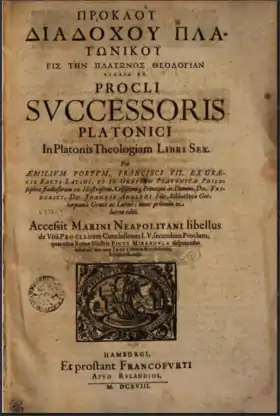
Thomas Taylor’s translation of Proclus' Platonic Theology in The Six Books of Proclus on the Theology of Plato, 1816 in 2 volumes, remains, more than 200 years later, the only complete English translation of the work.[345] The edition of the Greek text published by A. Portus in 1618 in Procli Successoris Platonici in Platonis Theologiam Libri Sex, remained the only complete standard edition of the Greek text for nearly 380 years, until the modern standard Greek text by Saffrey & Westerink was completely finished in 1997.[136] The modern standard edition of the Greek text and French translation is Proclus: Théologie platonicienne, edited by H. D. Saffrey & L. G. Westerink, 1968-1997 in six volumes, and took about 30 years to complete, and is regarded by scholars as one of the most momentous editorial accomplishments in modern Proclean scholarship.[345]
"The most beautiful and orderly development of this philosophy, which endeavours to explain all things by an analysis of consciousness, and builds up a world in the mind out of materials furnished by the mind itself, is to be found in the Platonic Theology by Proclus."[351][118]—Samuel Taylor Coleridge
Commentary on Cratylus
Proclus’ commentary on Plato’s Cratylus (Προκλου Σχόλιών εις τον Κραττλον Πλατωνος[352]) is the only commentary of that dialogue by Plato that exists from the writings of ancient philosophy.[353] The large work is regarded as special by scholars because it is the work of both Proclus, who was based in Athens, and another later Neoplatonist who is thought to have been based in Alexandria, and so it has the knowledge of two major late ancient centres of Platonic philosophy.[353] The commentary is separated into the subjects of language-theory and theological etymologies of names of Greek gods, with Proclus relating the names to the theologies of Orphism, Chaldean oracles and Homer.[353]
What has survived of Proclus' Commentary on Cratylus is partially complete, being a commentary of Plato's Cratylus from the beginning (383a[354]) to 407e,[355] whilst the dialogue itself finishes at 440e.[356] The modern standard edition of the Greek text is Proclus Diadochus in Platonis Cratylum Commentaria, edited by G. Pasquali, 1908.[357]
Commentary on First Alcibiades
Proclus’ commentary on Plato’s First Alcibiades (Προκλου Διαδοχου εις τον Πλατωνος Πρωτον Αλκιβιαδην[358]) is a lengthy commentary that clearly distinguishes between what the dialogue is about, its theme, and the purpose of understanding it, or its goal.[359] Throughout the commentary it is clear that Proclus was very interested in Aristotelian logic and that becomes evident in his use of ten syllogisms to structure the dialogue between Socrates and Alcibiades.[360] In the dialogue, Proclus makes it comprehensively clear that despite not being completely cognizant of our intuitive logic, we still use it unconsciously.[361]
What has survived of Proclus' Commentary on First Alcibiades is partially complete, being from the beginning (103a[362]) to 116b[363] whilst the dialogue itself finishes at 135e8.[364] The modern standard edition of the Greek text is Proclus: Sur le premier Alcibiade de Platon edited by. A.-P. Segonds, 1985-1986, in two volumes.[365]
Commentary on First Book of Euclid's Elements
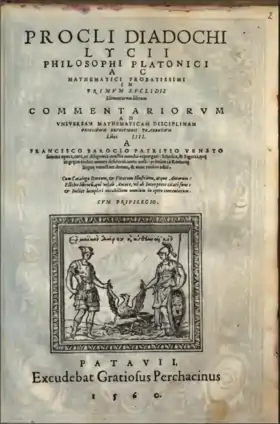
Proclus’ commentary on the first book of Euclid's Elements (Προκλου Διαδοχου εις το Πρωτον των Ευκλειδους Στοιχειων Βιβλιον Πρωτον[17]) is one of the most valuable sources we have for the history of ancient mathematics,[366][367] and its Platonic account of the status of mathematical objects was influential. In this work, Proclus also listed the first mathematicians associated with Plato: a mature set of mathematicians (Leodamas of Thasos, Archytas of Taras, and Theaetetus), a second set of younger mathematicians (Neoclides, Eudoxus of Cnidus), and a third yet younger set (Amyntas, Menaechmus and his brother Dinostratus, Theudius of Magnesia, Hermotimus of Colophon and Philip of Opus). Some of these mathematicians were influential in arranging the Elements that Euclid later published. The modern standard Greek text for the commentary is Procli Diadochi in primum Euclidis Elementorum Librum Commentarii edited by G. Friedlein, 1873.[136]
Proclus, the scholiast to Euclid, knew Eudemus of Rhodes' History of Geometry well, and gave a short sketch of the early history of geometry, which appeared to be founded on the older, lost book of Eudemus. The passage has been referred to as "the Eudemian summary," and determines some approximate dates, which otherwise might have remained unknown.[368]
Commentary on Parmenides
Proclus' commentary on Plato's Parmenides (Προκλου Διαδοχου των εις τον Πλατωνος Παρμενιδην[369]) in seven books[357] was written by Proclus when he was about forty years old.[370] It is an expression of the peak of Proclus' accomplishment in commentary writing in a mature period of his philosophical development.[370] In his Preface to the commentary, Proclus gives an illustrative description of the historical understanding of Plato's Parmenides from the Middle Platonists through Porphyry and Iamblichus and finally to Syrianus.[371][372] After the Preface, he starts the commentary with an explanation of the entire Neoplatonic theological order, acknowledges his debt to his teacher Syrianus, and dedicates the work to his pupil Asclepiodotus of Alexandria.[373] In the remainder of work, he discusses the dramatic setting, explains allegories in the dialogue including the allegorical representations of the three main characters Parmenides, Zeno, and Socrates and then turns to the examination of the subject matter of the dialogue.[374]
What has survived of Proclus' massive Commentary on Parmenides is partially complete, being a preface and a commentary of Plato's Parmenides from the beginning (126a[375]) to 142a10,[376] whilst the dialogue itself finishes at 166c5.[377] The commentary is extant in the Greek up to 141e10, the remainder (to 142a10) is from William of Moerbeke’s Latin translation.[376] From 1864 until 2009, the standard edition of the Greek text was Procli Philosophi Platonici Opera Inedita, edited by V. Cousin, 1864. Since 2009, there are two standard editions of the Greek text: the first is Procli in Platonis Parmenidem Commentaria, edited by C. Steel, with the collaboration of C. Macé, P. d’Hoine, A. Gribomont, and L. Van Campe, 2007-2009 in three volumes; and the second is Proclus. Commentaire sur le Parménide de Platon, edited by A.-P. Segonds and C. Luna, 2007-2021, in five volumes.[378]
Commentary on Republic
Proclus' commentary on Plato's Republic (Πλατωνικου Διαδοχυ εις τας Πολιτειας[15]) is a voluminous work that comprises 17 essays of varying length.[379] Essay 16 on the Myth of Er accounts for about 40 percent (263 pages) of the commentary,[379] while essays 5 and 6 on poetics and Homer in the Republic account for about a quarter of the commentary.[379] Essays 6, 9, 15, 16 and 17 may be regarded as independent.[380] The modern standard Greek text for the commentary is Procli Diadochi in Platonis Rem Pvblicam Commentarii, edited by Gvilelmvs (Wilhelm) Kroll, 2 volumes, 1899-1901.[381] Below is a summary of the seventeen essays and their page numbers in the Kroll 1899-1901 standard Greek text.
| Essay[382] | Description[382] | Kroll[382]
vol:page |
|---|---|---|
| 1 | Principle topics to understand before teaching Republic. | 1:5 |
| 2 | Socrates arguments on Justice against Polemarchus. [missing] | |
| 3 | Arguments on Justice in Republic against Thrasymachus [missing beginning] | 1:20 |
| 4 | Neoplatonic theology in Book 2 of Republic | 1:27 |
| 5 | Poetics in Republic | 1:42 |
| 6 | Homer in Republic | 1:69 |
| 7 | Soul and Virtues in Book 4 of Republic | 1:206 |
| 8 | Virtues and Education in Book 5 of Republic | 1:236 |
| 9 | Arguments of Socrates and Theodorus of Asine on Virtue | 1:251 |
| 10 | Love of Knowledge in Book 5 of Republic | 1:258 |
| 11 | The Good in Republic | 1:269 |
| 12 | The allegory of the Cave in Book 7 of Republic | 1:287 |
| 13 | Muses in Republic | 2:1 |
| 14 | Arguments on the Just and Unjust | 2:81 |
| 15 | Main topics in Book 10 of Republic | 2:85 |
| 16 | Myth of Er | 2:96 |
| 17 | Aristotle's objections to Republic | 2:360 |
In the commentary on Plato's Republic, Proclus presents his own philosophical system as a faithful interpretation of Plato, and in this he did not differ from other Neoplatonists, as he considered that "nothing in Plato’s corpus is unintended or there by chance", "that Plato’s writings were divinely inspired" (ὁ θεῖος Πλάτων ho theios Platon—the divine Plato, inspired by the gods), that "the formal structure and the content of Platonic texts imitated those of the universe",[383] and therefore that they spoke often of things under a veil, hiding the truth from the philosophically uninitiate. Proclus was however a close reader of Plato, and quite often makes very astute points about his Platonic sources.
Commentary on Timaeus
Proclus' commentary on Plato's Timaeus (Προκλου Διαδοχου εις τον Τιμαιον Πλατωνος[16]) is a massive work in five books, and is regarded by scholars as possibly the greatest commentary on a dialogue by Plato and gives an exceptional understanding of eight centuries of Platonic exposition.[384] It supplies crucial information of preliminary examinations of Plato's Timaeus and demonstrates Proclus' perspective on the sense and importance of Platonic philosophy.[384] Plato's dialogue Timaeus has demonstrated its significance historically because it has endured as a central philosophical text from the end of Plato's life (347 BC) and across Hellenistic philosophy, Philo of Alexandria, Middle Platonism, the Christian fathers, the Neoplatonists, and further.[385] Plato's dialogues Timaeus and Parmenides were regarded by Neoplatonists as the two most important texts for philosophical study.[385]
Proclus' Commentary on Timaeus is the pinnacle of centuries of explanatory studies and has earlier thoughts ingrained within it.[385] The commentary reveals the type of interpretive debates that thrived in prior ages and the point of view held by Proclus and Syrianus when they each headed the School of Plato in Athens.[385] Historically the commentary is the most prolific of Proclus' legacy and reveals meanings of the Platonic dialogues Republic and Critias that Proclus thought likely to belong to the same series.[385] What has survived of Proclus' voluminous Commentary on Timaeus is only partially complete, being a commentary of Plato's Timaeus from the beginning (17a[386]) to 44d,[387] whilst the dialogue itself finishes at 92c.[388] It is thought that the sudden termination of the commentary is possibly due to an exhausted scribe.[161] The modern standard edition of the Greek text is Procli Diadochi In Platonis Timaeum Commentaria, edited by E. Diehl, 1903-1906 in three volumes.[357]
| Book | Notes |
|---|---|
| I | Summary of Plato's Republic and myth of Atlantis |
| II | Timaeus 27c–31b: gods and cosmos |
| III | Timaeus 31b–37c: body of the world and generation of the soul |
| IV | Timaeus 37c–40e: heavenly bodies and traditional gods |
| V | Timaeus 40e–44d: genealogy of gods, Demiurge, souls |
Other Works
| Work[136][390] | Modern Standard edition of the Greek Text and Comments[136][390] |
|---|---|
| Elements of Physics | Procli Diadochi Lycii institutio physica, edited by A. Ritzenfeld, 1912. Proclus' summary of Aristotle's Physics books VI and VIII.[391] |
| Epigrams | Procli hymni accedunt hymnorum fragmenta, edited by E. Vogt, 1957 |
| Hymns | Procli hymni accedunt hymnorum fragmenta, edited by E. Vogt, 1957 |
Tria Opuscula (three treatises):
|
|
Treatises:
|
|
| Outline of Astronomical Hypotheses | Procli Diadochi hypotyposis astronomicarum positionum, edited by C. Manitius, C, 1909. There is no translation of Outline of Astronomical Hypotheses in any modern language[391] |
| Commentaries on Aristotle | Proclus de Lycie, by Luna & Segonds, 2012, pp. 1556–1562. There is growing evidence for existence of commentaries of Proclus on Aristotle's On Interpretation and Prior and Posterior Analytics[341] |
| Commentary on the Chaldean Oracles (fragments) | Eclogae e Proclo de philosophia chaldaica sive de doctrina oraculorum chaldaicorum, edited by A. Jahn, 1891. Extent works remain the major source for Proclus' elucidation of the Chaldean oracles.[341] |
| Commentary on Hesiod’s Works and Days (fragments) |
|
| Commentary on Enneads (fragments) | Exzerpte aus Proklos’ Enneadenkommentar bei Psellos in Byzantinische Zeitschrift, 52, pp. 1–10, by Westerink, 1959.[341] |
| On Plato’s Three Proofs for the Immortality of the Soul (fragments) |
|
| Chrestomathia (dubious) | Libanii Opera, edited by R. Foerster, 1927, volume IX, pp. 1-47 |
| Commentary on Pythagoras’ Golden Verses (dubious) | Proclus' Commentary on the Pythagorean Golden Verses, edited by N. Linley ( ibn at-tayyib), 1984 |
| On Epistolary Style (dubious) | Libanii Opera, edited by R. Foerster, 1927, volume IX, pp. 1-47 |
| Commentary on Ptolemy’s Tetrabiblion and Paraphrasis of the Tetrabiblion of Ptolemy (dubious) | Procli diadochi Paraphrasis in Ptolemaei libros IV sive De siderum affectionibus, edited by Allatius, 1635 |
| On the Sphere (spurious) | Procli sphaera. Ptolemaei de hypothesibus planetarum liber singularis, edited by J. Brainbridge, 1621 |
Citations and References
- Proclus: A Commentary on the First Book of Euclid's Elements. Translated by Morrow, Glenn R. New Jersey (USA): Princeton University Press. 1992 [1970]. pp. xxxxix, 3 (with the scholiast). ISBN 9780691020907.
- Kaufmann, Walter (1963). Philosophic Classics. Thales to St. Thomas. Englewood Cliffs, N.J. (New Jersey, USA): Prentice-Hall, INC. p. 536. ark:/13960/t11n91p54.
- Taylor, A. E. (1955) [1926]. Plato The Man and His Work. London: Methuen & Co. Ltd. p. 14.
- Tarrant, Harold, ed. (2014) [2007]. Proclus On Plato's "Cratylus". Translated by Duvick, Brian. London, New York: Bloomsbury Academic An imprint of Bloomsbury Publishing Plc 50 Bedford Square 1385 Broadway. pp. vii. ISBN 978-1-4725-5819-0.
- Tarrant, Harold, ed. (2007). Proclus: Commentary on Plato's Timaeus. 1. Translated by Tarrant, Harold. Cambridge: Cambridge University Press. pp. 1–2. doi:10.1017/CBO9780511482656.
- Sorabji 2005, p. 419, Main Thinkers Represented in the Sourcebook.
- Berg, R.M. van den (2001). Mansfeld, J.; Runia, D.T.; Van Winden, J. C. M. (eds.). Philosophia Antiqua. 90 Proclus’ Hymns Essays, Translations, Commentary. Leiden, Boston, Köln: Koninklijke Brill NV, Leiden, The Netherlands. pp. 3 (with the scholiast). ISBN 90 04 12236 2.
- d’Hoine, Pieter; Martijn, Marije, eds. (2017). All From One: A Guide to Proclus. United States of America: Oxford University Press 198 Madison Avenue, New York, NY 10016, United States of America. p. 6. ISBN 9780199640331.
- Smith, William, ed. (1870). Dictionary of Greek and Roman Biography and Mythology. 3. Boston: Little, Brown, and Company. pp. 533–534. ark:/13960/t23b60t0r.
- Phillips &c., Lawrence B. (1871). The Dictionary of Biographical Reference. London: Sampson Low, Son, & Marston Crown Buildings, 188 Fleet Street. p. 766. ark:/13960/t4qj7c873.
- Eadie, John; Waller, John Francis; Rankine, W. J. M.; Waller, John Francis; Bowen, Francis (1857). The Imperial Dictionary of Universal Biography. 3. London: William Mackenzie, 22 Paternoster Row; Howard Street, Glasgow; South Bridge, Edinburgh. p. 605. ark:/13960/t46q2760b.
- Proclus’ Commentary on Plato’s Parmenides. Translated by Morrow, Glenn R.; Dillon, John M. Preface, Introduction and Notes by Dillion. United States of America: Princeton University Press. 1992 [1987]. pp. xiii. ISBN 0-691-02089-2.CS1 maint: others (link)
- Proclus The Successor on Poetics and the Homeric Poems. Translated by Lamberton, Robert. Atlanta (Georgia USA): Society of Biblical Literature, 825 Houston Mill Road, Atlanta, GA 30329 USA. 2012. pp. iii, xi (with the scholiast). ISBN 9781589837119.
- Proclus The Elements of Theology. Translated by Dodds, E. R. Oxford: Reprinted Lithographically in Great Britain at the University Press, Oxford by Vivian Ridler printer to the University. 1971 [1933]. p. 3. ISBN 9780198140979.
- Kroll, Gvilelmvs, ed. (1899). Procli Diadochi in Platonis Rem Pvblicam Commentarii (in Latin and Greek). I. Lipsiae: Bibliotheca scriptorum Graecorum et Romanorum Teubneriana. p. 1. ark:/13960/t9183nh8x.
- Diehl, E., ed. (1903). Procli Diadochi in Platonis Timaevm Commentaria (in Latin and Greek). I. Lipsaie: Bibliotheca scriptorum Graecorum et Romanorum Teubneriana. p. 1. ark:/13960/t2m66v61s.
- Friedlein, Godofredi, ed. (1873). Procli Diadochi in Primum Euclidis Elementorum Librum Commentarii (in Latin and Greek). Lipsiae: Bibliotheca Scriptorum Graecorum et Romanorum Teubneriana. p. 1.
- d’Hoine & Martijn 2017, p. 1, Chapter 1 Proclus of Athens: A Life by Wildberg.
- Dodds 1971, pp. 257–260, Commentary.
- Dodds 1971, p. ix, Introduction.
- Morrow 1992, p. xxii, Forward by I. Mueller.
- d’Hoine & Martijn 2017, p. 7, Chapter 1 Proclus of Athens: A Life by Wildberg.
- d’Hoine & Martijn 2017, p. 6, Chapter 1 Proclus of Athens: A Life by Wildberg.
- Morrow 1992, p. xxxix, Introduction.
- d’Hoine & Martijn 2017, p. 7, 1 Proclus of Athens: A Life by Wildberg.
- Morrow 1992, p. xi, Forward by I. Mueller.
- d’Hoine & Martijn 2017, 1 Proclus of Athens: A Life by Wildberg.
- Whittaker, Thomas (1918). The Neo-Platonists. Cambridge: The University Press. p. 157. ark:/13960/t8bg3pj9v.
- Tarrant 2007, p. 2, General Introduction to the Commentary by D. Baltzly & Tarrant.
- d’Hoine & Martijn 2017, p. 8, Chapter 1 Proclus of Athens: A Life by Wildberg.
- Morrow & Dillon 1992, p. xii, General Introduction.
- d’Hoine & Martijn 2017, p. 8, 1 Proclus of Athens: A Life by Wildberg.
- Morrow 1992, p. xxxix, Forward by I. Mueller.
- Morrow 1992, p. xxiii, Introduction.
- Lamberton 2012, p. xii, Introduction.
- Lamberton 2012, p. xi, Introduction Proclus: Life and Works.
- Lamberton 2012, p. xx, Introduction.
- Sorabji 2005, p. 8, Introduction.
- Whittaker 1918, p. 158, The Athenian School.
- d’Hoine & Martijn 2017, p. 10, Chapter 1 Proclus of Athens: A Life by Wildberg.
- Morrow 1992, p. xxiii, Forward by I. Mueller.
- Sorabji 2005, p. 9, Introduction.
- d’Hoine & Martijn 2017, p. 22, Chapter 1 Proclus of Athens: A Life by Wildberg.
- Morrow 1992, p. xii, Forward by I. Mueller.
- Sorabji, Richard (2005). The Philosophy of the Commentators, 200-600 AD. 1 Psychology (with Ethics and Religion). Ithaca, New York: Cornell University Press, Sage House, 512 East State Street, Ithaca, New York 14850. p. 9. ISBN 0-8014-8987-3.
- Damascius’ Problems and Solutions Concerning First Principles. Translated by Ahbel-Rappe, Sara. New York: Oxford University Press, Inc. 198 Madison Avenue, New York, New York 10016. 2010. p. 423. ISBN 978-0-19-515029-2.
- Morrow & Dillon 1992, p. 5, Book I Introduction.
- Sorabji 2005, p. 419.
- d’Hoine & Martijn 2017, p. 31, Chapter 2 Proclus’ Place in the Platonic Tradition by Tarrant.
- Morrow & Dillon 1992, p. xiii, General Introduction.
- Marinus of Samaria, "The Life of Proclus or Concerning Happiness", Translated by Kenneth S. Guthrie (1925), pp.15–55:30, retrieved 21 May 2007.
- d’hoine & Martijn 2017, p. 11, Chapter 1 Proclus of Athens: A Life by Wildberg.
- Dodds 1971, p. xxviii (footnote 4), Introduction.
- Sorabji 2005, p. 20, Introduction.
- Morrow 1992, p. xliii.
- d’Hoine & Martijn 2017, p. 19, Chapter 1 Proclus of Athens: A Life by Wildberg.
- Morrow 1992, p. ix, Forward by I. Mueller.
- Sorabji 2005, p. 31, Introduction.
- d’Hoine & Martijn 2017, p. 16, Chapter 1 Proclus of Athens: A Life by Wildberg.
- Morrow 1992, p. xiv, Introduction.
- The Philosophical and Mathematical Commentaries of Proclus on the First Book of Euclid's Elements. I. Translated by Taylor, Thomas. London: T. Payne and Son; B. Wuire and Son; J. Robson; T. Cadell; Leigh and Co. G. Nicol; R. Faulder; and T. and J. Egerton. 1792. p. 32. ark:/13960/t5gc3g07m.
- d’Hoine & Martijn 2017, p. 290, Chapter 15 Proclus' Legacy by Adamson and Karfik.
- d’Hoine & Martijn 2017, p. 290, Chapter 15 Proclus’ Legacy by Adamson & Karfík.
- d’Hoine & Martijn 2017, p. 291, Chapter 15 Proclus’ Legacy by Adamson & Karfík.
- d’hoine & Martijn 2017, p. 301, Chapter 15 Proclus’ Legacy by Adamson & Karfík.
- Tarrant 2017, p. 15, Formal features of Proclus’ commentary(with the scholiast)
- Proclus Commentary On Plato’s Timaeus. 2 Book 2: Proclus On The Causes Of The Cosmos And Its Creation. Translated by Runia, David T.; Share, Michael. United States of America: Cambridge University Press, New York. 2008. pp. 235 (with the scholiast). ISBN 9780521848718.
- Lamberton 2012, p. 187 (footnote 218).
- Morrow & Dillon 1992, p. xxxviii, General Introduction.
- Sorabji 2005, p. 25, Introduction.
- Sorabji 2005, p. 97, 3(e) Plotinus’ undescended soul.
- Sorabji 2005, p. 10, Introduction.
- Sorabji 2005, p. 148, 4. Self-Awareness.
- d’Hoine & Martijn 2017, p. 292, Chapter 15 Proclus’ Legacy by Adamson & Karfík.
- Dodds 1971, p. 321, Commentary.
- Proclus On the Existence of Evils. Translated by Opsomer, Jan; Steel, Carlos. London, New York: Bloomsbury. 2014. p. 4. ISBN 9781472501035.
- "Benedict XVI General Audience St Peter's Square Wednesday, 14 May 2008". Benedictus XVI. Libreria Editrice Vaticana. 14 May 2008. Retrieved 3 November 2021.
- Sorabji 2005, p. 418, Main Thinkers Represented in the Sourcebook.
- d’Hoine & Martijn 2017, p. 300, Chapter 15 Proclus’ Legacy by Adamson & Karfík.
- Dodds, E. R. (1992). The Elements of Theology: A Revised Text with Translation, Introduction, and Commentary. Oxford University Press UK.
- Dodds 1971, p. 228, Commentary.
- Opsomer & Steel 2014, p. 5, Introduction.
- d’Hoine & Martijn 2017, p. 295, Chapter 15 Proclus’ Legacy by Adamson & Karfík.
- d’Hoine & Martijn 2017, p. 296, Chapter 15 Proclus’ Legacy by Adamson & Karfík.
- d’Hoine & Martijn 2017, p. 297, Chapter 15 Proclus’ Legacy by Adamson & Karfík.
- d’Hoine & Martijn, p. 297, Chapter 15 Proclus’ Legacy by Adamson & Karfík.
- d’Hoine & Martijn 2017, p. 317, Notes Proclus’ Legacy.
- Dodds 1971, p. xxix (footnote 2), Introduction.
- Günther, Hans-Christian (2007). "1". Studies in Platonism, Neoplatonism, and the Platonic Tradition (in German). 6 Die Übersetzungen der Elementatio Theologica des Proklos und Ihre Bedeutung für den Proklostext. Leiden: Brill. pp. 1–15. ISBN 9789004160620.
- Endress, Gerhard (1973). Beiruter Texte und Studien (in German). 10 Proclus Arabus. Beirut, Libanon: Orient-Institut der Deutschen Morgenländischen Gesellschaft. 590211.
- Dodds 1971, pp. xxviii–xxix, Introduction.
- Baumstark, Anton (1922). Geschichte der Syrischen Literatur (in German). Bonn: A. Marcus und E. Webers Verlag Dr. jur. Albert Ahn. p. 231. ark:/13960/t0wq07z11.
- Dodds 1971, p. xxix, Introduction.
- Steinschneider, Moritz (1889). Die Arabischen Uebersetzungen aus dem Greiechischen (in German). Leipzig: Otto Harrassowitz. p. 93. ark:/13960/t07x1dc0j.
- Dodds 1971, p. xxx, Introduction.
- d’Hoine & Martijn 2017, p. 294, Chapter 15 Proclus’ Legacy by Adamson & Karfík.
- Dodds 1971, p. xlii.
- d’Hoine & Martijn 2017, p. 236, Chapter 15 Proclus’ Legacy by Adamson & Karfík.
- d’Hoine & Martijn 2017, p. 298, Chapter 15 Proclus’ Legacy by Adamson & Karfík.
- Klibansky 1943, p. 24.
- Dodds 1971, p. 348, Addenda et Corrigenda.
- Klibansky 1943, p. 7.
- Dodds 1971, p. xlii, Introduction.
- Klibansky 1943, p. 6.
- d’Hoine & Martijn 2017, p. 299, Chapter 15 Proclus’ Legacy by Adamson & Karfík.
- d’Hoine & Martijn 2017, p. 319, Chapter 15 Proclus’ Legacy by Adamson & Karfík.
- Morrow 1992, p. xlii.
- Opsomer & Steel 2014, p. 7, Introduction.
- Klibansky, Raymond (1943). Plato's Parmenides in the Middle Ages and the Renaissance. London: The Warburg Institute. pp. 4, 6.
- d’Hoine & Martijn 2017, pp. 288–299, Chapter 15 Proclus’ Legacy by Adamson & Karfík.
- Klibansky 1943, p. 9.
- Dodds 1971, p. xxxii, Introduction.
- Dodds 1971, p. 221, Commentary.
- Dodds 1971, p. 230, Commentary.
- d’Hoine & Martijn 2017, p. 301, Chapter 15 Proclus’ Legacy by Adamson & Karfík.
- Dodds 1971, p. xxxiii, Introduction.
- Dodds 1971, p. xxxviii, Introduction.
- Dodds 1971, p. 342, Addenda et Corrigenda.
- d’Hoine & Martijn 2017, p. 302, Chapter 15 Proclus’ Legacy by Adamson & Karfík.
- Morrow & Dillon 1992, p. ix, Preface.
- d’Hoine & Martijn 2017, p. 303, Chapter 15 Proclus’ Legacy by Adamson & Karfík.
- Sasaki, C. (2013). Descartes’s Mathematical Thought. Netherlands: Springer Netherlands. p. 333. ISBN 9789401712255.
- d’Hoine & Martijn 2017, p. 304, Chapter 15 Proclus’ Legacy by Adamson & Karfík.
- Whittaker 1918, p. 288, The Commentaries of Proclus.
- Dodds 1971, p. 216, Commentary.
- Whittaker 1918, p. 252, The Commentaries of Proclus.
- "Thomas Taylor (neoplatonist)". Wikipedia. 12 September 2021. Retrieved 2 November 2021.
- Axon, William (1890). Thomas Taylor the Platonist. London: Reprinted from "The Library" for Private Circulation. pp. 10–14. ark:/13960/t6k07131m.
- Balch, Ruth (1917). Thomas Taylor the Platonist. Chicago: The Newberry Library. pp. 1–23. ark:/13960/t9c53sz70.
- "Universal Theosophy". Universal Theosophy. 29 October 2021. Retrieved 2 November 2021.
- Emerson, Ralph Waldo (1913). Emerson, Ralph Waldo; Forbes, Waldo Emerson (eds.). Journals of Ralph Waldo Emerson 1820-1872. VII. London, Boston and New York: Constable and Co. Limited, Haughton Mifflin Company. p. 262. ark:/13960/t54f1mz7n.
- Dodds 1971, p. xxvii, Introduction.
- Lamberton 2012, p. xxvi (footnote48).
- "De Wulf-Mansion Centre for Ancient, Medieval, and Renaissance Philosophy". KU Leuven. KU Leuven Oude Markt 13 - bus 5005 3000 Leuven Belgium. 22 February 2021. Retrieved 3 November 2021.
- d’Hoine & Martijn 2017, pp. 339–368, Bibliography.
- Duvick 2014, pp. 185–191, Bibliography.
- Duvick 2014, p. 185, Bibliography.
- d’Hoine & Martijn 2017, p. 356, Bibliography.
- d’Hoine & Martijn 2017, p. 347, Bibliography.
- Dodds 1971, p. xlii (footnote 13).
- d’Hoine & Martijn 2017, p. 358, Bibliography.
- d’Hoine & Martijn 2017, p. 357, Bibliography.
- d’Hoine & Martijn 2017, p. 361, Bibliography.
- d’Hoine & Martijn 2017, p. 354, Bibliography.
- Proclus Commentary on Plato’s Timaeus. Volume III Book 3, Part 1: Proclus on the World’s Body. Translated by Baltzly, Dirk. Cambridge: Cambridge University Press, The Edinburgh Building, Cambridge CB2 8RU, UK. 2006. p. 168. ISBN 9780521845953.
|volume=has extra text (help) - d’Hoine & Martijn 2017, p. 364, Bibliography.
- d’Hoine & Martijn 2017, p. 352, Bibliography.
- d’Hoine & Martijn 2017, p. 331, Bibliography.
- d’Hoine & Martijn 2017, p. 340, Bibliography.
- d’Hoine & Martijn 2017, p. 365, Bibliography.
- Tarrant 2007, p. 15, Formal features of Proclus’ commentary.
- Morrow & Dillon, p. xiv, General Introduction.
- Rosan, Laurence (1981). Harris, R. Baine (ed.). Neoplatonism and Indian Thought. State University of New York Press. pp. 45–49. ISBN 978-0873955461.
- Lamberton 2012, p. xxvi (footnote 48), Introduction.
- Lamberton 2012, p. xxv, Introduction.
- d’Hoine & Martijn 2017, p. 339-368, Bibliography.
- Duvick 2014, p. 185-186, Bibliography.
- Dodds 1971, p. xi, Introduction.
- Morrow & Dillon 1992, p. xiv, General Introduction.
- Duvick 2014, p. 144, Notes to pages 46-47.
- Opsomer & Steel 2012, p. 114, Notes to page 115.
- Morrow 1992, p. xvi (footnote 27), Forward by I. Mueller
- Morrow & Dillon, p. xv, General Introduction.
- d’Hoine & Martijn 2017, p. 36, 2 Proclus in the Platonic Tradition by H. Tarrant.
- Morrow & Dillon 1992, p. 205, Book IV Introduction.
- Ahbel-Rappe 2010, p. 25, Introduction to the Life and Philosophy of Damascius.
- Dillon, John; Gerson, Lloyd P. (2004). Neoplatonic Philosophy. United States of America: Hackett Publishing Company, Inc. p. 264. ISBN 0872207072.
- Proclus Ten Problems Concerning Providence. Translated by Opsomer, Jan; Steel, Carlos. London, New York: Bloomsbury Academic. 2012. p. 3. ISBN 9781472501783.
- d’Hoine & Martijn 2017, p. 38, 2 Proclus in the Platonic Tradition by H. Tarrant.
- d’Hoine & Martijn 2017, p. 49, 3 Proclus’ System by Martijn & Gerson.
- d’Hoine & Martijn 2017, p. 56, 3 Proclus’ System by Martijn & Gerson.
- d’Hoine & Martijn 2017, p. 106, 5 Platonic Forms and Being, Life and Intellect by d’Hoine.
- Opsomer & Steel 2014, p. 15, Introduction.
- Opsomer & Steel 2014, p. 16, Introduction.
- Dodds 1923, pp. 12, 28, 29, 44, 45, 50–64, 73, 82, 109.
- Morrow & Dillon 1992, pp. xviii–xxii, lxv, 4, 16, 82, 84, 93, 111, 116, 122, 227.
- Opsomer & Steel 2014, pp. 13, 14, 17, 23, 32, 38, 58, 67, 68, 80, 82, 95, 104, 109–111, 120, 121, 128, 136.
- Dodds 1971, pp. 105, 200.
- Opsomer & Steel 2014, pp. 7, 8, 73, 116.
- Morrow & Dillon, pp. 341, 444, 593.
- Dodds 1971, pp. 5, 43, 83, 91, 101, 103, 105, 109, 119, 121, 137, 234.
- Morrow & Dillon 1992, pp. 155, 390, 427, 491.
- Dodds 1971, p. 15, Of Causes.
- Ahbel-Rappe 2010, p. 44, Introduction to the Life and Philosophy of Damascius.
- Tarrant 2007, p. 181, On the Timaeus of Plato: Book 1 Atlantis.
- Morrow & Dillon, p. xvi, General Introduction.
- Dodds 1923, p. 51, The One.
- Morrow & Dillon 1992, pp. 110, 112, 137, 162, 168, 249, 262, 275, 311, 348, 379, 381, 424, 428–429, 452–454.
- Dodds 1971, p. 91, Supplementary Theorems on Causality.
- Morrow & Dillon 1992, pp. 37, 130, 177, 233, 241, 317, 333, 353.
- Select Passages Illustrating Neoplatonism. Translated by Dodds, E. R. London; New York and Toronto: Society for Promoting Christian Knowledge, The Macmillan Co. 1923. pp. 51–64. ark:/13960/t5t77jp65.
- Dodds 1971, pp. ix–x, Introduction.
- Dodds 1971, p. x, Introduction.
- Morrow & Dillon 1992, p. xvi, General Introduction.
- Dodds 1971, p. 51-54, Of Time and Eternity.
- Dodds 1971, p. 227, Commentary.
- Dodds 1971, p. 188-189, Commentary.
- Dodds 1971, p. 188, Commentary.
- Dodds 1971, p. 189, Commentary.
- Dodds 1971, p. 188-193, Commentary.
- Dodds 1971, p. 7, Of the One and the Many.
- Dodds 1971, pp. 193–200, Commentary.
- Dodds 1971, p. 194, Commentary.
- Dodds 1971, p. 195, Commentary.
- Dodds 1971, p. 196, Commentary.
- Proclus' Metaphysical Elements. Translated by Johnson, Thos. Missouri, U.S.A: Osceola. 1909. p. 9. ark:/13960/t2m61bt9m.
- Dodds 1971, p. 11, Of Causes.
- Dodds 1971, pp. 11–13, Of Causes.
- Dodds 1971, p. 197, Commentary.
- Dodds 1971, p. 198, Commentary.
- Dodds 1971, p. 199, Commentary.
- Dodds 1971, pp. 196–200, Of Causes.
- Morrow & Dillon 1992, p. xix, General Introduction.
- Dodds 1971, p. 200-201, Commentary.
- Morrow & Dillon 1992, p. xx, General Introduction.
- Dodds 1971, p. 200, Commentary.
- Dodds 1971, pp. 200–208, Commentary.
- Dodds 1971, p. 208, Commentary.
- Dodds 1971, p. 13, Of Causes, prop. 11.
- Dodds 1971, p. 212, Commentary.
- Dodds 1971, p. 214, Commentary.
- Dodds 1971, p. 259, Commentary.
- Morrow & Dillon 1992, p. xvi-xvii, General Introduction.
- Morrow & Dillon 1992, p. xxii, General Introduction.
- Morrow & Dillon 1992, p. xvii, General Introduction.
- Dodds 1971, p. 33, Of Procession and Reversion.
- Morrow & Dillon 1992, p. xvii-xviii, General Introduction.
- Morrow & Dillon 1992, p. xviii, General Introduction.
- Dodds 1971, p. 35, Of Procession and Reversion.
- Dodds 1971, p. 217, Commentary.
- Dodds 1971, pp. 217–218, Commentary.
- Dodds 1971, p. 218, Commentary.
- Dodds 1971, p. 219, Commentary.
- Dodds 1971, p. 220, Commentary.
- Dodds 1971, p. 222, Commentary.
- d’Hoine & Martijn 2017, p. 394, Index of Subjects.
- Dodds 1971, p. 241, Commentary.
- Dodds 1971, pp. 241–242, Commentary.
- Dodds 1971, p. 242, Commentary.
- Morrow & Dillon 1992, pp. xx–xxi, General Introduction.
- Dodds 1971, p. 4, Of the One and the Many.
- Morrow & Dillon 1992, p. xxi, General Introduction.
- Morrow & Dillon 1992, p. 49, Book I Commentary.
- Dodds 1971, p. 246, Commentary.
- Dodds 1971, p. xxiv, Introduction.
- Dodds 1971, p. 257, Commentary.
- Duvick 2014, pp. 67, 94, 96, 151, 155, 158, 170.
- Dodds 1971, p. 289, Commentary.
- Morrow & Dillon 1992, p. xxiii, General Introduction.
- Morrow & Dillon 1992, p. xxiv, General Introduction.
- Dodds 1971, p. 145, Of Intelligences.
- Johnson 1909, p. 120.
- Johnson 1909, p. 121.
- Tarrant 2007, p. 18, General Introduction to the Commentary.
- Morrow & Dillon 1992, pp. 28, 264, 306, 310.
- Dodds 1971, pp. 97, 194, 215.
- Morrow & Dillon 1992, pp. xix, 405.
- Morrow & Dillon 1992, pp. xxiii, xxiv, 3, 6, 270, 405.
- Morrow & Dillon 1992, pp. xxvi, 254, 429.
- d’Hoine & Martijn 2017, p. 398, Index of Subjects.
- Morrow & Dillon 1992, p. 203, Book IV Introduction.
- Morrow & Dillon 1992, p. 269, Book IV Commentary.
- Morrow & Dillon 1992, p. 204, Book IV Introduction.
- Morrow & Dillon 1992, p. 333, Book V Commentary.
- Dodds 1971, p. 107, Of Divine Henads, or Gods.
- Berg 2001, p. 290, Commentary.
- d’Hoine & Martijn 2017, p. 168, Chapter 8 Mathematics and the Sciences by O’Meara.
- Morrow & Dillon 1992, p. 213, Book IV Introduction.
- Morrow & Dillon 1992, p. 333, Book III Introduction.
- Morrow & Dillon 1992, p. 174, Book III Commentary.
- Dillon & Gerson 2004, p. 299, Proclus.
- Morrow & Dillon 1992, p. 224, Book IV Commentary.
- Morrow & Dillon 1992, p. 216, Book IV Commentary.
- Dillon & Gerson 2004, p. 316, Proclus.
- Dodds 1971, p. 292, Commentary.
- Dodds 1971, p. 293, Commentary.
- Dodds 1971, p. 272, Commentary.
- Dodds 1971, p. 258, Commentary.
- Morrow & Dillon 1992, pp. xviii–xxix, General Introduction.
- Dodds 1971, p. 271, Commentary.
- Dodds 1971, p. 277, Commentary.
- Dodds 1971, p. 245, Commentary.
- Morrow & Dillon 1992, pp. 316–317, Book IV Commentary.
- Dodds 1971, pp. 209, 262, 289.
- Dodds 1971, p. 240, Commentary.
- Dodds 1971, p. 239, Commentary.
- ΠΛΑΤΩΝΟΣ ΤΙΜΑΙΟΣ The Timaeus of Plato. Translated by Archer-Hind, R. D. (Richard Dacre). London: Macmillan and Co. 1888. pp. 91–93. ark:/13960/t2v40n58f.
- Burnet, John (1920). Greek Philosophy. 1 Thales to Plato. London: Macmillan and Co., Limited; St. Martin’s Street. pp. 169 (footnote 1). ark:/13960/t3fz2q47x.
- Cornford, Francis (1939). "The Parmenides". Plato and Parmenides. London: Kegan Paul, Trench, Trubner & Co. Ltd. Broadway House: 68-74 Carter Lane, E.C. p. 92. ark:/13960/t3b04kd90.
- "Introduction and Notes by A. Gregory". Timaeus and Critias. Translated by Waterfield, Robin. Oxford: Oxford University Press. 2008. pp. ix, xxviii, xxxii, xxxiii, 128, 142. ISBN 9780192807359.
- Partenie, Catalin, ed. (2004). "Explanatory Notes 9. The Two Cosmic Eras by R. Waterfield". Plato; Selected Myths. Oxford: Oxford University Press. pp. 147 (270a). ISBN 0192805088.
- Dillon & Gerson 2004, p. 203 (footnote 6), Porphyry.
- Sorabji 2005, p. 200, Soul-Body.
- Morrow & Dillon 1992, p. 37, 443.
- d’Hoine & Martijn 2017, p. 409, Index of Subjects.
- d’Hoine & Martijn 2017, p. 107, Chapter 5 Platonic Forms and Being-Life-Intellect by P. d’Hoine.
- d’Hoine & Martijn 2017, p. 108, Chapter 5 Platonic Forms and Being-Life-Intellect by P. d’Hoine.
- d’Hoine & Martijn 2017, p. 120, Chapter 5 Note 35.
- d’Hoine & Martijn 2017, p. 120, Chapter 5 Note 36.
- d’Hoine & Martijn 2017, p. 120, Chapter 5 Note 37.
- d’Hoine & Martijn 2017, p. 120, Chapter 5 Note 34.
- Dodds 1971, p. 205, Commentary.
- Emilsson, Eyjólfur Kjalar (2007). Plotinus on Intellect. Oxford: Clarendon Press. pp. 22–68. ISBN 9780199281701.
- Dodds 1971, pp. 204–205, Commentary.
- d’Hoine & Martijn 2017, p. 120, Chapter 5 Note 38.
- Dodds 1971, p. 210-211, Commentary.
- Dodds 1971, p. 211, Commentary.
- d’Hoine & Martijn 2017, p. 137, Chapter 6 Proclus on the Psychê Note 33 by Finamore & Kutash.
- d’Hoine & Martijn 2017, p. 137-138, Chapter 6 Proclus on the Psychê Note 33 by Finamore & Kutash.
- d’Hoine & Martijn 2017, p. 138, Chapter 6 Proclus on the Psychê Note 33 by Finamore & Kutash.
- d’Hoine & Martijn 2017, p. 109, Chapter 5 Platonic Forms and Being-Life-Intellect by P. d’Hoine.
- d’Hoine & Martijn 2017, p. 121, Chapter 5 Note 52.
- Dodds 1971, p. 244, Commentary.
- d’Hoine & Martijn 2017, p. 120, Chapter 5 Note 40.
- Dodds 1971, p. 156, Of Intelligences.
- d’Hoine & Martijn 2017, p. 111, Chapter 5 Platonic Forms and Being-Life-Intellect by P. d’Hoine.
- d’Hoine & Martijn 2017, p. 120, Chapter 5 Note 41.
- d’Hoine & Martijn 2017, p. 110, Chapter 5 Platonic Forms and Being-Life-Intellect by P. d’Hoine.
- d’Hoine & Martijn 2017, p. 413, Index of Subjects.
- d’Hoine & Martijn 2017, p. 411, Index of Subjects.
- Kutash, Emilie (2013). Ten Gifts of the Demiurge. London; New York: Bloomsbury Publishing. p. 109. ISBN 9781472519818.
- d’Hoine & Martijn 2017, p. 120, Chapter 5 Note 47.
- d’Hoine & Martijn 2017, p. 121, Chapter 5 Note 48.
- Whittaker 1918, p. 161, The Athenian School.
- Whittaker 1918, p. 231, The Commentaries of Proclus.
- Whittaker 1918, p. 232, The Commentaries of Proclus.
- Whittaker 1918, p. 233, The Commentaries of Proclus.
- "Proclus' Works (the main extant works)". Stanford Encyclopedia of Philosophy. The Metaphysics Research Lab Philosophy Department Stanford University Stanford, CA 94305-4115. 3 November 2021. ISSN 1095-5054.
- Dodds 1971, p. xiii, Introduction.
- d’Hoine & Martijn 2017, pp. 329–336, Appendix II.
- Dodds 1971, pp. xiv–xvii, Introduction.
- Whittaker 1918, p. 234, The Commentaries of Proclus.
- d’Hoine & Martijn 2017, pp. 333–334, Appendix II.
- Morrow 1992, p. xlii, Introduction.
- Ahbel-Rappe 2010, p. 49, Introduction to the life and Philosophy of Damascius.
- d’Hoine & Martijn, p. 142, 7 The Natural World by J. Opsomer.
- Dodds 1971, p. xliii, Introduction.
- d’Hoine & Martijn 2017, pp. 329–332, Appendix II.
- d’Hoine & Martijn 2017, p. 332, Appendix II.
- Dodds 1971, p. xiv, Introduction.
- Berg 2001, p. 5, Introduction.
- d’Hoine & Martijn 2017, p. 234, 11 Theurgy and Proclus’ Philosophy by Berg.
- d’Hoine & Martijn 2017, p. 333, Appendix II.
- Portus, Aemilius, ed. (1618). Procli Successoris Platonici in Platonis Theologiam Libri Sex (in Latin and Greek). Hamburgi: Apud Michaelem Heringium. pp. cover.
- d’Hoine & Martijn 2017, p. 208, 10 Proclus’ Theology by L. Brisson.
- d’Hoine & Martijn 2017, p. 209, 10 Proclus’ Theology by L Brisson.
- d’Hoine & Martijn 2017, p. 47, 3 Proclus’ System by M. Martijn and L. P. Gerson.
- "De Wulf-Mansion Centre for Ancient, Medieval, and Renaissance Philosophy". KU Leuven. KU Leuven Oude Markt 13 - bus 5005 3000 Leuven Belgium. 22 February 2021. Retrieved 11 November 2021.
- Knight, William, ed. (1887). Memorials of Coleorton Being Letters from Coleridge, Wordsworth, and his Sister Southey and Sir Walter Scott. II. Edinburgh: David Douglas. p. 107. ark:/13960/t62557m6j.
- Pasqvali, G., ed. (1908). Procli Diadochi in Platonis Cratylvm Commentaria (in Latin and Greek). Lipsaie: Bibliotheca scriptorum Graecorum et Romanorum Teubneriana. p. 1. ark:/13960/t5v77jp0k.
- Duvick & Tarrant 2014, p. vii, Preface by H. Tarrant.
- Pasqvali 1908, p. 3, Procli Scholia.
- Pasqvali 1908, p. 113, Procli Scholia.
- Burnet, I., ed. (1900). "Κρατυλος". Platonis Opera (in Latin and Greek). Tomvs I Tetralogia II. Oxonii: Scriptorum Classicorum Bibliotheca Oxoniensis. pp. 440c. ark:/13960/t3qv3w26f.
- d’Hoine & Martijn 2017, p. 330, Appendix II Proclus' Works.
- Cousin 1864, p. 281, Προκλου Διαδοχου εις τον Πλατωνος Πρωτον Αλκιβιαδην.
- d’Hoine & Martijn 2017, p. 267, 13 The Human Life by D. Baltzly.
- d’Hoine & Martijn 2017, p. 188, 9 Proclus on Epistemology, Language, Logic by C. Helmig.
- d’Hoine & Martijn 2017, p. 197, 9 Proclus on Epistemology, Language, Logic by C. Helmig.
- Proclus: Alcibiades I. Translated by O'Neil, William (2nd ed.). The Hague, Netherlands: Springer Science+Business Media Dordrecht. 1971. p. 11. ISBN 9789401758543.
- O'Neil 1971, p. 221.
- Burnet 1901, p. 135c, Tetralogia IV Αλκιβιαδην.
- d’Hoine & Martijn 2017, p. 329, Appendix II Proclus' Works.
- Morrow 1992, p. lvi, Introduction.
- Heath (1908). "Proclus and His Sources". The Thirteen Books of Euclid's Elements Vol. 1. p. 29.
It is well known that the commentary of Proclus on Eucl. Book I is one of the two main sources of information as to the history of Greek geometry which we possess, the other being the Collection of Pappus
- James Gow, A Short History of Greek Mathematics (1884)
- V., Cousin, ed. (1864). Procli Philosophi Platonici Opera Inedita (in Latin and Greek) (2nd ed.). Paris: Parisiis, prostant apud A. Durand. p. 617. ark:/13960/t2q53kc4m.
- Morrow & Dillon 1992, p. xxxvii, General Introduction.
- Morrow & Dillon 1992, p. xxiv-xxv, General Introduction.
- Morrow & Dillon 1992, p. 3, Book I Introduction.
- Morrow & Dillon 1992, p. 5, Book I Introduction.
- Morrow & Dillon 1992, p. 6-7, Book I Introduction.
- Morrow & Dillon 1992, p. 48, Book I.
- Morrow & Dillon 1992, p. 474, Book VII Introduction.
- Burnet, I., ed. (1901). "Παρμενιδην". Platonis Opera (in Latin and Greek). Tomvs II Tetralogia III. Oxonii: Scriptorum Classicorum Bibliotheca Oxoniensis. pp. 165d. ark:/13960/t2n59223j.
- d’Hoine & Martijn 2017, p. 330-331, Appendix II Proclus' Works.
- Lamberton 2012, p. xv, Introduction.
- Lamberton 2012, p. xvi (footnote 19).
- Lamberton 2012, p. 311, Bibliography.
- Lamberton 2012, pp. xxxi–xxxiii, Introduction.
- Calian, Florin George (2013), ""Clarifications" of Obscurity: Conditions for Proclus's Allegorical Reading of Plato's Parmenides", Obscurity in medieval texts, pp. 15–31
- Tarrant 2007, p. i.
- Tarrant 2007, p. 1, General Introduction to the Commentary by D. Baltzly & Tarrant.
- Diehl, E., ed. (1903). "Προκλου εις τον Τιμαιον A [Tim.17 A]". Procli Diadochi in Platonis Timaevm Commentaria (in Latin and Greek). I. Lipsiae: Bibliotheca scriptorum Graecorum et Romanorum Teubneriana. p. 14.
- Diehl, E., ed. (1906). "Προκλου εις τον Τιμαιον A [Tim. 44CD]". Procli Diadochi in Platonis Timaevm Commentaria (in Latin and Greek). III. Lipsiae: Bibliotheca scriptorum Graecorum et Romanorum Teubneriana. p. 356. ark:/13960/t54f7484q.
- Burnet, I., ed. (1905). "Τιμαιος". Platonis Opera (in Latin and Greek). Tomvs IV Tetralogia VIII. Oxonii: Scriptorum Classicorum Bibliotheca Oxoniensis. pp. 92a. ark:/13960/t0qr55g3k.
- Tarrant 2007, p. 16, General introduction to the Commentary.
- d’Hoine & Martijn 2017, pp. 329–337, Appendix II.
- d’Hoine & Martijn 2017, p. 334, Appendix II.
Further reading
Monographs
- Proklos: Grundzüge seiner Metaphysik, by Werner Beierwaltes
- L'Un et L'Âme selon Proclos, by Jean Trouillard
- La mystagogie de Proclos, by Jean Trouillard
- KINESIS AKINETOS: A study of spiritual motion in the philosophy of Proclus, by Stephen Gersh
- From Iamblichus to Eriugena. An investigation of the prehistory and evolution of the Pseudo-Dionysius tradition, by Stephen Gersh
- L'architecture du divin. Mathématique et Philosophie chez Plotin et Proclus, by Annick Charles-Saget
- Proclus: Neoplatonic philosophy and science, by Lucas Siorvanes
- The Philosophy of Proclus – the Final Phase of Ancient Thought, by L J Rosan
- The Logical Principles of Proclus' Stoicheiôsis Theologikê as Systematic Ground of the Cosmos, by James Lowry
Collections of essays
- Proclus et son influence, actes du Colloque de Neuchâtel, Juin, 1985. Zürich: Éditions du Grand Midi, 1987.
- Proclus lecteur et interprète des anciens. Actes du Colloque internationale du C.N.R.S., Paris 2–4 October 1985. J. Pépin et H.-D. Saffrey. Paris: C.N.R.S., 1987.
- On Proclus and his Influence in Medieval Philosophy, ed. by E.P. Bos and P.A. Meijer (Philosophia antiqua 53), Leiden-Köln-New York: Brill, 1992.
- The perennial tradition of neoplatonism, ed. by J. Cleary (Ancient and medieval philosophy, Series I, 24), Leuven: Leuven University Press, 1997.
- Proclus et la Théologie platonicienne: actes du colloque international de Louvain (13–16 mai 1998) en l'honneur de H. D. Saffrey et L. G. Westerink, éd. par A.-Ph. Segonds et C. Steel (Ancient and medieval philosophy, Series I 26), Leuven-Paris: Leuven University Press / Les Belles Lettres, 2000.
- Stephen Gersh (ed.), Interpreting Proclus from Antiquity to the Renaissance, Cambridge: Cambridge University Press, 2014.
Studies on particular aspects of Proclus' philosophy
- Gertz, S.R.P., "A Testimonium on Proclus' Views about the Rationality of Animals", Classical Quarterly 68.1, 352-357.
Bibliographic resources
- Proclo, negli ultimi quarant' anni. Bibliografia ragionata delle letteratura primaria e secondaria riguardante il pensiero procliano e i suoi influssi storici (anni 1949–1992), by Nicoletta Scotti Muth
- "Proclus Bibliography (covering the years 1990–2016)".
See Also
External links
 |
Wikisource has original works written by or about: Proclus |
 |
Wikiquote has quotations related to: Proclus |
- Helmig, Christoph; Steel, Carlos. "Proclus". In Zalta, Edward N. (ed.). Stanford Encyclopedia of Philosophy.
- Helmig, Christoph; Steel, Carlos. "Bibliography: Proclus' Complete Works (extant, lost, and spurious)". In Zalta, Edward N. (ed.). Stanford Encyclopedia of Philosophy.
- Article by Encyclopædia Britannica
- O'Connor, John J.; Robertson, Edmund F., "Proclus", MacTutor History of Mathematics archive, University of St Andrews
- Editions and Translations Proclus – Hoger Instituut voor Wijsbegeerte
- Article at "The Encyclopedia of Goddess Athena"
- The Six Books of Proclus, the Platonic Successor, on the Theology of Plato Thomas Taylor translation.
- Five Hymns of Proclus Thomas Taylor translation.
- Fragments that Remain of the Lost Writings of Proclus Thomas Taylor translation.
- Commentaries of Proclus on the Timaeus of Plato, in Five Books Thomas Taylor translation.
- Ten Doubts Concerning Providence and On the Existence of Evils Thomas Taylor translation.
- Proclus's Life and Teachings
- Index page of the Proclus section for the "Plato Transformed" project at the University Leuven, Belgium.
- Commentary on Plato's Parmenides – (Greek text, scans of Cousin's edition)
- Catalogue of the Prometheus Trust "Thomas Taylor Series" which includes translations of many of the works of Proclus. The site has lengthy extracts of these.
- Proclus's Commentary on Euclid, Book I. PDF scans of Friedlein's Greek edition, now in the public domain (Classical Greek)
- On the Signs of Divine Possession – (partial translation of Proclus's work)
- On the Sacred Art – (translation and discussion of this surviving extract from a larger work by Proclus)
- On the Sacred Art (French introduction and Greek text)
- On the Sacred Art - Greek text and English translation
- Hypotyposis Astronomicon Hypotheseon - Greek text
- Proclus in English and Greek, Select Online Resources
- Works by Proclus at LibriVox (public domain audiobooks)

- Guide to Proclus, Elementa theologica. Manuscript, 1582 at the University of Chicago Special Collections Research Center
Authority control  | |
|---|---|
| General | |
| National libraries | |
| Scientific databases | |
| Other | |