Protestant Reformers
Protestant Reformers were those theologians whose careers, works and actions brought about the Protestant Reformation of the 16th century.
| Part of a series on the |
| Reformation |
|---|
 |
| Protestantism |
| Part of a series on |
| Protestantism |
|---|
 |
 Christianity portal Christianity portal |
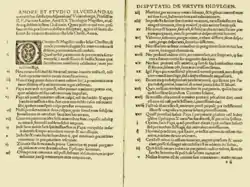
In the context of the Reformation, Martin Luther was the first reformer (sharing his views publicly in 1517), followed by people like Andreas Karlstadt and Philip Melanchthon at Wittenberg, who promptly joined the new movement. In 1519, Huldrych Zwingli became the first reformer to express a form of the Reformed tradition.
Listed are the most influential reformers only. They are listed by movement, although some reformers (e.g. Martin Bucer) influenced multiple movements.
Notable precursors
According to Edmund Hamer Broadbent, throughout the Middle Ages, there were a number of Christian movements that sought a return to what they perceived as the purity of the Apostolic church and whose teachings foreshadowed Protestant ideas.[1]
Magisterial Reformers

There were a number of key reformers within the Magisterial Reformation, including:
Lutheran
Reformed
Arminian
Unitarian
Second Front Reformers
There were also a number of people who initially cooperated with the Radical Reformers, but separated from them to form a "Second Front", principally in objection to sacralism. Among these were:
Counter Reformers
Roman Catholics who worked against the Protestant Reformation included:
See also
- List of Protestant Reformers (alphabetical)
- Protestantism in Germany
References
- Broadbent, E.H. (1931). The Pilgrim Church. Basingstoke: Pickering & Inglis. ISBN 0720806771.
Further reading
- George, Timothy. Theology of the Reformers. Nashville, Tenn.: Broadman Press, 1988. N.B.: Comparative studies of the various leaders of the Magisterial and Radical movements of the 16th century Protestant Reformation.
Authority control  | |
|---|---|
| General | |
| National libraries | |