Mongolian script
The classical or traditional Mongolian script,[lower-alpha 1] also known as the Qudum Mongγol bičig,[lower-alpha 2] was the first writing system created specifically for the Mongolian language, and was the most widespread until the introduction of Cyrillic in 1946. It is traditionally written in vertical lines  Top-Down, right across the page. Derived from the Old Uyghur alphabet, Mongolian is a true alphabet, with separate letters for consonants and vowels. The Mongolian script has been adapted to write languages such as Oirat and Manchu. Alphabets based on this classical vertical script are used in Inner Mongolia and other parts of China to this day to write Mongolian, Xibe and experimentally, Evenki.
| Mongolian script ᠮᠣᠩᠭᠣᠯ ᠪᠢᠴᠢᠭ | |
|---|---|
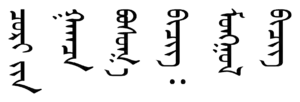 Example text | |
| Script type | |
| Creator | Tata-tonga |
Time period | ca.1204 – present |
| Direction | top-to-bottom, left-to-right  |
| Languages | Mongolian language Manchu language (obsolete) Daur language (obsolete) Evenki language (experimentally) |
| Related scripts | |
Parent systems | |
Child systems | Manchu alphabet Oirat alphabet (Clear script) Buryat alphabet Galik alphabet Evenki alphabet Xibe alphabet |
| ISO 15924 | |
| ISO 15924 | Mong, 145 , Mongolian |
| Unicode | |
Unicode alias | Mongolian |
| |
Computer operating systems have been slow to adopt support for the Mongolian script, and almost all have incomplete support or other text rendering difficulties.
History

The Mongolian vertical script developed as an adaptation of the Old Uyghur alphabet for the Mongolian language.[2]: 545 From the seventh and eighth to the fifteenth and sixteenth centuries, the Mongolian language separated into southern, eastern and western dialects. The principal documents from the period of the Middle Mongol language are: in the eastern dialect, the famous text The Secret History of the Mongols, monuments in the Square script, materials of the Chinese–Mongolian glossary of the fourteenth century, and materials of the Mongolian language of the middle period in Chinese transcription, etc.; in the western dialect, materials of the Arab–Mongolian and Persian–Mongolian dictionaries, Mongolian texts in Arabic transcription, etc.[3]: 1–2 The main features of the period are that the vowels ï and i had lost their phonemic significance, creating the i phoneme (in the Chakhar dialect, the Standard Mongolian in Inner Mongolia, these vowels are still distinct); inter-vocal consonants γ/g, b/w had disappeared and the preliminary process of the formation of Mongolian long vowels had begun; the initial h was preserved in many words; grammatical categories were partially absent, etc. The development over this period explains why the Mongolian script looks like a vertical Arabic script (in particular the presence of the dot system).[3]: 1–2
Eventually, minor concessions were made to the differences between the Uyghur and Mongol languages: In the 17th and 18th centuries, smoother and more angular versions of the letter tsadi became associated with [dʒ] and [tʃ] respectively, and in the 19th century, the Manchu hooked yodh was adopted for initial [j]. Zain was dropped as it was redundant for [s]. Various schools of orthography, some using diacritics, were developed to avoid ambiguity.[2]: 545
Traditional Mongolian is written vertically from top to bottom, flowing in lines from left to right. The Old Uyghur script and its descendants, of which traditional Mongolian is one among Oirat Clear, Manchu, and Buryat are the only known vertical scripts written from left to right. This developed because the Uyghurs rotated their Sogdian-derived script, originally written right to left, 90 degrees counterclockwise to emulate Chinese writing, but without changing the relative orientation of the letters.[4][1]: 36
The reed pen was the writing instrument of choice until the 18th century, when the brush took its place under Chinese influence.[5]: 422 Pens were also historically made of wood, reed, bamboo, bone, bronze, or iron. Ink used was black or cinnabar red, and written with on birch bark, paper, cloths made of silk or cotton, and wooden or silver plates.[6]: 80–81
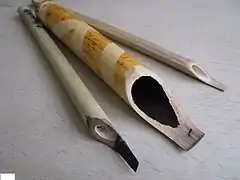 Reed pens
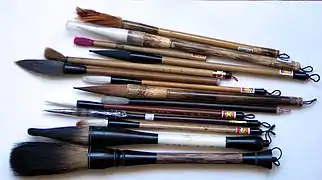 Ink brushes
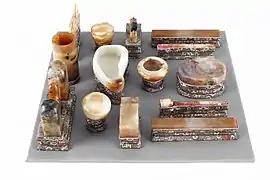 Writing implements of the Bogd Khan
Mongols learned their script as a syllabary, dividing the syllables into twelve different classes, based on the final phonemes of the syllables, all of which ended in vowels.[7]
The script remained in continuous use by Mongolian speakers in Inner Mongolia in People's Republic of China. In the Mongolian People's Republic, it was largely replaced by the Mongolian Cyrillic alphabet, although the vertical script remained in limited use. In March 2020, the Mongolian government announced plans to increase the use of the traditional Mongolian script and to use both Cyrillic and Mongolian script in official documents by 2025.[8][9][10]
Names
The traditional Mongolian script is known by a wide variety of names. Because of its similarity to the Old Uyghur alphabet, it became known as the Uigurjin Mongol script.[lower-alpha 3] During the communist era, when Cyrillic became the official script for the Mongolian language, the traditional script became known as the Old Mongol script,[lower-alpha 4] in contrast to the New script,[lower-alpha 5] referring to Cyrillic. The name Old Mongol script stuck, and it is still known as such among the older generation, who did not receive education in the new script.
Overview
The traditional or classical Mongolian alphabet, sometimes called Hudum 'traditional' in Oirat in contrast to the Clear script (Todo 'exact'), is the original form of the Mongolian script used to write the Mongolian language. It does not distinguish several vowels (o/u, ö/ü, final a/e) and consonants (syllable-initial t/d and k/g, sometimes ǰ/y) that were not required for Uyghur, which was the source of the Mongol (or Uyghur-Mongol) script.[4] The result is somewhat comparable to the situation of English, which must represent ten or more vowels with only five letters and uses the digraph th for two distinct sounds. Ambiguity is sometimes prevented by context, as the requirements of vowel harmony and syllable sequence usually indicate the correct sound. Moreover, as there are few words with an exactly identical spelling, actual ambiguities are rare for a reader who knows the orthography.
Letters have different forms depending on their position in a word: initial, medial, or final. In some cases, additional graphic variants are selected for visual harmony with the subsequent character.
The rules for writing below apply specifically for the Mongolian language, unless stated otherwise.
Sort orders
Vowel harmony
Mongolian vowel harmony separates the vowels of words into three groups – two mutually exclusive and one neutral:
- The back, male, masculine,[14] hard, or yang[15] vowels a, o, and u.
- The front, female, feminine,[14] soft, or yin[15] vowels e, ö, and ü.
- The neutral vowel i, able to appear in all words.
Any Mongolian word can contain the neutral vowel i, but only vowels from either of the other two groups. The vowel qualities of visually separated vowels and suffixes must likewise harmonize with those of the preceding word stem. Such suffixes are written with front or neutral vowels when preceded by a word stem containing only neutral vowels. Any of these rules might not apply for foreign words however.[3]: 11, 35, 39 [16]: 10 [17]: 4 [13]
Separated final vowels
 ) and the final vowel ‑a (
  )
)A separated final form of vowels a or e is common, and can appear at the end of a word stem, or suffix. This form requires a final-shaped preceding letter, and an inter-word gap in between. This gap can be transliterated with a hyphen.[note 1][3]: 30, 77 [18]: 42 [1]: 38–39 [17]: 27 [19]: 534–535
The presence or lack of a separated a or e can also indicate differences in meaning between different words (compare ᠬᠠᠷᠠ⟨?⟩ qar‑a 'black' with ᠬᠠᠷᠠ qara 'to look').[20]: 3 [19]: 535
Its form could be confused with that of the identically shaped traditional dative-locative suffix ‑a/‑e exemplified further down. That form however, is more commonly found in older texts, and more commonly takes the forms of ⟨ᠲ᠋ᠤᠷ⟩ tur/tür or ⟨ᠳ᠋ᠤᠷ⟩ dur/dür instead.[16]: 15 [21][1]: 46
Separated suffixes
All case suffixes, as well as any plural suffixes consisting of one or two syllables, are likewise separated by a preceding and hyphen-transliterated gap.[note 2] A maximum of two case suffixes can be added to a stem.[3]: 30, 73 [16]: 12 [21][22][17]: 28 [19]: 534
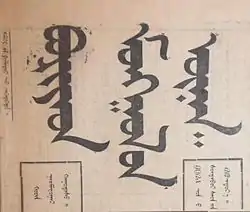
Such single-letter vowel suffixes appear with the final-shaped forms of a/e, i, or u/ü,[3]: 30 as in ᠭᠠᠵᠠᠷ ᠠ⟨?⟩ γaǰar‑a 'to the country' and ᠡᠳᠦᠷ ᠡ⟨?⟩ edür‑e 'on the day',[3]: 39 or ᠤᠯᠤᠰ ᠢ⟨?⟩ ulus‑i 'the state' etc.[3]: 23 Multi-letter suffixes most often start with an initial- (consonants), medial- (vowels), or variant-shaped form. Medial-shaped u in the two-letter suffix ᠤᠨ⟨?⟩ ‑un/‑ün is exemplified in the adjacent newspaper logo.[3]: 30 [19]: 27
Compound names
In the modern language, proper names (but not words) usually forms graphic compounds (such as those of ᠬᠠᠰᠡᠷᠳᠡᠨᠢ Qas'erdeni 'Jasper-jewel' or ᠬᠥᠬᠡᠬᠣᠲᠠ Kökeqota – the city of Hohhot). These also allow components of different harmonic classes to be joined together, and where the vowels of an added suffix will harmonize with those of the latter part of the compound. Orthographic peculiarities are most often retained, as with the short and long teeth of an initial-shaped ö in ᠮᠤᠤᠥ᠌ᠬᠢᠨ Muu'ökin 'Bad Girl' (protective name). Medial t and d, in contrast, are not affected in this way.[3]: 30 [23]: 92 [1]: 44 [24]: 88
Isolate citation forms
Isolate citation forms for syllables containing o, u, ö, and ü may in dictionaries appear without a final tail as in ⟨ᠪᠣ⟩ bo/bu or ⟨ᠮᠣ᠋⟩ mo/mu, and with a vertical tail as in ⟨ᠪᠥ᠋⟩ bö/bü or ⟨ᠮᠥ᠋⟩ mö/mü (as well as in transcriptions of Chinese syllables).[13][1]: 39
Notes on letter tables
A dash indicates a non-applicable position for that letter.
Parentheses enclose glyphs or positions whose corresponding sounds are not found in native Mongolian words.
Palatalized phonemes have been excluded. These are conditioned by a following i.[18]: 178
Letter Tables
Vowels
| Letter | Letter in Context | |||||||||||
|---|---|---|---|---|---|---|---|---|---|---|---|---|
| Letter | IPA | Type | Transliteration | Alone | Initial | Medial | Final | Whole | ||||
| Chakhar | Khalkha | Onset | Nucleus | Coda | Connected | Separated | ||||||
| ᠠ | /ɑ/ | /a/
/ə/ /∅/ |
Letter | a | ᠠ ᠠ᠋ ᠠ | ᠠ | ᠠ | ᠠ | ||||
| -a | ᠠ | |||||||||||
| Ligatures | ba | ᠪᠠ | ᠪᠠ | ᠪᠠ | ᠪᠠ | |||||||
| pa | ᠫᠠ | ᠫᠠ | ᠫᠠ | ᠫᠠ | ||||||||
| Separated suffixes | -a | ᠠ | ᠠ | |||||||||
| ᠡ | /ə/ | /i/
/e/ /ə/ /∅/ |
Letter | e | ᠡᠠ | ᠡ | ᠡ | ᠡ | ||||
| -e | ᠡ | |||||||||||
| Ligatures | be | ᠪᠡ | ᠪᠡ | ᠪᠡ | ᠪᠡ | |||||||
| pe | ᠫᠡ | ᠫᠡ | ᠫᠡ | ᠫᠡ | ||||||||
| ke
ge |
ᠬᠡ | ᠬᠡ | ᠬᠡ | ᠬᠡ | ||||||||
| Separated suffixes | -e | ᠡ | ᠡ | |||||||||
| ᠢ | /i/
/ɪ/ |
/i/
/ə/ /∅/ |
Letter | i | ᠢ | ᠢ | ᠢᠢᠢ | ᠢ | ||||
| Ligatures | bi | ᠪᠢ | ᠪᠢ | ᠪᠢ | ᠪᠢ | |||||||
| pi | ᠫᠢ | ᠫᠢ | ᠫᠢ | ᠫᠢ | ||||||||
| ki
gi |
ᠬᠢ | ᠬᠢ | ᠬᠢ | ᠬᠢ | ||||||||
| Separated suffixes | -i | ᠢ | ᠢ | |||||||||
| ᠣ | /ɔ/ | /ɔ/
/ə/ /∅/ |
Letter | o | ᠣ | ᠣ | ᠣ | ᠣ | ||||
| Ligatures | bo | ᠪᠣ | ᠪᠣ | ᠪᠣ | ᠪᠣ | |||||||
| po | ᠫᠣ | ᠫᠣ | ᠫᠣ | ᠫᠣ | ||||||||
| ᠤ | /ʊ/ | /ʊ/
/ə/ /∅/ |
Letter | u | ᠤ | ᠤ | ᠤ | ᠤ | ||||
| Ligatures | bu | ᠪᠤ | ᠪᠤ | ᠪᠤ | ᠪᠤ | |||||||
| pu | ᠫᠤ | ᠫᠤ | ᠫᠤ | ᠫᠤ | ||||||||
| Separated suffixes | -u | ᠤᠤᠤ | ||||||||||
| -u | ᠤ | |||||||||||
| -un | ᠤᠨ | |||||||||||
| -ud | ᠤᠳ | |||||||||||
| -uruγu | ᠤᠷᠤᠭᠤ | |||||||||||
| ᠥ | /o/ | /o/[ɵ]
/ə/ /∅/ |
Letter | ö | ᠥ | ᠥ | ᠥ᠋ᠥ | ᠥ | ||||
| Ligatures | bö | ᠪᠥ | ᠪᠥ | ᠪᠥ | ᠪᠥ | |||||||
| pö | ᠫᠥ | ᠫᠥ | ᠫᠥ | ᠫᠥ | ||||||||
| kö
gö |
ᠭᠥᠭᠥ᠋ | ᠭᠥ | ᠭᠥ | ᠭᠥ | ||||||||
| ᠦ | /u/ | /u/
/ə/ /∅/ |
Letter | ü | ᠦ | ᠦ | ᠦ᠋ᠦ | ᠦ | ||||
| Ligatures | bü | ᠪᠦ | ᠪᠦ | ᠪᠦ | ᠪᠦ | |||||||
| pü | ᠫᠦ | ᠫᠦ | ᠫᠦ | ᠫᠦ | ||||||||
| kü
gü |
ᠭᠦᠭᠦ᠋ | ᠭᠦ | ᠭᠦ | ᠭᠦ | ||||||||
| Separated suffixes | -ü | ᠦᠦᠦ | ||||||||||
| -ü | ᠦ | |||||||||||
| -ün | ᠦᠨ | |||||||||||
| -ügei | ᠦᠭᠡᠢ | |||||||||||
| -üd | ᠦᠳ | |||||||||||
| ᠧ | e in loanwords | Letter | ē | ᠧ | ᠧ | ᠧ | ᠧ | |||||
| Ex. Ligatures | fē | ᠹᠧ | ᠹᠧ | ᠹᠧ | ᠹᠧ | |||||||
| gē | ᠺᠧ | ᠺᠧ | ᠺᠧ | ᠺᠧ | ||||||||
| kē | ᠻᠧ | ᠻᠧ | ᠻᠧ | ᠻᠧ | ||||||||
| ᠢ | Long | Double Vowels | ii | ᠢᠢ | ||||||||
| ᠣ | Short / Not u | oo | ᠣᠣ | |||||||||
| ᠣ | Long | uu | ᠤᠤᠣᠣ | ᠤᠤ | ᠤᠤ | |||||||
| ᠦ | üü | |||||||||||
| Diphthongs | Diphthongs | ai | ᠠᠢ | ᠠᡳ᠌ | ᠠᡳ᠌ | ᠠᠢ | ||||||
| ei | ᠡᠢ | ᠡᡳ᠌ | ||||||||||
| oi
ui |
ᠣᠢ | ᠣᡳ᠌ | ᠣᡳ᠌ | ᠣᠢ | ||||||||
| öi | ᠥᠢ | |||||||||||
| üi | ᠣᡳ᠌ | ᠦᡳ᠌ | ᠦᠢ | |||||||||
| au | ᠠᠤ | ᠠᠤ | ||||||||||
| eü | ||||||||||||
| u-a | ᠤᠠ | |||||||||||
| uu-a | ᠤᠤᠠ | |||||||||||
Native Consonants
| Letter | Letter in Context | |||||||||||
|---|---|---|---|---|---|---|---|---|---|---|---|---|
| Letter | IPA | Type | Transliteration | Alone | Initial | Medial | Final | Whole | ||||
| Chakhar | Khalkha | Onset | Nucleus | Coda | Connected | Separated | ||||||
| ᠨ | /n/ | /n/
/ŋ/ |
Letter | n | ᠨ | ᠨ᠋ | ᠨ | ᠨ | ||||
| C-V Syllables | n-a
n-e |
ᠨᠠ | ||||||||||
| na
ne |
ᠨᠠ | ᠨᠠ | ᠨᠠ | ᠨᠠ | ||||||||
| ni | ᠨᠢ | ᠨᠢ | ᠨᠢ | ᠨᠢ | ||||||||
| no
nu |
ᠨᠣ᠋ | ᠨᠣ | ᠨᠣ | ᠨᠣ | ||||||||
| nö
nü |
ᠨᠥ᠋ | ᠨᠥ | ||||||||||
| Separated suffixes | -na
-ne |
ᠨᠠ | ||||||||||
| -nu
-nü |
ᠨᠤ | |||||||||||
| ᠩ | /ŋ/ | /ŋ/ | Letter | ng | ᠩ | ᠩ | ||||||
| ᠪ | /b/ | /p/
/w/ /∅/ | Letter | b | ᠪ | ᠪ | ᠪ | |||||
| C-V Syllables | ba
be |
ᠪᠠ | ᠪᠠ | ᠪᠠ | ᠪᠠ | |||||||
| bi | ᠪᠢ | ᠪᠢ | ᠪᠢ | ᠪᠢ | ||||||||
| bo
bu |
ᠪᠣ | ᠪᠣ | ᠪᠣ | ᠪᠣ | ||||||||
| bö
bü |
ᠪᠥ᠋ | ᠪᠥ | ||||||||||
| Separated suffixes | -ban
-ben |
ᠪᠠᠨ | ||||||||||
| -bar
-ber |
ᠪᠠᠷ | |||||||||||
| ᠫ | /p/ | /pʰ/ | Letter | p | ᠫ | ᠫ | ᠫ | |||||
| C-V Syllables | pa
pe |
ᠫᠠ | ᠫᠠ | ᠫᠠ | ᠫᠠ | |||||||
| pi | ᠫᠢ | ᠫᠢ | ᠫᠢ | ᠫᠢ | ||||||||
| po
pu |
ᠫᠣ | ᠫᠣ | ᠫᠣ | ᠫᠣ | ||||||||
| pö
pü |
ᠫᠥ᠋ | ᠫᠥ | ||||||||||
| ᠬ | /x/ | /x/ | Letter | q | ᠬ | ᠬ | ||||||
| C-V Syllables | q-a | ᠬᠠ | ||||||||||
| qa | ᠬᠠ | ᠬᠠ | ᠬᠠ | |||||||||
| qo
qu |
ᠬᠣ᠋ | ᠬᠣ | ᠬᠣ | |||||||||
| ᠬ | /x/ | /x/ | Letter | k | ? | ? | ||||||
| C-V Syllables | ke | ᠬᠡ | ᠬᠡ | ᠬᠡ | ᠬᠡ | |||||||
| ki | ᠬᠢ | ᠬᠢ | ᠬᠢ | ᠬᠢ | ||||||||
| kö
kü |
ᠬᠥ
ᠬᠥ᠋ |
ᠬᠥ | ᠬᠥ | ᠬᠥ | ||||||||
| Separated suffixes | -ki | ᠬᠢ | ||||||||||
| -kin | ᠬᠢᠨ | |||||||||||
| ᠭ | /ɣ/ | /ɢ/
/∅/ |
Letter | γ | ᠭ | ᠭ᠋ | ᠭ | ᠭ | ||||
| C-V Syllables | γ-a | ᠭᠠ | ||||||||||
| γa | ᠭᠠ | ᠭᠠ | ᠭᠠ | |||||||||
| γo
γu |
ᠭᠣ᠋ | ᠭᠣ | ᠭᠣ | ᠭᠣ | ||||||||
| ᠭ | /g/ | /g/ | Letter | g | ᠭ᠍ | ᠭ᠍ | ᠭ᠋ | |||||
| C-V Syllables | ge | ᠭᠡ | ᠭᠡ | ᠭᠡ | ᠭᠡ | |||||||
| gi | ᠭᠢ | ᠭᠢ | ᠭᠢ | ᠬᠢ | ||||||||
| gö
gü |
ᠭᠥ
ᠭᠥ᠋ |
ᠭᠥ | ᠭᠥ | ᠭᠥ | ||||||||
| ᠮ | /m/ | /m/ | Letter | m | ᠮ | ᠮ | ᠮ | |||||
| C-V Syllables | m-a
m-e |
ᠮᠠ | ||||||||||
| ma
me |
ᠮᠠ | ᠮᠠ | ᠮᠠ | ᠮᠠ | ||||||||
| mi | ᠮᠢ | ᠮᠢ | ᠮᠢ | ᠮᠢ | ||||||||
| mo
mu |
ᠮᠣ᠋ | ᠮᠣ | ᠮᠣ | ᠮᠣ | ||||||||
| mö
mü |
ᠮᠥ᠋ | ᠮᠥ | ||||||||||
| ᠯ | /l/ | /ɮ/ | Letter | l | ᠯ | ᠯ | ᠯ | |||||
| C-V Syllables | l-a
l-e |
ᠯᠠ | ||||||||||
| la
le |
ᠯᠠ | ᠯᠠ | ᠯᠠ | ᠯᠠ | ||||||||
| li | ᠯᠢ | ᠯᠢ | ᠯᠢ | ᠯᠢ | ||||||||
| lo
lu |
ᠯᠣ᠋ | ᠯᠣ | ᠯᠣ | ᠯᠣ | ||||||||
| lö
lü |
ᠯᠥ᠋ | ᠯᠥ | ||||||||||
| Separated suffixes | -lu
-lü |
ᠯᠤ | ||||||||||
| ᠰ | /s/
/ʃ/(i) |
/s/
/ʃ/(i) |
Letter | s | ᠰ | ᠰ | ᠰ | |||||
| C-V Syllables | s-a
s-e |
ᠰᠠ | ||||||||||
| sa
se |
ᠰᠠ | ᠰᠠ | ᠰᠠ | ᠰᠠ | ||||||||
| si | ᠰᠢ | ᠰᠢ | ᠰᠢ | ᠰᠢ | ||||||||
| so
su |
ᠰᠣ᠋ | ᠰᠣ | ᠰᠣ | ᠰᠣ | ||||||||
| sö
sü |
ᠰᠥ᠋ | ᠰᠥ | ||||||||||
| ᠱ | /ʃ/ | /ʃ/ | Letter | š | ᠱ | ᠱ | ᠱ | |||||
| C-V Syllables | ša
še |
ᠱᠠ | ᠱᠠ | ᠱᠠ | ᠱᠠ | |||||||
| ši | ᠱᠢ | ᠱᠢ | ᠱᠢ | ᠱᠢ | ||||||||
| šo | ᠱᠣ᠋
ᠱᠣ |
ᠱᠣ | ᠱᠣ | ᠱᠣ | ||||||||
| šu | ᠱᠣ᠋ | |||||||||||
| šö
šü |
ᠱᠥ᠋ | ᠱᠥ | ||||||||||
| ᠲ | /t/ | /t/ | Letter | t | ᠲ | ᠲ | ||||||
| C-V Syllables | ta
te |
ᠲᠠ | ᠲᠠ | ᠲᠠ | ||||||||
| ti | ᠲᠢ | ᠲᠢ | ᠲᠢ | ᠲᠢ | ||||||||
| to
tu |
ᠲᠣ᠋ | ᠲᠣ | ᠲᠣ | ᠲᠣ | ||||||||
| tö
tü |
ᠲᠥ᠋ | ᠲᠥ | ||||||||||
| Separated suffixes | -ta
-te |
ᠲᠠ | ||||||||||
| -tu
-tü |
ᠲᠤ | ᠲᠤ | ||||||||||
| ᠳ | /d/ | /t/
/tʰ/ |
Letter | d | ᠳ | ᠳ᠋ | ᠳ | ᠳ | ||||
| C-V Syllables | da
de |
ᠳᠠ | ᠳᠠ | ᠳᠠ | ᠳᠠ | |||||||
| di | ᠳᠢ | ᠳᠢ | ᠳᠢ | ᠳᠢ | ||||||||
| do
du |
ᠳᠣ᠋
ᠳ᠋ᠣ᠋ |
ᠳᠣ | ᠳᠣ | ᠳᠣ | ||||||||
| dö
dü |
ᠳᠥ᠋
ᠳ᠋ᠥ᠋ |
ᠳᠥ | ||||||||||
| Separated suffixes | -d | ᠳ᠋ | ᠳ᠋ | |||||||||
| -da
-de |
ᠳᠠ | |||||||||||
| -du
-dü |
ᠳᠤ | ᠳᠤ | ||||||||||
| ᠴ | /t͡ʃ/ | /t͡ʃʰ/
/t͡sʰ/ |
Letter | č | ᠴ | ᠴ | ᠴ | |||||
| C-V Syllables | ča
če |
ᠴᠠ | ᠴᠠ | ᠴᠠ | ᠴᠠ | |||||||
| či | ᠴᠢ | ᠴᠢ | ᠴᠢ | ᠴᠢ | ||||||||
| čo
ču |
ᠴᠣ᠋
ᠴᠣ |
ᠴᠣ | ᠴᠣ | ᠴᠣ | ||||||||
| čö | ᠴᠥ᠋ | ᠴᠥ | ||||||||||
| čü | ᠴᠥ᠋
ᠴᠦ |
|||||||||||
| ᠵ | /d͡ʒ/ | /d͡ʒ/
/d͡z/ |
Letter | ǰ | ᠵ | ᠵ | ᠵ | |||||
| C-V Syllables | ǰ-a
ǰ-e |
ᠵᠠ | ||||||||||
| ǰa
ǰe |
ᠵᠠ | ᠵᠠ | ᠵᠠ | ᠵᠠ | ||||||||
| ǰi | ᠵᠢ | ᠵᠢ | ᠵᠢ | ᠵᠢ | ||||||||
| ǰo | ᠵᠣ᠋
ᠵᠣ |
ᠵᠣ | ᠵᠣ | ᠵᠣ | ||||||||
| ǰu | ᠵᠣ᠋ | |||||||||||
| ǰö
ǰü |
ᠵᠥ᠋ | ᠵᠥ | ||||||||||
| ᠶ | /j/ | /j/ | Letter | y | ᠶ | ᠶ
ᠶ |
||||||
| C-V Syllables | y-a
y-e |
ᠶᠠ | ||||||||||
| ya
ye |
ᠶᠠ | ᠶᠠ | ᠶᠠ | ᠶᠠ | ||||||||
| yi | ᠶᠢ | ᠶᠢ | ᠶᠢ | ᠶᠢ | ||||||||
| yo
yu |
ᠶᠣ᠋ | ᠶᠣ | ᠶᠣ | ᠶᠣ | ||||||||
| yö
yü |
ᠶᠥ᠋ | ᠶᠥ | ||||||||||
| Separated suffixes | -y | ᠶ
ᠶ | ||||||||||
| -yi | ᠶᠢ | |||||||||||
| -yin | ᠶᠢᠨ | |||||||||||
| -yuγan | ᠶᠤᠭᠠᠨ | |||||||||||
| -yügen | ᠶᠦᠭᠡᠨ | |||||||||||
| ᠷ | /r/ | /r/ | Letter | r | ᠷ | ᠷ | ᠷ | |||||
| C-V Syllables | r-a
r-e |
ᠷᠠ | ||||||||||
| ra
re |
ᠷᠠ | ᠷᠠ | ᠷᠠ | ᠷᠠ | ||||||||
| ri | ᠷᠢ | ᠷᠢ | ᠷᠢ | ᠷᠢ | ||||||||
| ro
ru |
ᠷᠣ᠋ | ᠷᠣ | ᠷᠣ | ᠷᠣ | ||||||||
| rö
rü |
ᠷᠥ᠋ | ᠷᠥ | ||||||||||
Foreign Consonants
| Letter | Letter in Context | |||||||||||
|---|---|---|---|---|---|---|---|---|---|---|---|---|
| Letter | IPA | Type | Transliteration | Alone | Initial | Medial | Final | Whole | ||||
| Chakhar | Khalkha | Onset | Nucleus | Coda | Connected | Separated | ||||||
| ᠸ | /w/ | Letter | w | ᠸ | ᠸ | ᠸ | ||||||
| C-V Syllables | w-a
w-e |
ᠸᠠ | ||||||||||
| ᠹ | /f/ | Letter | f | ᠹ | ᠹ | ᠹ | ||||||
| Ligatures | fa | ᠹᠠ | ᠹᠠ | ᠹᠠ | ᠹᠠ | |||||||
| fē | ᠹᠧ | ᠹᠧ | ᠹᠧ | ᠹᠧ | ||||||||
| fi | ᠹᠢ | ᠹᠢ | ᠹᠢ | ᠹᠢ | ||||||||
| fo | ᠹᠣ | ᠹᠣ | ᠹᠣ | ᠹᠣ | ||||||||
| fü | ᠹᠦ᠋ | ᠹᠦ | ᠹᠦ᠋ | ᠹᠦ᠋ | ||||||||
| ᠺ | /k/ | Letter | g | ᠺ | ᠺ | ᠺ | ||||||
| Ligatures | ga | ᠺᠠ | ᠺᠠ | ᠺᠠ | ᠺᠠ | |||||||
| gē | ᠺᠧ | ᠺᠧ | ᠺᠧ | ᠺᠧ | ||||||||
| gi | ᠺᠢ | ᠺᠢ | ᠺᠢ | ᠺᠢ | ||||||||
| go | ᠺᠣ | ᠺᠣ | ᠺᠣ | ᠺᠣ | ||||||||
| gu | ᠺᠦ᠋ | ᠺᠦ | ᠺᠦ᠋ | ᠺᠦ᠋ | ||||||||
| ᠻ | Letter | k | ᠻ | ᠻ | ᠻ | |||||||
| Ligatures | ka | ᠻᠠ | ᠻᠠ | ᠻᠠ | ᠻᠠ | |||||||
| kē | ᠻᠧ | ᠻᠧ | ᠻᠧ | ᠻᠧ | ||||||||
| ki | ᠻᠢ | ᠻᠢ | ᠻᠢ | ᠻᠢ | ||||||||
| ko | ᠻᠣ | ᠻᠣ | ᠻᠣ | ᠻᠣ | ||||||||
| kü | ᠻᠦ᠋ | ᠻᠦ | ᠻᠦ᠋ | ᠻᠦ᠋ | ||||||||
| ᠼ | /t͡s/ | Letter | c | ᠼ | ᠼ | ᠼ | ||||||
| ᠽ | /d͡z/ | Letter | z | ᠽ | ᠽ | ᠽ | ||||||
| ᠾ | /h/[x] | Letter | h | ᠾ | ᠾ | ᠾ | ||||||
| ᠿ | /ʐ/ | Letter | ž | ᠿ | ||||||||
| ᡀ | Letter | lh | ᡀ | ᡀ | ||||||||
| ᡁ | Letter | zh | ᡁ | |||||||||
| ᡂ | Letter | ch | ᡂ | |||||||||
Vowels
ᠠ
| Letter[3]: 17, 18 [2]: 546 | ||
|---|---|---|
| ‑a | a | Transliteration[note 3] |
| — | ᠠ[lower-alpha 6] | Alone |
| ᠠ᠋[lower-alpha 7] | ||
.svg.png.webp) [lower-alpha 8] [lower-alpha 8] | ||
| ᠠ | Initial | |
| ᠠ | Medial | |
| ᠠ | Connected final | |
| ᠠ⟨?⟩ ⟨⟩ |
— | Separated final |
| Ligatures[3]: 22–23 [2]: 546 | ||
|---|---|---|
| ba | pa | Transliteration |
| ᠪᠠ[lower-alpha 9] | ᠫᠠ | Alone |
| ᠪᠠ | ᠫᠠ | Initial |
| ᠪᠠ | ᠫᠠ | Medial |
| ᠪᠠ | ᠫᠠ | Final |
| Separated suffixes[note 4] | |
|---|---|
| ‑a | Transliteration |
ᠠ⟨?⟩ ⟨.svg.png.webp) ⟩ ⟩ |
Initial |
| ᠠ⟨?⟩ ⟨⟩ |
Whole |
- Transcribes Chakhar /ɑ/;[13][27] Khalkha /a/, /ə/, and /∅/.[18]: 40–42 Transliterated into Cyrillic with the letter а.[28][25]
- Medial and final forms may be distinguished from those of other tooth-shaped letters through: vowel harmony (e), the shape of adjacent consonants (see q/k and γ/g below), and position in syllable sequence (n, ng, q, γ, d).[21]
- The final tail extends to the left after bow-shaped consonants (such as b, and p), and to the right in all other cases.
- ᠠ᠋ = medial form used after the junction in a proper name compound.[1]: 44
- ᠠ᠋⟨?⟩ ⟨⟩ = connected galik final.[3]: 26–28 [1]: 38–39
- Derived from Old Uyghur aleph (𐽰), written twice for isolate and initial forms.[2]: 539–540, 545–546 [29]: 111, 113 [1]: 35
- Produced with A using the Windows Mongolian keyboard layout.[30]
ᠡ
| Letter[3]: 17, 18–19 [2]: 546 | ||
|---|---|---|
| ‑e | e | Transliteration |
| — | ᠡ[lower-alpha 7] | Alone |
.svg.png.webp) [lower-alpha 8] [lower-alpha 8] | ||
| ᠡ | Initial | |
| ᠡ | Medial | |
| ᠡ | Connected final | |
| ᠡ⟨?⟩ ⟨⟩ |
— | Separated final |
| Ligatures[3]: 22–23, 24–25 [2]: 546 | |||
|---|---|---|---|
| be | pe | ke, ge | Transliteration |
| ᠪᠡ[lower-alpha 9] | ᠫᠡ | ᠬᠡ[lower-alpha 10] | Alone |
| ᠪᠡ | ᠫᠡ | ᠬᠡ | Initial |
| ᠪᠡ | ᠫᠡ | ᠬᠡ | Medial |
| ᠪᠡ | ᠫᠡ | ᠬᠡ | Final |
| Separated suffixes[note 5] | |
|---|---|
| ‑e | Transliteration |
| ᠡ | Initial |
| ᠡ⟨?⟩ ⟨⟩ |
Whole |
- Transcribes Chakhar /ə/;[13][27] Khalkha /i/, /e/, /ə/, and /∅/.[18]: 40–42 Transliterated into Cyrillic with the letter э.[28][25]
- Medial and final forms may be distinguished from those of other tooth-shaped letters through: vowel harmony (a) and its effect on the shape of a word's consonants (see q/k and γ/g below), or position in syllable sequence (n, ng, d).[21]
- The final tail extends to the left after bow-shaped consonants (such as b, p, k, and g), and to the right in all other cases.
- ᠡ᠋ = a traditional initial form.[31]: 6
- Derived from Old Uyghur aleph.[2]: 539–540, 545–546 [29]: 111, 113 [1]: 35
- Produced with E using the Windows Mongolian keyboard layout.[30]
ᠢ
| Letter[3]: 17, 19 [2]: 546 | |
|---|---|
| i | Transliteration |
| ᠢ | Alone |
| ᠢ | Initial |
| ᠢ | Medial (syllable-initial) |
.svg.png.webp) [lower-alpha 11] [lower-alpha 11] |
Medial (syllable-final) |
| ᠢ | Final |
| Ligatures[3]: 22–23, 24–25 [2]: 546 | |||
|---|---|---|---|
| bi | pi | ki, gi | Transliteration |
| ᠪᠢ[lower-alpha 12] | ᠫᠢ | ᠬᠢ[lower-alpha 13] | Alone |
| ᠪᠢ | ᠫᠢ | ᠬᠢ | Initial |
| ᠪᠢ | ᠫᠢ | ᠬᠢ | Medial |
| ᠪᠢ | ᠫᠢ | ᠬᠢ | Final |
| Separated suffixes[note 6] | |
|---|---|
| ‑i | Transliteration |
ᠢ⟨?⟩ ⟨.svg.png.webp) ⟩ ⟩ |
Initial |
ᠢ⟨?⟩ ⟨.svg.png.webp) ⟩ ⟩ |
Whole |
- Transcribes Chakhar /i/ or /ɪ/;[13][27] Khalkha /i/, /ə/, and /∅/.[18]: 40–42 Transliterated into Cyrillic with the letter и.[28][25]
- Today, often absorbed into a preceding syllable when at the end of a word.
- Written medially with the single long tooth after a consonant, and with two after a vowel (with rare exceptions like ᠨᠠᠢᠮᠠ naima 'eight' or ᠨᠠᠢᠮᠠᠨ naiman 'eight'/tribal name).[3]: 31 [16]: 9, 39 [1]: 38
- ᠢ᠋ = a handwritten Inner Mongolian variant on the sequence yi (as in ᠰᠠᠶ᠋ᠢᠨ / ᠰᠠᠶᠢᠨ sayin 'good' being written ᠰᠠᠢ᠋ᠨ sain).[16]: 58 [1]: 38 [32]: 346
- Also the medial form used after the junction in a proper name compound.[1]: 44
- Derived from Old Uyghur yodh (𐽶), preceded by an aleph for isolate and initial forms.[2]: 539–540, 545–546 [29]: 111, 113 [1]: 35
- Produced with I using the Windows Mongolian keyboard layout.[30]
ᠣ
| Letter[3]: 17, 19–20 [2]: 546 | |
|---|---|
| o | Transliteration |
| ᠣ[lower-alpha 14] | Alone |
| ᠣ | Initial |
| ᠣ | Medial |
| ᠣ | Final |
| Ligatures[3]: 22–23 [2]: 546 | ||
|---|---|---|
| bo | po | Transliteration |
| ᠪᠣ | ᠫᠣ | Alone |
| ᠪᠣ | ᠫᠣ | Initial |
| ᠪᠣ | ᠫᠣ | Medial |
| ᠪᠣ | ᠫᠣ | Final |
- Transcribes Chakhar /ɔ/;[13][27] Khalkha /ɔ/, /ə/, and /∅/.[18]: 40–42 Transliterated into Cyrillic with the letter о.[28][25]
- Indistinguishable from u, except when inferred by its placement: it is only found in medial or final syllables if the initial syllable also carries it, or rarely when it carries the vowel i.[3]: 11, 19 [16]: 9–10
- ᠣ᠋ = the final form used in loanwords, as in ᠷᠠᠳᠢᠣ᠋ radio (радио radio).[28]: 48 [1]: 36 [33]
- ᠣ᠋ = medial form used after the junction in a proper name compound.[1]: 44
- Derived from Old Uyghur waw (𐽳), preceded by an aleph for isolate and initial forms.[2]: 539–540, 545–546 [29]: 111, 113 [1]: 35
- Produced with W using the Windows Mongolian keyboard layout.[30]
ᠤ
| Letter[3]: 17, 19–20 [2]: 546 | |
|---|---|
| u | Transliteration |
| ᠤ | Alone |
| ᠤ | Initial |
| ᠤ | Medial |
| ᠤ | Final |
| Ligatures[3]: 22–23 [2]: 546 | ||
|---|---|---|
| bu | pu | Transliteration |
| ᠪᠤ | ᠫᠤ | Alone |
| ᠪᠤ | ᠫᠤ | Initial |
| ᠪᠤ | ᠫᠤ | Medial |
| ᠪᠤ | ᠫᠤ | Final |
| Separated suffixes[note 7] | |||||
|---|---|---|---|---|---|
| ‑u | ‑u | ‑un | ‑ud | ‑uruγu | Transliteration |
.svg.png.webp) |
ᠤ⟨?⟩ | — | — | — | Whole |
.svg.png.webp) |
— | ᠤᠨ⟨?⟩ | ᠤᠳ⟨?⟩ | ||
.svg.png.webp) |
— | — | ᠤᠷᠤᠭᠤ⟨?⟩ | ||
- Transcribes Chakhar /ʊ/;[13][27] Khalkha /ʊ/, /ə/, and /∅/.[18]: 40–42 Transliterated into Cyrillic with the letter у.[28][25]
- Indistinguishable from o.[3]: 19 [16]: 9–10
- ᠤ᠋ = medial form used after the junction in a proper name compound.[1]: 44
- Derived from Old Uyghur waw, preceded by an aleph for isolate and initial forms.[2]: 539–540, 545–546 [29]: 111, 113 [1]: 35
- Produced with V using the Windows Mongolian keyboard layout.[30]
ᠥ
| Letter[3]: 17, 20 [2]: 546 | |
|---|---|
| ö | Transliteration |
| ᠥ[lower-alpha 15] | Alone |
| ᠥ | Initial |
| ᠥ᠋ | Medial (word-initial syllable) |
| ᠥ | Medial (subsequent syllables) |
| ᠥ | Final |
| Ligatures[3]: 22–23, 24–25 [2]: 546 | |||
|---|---|---|---|
| bö | pö | kö, gö | Transliteration |
| ᠪᠥ | ᠫᠥ | ᠭᠥ⟨?⟩ (w/o tail)[lower-alpha 16] | Alone |
| ᠭᠥ᠋⟨?⟩ (w/ tail) | |||
| ᠪᠥ | ᠫᠥ | ᠭᠥ | Initial |
| ᠪᠥ | ᠫᠥ | ᠭᠥ | Medial |
| ᠪᠥ | ᠫᠥ | ᠭᠥ | Final |
- Transcribes Chakhar /o/;[13][27] Khalkha /o/[ɵ], /ə/, and /∅/.[18]: 40–42 Transliterated into Cyrillic with the letter ө.[28][25]
- Indistinguishable from ü, except when inferred by its placement: it is only found in medial or final syllables if the initial syllable also carries it.[3]: 11, 20 [16]: 9–10
- ᠥ᠋ = an alternative final form; also used in loanwords.[1]: 39
- The syllable-initial medial form ᠥ᠋ is also used in non-initial syllables in proper name compounds,[1]: 44 as well as in loanwords.
- ᠥ᠌ = medial form used after the junction in a proper name compound.[1]: 44
- Derived from Old Uyghur waw, followed by a yodh in word-initial syllables, and preceded by an aleph for isolate and initial forms.[2]: 539–540, 545–546 [29]: 111, 113 [1]: 35
- Produced with O using the Windows Mongolian keyboard layout.[30]
ᠦ
| Letter[3]: 17, 20 [2]: 546 | |
|---|---|
| ü | Transliteration |
| ᠦ[lower-alpha 17] | Alone |
| ᠦ | Initial |
| ᠦ᠋ | Medial (word-initial syllable) |
| ᠦ | Medial (subsequent syllables) |
| ᠦ | Final |
| Ligatures[3]: 22–23, 24–25 [2]: 546 | |||
|---|---|---|---|
| bü | pü | kü, gü | Transliteration |
| ᠪᠦ | ᠫᠦ | ᠭᠦ⟨?⟩ (w/o tail)[lower-alpha 16] | Alone |
| ᠭᠦ᠋⟨?⟩ (w/ tail) | |||
| ᠪᠦ | ᠫᠦ | ᠭᠦ | Initial |
| ᠪᠦ | ᠫᠦ | ᠭᠦ | Medial |
| ᠪᠦ | ᠫᠦ | ᠭᠦ | Final |
| Separated suffixes[note 8] | |||||
|---|---|---|---|---|---|
| ‑ü | ‑ü | ‑ün | ‑ügei | ‑üd | Transliteration |
.svg.png.webp) |
ᠦ⟨?⟩ | — | — | — | Whole |
.svg.png.webp) |
— | ᠦᠨ⟨?⟩ | ᠦᠳ⟨?⟩ | ||
.svg.png.webp) |
— | ᠦᠭᠡᠢ⟨?⟩ | — | ||
- Transcribes Chakhar /u/;[13][27] Khalkha /u/, /ə/, and /∅/.[18]: 40–42 Transliterated into Cyrillic with the letter ү.[28][25]
- Indistinguishable from ö.[3]: 20 [16]: 9–10
- ᠦ᠋ = an alternative final form; also used in loanwords.[1]: 39 Additionally used in native and modern Mongolian ᠰᠦ᠋⟨?⟩ sü 'milk' (Classical Mongolian ᠰᠦ⟨?⟩ ⟨
 ⟩ sü or ᠰᠦᠨ sün).[26]: 741, 744 [1]: 39
 - The syllable-initial medial form ᠦ᠋ is also used in non-initial syllables in proper name compounds,[1]: 44 as well as in loanwords.
- ᠦ᠌ = medial form used after the junction in a proper name compound.[1]: 44
- Derived from Old Uyghur waw, followed by a yodh in word-initial syllables, and preceded by an aleph for isolate and initial forms.[2]: 539–540, 545–546 [29]: 111, 113 [1]: 35
- Produced with U using the Windows Mongolian keyboard layout.[30]
ᠧ
| Letter[1]: 38–39 | |
|---|---|
| ē | Transliteration[lower-alpha 18] |
| ᠧ | Alone |
| ᠧ | Initial |
| ᠧ | Medial |
| ᠧ | Final |
| Example ligatures | |||
|---|---|---|---|
| fē | gē | kē | Transliteration |
| ᠹᠧ | ᠺᠧ | ᠻᠧ | Alone |
| ᠹᠧ | ᠺᠧ | ᠻᠧ | Initial |
| ᠹᠧ | ᠺᠧ | ᠻᠧ | Medial |
| ᠹᠧ | ᠺᠧ | ᠻᠧ | Final |
Vowel combinations
| Doubled vowels[3]: 10, 30 [16]: 59 [note 9] | ||||
|---|---|---|---|---|
| ii | oo | uu | üü | Transliteration |
| — | — | ᠤᠤ⟨?⟩ ⟨ ⟩[lower-alpha 19] ⟩[lower-alpha 19] |
Alone | |
| ᠣᠣ[lower-alpha 20] | — | |||
| ᠤᠤ | Initial | |||
| ᠢᠢ | ᠣᠣ | Medial | ||
| — | — | ᠤᠤ[lower-alpha 21] | Final | |
- The doubled vowels ii, uu, and üü mark these as long. Medial oo is instead both used in a few words to mark the vowel as short, and to distinguish it from u.[3]: 30
| Diphthongs[3]: 31–32 [16]: 58 [18]: 111 [1]: 41–42 | |||||
|---|---|---|---|---|---|
| ai | ei | oi, ui | öi | üi | Transliteration |
| ᠠᠢ[lower-alpha 22] | ᠡᠢ[lower-alpha 23] | ᠣᠢ[lower-alpha 24] | ᠥᠢ[lower-alpha 25] | Alone | |
| ᠠᡳ᠌ | ᠡᡳ᠌ | ᠣᡳ᠌ | — | ᠣᡳ᠌ | Initial |
| ᠠᡳ᠌ | ᠣᡳ᠌ | — | ᠦᡳ᠌ | Medial | |
| ᠠᠢ | ᠣᠢ | — | ᠦᠢ | Final | |
- Most of the i's of these diphthongs derive from an earlier yi, but is no longer recognized as such. This origin can be seen in the doubled long teeth of earlier ᠰᠠᠶᠢᠨ⟨?⟩ sayin 'good' having become ᠰᠠᠢᠨ⟨?⟩ sain, but it also appears with the single form of i as in ᠳᠠᠯᠠᠢ dalai 'sea'.[16]: 9
| Diphthongs, continued[3]: 31–32 | ||||
|---|---|---|---|---|
| au | eü | u‑a | uu‑a | Transliteration |
| ᠠᠤ | — | — | — | Initial |
| ᠠᠤ | Medial | |||
| — | ᠤᠠ⟨?⟩ ⟨  ⟩[lower-alpha 26] ⟩[lower-alpha 26] |
ᠤᠤᠠ⟨?⟩ | Final | |
Native consonants
Consonant clusters
Two medial consonants are the most that can come together in original Mongolian words. There are however, a few loanwords that can begin or end with two or more. Examples of such include: (dotless š) gšan 'moment' ( ), gkir 'dirt' (
 ), or bodisdv 'Bodhisattva' (
 ).[3]: 15, 32 [16]: 9 [26]: 385
ᠨ
| Letter[3]: 17, 20–21 [2]: 546 [35]: 212–213 | |
|---|---|
| n | Transliteration |
| ᠨ | Initial |
ᠨ᠋⟨?⟩ ⟨.svg.png.webp) ⟩ ⟩ |
Medial (syllable-initial) |
ᠨ⟨?⟩ ⟨.svg.png.webp) ⟩ ⟩ |
Medial (syllable-final) |
| ᠨ | Final |
| C-V syllables[28]: 8 | |||||
|---|---|---|---|---|---|
| n‑a, n‑e | na, ne | ni | no, nu | nö, nü | Transliteration |
| — | ᠨᠠ | ᠨᠢ[lower-alpha 27] | ᠨᠣ᠋ | ᠨᠥ᠋ | Alone |
| ᠨᠠ | ᠨᠢ | ᠨᠣ | ᠨᠥ | Initial | |
| ᠨᠠ | ᠨᠢ | ᠨᠣ | Medial | ||
ᠨᠠ⟨?⟩ ⟨ ⟩ ⟩ |
ᠨᠠ | ᠨᠢ | ᠨᠣ | Final | |
| Separated suffixes[note 10] | ||
|---|---|---|
| ‑na, ‑ne | ‑nu, ‑nü | Transliteration |
| ᠨᠠ | ᠨᠤ | Initial |
- Transcribes Chakhar /n/;[13][27] Khalkha /n/, and /ŋ/.[18]: 40–42 Transliterated into Cyrillic with the letter н.[28][25]
- Distinction from other tooth-shaped letters by position in syllable sequence.
- Dotted before a vowel (attached or separated); undotted before a consonant (syllable-final) or a whitespace.[3]: 20 [2]: 546 [17]: 6 [13] Final dotted n is also found in modern Mongolian words.[1]: 37
- Derived from Old Uyghur nun (𐽺).[2]: 539–540, 545–546 [29]: 111, 114 [1]: 35
- Produced with N using the Windows Mongolian keyboard layout.[30]
ᠩ
| Letter[3]: 15, 17 [2]: 546 [35]: 212–213 | |
|---|---|
| ng | Transliteration[lower-alpha 18] |
| — | Initial |
| — | Medial (syllable-initial) |
| ᠩ | Medial (syllable-final) |
| ᠩ | Final |
ᠪ
| Letter[3]: (12), 17, 22 [2]: 546 [35]: 212–213 | |
|---|---|
| b | Transliteration |
| ᠪ | Initial |
| ᠪ | Medial (syllable-initial) |
| Medial (syllable-final) | |
| ᠪ | Final |
| C-V syllables[28]: 16 | ||||
|---|---|---|---|---|
| ba, be | bi | bo, bu | bö, bü | Transliteration |
| ᠪᠠ[lower-alpha 9] | ᠪᠢ[lower-alpha 12] | ᠪᠣ | ᠪᠥ᠋ | Alone |
| ᠪᠠ | ᠪᠢ | ᠪᠣ | ᠪᠥ | Initial |
| ᠪᠠ | ᠪᠢ | ᠪᠣ | Medial | |
| ᠪᠠ | ᠪᠢ | ᠪᠣ | Final | |
| Separated suffixes[note 11] | ||
|---|---|---|
| ‑ban, ‑ben | ‑bar, ‑ber | Transliteration |
| ᠪᠠᠨ | ᠪᠠᠷ | Whole |
- Transcribes Chakhar /b/;[13][27] Khalkha /p/, /w/, and /∅/.[18]: 40–42 Transliterated into Cyrillic with the letter б.[28][25]
- For Classical Mongolian, Latin v is used only for transcribing foreign words, so most в (v) in Mongolian Cyrillic correspond to б (b) in Classical Mongolian.
- Derived from Old Uyghur pe (𐽼).[2]: 539–540, 545–546 [29]: 111, 115 [1]: 35
- Produced with B using the Windows Mongolian keyboard layout.[30]
ᠫ
| Letter[3]: 12, 15, 17, 23 [2]: 546 [35]: 212–213 | |
|---|---|
| p | Transliteration |
| ᠫ | Initial |
| ᠫ | Medial (syllable-initial) |
| — | Medial (syllable-final) |
| (ᠫ) | Final |
| C-V syllables[28]: 46 | ||||
|---|---|---|---|---|
| pa, pe | pi | po, pu | pö, pü | Transliteration |
| ᠫᠠ | ᠫᠢ | ᠫᠣ | ᠫᠥ᠋ | Alone |
| ᠫᠠ | ᠫᠢ | ᠫᠣ | ᠫᠥ | Initial |
| ᠫᠠ | ᠫᠢ | ᠫᠣ | Medial | |
| ᠫᠠ | ᠫᠢ | ᠫᠣ | Final | |
- Transcribes Chakhar /p/;[13][27] Khalkha /pʰ/.[18]: 40–42 Transliterated into Cyrillic with the letter п.[28][25]
- Only at the beginning of Mongolian words (although words with an initial p tend to be foreign).[20]: 5 [24]: 27 [13]
- Galik letter, derived from Mongolian b.[1]: 35
- Produced with P using the Windows Mongolian keyboard layout.[30]
ᠬ (1/2)
| Letter[3]: 14, 17, 21 [2]: 546 [35]: 212–213 | |
|---|---|
| q | Transliteration |
| ᠬ | Initial |
| ᠬ | Medial (syllable-initial) |
| — | Medial (syllable-final) |
| — | Final |
| C-V syllables[3]: 15 [28]: 19 | |||||
|---|---|---|---|---|---|
| q‑a | qa | qe, qi | qo, qu | qö, qü | Transliteration |
| — | ᠬᠠ[lower-alpha 28] | — | ᠬᠣ᠋ | — | Alone |
| — | ᠬᠠ | — | ᠬᠣ | — | Initial |
| — | ᠬᠠ | — | ᠬᠣ | — | Medial |
ᠬᠠ⟨?⟩ ⟨ ⟩ ⟩ |
— | ᠬᠣ | — | Final | |
- Transcribes Chakhar /x/;[13][27] Khalkha /x/. Transliterated into Cyrillic with the letter х.[28][25]
- Distinction from other tooth-shaped letters by position in syllable sequence.
- A separated isolate-shaped
 ‑q appears in the Uyghur loan title ayaγ‑q‑a tegimlig 'worthy of respect; reverend'.[2]: 546 [23]: 43
 - Derived from Old Uyghur merged gimel and heth (𐽲).[2]: 539–540, 545–546 [29]: 111, 113–115 [1]: 35
- Produced with H using the Windows Mongolian keyboard layout.[30]
ᠬ (2/2)
| Letter[3]: 14, 17, 24–25 [2]: 546 [35]: 212–213 | |
|---|---|
| k | Transliteration |
.svg.png.webp) |
Initial |
|
Medial (syllable-initial) |
| — | Medial (syllable-final) |
| — | Final |
| C-V syllables[3]: 15 [28]: 19 | |||||
|---|---|---|---|---|---|
| ka | ke | ki | ko, ku | kö, kü | Transliteration |
| — | ᠬᠡ[lower-alpha 10] | ᠬᠢ[lower-alpha 13] | — | ᠬᠥ⟨?⟩ (w/o tail)[lower-alpha 16] | Alone |
| ᠬᠥ᠋⟨?⟩ (w/ tail)[lower-alpha 29] | |||||
| — | ᠬᠡ | ᠬᠢ | — | ᠬᠥ | Initial |
| — | ᠬᠡ | ᠬᠢ | — | ᠬᠥ | Medial |
| — | ᠬᠡ | ᠬᠢ | — | ᠬᠥ | Final |
| Separated suffixes[note 12] | ||
|---|---|---|
| ‑ki | ‑kin | Transliteration |
| ᠬᠢ | ᠬᠢᠨ | Whole |
- Transcribes Chakhar /x/;[13][27] Khalkha /x/. Transliterated into Cyrillic with the letter х.[28][25]
- Syllable-initially indistinguishable from g.[3]: 15, 24 [16]: 9
- Derived from Old Uyghur kaph (𐽷).[2]: 539–540, 545–546 [29]: 111, 113, 115 [1]: 35
- Produced with H using the Windows Mongolian keyboard layout.[30]
ᠭ (1/2)
| Letter[3]: 14, 17, 21–22 [2]: 546 [35]: 212–213 | |
|---|---|
| γ | Transliteration[lower-alpha 18] |
| ᠭ | Initial |
ᠭ᠋⟨?⟩ ⟨.svg.png.webp) ⟩ ⟩ |
Medial (syllable-initial) |
ᠭ⟨?⟩ ⟨.svg.png.webp) ⟩ ⟩ |
Medial (syllable-final) |
| ᠭ[lower-alpha 30] | Final |
| C-V syllables[3]: 15 [28]: 21 | |||||
|---|---|---|---|---|---|
| γ‑a | γa | γe, γi | γo, γu | γö, γü | Transliteration |
| — | ᠭᠠ | — | ᠭᠣ᠋ | — | Alone |
| — | ᠭᠠ | — | ᠭᠣ | — | Initial |
| — | ᠭᠠ | — | ᠭᠣ | — | Medial |
ᠭᠠ⟨?⟩ ⟨ ⟩ ⟩ |
— | ᠭᠣ | — | Final | |
- Transcribes Chakhar /ɣ/;[13] Khalkha /ɢ/, and /∅/.[18]: 40–42 Transliterated into Cyrillic with the letter г.[28][25]
- Dotted before a vowel (attached or separated); undotted before a consonant (syllable-final) or a whitespace.[3]: 21 [2]: 546 [17]: 5 [13]
- May turn silent between two adjacent vowels, and merge these into a long vowel or diphthong.[3]: 36–37 [1]: 7 Qaγan (ᠬᠠᠭᠠᠨ) 'Khagan' for instance, is read as Qaan unless reading classical literary Mongolian. Some exceptions like tsa-g-aan 'white' exist.
- Derived from Old Uyghur merged gimel and heth.[2]: 539–540, 545–546 [29]: 111, 113–115 [1]: 35
- Produced with G using the Windows Mongolian keyboard layout.[30]
ᠭ (2/2)
| Letter[3]: 14–15, 17, 24–25 [2]: 546 [35]: 212–213 | |
|---|---|
| g | Transliteration |
(⟨.svg.png.webp) ⟩) ⟩) |
Initial |
ᠭ᠍⟨?⟩ ⟨.svg.png.webp) ⟩ ⟩ |
Medial (syllable-initial) |
| Medial (syllable-final) | |
ᠭ᠋⟨?⟩ ⟨ ⟩[lower-alpha 30] ⟩[lower-alpha 30] |
Final |
| C-V syllables[3]: 15 [28]: 21 | |||||
|---|---|---|---|---|---|
| ga | ge | gi | go, gu | gö, gü | Transliteration |
| — | ᠭᠡ[lower-alpha 10] | ᠭᠢ[lower-alpha 13] | — | ᠭᠥ⟨?⟩ (w/o tail)[lower-alpha 16] | Alone |
| ᠭᠥ᠋ (w/ tail) | |||||
| — | ᠭᠡ | ᠭᠢ | — | ᠭᠥ | Initial |
| — | ᠭᠡ | ᠭᠢ | — | ᠭᠥ | Medial |
| — | ᠭᠡ | ᠬᠢ | — | ᠭᠥ | Final |
- Transcribes Chakhar /g/;[13][27] Khalkha /g/. Transliterated into Cyrillic with the letter г.[28][25]
- Syllable-initially indistinguishable from k.[3]: 15, 24 [16]: 9 When it must be distinguished from k medially, it can be written twice (as in ᠥᠭᠭᠦᠭᠰᠡᠨ öggügsen 'given', compared with ᠦᠬᠦᠭᠰᠡᠨ ükügsen 'dead').[16]: 59 [33]
- The final form is also found written like the bow-shaped Manchu final ᡴ᠋ k.[1]: 39
- May turn silent between two adjacent vowels, and merge these into a long vowel or diphthong.[3]: 36–37 [1]: 7 Deger for instance, is read as deer. Some exceptions like ügüi 'no' exist.
- Derived from Old Uyghur kaph.[2]: 539–540, 545–546 [29]: 111, 113, 115 [1]: 35
- Produced with G using the Windows Mongolian keyboard layout.[30]
ᠮ
| Letter[3]: 13, 17, 24 [2]: 546 [35]: 212, 214 | |
|---|---|
| m | Transliteration |
| ᠮ | Initial |
| ᠮ | Medial (syllable-initial) |
| Medial (syllable-final) | |
| ᠮ | Final |
| C-V syllables[28]: 8 | |||||
|---|---|---|---|---|---|
| m‑a, m‑e | ma, me | mi | mo, mu | mö, mü | Transliteration |
| — | ᠮᠠ[lower-alpha 31] | ᠮᠢ | ᠮᠣ᠋ | ᠮᠥ᠋ | Alone |
| ᠮᠠ | ᠮᠢ | ᠮᠣ | ᠮᠥ | Initial | |
| ᠮᠠ | ᠮᠢ | ᠮᠣ | Medial | ||
ᠮᠠ⟨?⟩ ⟨ ⟩ ⟩ |
ᠮᠠ | ᠮᠢ | ᠮᠣ | Final | |
ᠯ
| Letter[3]: 13, 17 [2]: 546 [35]: 212, 214 | |
|---|---|
| l | Transliteration |
| (ᠯ) | Initial |
| ᠯ | Medial (syllable-initial) |
| Medial (syllable-final) | |
| ᠯ | Final |
| C-V syllables[28]: 8 | |||||
|---|---|---|---|---|---|
| l‑a, l‑e | la, le | li | lo, lu | lö, lü | Transliteration |
| — | ᠯᠠ[lower-alpha 32] | ᠯᠢ | ᠯᠣ᠋ | ᠯᠥ᠋ | Alone |
| ᠯᠠ | ᠯᠢ | ᠯᠣ | ᠯᠥ | Initial | |
| ᠯᠠ | ᠯᠢ | ᠯᠣ | Medial | ||
ᠯᠠ⟨?⟩ ⟨ ⟩ ⟩ |
ᠯᠠ | ᠯᠢ | ᠯᠣ | Final | |
| Separated suffixes[note 13] | |
|---|---|
| ‑lu, ‑lü | Transliteration |
| ᠯᠤ | Initial |
- Transcribes Chakhar /l/;[13][27] Khalkha /ɮ/.[18]: 40–42 Transliterated into Cyrillic with the letter л.[28][25]
- Not occurring word-initially in native words.[16]: 10
- Forms a ligature with a preceding bow-shaped consonant in loanwords such as ᠪᠯᠠᠮᠠ⟨?⟩ blam-a 'lama' from Tibetan བླ་མ་ Wylie: bla-ma.[3]: 15, 32 [1]: 36
- Derived from Old Uyghur hooked resh (𐾁).[2]: 539–540, 545–546 [29]: 111, 113 [1]: 35
- Produced with L using the Windows Mongolian keyboard layout.[30]
ᠰ
| Letter[3]: 13, 17, 23 [2]: 546 [35]: 212, 214 | |
|---|---|
| s | Transliteration |
| ᠰ | Initial |
| ᠰ | Medial (syllable-initial) |
| Medial (syllable-final) | |
| ᠰ | Final |
| C-V syllables[28]: 41 | |||||
|---|---|---|---|---|---|
| s‑a, s‑e[36] | sa, se | si | so, su | sö, sü | Transliteration |
| — | ᠰᠠ[lower-alpha 33] | ᠰᠢ | ᠰᠣ᠋ | ᠰᠥ᠋ | Alone |
| ᠰᠠ | ᠰᠢ | ᠰᠣ | ᠰᠥ | Initial | |
| ᠰᠠ | ᠰᠢ | ᠰᠣ | Medial | ||
ᠰᠠ⟨?⟩ ⟨ ⟩ ⟩ |
ᠰᠠ | ᠰᠢ | ᠰᠣ | Final | |
- Transcribes Chakhar /s/, or /ʃ/ before i;[16]: 58 [13] Khalkha /s/, or /ʃ/ before i. Before a morpheme boundary, however, there is no change of s to /ʃ/ before an i.[16]: 84 Transliterated into Cyrillic with the letter с.[28][25]
- Derived from Old Uyghur merged samekh and shin (𐽻 and 𐽿).[2]: 539–540, 545–546 [29]: 111, 113 [1]: 35
- Produced with S using the Windows Mongolian keyboard layout.[30]
ᠱ
| Letter[3]: 13, 17, 23 [2]: 546 [35]: 212, 214 | |
|---|---|
| š | Transliteration |
| ᠱ | Initial |
| ᠱ | Medial (syllable-initial) |
| Medial (syllable-final) | |
| (ᠱ) | Final |
| C-V syllables[28]: 41 | |||||
|---|---|---|---|---|---|
| ša, še | ši | šo | šu | šö, šü | Transliteration |
| ᠱᠠ[lower-alpha 34] | ᠱᠢ | ᠱᠣ᠋ | ᠱᠥ᠋ | Alone | |
| ᠱᠣ[lower-alpha 35] | — | ||||
| ᠱᠠ | ᠱᠢ | ᠱᠣ | ᠱᠥ | Initial | |
| ᠱᠠ | ᠱᠢ | ᠱᠣ | Medial | ||
| ᠱᠠ | ᠱᠢ | ᠱᠣ | Final | ||
- Transcribes Chakhar /ʃ/;[13][27] Khalkha /ʃ/. Transliterated into Cyrillic with the letter ш.[28][25]
- Final š is only found in modern Mongolian words.[3]: 15 [1]: 37
- Derived from Old Uyghur merged samekh and shin.[2]: 539–540, 545–546 [29]: 111, 113–114 [1]: 35
- Produced with X using the Windows Mongolian keyboard layout.[30]
ᠲ
| Letter[3]: 13, 17, 23 [2]: 546 [35]: 212, 214 | |
|---|---|
| t | Transliteration |
| ᠲ | Initial |
| ᠲ | Medial (syllable-initial) |
| — | Medial (syllable-final) |
| — | Final |
| C-V syllables[28]: 31 | ||||
|---|---|---|---|---|
| ta, te | ti | to, tu | tö, tü | Transliteration |
| ᠲᠠ[lower-alpha 36] | ᠲᠢ | ᠲᠣ᠋ | ᠲᠥ᠋ | Alone |
| ᠲᠠ | ᠲᠢ | ᠲᠣ | ᠲᠥ | Initial |
| ᠲᠠ | ᠲᠢ | ᠲᠣ | Medial | |
| ᠲᠠ | ᠲᠢ | ᠲᠣ | Final | |
| Separated suffixes[note 14] | ||
|---|---|---|
| ‑ta, ‑te | ‑tu, ‑tü | Transliteration |
| — | ᠲᠤ | Whole |
| ᠲᠠ | ᠲᠤ | Initial |
- Transcribes Chakhar /t/;[13][27] Khalkha /t/.[18]: 40–42 Transliterated into Cyrillic with the letter т.[28][25]
- Syllable-initially indistinguishable from d.[3]: 23 [16]: 9 [13]
- Derived from Old Uyghur taw (𐾀, initial) and lamedh (𐽸, medial).[2]: 539–540, 545–546 [29]: 111, 113 [1]: 35
- Positional variants on taw ⟨ᠲ/ᠲ᠋/ᠲ⟩ are used consistently for t in foreign words.[3]: 23 [1]: 37
- Produced with T using the Windows Mongolian keyboard layout.[30]
ᠳ
| Letter[3]: 13, 17, 23 [2]: 546 [35]: 212, 214 | |
|---|---|
| d | Transliteration |
| ᠳ | Initial |
ᠳ᠋⟨?⟩ ⟨.svg.png.webp) ⟩ ⟩ |
Medial (syllable-initial) |
ᠳ⟨?⟩ ⟨.svg.png.webp) ⟩ ⟩ |
Medial (syllable-final) |
| ᠳ | Final |
| C-V syllables[28]: 31 | ||||
|---|---|---|---|---|
| da, de | di | do, du | dö, dü | Transliteration |
| ᠳᠠ[lower-alpha 36] | ᠳᠢ | ᠳᠣ᠋ | ᠳᠥ᠋ | Alone |
| ᠳ᠋ᠣ᠋ | ᠳ᠋ᠥ᠋ | |||
| ᠳᠠ | ᠳᠢ | ᠳᠣ | ᠳᠥ | Initial |
| ᠳᠠ | ᠳᠢ | ᠳᠣ | Medial | |
| ᠳᠠ | ᠳᠢ | ᠳᠣ | Final | |
| Separated suffixes[note 15] | |||
|---|---|---|---|
| ‑d | ‑da, ‑de | ‑du, ‑dü | Transliteration |
.svg.png.webp) |
— | ᠳᠤ⟨?⟩ | Whole |
| ᠳᠠ⟨?⟩ | ᠳᠤ⟨?⟩ | Initial | |
- Transcribes Chakhar /d/;[13][27] Khalkha /t/, and /tʰ/.[18]: 40–42 Transliterated into Cyrillic with the letter д.[28][25]
- Syllable-initially indistinguishable from t.[3]: 23 [16]: 9 [13] When it must be distinguished from t medially, it can be written twice, and with both medial forms (as in ᠬᠤᠳᠳᠤᠭ qudduγ 'well', compared with ᠬᠤᠲᠤᠭ qutuγ 'holy').[16]: 59 [33] Alternatively, a dot is sometimes used to the right of the letter in 19th and 20th century manuscripts.[3]: 26
- The belly-tooth-shaped form is used before consonants (syllable-final), the other before vowels.[16]: 58 [17]: 5
- Derived from Old Uyghur taw (initial, belly-tooth-shaped medial, and final) and lamedh (other medial form).[2]: 539–540, 545–546 [29]: 111, 113 [1]: 35
- Positional variants on lamedh ⟨ᠳ᠋/ᠲ/ᠳ᠋⟩ are used consistently for d in foreign words.[3]: 23 (As in ᠳ᠋ᠧᠩ dēng / дэн den, ᠳᠡᠳ᠋ ded / дэд ded, or ᠡᠳ᠋ ed / эд ed).[33]
- Produced with D using the Windows Mongolian keyboard layout.[30]
ᠴ
| Letter[3]: 13, 17 [2]: 546 [35]: 212, 214 | |
|---|---|
| č | Transliteration |
| ᠴ | Initial |
| ᠴ | Medial (syllable-initial) |
| — | Medial (syllable-final) |
| (ᠴ) | Final |
| C-V syllables[28]: 38 | |||||
|---|---|---|---|---|---|
| ča, če | či | čo, ču | čö | čü | Transliteration |
| ᠴᠠ | ᠴᠢ[lower-alpha 37] | ᠴᠣ᠋ | ᠴᠥ᠋ | Alone | |
| ᠴᠣ[lower-alpha 38] | — | ᠴᠦ[lower-alpha 38] | |||
| ᠴᠠ | ᠴᠢ | ᠴᠣ | ᠴᠥ | Initial | |
| ᠴᠠ | ᠴᠢ | ᠴᠣ | Medial | ||
| ᠴᠠ | ᠴᠢ | ᠴᠣ | Final | ||
- Transcribes Chakhar /t͡ʃ/;[13][27] Khalkha /t͡ʃʰ/, and /t͡sʰ/ (Mongolian Cyrillic ч, and ц, respectively).[13]: § 1.2 [20]: 2 Transliterated into Cyrillic with the letter ч.[28][25]
- In Buryat, a derived letter with two dots on the right ⟨ᡸ;
.svg.png.webp) ⟩ is used in places where č is pronounced as š.[37]
⟩ is used in places where č is pronounced as š.[37] - Derived from Old Uyghur (through early Mongolian) tsade (𐽽).[16]: 59 [2]: 539–540, 545–546 [29]: 111, 113 [1]: 35
- Produced with Q using the Windows Mongolian keyboard layout.[30]
ᠵ
| Letter[3]: 13, 17, 24 [2]: 546 [35]: 212, 214 | |
|---|---|
| ǰ | Transliteration[lower-alpha 18] |
| ᠵ | Initial |
| ᠵ | Medial (syllable-initial) |
| — | Medial (syllable-final) |
| (ᠵ) | Final |
| C-V syllables[28]: 28 | ||||||
|---|---|---|---|---|---|---|
| ǰ‑a, ǰ‑e | ǰa, ǰe | ǰi | ǰo | ǰu | ǰö, ǰü | Transliteration |
ᠵᠠ⟨?⟩ ⟨ ⟩[lower-alpha 39] ⟩[lower-alpha 39] |
ᠵᠠ[lower-alpha 40] | ᠵᠢ[lower-alpha 41] | ᠵᠣ᠋ | ᠵᠥ᠋ | Alone | |
| ᠵᠣ[lower-alpha 42] | — | |||||
| — | ᠵᠠ | ᠵᠢ | ᠵᠣ | ᠵᠥ | Initial | |
| ᠵᠠ | ᠵᠢ | ᠵᠣ | Medial | |||
| ᠵᠠ | ᠵᠢ | ᠵᠣ | Final | |||
- Transcribes Chakhar /d͡ʒ/;[13][27] Khalkha /d͡ʒ/, and d͡z (Mongolian Cyrillic ж, and з, respectively).[13]: § 1.2 [20]: 2 Transliterated into Cyrillic with the letter ж.[28][25]
- Derived from Old Uyghur yodh (initial), and Old Uyghur (through early Mongolian) tsade (medial).[16]: 59 [2]: 539–540, 545–546 [29]: 111, 113 [1]: 35
- Produced with J using the Windows Mongolian keyboard layout.[30]
ᠶ
| Letter[3]: 14, 17, 24 [2]: 546 [35]: 212, 214 | |
|---|---|
| y | Transliteration |
| ᠶ | Initial |
ᠶ⟨?⟩ ⟨.svg.png.webp) ⟩ ⟩ |
Medial (syllable-initial) |
ᠶ᠋⟨?⟩ ⟨.svg.png.webp) ⟩ ⟩ | |
| — | Medial (syllable-final) |
| — | Final |
| C-V syllables[28]: 25 | |||||
|---|---|---|---|---|---|
| y‑a, y‑e | ya, ye | yi | yo, yu | yö, yü | Transliteration |
| — | ᠶᠠ | ᠶᠢ | ᠶᠣ᠋ | ᠶᠥ᠋ | Alone |
| ᠶᠠ | ᠶᠢ | ᠶᠣ | ᠶᠥ | Initial | |
| ᠶᠠ | ᠶᠢ | ᠶᠣ | Medial | ||
| ᠶᠠ⟨?⟩ ⟨ ⟩ |
ᠶᠠ | ᠶᠢ | ᠶᠣ | Final | |
| Separated suffixes[note 16] | |||||
|---|---|---|---|---|---|
| ‑y | ‑yi | ‑yin | ‑yuγan | ‑yügen | Transliteration |
.svg.png.webp) |
ᠶᠢ⟨?⟩ | ᠶᠢᠨ⟨?⟩ | — | Whole | |
.svg.png.webp) |
— | ᠶᠤᠭᠠᠨ | ᠶᠦᠭᠡᠨ⟨?⟩ | ||
- Transcribes Chakhar /j/;[13][27] Khalkha /j/.[18]: 40–42 Transliterated into Cyrillic with the letter й.[28][25]
- The unhooked ⟨ᠶ᠋⟩ initial and medial forms are older ones.[2]: 545, 546 [1]: 40
- Derived from Old Uyghur yodh, through borrowed Manchu hooked yodh.[2]: 545 [16]: 59
- Produced with Y using the Windows Mongolian keyboard layout.[30]
ᠷ
| Letter[3]: 13–14, 17 [2]: 546 [35]: 212, 214 | |
|---|---|
| r | Transliteration |
| (ᠷ) | Initial |
| ᠷ | Medial (syllable-initial) |
| Medial (syllable-final) | |
| ᠷ | Final |
| C-V syllables[28]: 14 | |||||
|---|---|---|---|---|---|
| r‑a, r‑e | ra, re | ri | ro, ru | rö, rü | Transliteration |
| — | ᠷᠠ | ᠷᠢ | ᠷᠣ᠋ | ᠷᠥ᠋ | Alone |
| ᠷᠠ | ᠷᠢ | ᠷᠣ | ᠷᠥ | Initial | |
| ᠷᠠ | ᠷᠢ | ᠷᠣ | Medial | ||
ᠷᠠ⟨?⟩ ⟨ ⟩ ⟩ |
ᠷᠠ | ᠷᠢ | ᠷᠣ | Final | |
- Transcribes Chakhar /r/;[13][27] Khalkha /r/.[18]: 40–42 Transliterated into Cyrillic with the letter р.[28][25]
- Not occurring word-initially except in loanwords.[3]: 14 Transcribed foreign words usually get a vowel prepended; transcribing Русь (Russia) results in ᠣᠷᠤᠰ Oros.
- Derived from Old Uyghur resh (𐽾).[2]: 539–540, 545–546 [29]: 111, 113 [1]: 35
- Produced with R using the Windows Mongolian keyboard layout.[30]
Foreign consonants
Galik characters
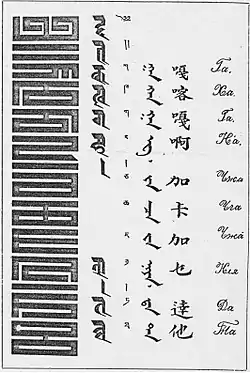
In 1587, the translator and scholar Ayuush Güüsh (Аюуш гүүш) created the Galik alphabet (Али-гали Ali-gali), inspired by the third Dalai Lama, Sonam Gyatso. It primarily added extra characters for transcribing Tibetan and Sanskrit terms when translating religious texts, and later also from Chinese. Some of those characters are still in use today for writing foreign names (as listed below).[39]
ᠸ
| Letter[1]: 38 [28]: 44–45 | |
|---|---|
| w | Transliteration[lower-alpha 18] |
| ᠸ[lower-alpha 43] | Initial |
| ᠸ[lower-alpha 44] | Medial (syllable-initial) |
| Medial (syllable-final) | |
| ᠸ⟨?⟩ ⟨ᠧ⟩[lower-alpha 45] | Final |
| C-V syllables[28]: 45 | |
|---|---|
| w‑a, w‑e[lower-alpha 46] | Transliteration |
| ᠸᠠ⟨?⟩ ⟨ ⟩[lower-alpha 47] |
Final |
- Transcribes Chakhar /w/;[13][27] Transliterated into Cyrillic with the letter в.[28][25]
- Used to transcribe foreign words (originally for v in Sanskrit व /va/). Transcribes /w/ in Tibetan ཝ /wa/;[40]: 254 [3]: 28 [29]: 113 Old Uyghur and Chinese loanwords.[1]: 34–35
- Derived from Old Uyghur bet (𐽱),[2]: 539–540, 545–546 [29]: 111, 113 and waw (before a separated vowel).
- Produced with ⇧ Shift+W using the Windows Mongolian keyboard layout.[30]
ᠹ
| Letter[28]: 45 | |
|---|---|
| f | Transliteration |
| ᠹ[lower-alpha 48] | Initial |
| ᠹ | Medial |
| ᠹ | Final |
| Ligatures[28]: 45 | |||||
|---|---|---|---|---|---|
| fa | fē | fi | fo | fü | Transliteration |
| ᠹᠠ | ᠹᠧ | ᠹᠢ | ᠹᠣ | ᠹᠦ᠋ | Alone |
| ᠹᠠ | ᠹᠧ | ᠹᠢ | ᠹᠣ | ᠹᠦ | Initial |
| ᠹᠠ | ᠹᠧ | ᠹᠢ | ᠹᠣ | ᠹᠦ᠋ | Medial |
| ᠹᠠ | ᠹᠧ | ᠹᠢ | ᠹᠣ | ᠹᠦ᠋ | Final |
ᠺ
| Letter | |
|---|---|
| g | Transliteration[lower-alpha 18] |
| ᠺ | Initial |
| ᠺ | Medial |
| ᠺ | Final |
| Ligatures | |||||
|---|---|---|---|---|---|
| ga | gē | gi | go | gü | Transliteration |
| ᠺᠠ | ᠺᠧ | ᠺᠢ | ᠺᠣ | ᠺᠦ᠋⟨?⟩ (w/ tail)[lower-alpha 49] | Alone |
| ᠺᠠ | ᠺᠧ | ᠺᠢ | ᠺᠣ | ᠺᠦ | Initial |
| ᠺᠠ | ᠺᠧ | ᠺᠢ | ᠺᠣ | ᠺᠦ᠋⟨?⟩ (w/ yodh)[lower-alpha 50] | Medial |
| ᠺᠠ | ᠺᠧ | ᠺᠢ | ᠺᠣ | ᠺᠦ᠋⟨?⟩ (w/ tail)[lower-alpha 51] | Final |
ᠻ
| Letter[28]: 46 | |
|---|---|
| k | Transliteration[lower-alpha 18] |
| ᠻ | Initial |
| ᠻ | Medial |
| ᠻ | Final |
| Ligatures[28]: 46 | |||||
|---|---|---|---|---|---|
| ka | kē | ki | ko | kü | Transliteration |
| ᠻᠠ | ᠻᠧ | ᠻᠢ | ᠻᠣ | ᠻᠦ᠋ | Alone |
| ᠻᠠ | ᠻᠧ | ᠻᠢ | ᠻᠣ | ᠻᠦ | Initial |
| ᠻᠠ | ᠻᠧ | ᠻᠢ | ᠻᠣ | ᠻᠦ᠋ | Medial |
| ᠻᠠ | ᠻᠧ | ᠻᠢ | ᠻᠣ | ᠻᠦ᠋ | Final |
ᠼ
| Letter[28]: 46 | |
|---|---|
| c | Transliteration |
| ᠼ[lower-alpha 52] | Initial |
| ᠼ[lower-alpha 53] | Medial |
| ᠼ[lower-alpha 54] | Final |
- Transcribes Chakhar /t͡s/;[13][27] Transliterated into Cyrillic with the letter ц.[28][25]
- Used to transcribe foreign words (originally for tsʰ in Tibetan ཚ /tsʰa/; Sanskrit छ /cha/).[40]: 89, 144, 245, 254 [3]: 28
- Galik letter, derived from Pre-classical Mongolian tsade č/ǰ ⟨ᠴ~ᠵ⟩.[1]: 35
- Produced with C using the Windows Mongolian keyboard layout.[30]
ᠽ
| Letter[28]: 46 | |
|---|---|
| z | Transliteration |
| ᠽ[lower-alpha 55] | Initial |
| ᠽ[lower-alpha 56] | Medial |
| ᠽ[lower-alpha 57] | Final |
- Transcribes Chakhar /d͡z/;[13][27] Transliterated into Cyrillic with the letter з.[28][25]
- Used to transcribe foreign words (originally for dz in Tibetan ཛ /dza/; Sanskrit ज /ja/).[40]: 89, 144, 245, 254 [3]: 28
- Galik letter, derived from Pre-classical Mongolian tsade č/ǰ ⟨ᠴ~ᠵ⟩.[1]: 35
- Produced with Z using the Windows Mongolian keyboard layout.[30]
ᠾ
| Letter[28]: 47 | |
|---|---|
| h | Transliteration |
| ᠾ[lower-alpha 58] | Initial |
| ᠾ | Medial |
| ᠾ | Final |
- Transcribes Chakhar /h/[x];[13][27] Transliterated into Cyrillic with the letter х.[28][25]
- Used to transcribe foreign words (originally for h in Tibetan ཧ /ha/, ྷ /-ha/; Sanskrit ह /ha/).[40]: 69, 102, 194, 244–249, 255 [3]: 27–28 [16]: 59
- Galik letter, borrowed from the Tibetan alphabet, and preceded by an aleph for initial form.[16]: 59–60 [2]: 545–546 [1]: 35
- Produced with ⇧ Shift+H using the Windows Mongolian keyboard layout.[30]
ᠿ
| Letter[28]: 47 | |
|---|---|
| ž | Transliteration |
| ᠿ[lower-alpha 59] | Initial |
| — | Medial |
| — | Final |
- Transcribes Chakhar /ʐ/;[13][27] Transliterated into Cyrillic with the letter ж.[28][25]
- Transcribes Chinese r /ɻ/ ([ɻ ~ ʐ];[lower-alpha 60] as in 日 Ri), and used in Inner Mongolia. Always followed by an i.[27]
- Transliterates /ʒ/ in Tibetan ཞ /ʒa/.[40]: 254 (紗)
- Produced with ⇧ Shift+R using the Windows Mongolian keyboard layout.[30]
ᡁ
| Letter | |
|---|---|
| zh | Transliteration |
| ᡁ | Initial |
| — | Medial |
| — | Final |
ᡂ
| Letter | |
|---|---|
| ch | Transliteration |
| ᡂ | Initial |
| — | Medial |
| — | Final |
Punctuation
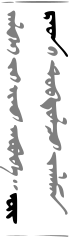
When written between words, punctuation marks use space on both sides of them. They can also appear at the very end of a line, regardless of where the preceding word ends.[23]: 99 Red (cinnabar) ink is used in many manuscripts, either to symbolize emphasis or respect.[23]: 241 Modern punctuation incorporates Western marks: parentheses; quotation, question, and exclamation marks; as well as precomposed ⁈ and ⁉.[19]: 535–536
| Form(s) | Name | Function(s) |
|---|---|---|
| ᠀ | Birga: ᠪᠢᠷᠭᠠ⟨?⟩ birγ‑a (бярга byarga) | Marks start of a book, chapter, passage, or first line |
| ᠀᠋ | ||
| ᠀᠌ | ||
| ᠀᠍ | ||
| [...] | ||
| ᠂ | 'Dot': ᠴᠡᠭ čeg (цэг tseg) | Comma |
| ᠃ | 'Double-dot': ᠳᠠᠪᠬᠤᠷ ᠴᠡᠭ dabqur čeg (давхар цэг davkhar tseg) | Period / full stop |
| ᠅ | 'Four-fold/quadripartite dot': ᠳᠥᠷᠪᠡᠯᠵᠢᠨ ᠴᠡᠭ dörbelǰin čeg (дөрвөлжин цэг dörvöljin tseg) | Marks end of a passage, paragraph, or chapter |
| ᠁ | 'Dotted line': ᠴᠤᠪᠠᠭᠠ⟨?⟩/ᠴᠤᠪᠤᠭᠠ ᠴᠡᠭ⟨?⟩ čubaγ‑a/čubuγ‑a čeg (цуваа цэг tsuvaa tseg) | Ellipsis |
| ᠄ | Хос цэг khos tseg | Colon |
| ᠆ | 'Spine, backbone': ᠨᠢᠷᠤᠭᠤ niruγu (нуруу nuruu) | Mongolian soft hyphen |
| ᠊ | Mongolian non-breaking hyphen, or stem extender |
Numerals
.jpg.webp)
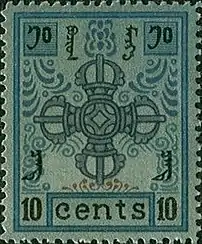
Mongolian numerals are either written from left to right, or from top to bottom.[3]: 54 [28]: 9
| 0 | 1 | 2 | 3 | 4 | 5 | 6 | 7 | 8 | 9 |
|---|---|---|---|---|---|---|---|---|---|
| ᠐ | ᠑ | ᠒ | ᠓ | ᠔ | ᠕ | ᠖ | ᠗ | ᠘ | ᠙ |
Components
Listed in the table below are letter components (graphemes, or in Mongolian: ᠵᠢᠷᠤᠯᠭᠠ ǰirulγ‑a / зурлага zurlaga) commonly used across the script. Some of these are used with several letters, and others to contrast between them. As their forms and usage may differ between § writing styles however, examples of these can be found under this section below.
| Form | Name(s) | Used with |
|---|---|---|
| ᠡ | 'Crown': ᠲᠢᠲᠢᠮ titim (тит(и/э)м tit(i/e)m) | all initial vowels (a, e, i, o, u, ö, ü, ē), and some initial consonants (n, m, l, h, etc). |
| ᠊ᠡ | 'Tooth': ᠠᠴᠤᠭ ačuγ (ацаг atsag) | a, e, n, ng, q, γ, m, l, d, etc; historically also r. |
| 'Tooth': ᠰᠢᠳᠦ sidü (шүд shüd) | ||
| ᠊᠊ | 'Spine, backbone': ᠨᠢᠷᠤᠭᠤ niruγu (нуруу nuruu) | the vertical line running through words. |
| ᠊ᠠ | 'Tail': ᠰᠡᠭᠦᠯ segül (сүүл süül) | a, e, n, etc. A final connected flourish/swash pointing right. |
| ᠊ᠰ᠋ | 'Short tail': ᠪᠣᠭᠤᠨᠢ ᠰᠡᠭᠦᠯ boγuni segül (богино/богонь сүүл bogino/bogoni süül) | final q, γ, m, and s |
| ᠠ⟨?⟩ ⟨⟩ |
[...]: ᠣᠷᠬᠢᠴᠠ orkiča (орхиц orkhits) | separated final a or e. |
| 'Sprinkling, dusting': ᠴᠠᠴᠤᠯᠭᠠ⟨?⟩ čačulγ‑a (цацлага tsatslaga) | lower part of final a or e; the lower part of final g. | |
| ᡳ᠌ | 'Hook': ᠳᠡᠭᠡᠭᠡ degege (дэгээ degee) | final i and d. |
| ᠵ | 'Shin, stick': ᠰᠢᠯᠪᠢ silbi (шилбэ shilbe) | i; initial ö and ü; the upper part of final g; ǰ and y, etc. |
| 'Straight shin': ᠰᠢᠯᠤᠭᠤᠨ ᠰᠢᠯᠪᠢ siluγun silbi (шулуун шилбэ shuluun shilbe) | ||
| 'Long tooth': ᠤᠷᠲᠤ ᠰᠢᠳᠦ urtu sidü (урт шүд urt shüd) | ||
| ᠶ | 'Shin with upturn': ᠡᠭᠡᠲᠡᠭᠡᠷ ᠰᠢᠯᠪᠢ egeteger silbi (э(э)тгэр шилбэ e(e)tger shilbe) | y. |
| ᠸ | Shin with downturn: ᠮᠠᠲᠠᠭᠠᠷ ᠰᠢᠯᠪᠢ mataγar silbi (матгар шилбэ matgar shilbe) | ē and w. |
| ᠷ | Horned shin: ᠥᠷᠭᠡᠰᠦᠲᠡᠢ ᠰᠢᠯᠪᠢ örgesütei silbi (өргөстэй шилбэ örgöstei shilbe) | r, and historically also the upper part of final g and separated a. |
| ᠳ᠋ | 'Looped shin': ᠭᠣᠭᠴᠤᠭᠠᠲᠠᠢ ᠰᠢᠯᠪᠢ γoγčuγatai silbi (гогцоотой шилбэ gogtsootoi shilbe) | t and d. |
| ᡁ | 'Hollow shin': ᠬᠥᠨᠳᠡᠢ ᠰᠢᠯᠪᠢ köndei silbi (хөндий шилбэ khöndii shilbe) | h and zh. |
| ᠢ | 'Bow': ᠨᠤᠮᠤ numu (нум num) | final i, o–ü, and r; ng, b, p, k, g, etc. |
| ᠊ᠣ | 'Belly, stomach,' loop, contour: ᠭᠡᠳᠡᠰᠦ gedesü (гэдэс gedes) | the enclosed part of o–ü, b, p, initial t and d, etc. |
| ᠲ | 'Hind-gut': ᠠᠷᠤ ᠶᠢᠨ ᠭᠡᠳᠡᠰᠦ⟨?⟩ aru‑yin gedesü (арын гэдэс aryn gedes) | initial t and d. |
| ᠊ᠹ | Flaglet, tuft: ᠵᠠᠷᠲᠢᠭ ǰartiγ (зартиг zartig Wylie: 'jar-thig) | the left-side diacritic of f and z. |
| ᠽ | ||
| ᠬ | [...]: [...] (ятгар зартиг yatgar zartig) | initial q and γ. |
| ᠊ᠮ | 'Braid, pigtail': ᠭᠡᠵᠢᠭᠡ geǰige (гэзэг gezeg) | m. |
| 'Horn': ᠡᠪᠡᠷ eber (эвэр ever) | ||
| ᠊ᠯ | 'Horn': ᠡᠪᠡᠷ eber (эвэр ever) | l. |
| 'Braid, pigtail': ᠭᠡᠵᠢᠭᠡ geǰige (гэзэг gezeg) | ||
| ᠊ᠰ | 'Corner of the mouth': ᠵᠠᠪᠠᠵᠢ ǰabaǰi (зав(и/ь)ж zavij) | s and š. |
| ᠴ | [...]: ᠰᠡᠷᠡᠭᠡ ᠡᠪᠡᠷ serege eber (сэрээ эвэр seree ever) | č. |
| 'Fork': ᠠᠴᠠ ača (ац ats) | ||
| ᠵ | [...]: [...] (жалжгар эвэр jaljgar ever) | ǰ. |
| 'Tusk, fang': ᠰᠣᠶᠤᠭᠠ⟨?⟩ soyuγ‑a (соёо soyoo) |
Examples
Writing styles
As exemplified in this section, the shapes of glyphs may vary widely between different styles of writing and choice of medium with which to produce them. The development of written Mongolian can be divided into the three periods of pre-classical (beginning – 17th century), classical (16/17th century – 20th century), and modern (20th century onward):[26][3]: 2–3, 17, 23, 25–26 [16]: 58–59 [2]: 539–540, 545–546 [28]: 62–63 [29]: 111, 113–114 [18]: 40–42, 100–101, 117 [1]: 34–37 [51]: 8–11 [35]: 211–215
- Rounded letterforms tend to be more prevalent with handwritten styles (compare printed and handwritten arban 'ten').
| Block‑printed | Pen-written form | Modern brush‑ |
Transliteration(s) & 'translation' | |
|---|---|---|---|---|
| Uyghur Mong. form | semi-modern forms | |||
 |
 |
 |
 |
arban 'ten' |
 | ||||
- Final letterforms with a right-pointing tail (such as those of a, e, n, q, γ, m, l, s, š, and d) may have the notch preceding it in printed form, written in a span between two extremes: from as a more or less tapered point, to a fully rounded curve in handwriting.
- The long final tails of a, e, n, and d in the texts of pre-classical Mongolian can become elongated vertically to fill up the remainder of a line. Such tails are used consistently for these letters in the earliest 13th to 15th century Uyghur Mongolian style of texts.
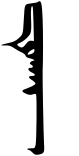

| Block‑printed | Pen-written forms | Modern brush‑ |
Transliteration(s) & 'translation' | |
|---|---|---|---|---|
| Uyghur Mong. forms | semi-modern forms | |||
 |
 |
 |
 |
‑ača/ |
 | ||||
 |
 |
 |
|
‑un/ |
 | ||||
 |
 |
 |
 |
‑ud/ |
 | ||||
 |
 |
 |
 |
ba 'and' |
- A hooked form of yodh was borrowed from the Manchu alphabet in the 19th century to distinguish initial y from ǰ. The handwritten form of final-shaped yodh (i, ǰ, y), can be greatly shortened in comparison with its initial and medial forms.
| Block‑printed | Pen-written forms | Modern brush‑ |
Transliteration(s) & 'translation' | |
|---|---|---|---|---|
| Uyghur Mong. forms | semi-modern forms | |||
 |
 |
 |
 |
‑i |
 | ||||
 |
 |
 |
 |
‑yi |
 |
 |
 |
 |
‑yin |
 | ||||
 |
 |
 |
 |
sain/sayin 'good' |
 | ||||
 |
 |
 |
 |
yeke 'great' |
- The definite status or function of diacritics was not established prior to classical Mongolian. As such, the dotted letters n, γ, and š, can be found sporadically dotted or altogether lacking them. Additionally, both q and γ could be (double-)dotted to identify them regardless of their sound values. Final dotted n is also found in modern Mongolian words. Any diacritical dots of γ and n can be offset downward from their respective letters (as in ᠭᠣᠣᠯ
 γool and ᠭᠦᠨ ᠢ⟨?⟩
  gün‑i).
 - When a bow-shaped consonant is followed by a vowel in Uyghur style text, said bow can be found to notably overlap it (see bi). A final b has, in its final pre-modern form, a bow-less final form as opposed to the common modern one:[1]: 39
| Block‑printed | Pen-written forms | Modern brush‑ |
Transliteration(s) & 'translation' | |
|---|---|---|---|---|
| Uyghur Mong. forms | semi-modern forms | |||
 |
 |
 |
 |
‑u/ |
 |
 |
 |
 |
bi 'I' |
 |
 |
 |
 |
ab (intensifying particle) |
- As in
 /
/ kü, köke, ǰüg and separated a/e, two teeth can also make up the top-left part of a kaph (k/g) or aleph (a/e) in pre-classical texts. In back-vocalic words of Uyghur Mongolian, qi was used in place of ki, and can therefore be used to identify this stage of the written language. An example of this appears in the suffix
  ‑taqi/‑daqi.[18]: 100, 117
| Block‑printed | Pen-written forms | Modern brush‑ |
Transliteration(s) & 'translation' | |
|---|---|---|---|---|
| Uyghur Mong. forms | semi-modern forms | |||
 |
 |
 |
|
‑a/ |
 | ||||
 | ||||
 | ||||
 |
 |
 |
 |
‑luγ‑a |
 |
 |
 |
 |
köke 'blue' |
| köge 'soot' | ||||
 |
 |
 |
 |
ǰüg 'direction' |
- In pre-modern Mongolian, medial ml (ᠮᠯ) forms a ligature:
 .
. - A pre-modern variant form for final s appears in the shape of a short final n ⟨ᠰ᠋⟩, derived from Old Uyghur zayin (𐽴). It tended to be replaced by the mouth-shaped form and is no longer used. An early example of it is found in the name of Gengis Khan on the Stele of Yisüngge: ᠴᠢᠩᠭᠢᠰ᠋ Činggis. A zayin-shaped final can also appear as part of final m and γ.
| Block‑printed | Pen-written forms | Transliteration(s) & 'translation' | |
|---|---|---|---|
| Uyghur Mong. forms | semi-modern forms | ||
 |
 |
 |
es(‑)e 'not, no', (negation) |
 | |||
 |
 |
 |
ulus 'nation' |
 | |||
 |
 |
 |
nom 'book' |
 |
 |
 |
čaγ 'time' |
 |
 | ||
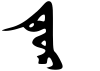
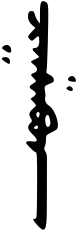
- Initial taw (t/d) can, akin to final mem (m), be found written quite explicitly loopy (as in nom 'book' and toli 'mirror'). The lamedh (t or d) may appear simply as an oval loop or looped shin, or as more angular, with an either closed or open counter (as in ‑daki/‑deki or ‑dur/‑dür). As in metü, a Uyghur style word-medial t can sometimes be written with the pre-consonantal form otherwise used for d. Taw was applied to both initial t and d from the outset of the script's adoption. This was done in imitation of Old Uyghur which, however, had lacked the phoneme d in this position.
| Block‑printed | Pen-written forms | Modern brush‑ |
Transliteration(s) & 'translation' | |
|---|---|---|---|---|
| Uyghur Mong. forms | semi-modern forms | |||
 |
 |
[...] |  |
toli 'mirror' |
 |
 |
 |
[...] | ‑daki/‑deki |
 |
 |
 |
[...] | ‑tur/ |
 |
 |
 |
‑dur/ | |
 |
 |
 |
[...] | metü 'as' |
- Following the late classical Mongolian orthography of the 17th and 18th centuries, a smooth and angular tsade (ᠵ and ᠴ) has come to represent ǰ and č respectively. The tsade before this was used for both these phonemes, regardless of graphical variants, as no ǰ had existed in Old Uyghur:
| Block‑printed | Transliteration(s) & 'translation' | |
|---|---|---|
| Uyghur Mong. form | semi-modern form | |
 |
 |
čečeg 'flower' |
| Block-printed semi-modern form | Pen-written form | Transliteration(s) & 'translation' |
|---|---|---|
 |
 |
qačar/γaǰar 'cheek/place' |
- As in sara and ‑dur/‑dür, a resh (of r, and sometimes of l) can appear as two teeth or crossed shins; adjacent, angled, attached to a shin and/or overlapping.
| Block‑printed | Pen-written form | Modern brush‑ |
Transliteration(s) & 'translation' | |
|---|---|---|---|---|
| Uyghur Mong. form | semi-modern forms | |||
 |
 |
 |
 |
sar(‑)a 'moon/month' |
 | ||||
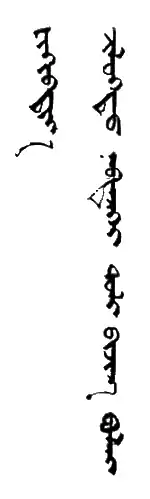
| Manuscript | Type | Unicode | Transliteration (first word) |
|---|---|---|---|
 |
 |
ᠸᠢᠺᠢᠫᠧᠳᠢᠶᠠ᠂ ᠴᠢᠯᠦᠭᠡᠲᠦ ᠨᠡᠪᠲᠡᠷᠬᠡᠢ ᠲᠣᠯᠢ ᠪᠢᠴᠢᠭ ᠪᠣᠯᠠᠢ᠃ |
ᠸᠢ wi/ |
| ᠺᠢ gi/ki | |||
| ᠫᠧ pē/pé | |||
| ᠲᠢ di | |||
| ᠶᠠ ya | |||
| |||
Gallery

.jpg.webp) Mongolian calligraphy of the 13th century work Оюун Түлхүүр (Key of Intelligence)
Mongolian calligraphy of the 13th century work Оюун Түлхүүр (Key of Intelligence)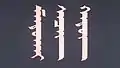 ''Mandukhai setsen khatan'' (film) title screen, 1988
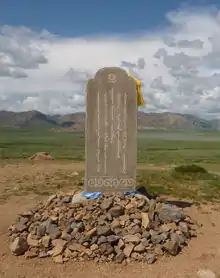 Stele for Queen Mandukhai the Wise. See also: Mongolian inscriptions (Wikimedia Commons)
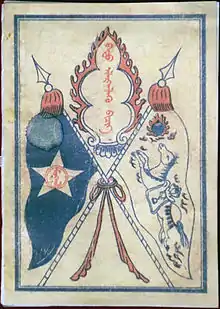
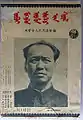 Cover page with printed hand-lettering in red, early 20th century
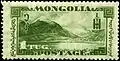 Postage stamp with words augmented with letters from the Manchu alphabet, 1932. See also: Stamps of Mongolia (Commons)
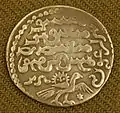
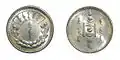 1 Mongolian tögrög, 1925. See also: Coins with Mongolian script (Commons)
_-_%D0%B2%D1%8B%D0%BF%D1%83%D1%81%D0%BA_6%25_%D0%BE%D0%B1%D1%8F%D0%B7%D0%B0%D1%82%D0%B5%D0%BB%D1%8C%D1%81%D1%82%D0%B2%252C_10_%D0%B4%D0%BE%D0%BB%D0%BB%D0%B0%D1%80%D0%BE%D0%B2.jpg.webp) Mongolian dollar with a long body of printed text, 1921
Mongolian dollar with a long body of printed text, 1921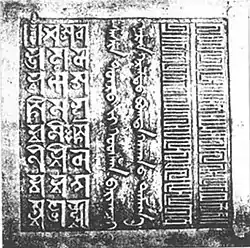 Imperial seal of the Bogd Khan, ca 1911. See also: Seals with Mongolian script (Commons)
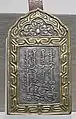 Mixed Manchu–Mongolian text on a Paiza.
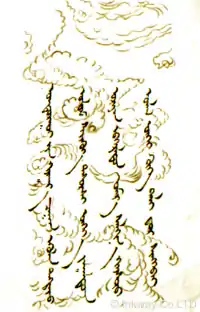 Poem composed and brush-written by Injinash, 19th century. See also: Mongolian calligraphy (Commons)
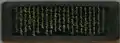 Mongolian Diamond Sutra manuscript, 19th century. See also: Manuscripts in Mongolian script (Commons)
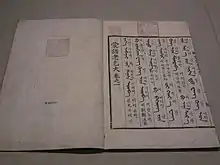 Nogeoldae textbook in Korean and Mongolian, 18th century. See also: Documents in Mongolian (Commons)
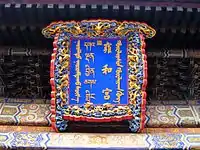 Mongolian on the far left of a Yonghe Temple board in Beijing, 1722. See also: Signs in Mongolian script (Commons)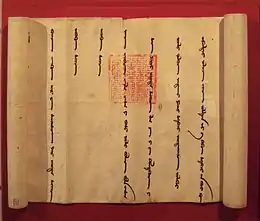
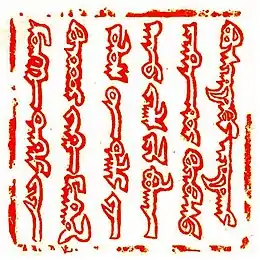 Imperial seal of Güyük Khan in letter to Pope Innocent IV, 1246
Child systems
The Mongol script has been the basis of alphabets for several languages. First, after overcoming the Uyghur script ductus, it was used for Mongolian itself.
Clear script (Oirat alphabet)
In 1648, the Oirat Buddhist monk Zaya-pandita Namkhaijamco created this variation with the goals of bringing the written language closer to the actual pronunciation of Oirat and making it easier to transcribe Tibetan and Sanskrit. The script was used by the Kalmyks of Russia until 1924, when it was replaced by the Cyrillic alphabet. In Xinjiang, China, the Oirat people still use it.
Manchu alphabet
The Manchu alphabet was developed from the Mongolian script in the early 17th century to write the Manchu language. A variant is still used to write Xibe. It is also used for Daur. Its folded variant may for example be found on Chinese Qing seals.
Vagindra alphabet
Another alphabet, sometimes called Vagindra or Vaghintara, was created in 1905 by the Buryat monk Agvan Dorjiev (1854–1938). It was also meant to reduce ambiguity, and to support the Russian language in addition to Mongolian. The most significant change, however, was the elimination of the positional shape variations. All letters were based on the medial variant of the original Mongol alphabet. Fewer than a dozen books were printed using it.
Evenki alphabet
The Qing dynasty Qianlong Emperor erroneously identified the Khitan people and their language with the Solons, leading him to use the Solon language (Evenki) to "correct" Chinese character transcriptions of Khitan names in the History of Liao in his "Imperial Liao Jin Yuan Three Histories National Language Explanation" (欽定遼金元三史國語解/钦定辽金元三史国语解 Qīndìng Liáo Jīn Yuán Sānshǐ Guóyǔjiě) project. The Evenki words were written in the Manchu script in this work.
In the 1980s, an experimental alphabet for Evenki was created.
Unicode
Mongolian script was added to the Unicode standard in September 1999 with the release of version 3.0. However, there are multiple design issues in Mongolian Unicode that have not been fixed until now.[52] The model is extremely unstable[53] and the user group dislike the 1999 design.
- The 1999 Mongolian script Unicode codes are duplicated and not searchable.
- The 1999 Mongolian script Unicode model has multiple layers of FVS (free variation selectors), MVS, ZWJ, NNBSP, and those variation selections conflict with each other, which create incorrect results.[54] Furthermore, different vendors understood the definition of each FVS differently, and developed multiple applications in different standards.[55]
- The Mongolian User Group is in a panic, and over 10,000 users signed up in 10 days in 2019 April to request local authority to fundamentally review the 1999 Unicode model.
Blocks
The Unicode block for Mongolian is U+1800–U+18AF. It includes letters, digits and various punctuation marks for Hudum Mongolian, Todo Mongolian, Xibe (Manchu), Manchu proper, and Ali Gali, as well as extensions for transcribing Sanskrit and Tibetan.
| Mongolian[1][2] Official Unicode Consortium code chart (PDF) | ||||||||||||||||
| 0 | 1 | 2 | 3 | 4 | 5 | 6 | 7 | 8 | 9 | A | B | C | D | E | F | |
| U+180x | ᠀ | ᠁ | ᠂ | ᠃ | ᠄ | ᠅ | ᠆ | ᠇ | ᠈ | ᠉ | ᠊ | FV S1 |
FV S2 |
FV S3 |
MV S |
FV S4 |
| U+181x | ᠐ | ᠑ | ᠒ | ᠓ | ᠔ | ᠕ | ᠖ | ᠗ | ᠘ | ᠙ | ||||||
| U+182x | ᠠ | ᠡ | ᠢ | ᠣ | ᠤ | ᠥ | ᠦ | ᠧ | ᠨ | ᠩ | ᠪ | ᠫ | ᠬ | ᠭ | ᠮ | ᠯ |
| U+183x | ᠰ | ᠱ | ᠲ | ᠳ | ᠴ | ᠵ | ᠶ | ᠷ | ᠸ | ᠹ | ᠺ | ᠻ | ᠼ | ᠽ | ᠾ | ᠿ |
| U+184x | ᡀ | ᡁ | ᡂ | ᡃ | ᡄ | ᡅ | ᡆ | ᡇ | ᡈ | ᡉ | ᡊ | ᡋ | ᡌ | ᡍ | ᡎ | ᡏ |
| U+185x | ᡐ | ᡑ | ᡒ | ᡓ | ᡔ | ᡕ | ᡖ | ᡗ | ᡘ | ᡙ | ᡚ | ᡛ | ᡜ | ᡝ | ᡞ | ᡟ |
| U+186x | ᡠ | ᡡ | ᡢ | ᡣ | ᡤ | ᡥ | ᡦ | ᡧ | ᡨ | ᡩ | ᡪ | ᡫ | ᡬ | ᡭ | ᡮ | ᡯ |
| U+187x | ᡰ | ᡱ | ᡲ | ᡳ | ᡴ | ᡵ | ᡶ | ᡷ | ᡸ | |||||||
| U+188x | ᢀ | ᢁ | ᢂ | ᢃ | ᢄ | ᢅ | ᢆ | ᢇ | ᢈ | ᢉ | ᢊ | ᢋ | ᢌ | ᢍ | ᢎ | ᢏ |
| U+189x | ᢐ | ᢑ | ᢒ | ᢓ | ᢔ | ᢕ | ᢖ | ᢗ | ᢘ | ᢙ | ᢚ | ᢛ | ᢜ | ᢝ | ᢞ | ᢟ |
| U+18Ax | ᢠ | ᢡ | ᢢ | ᢣ | ᢤ | ᢥ | ᢦ | ᢧ | ᢨ | ᢩ | ᢪ | |||||
| Notes | ||||||||||||||||
The Mongolian Supplement block (U+11660–U+1167F) was added to the Unicode Standard in June, 2016 with the release of version 9.0:
| Mongolian Supplement[1][2] Official Unicode Consortium code chart (PDF) | ||||||||||||||||
| 0 | 1 | 2 | 3 | 4 | 5 | 6 | 7 | 8 | 9 | A | B | C | D | E | F | |
| U+1166x | 𑙠 | 𑙡 | 𑙢 | 𑙣 | 𑙤 | 𑙥 | 𑙦 | 𑙧 | 𑙨 | 𑙩 | 𑙪 | 𑙫 | 𑙬 | |||
| U+1167x | ||||||||||||||||
| Notes | ||||||||||||||||
Rendering issues
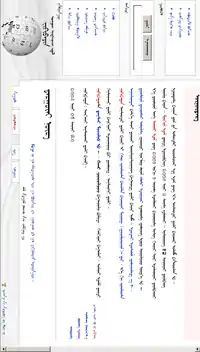
Although the Mongolian script has been defined in Unicode since 1999, there was no native support for Unicode Mongolian from the major vendors until the release of the Windows Vista operating system in 2007 and fonts need to be installed in Windows XP and Windows 2000 to show properly, and so Unicode Mongolian is not yet widely used. In China, legacy encodings such as the Private Use Areas (PUA) Unicode mappings and GB18030 mappings of the Menksoft IMEs (espc. Menksoft Mongolian IME) are more commonly used than Unicode for writing web pages and electronic documents in Mongolian. In addition, unlike the usual vertical format, computers tend to show the script in right-to-left lines by default.
The inclusion of a Unicode Mongolian font and keyboard layout in Windows Vista has meant that Unicode Mongolian is now gradually becoming more popular, but the complexity of the Unicode Mongolian encoding model and the lack of a clear definition for the use variation selectors are still barriers to its widespread adoption, as is the lack of support for inline vertical display. As of 2015 there are no fonts that successfully display all of Mongolian correctly when written in Unicode. A report published in 2011 revealed many shortcomings with automatic rendering in all three Unicode Mongolian fonts the authors surveyed, including Microsoft's Mongolian Baiti.[56]
Furthermore, Mongolian language support has suffered from buggy implementations: the initial version of Microsoft's Mongolian Baiti font (version 5.00) was, in the supplier's own words, "almost unusable",[57] and as of 2011 there remain some minor bugs with the rendering of suffixes in Firefox.[58] Other fonts, such as Monotype's Mongol Usug and Myatav Erdenechimeg's MongolianScript, suffer even more serious bugs.[56]
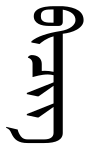
In January 2013, Menksoft released several OpenType Mongolian fonts, delivered with its Menksoft Mongolian IME 2012. These fonts strictly follow Unicode standard, i.e. bichig is no longer realized as "B+I+CH+I+G+FVS2" (incorrect) but "B+I+CH+I+G" (correct), which is not done by Microsoft and Founder's Mongolian Baiti, Monotype's Mongol Usug, or Myatav Erdenechimeg's MongolianScript.[59] However, due to the impact of Mongolian Baiti, many still use the Microsoft defined incorrect realization "B+I+CH+I+G+FVS2", which results in an incorrect rendering in correctly-designed fonts like Menk Qagan Tig.
Mongolian script can be represented in LaTeX with the MonTeX package.[60]
Sometimes even if a font is installed the script may display as horizontal rather than vertical depending on the operating system or font.
Samples
The text samples below should resemble their image counterparts. This ensures that a text in Mongolian script is being rendered somewhat properly. Note that in some browsers, letters are rotated 90° counterclockwise. If an isolate letter a (ᠠ) resembles a 'W' and not a 'Σ', rotate the letters 90° clockwise.
| Image | Text | Transliteration(s) |
|---|---|---|
 |
ᠭᠡᠨᠡ | gen |
|
(‑a) / ‑e |
| Image | Text | Transliteration(s) |
|---|---|---|
|
ᠶᠢᠨ | ‑yin |
 |
ᠢᠶᠠᠷ | ‑iyar / ‑iyer |
|
ᠳᠦᠷ | ‑dur / ‑dür |
| Image | Text | Transliteration |
|---|---|---|
 |
ᠪᠢᠯᠢᠭ | bilig |
| Image | Text | Transliteration(s) |
|---|---|---|
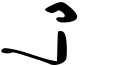 |
ᠵᠠ | ǰ‑a |
 |
ᠪᠦᠦ | buu / büü |
|
ᠦᠦ | uu / üü |
See also
- Mongolian writing systems
- Mongolian script
- ʼPhags-pa script
- Soyombo script
- Mongolian Latin alphabet
- Mongolian Cyrillic alphabet
- Mongolian transliteration of Chinese characters
- Sino–Mongolian Transliterations
- Mongolian Braille
- Mongolian Sign Language
- Mongolian name
Notes
- In Mongolian script: ᠮᠣᠩᠭᠣᠯ ᠪᠢᠴᠢᠭ ⟨
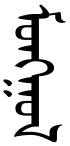 ⟩ Mongγol bičig; in Mongolian Cyrillic: Монгол бичиг Mongol bichig
 - In Mongolian script: ᠬᠤᠳᠤᠮ ᠮᠣᠩᠭᠣᠯ ᠪᠢᠴᠢᠭ; Mongolian Cyrillic: Khalkha: Худам Монгол бичиг, Khudam Mongol bichig, Buryat: Худам Монгол бэшэг, Khudam Mongol besheg, Kalmyk: Хуудм Моңһл бичг, Huudm Moñḥl bichg
- Mongolian: Уйгуржин монгол бичиг Uigurjin mongol bichig
- Mongolian: Хуучин монгол бичиг Khuuchin mongol bichig
- Mongolian: Шинэ үсэг Shine üseg
- As in the interjection ᠠ a (аа aa) 'a!, oh!, well!'.[26]: 1
- As in the exclamation ⟨ᠠ᠋/⟩ a/e (аа/ээ/оо/өө aa/ee/oo/öö), or interjection ᠡ e (ээ ee) 'oh!'.[26]: 1, 284
- As in the exclamation ⟨ᠠ᠋/⟩ a/e (аа/ээ/оо/өө aa/ee/oo/öö).[26]: 1
- As in ᠪᠠ ba (ба ba) 'and'.[26]: 64 [3]: 22
- As in ᠬᠡ/ᠬᠡᠭᠡ/ᠬᠡᠭᠡᠨ ke/kege/kegen (хээ khee) 'pattern, piping, design, stamp'.[26]: 438, 442
- Stand-in for the correct (context-sensitive only) glyph.
- As in ᠪᠢ bi (би bi) 'I'.[26]: 101 [3]: 22
- See the ᠬᠢ ‑ki suffix.[26]: 462
- As in ᠣ о (оо oo) 'powder' in general; 'face powder'.[26]: 598, 625
- As in ᠥ/ᠥᠭᠡ ö/öge (өө öö) 'fault; roughness, unevenness'.[26]: 627, 630
- As in the strengthening (emphatic) ᠭᠦ⟨?⟩ kü (хүү khüü) particle,[26]: 494 [16]: 46 or ᠬᠥ⟨?⟩/ᠬᠥᠭᠡ kö/köge (хөө khöö) 'soot; obstacle, hindrance; trouble', or 'ring of mail'.[26]: 475, 478
- As in ᠡᠭᠦᠦ/ᠦ egüü/ü (үү üü) 'wart; excrescence'.[26]: 303, 995
- Alternative scholarly transliterations include those of native ng (ŋ), γ (ɣ), ǰ (j), and those of galik ē (é), w (v), g (k), and k (kh).[25]
- Interrogative uu/üü particle (subject to vowel harmony; уу/үү/юу/юү uu/üü/yuu/yuü) used after the predicate.[26]: 437, 889, 1014 [3]: 172 [16]: 38 [1]: 53 [24]: 183 The positional variant ⟨ᠶᠤᠤ⟩ yuu/yüü (юу/юү yuu/yuü) is only used in the modern language.[26]: 0437 [1]: 53
- As in ᠣᠣ/ᠠᠭᠤᠤ uu/aγuu (—/агуу —/aguu) 'vast, great[ly]' etc.[26]: 18, 889
- As in the prohibitive particle ᠪᠤᠤ () buu/büü (бүү büü) 'don't'.[26]: 141, 153 [3]: 166 [16]: 38 Compare with the conjunction ᠪᠤᠶᠤ (
 ): xiii buyu (буюу buyuu) 'or',[26]: 132 [16]: 44 and ᠬᠦᠦ küü (хүү khüü) 'son, young boy'.[26]: 509 [28]: 37
 - As in ᠠᠢ ai (ай ai) 'category; sound, noise', or an pity/sympathy/worry-expressing interjection.[26]: 19
- As in ᠡᠢ ei (ий ii), an compassion/sorrow/fright/disgust-expressing interjection.[26]: 303
- As in ᠣᠢ oi (ой oi) 'woods, forest, grove; mind, intellect; memory',[26]: 603–604 or ᠤᠢ ui (уй ui) 'mourning, sorrow'.[26]: 866
- As in ᠥᠢ/ᠥᠶᠢ öi/öyi (өөе ööye), an exclamatory interjection meaning 'hello', 'I say', or 'look here',[26]: 633 [33] or ᠦᠢ ᠲᠦᠮᠡᠨ üi (үй üi) tümen 'multitude; innumerable'.[26]: 999
- As in the final diphthongs u-a and uu-a.[3]: 31
- As in ᠨᠢ ni (нь ni), a modern form used in place of ᠠᠨᠤ anu 'their' and ᠢᠨᠤ inu 'his'.[26]: 46–47, 412, 577 [3]: 139
- As in ᠬᠠ/ᠬᠠᠮᠢᠭᠠ⟨?⟩ qa/qamiγ‑a (хаа khaa) 'where'.[26]: 895, 923
- As in kö/хөө.[33]
- For the two looks of the particle ᠰᠢᠭ᠋⟨?⟩/ᠰᠢᠭ⟨?⟩ siγ/sig (шиг shig) 'similar to, similarly, like' etc, the choice between final γ or g is dependent on whether it occurs after a masculine or a feminine word, respectively.[26]: 699 [24]: 201
- As in the exclamation ᠮᠠ/ᠮᠠᠢ ma/mai (ма(й) ma(i)) 'here, take it'.[26]: 519, 522
- As in the intensifying ⟨ᠯᠠ⟩ / ᠡᠯᠡ la/le / ele (л l) particle, or ᠯᠠ la (лаа(н) laa(n)) 'candle'.[26]: 308, 513
- As in ᠰᠠ sa (саа saa) 'paralysis, palsy'.[26]: 653
- As in ᠱᠠ ša (шаа shaa) 'crape, netting'.[26]: 747
- As in ᠱᠣ šo (шоо shoo) 'dice, oracle bones'.[26]: 754
- As in the second person singular/plural pronoun ᠲᠠ ta 'you',[26]: 760 [3]: 85–86 or the intensifying ⟨ᠳᠠ⟩ da/de (даа/дээ daa/dee) particle used after the predicate.[26]: 211
- As in the second person singular pronoun ᠴᠢ či (чи chi) 'thou, you'.[26]: 174 [3]: 85–86
- As in the strengthening/intensifying (emphatic) and concessive ⟨ᠴᠤ⟩ ču/čü (ч ch) 'even, as for' particle,[26]: 203 [16]: 46 ᠴᠣ/ᠴᠣᠭᠤ čo/čoγu (цоо tsoo) 'through and through, completely',[26]: 193, 195 or ᠴᠦ čü (цүү tsüü) 'spike, bolt'.[26]: 209
- [2]: 546 As in ǰ‑a (за(а) za(a)) 'well', 'allright';[3]: 24 [35]: 345 [33] emphatic final;[16]: 46, 59 ǰ‑a particle expressing presumption, probability, or hope;[26]: 1018 doubt-expressing ǰ‑a and corroborative ǰ‑e particle.[38]
- As in the interjection ᠵᠠ ǰa (заа zaa) 'all right, yes, very good, well!, now then'.[26]: 1018
- See the ᠶᠢ⟨?⟩ ‑yi suffix.
- As in ᠵᠣ ǰo (зоо zoo) 'vertebrae'.[26]: 1065
- As in ᠸᠴᠢᠷ wčir (очир ochir),[28]: 44 or ᠸᠢᠸᠠᠩᠭᠢᠷᠢᠳ wiwanggirid (вивангирид vivangirid).[3]: 12 [33]
- As in ᠳᠠᠸᠠ dawa (даваа davaa), or ᠫᠠᠸᠯᠣᠸ⟨?⟩ pawlow.[28]: 44–45
- As in ᠫᠠᠸᠯᠣᠸ⟨?⟩ pawlow.[28]: 45 [33]
- [36][13]
- As in ᠪᠣᠳᠢᠰᠠᠳ᠋ᠸᠠ⟨?⟩ bodisadw‑a (бодисадва bodisadva).[28]: 45 [33]
- As in ᠹᠣᠲ᠋ᠣ᠋ foto (фото foto).[28]: 48
- With a vertical tail is correct, but isolate ᠺᠦ᠋ gü renders incorrectly (without) as of Noto 1.04.
- With a yodh/shilbe is correct, but medial ᠺᠦ᠋ gü renders incorrectly (without) as of Noto 1.04.
- With a vertical tail is correct, but final ᠺᠦ᠋ gü renders incorrectly (without) as of Noto 1.04.
- As in (n-dotted) ᠴᠧᠮᠧᠨ᠋ᠲ/ᠼᠧᠮᠧᠨ᠋ᠲ⟨?⟩ čēmēnt/cēmēnt (цемент tsyemyent).[28]: 49 [33]
- As in (n-dotted) ᠰᠲ᠋ᠠᠨ᠋ᠼᠢ⟨?⟩ stanci (станц stants).[28]: 48 [33]
- As in ᠲᠷᠠᠫᠧᠼ trapēc (трапец trapyets).[33]
- As in (medially n-dotted) ᠽᠠᠨ᠋ᠳᠠᠨ⟨?⟩ zandan (зандан zandan).[33]
- As in (medially n-dotted) ᠪᠧᠨ᠋ᠽᠢᠨ⟨?⟩ bēnzin (бензин benzin).[33]
- As in (n-dotted) ᠪᠷᠣᠨ᠋ᠽ⟨?⟩ bronz (бронз bronz).[33]
- As in sanskrit hari 'green',[3]: 15 or ᠾᠷᠣᠮ hrom (хром khrom).[33]
- As in ᠿᠦᠻᠣᠸ⟨?⟩ žükow (жуков jukov).[28]: 49
- Lee & Zee (2003) and Lin (2007) transcribe these as approximants, while Duanmu (2007) transcribes these as voiced fricatives. The actual pronunciation has been acoustically measured to be more approximant-like.[41]
- In digital typesetting, this shaping is achieved by inserting a U+180E MONGOLIAN VOWEL SEPARATOR (HTML
᠎·MVS) between the separated letters. - In digital typesetting, this shaping is achieved by inserting a U+202F NARROW NO-BREAK SPACE (HTML
 ·NNBSP) between the separated letters. - Scholarly/Scientific transliteration.[25]
- Separated suffixes starting with, or made up by the letter a include: ᠠ⟨?⟩ ‑a (vocative or dative-locative), ᠠᠴᠠ⟨?⟩ ‑ača (ablative), and ᠠᠴᠠᠭᠠᠨ⟨?⟩ ‑ačaγan (reflexive+ablative).[22]
- Separated suffixes starting with, or made up by the letter e include: ᠡ⟨?⟩ ‑e (vocative or dative-locative), ᠡᠴᠡ ‑eče (ablative), and ᠡᠴᠡᠭᠡᠨ ‑ečegen (reflexive+ablative).[22]
- Separated suffixes starting with, or made up by the letter i include: ᠢ⟨?⟩ ‑i (accusative), ᠢᠶᠠᠨ⟨?⟩ ‑iyan/‑iyen (reflexive), and ᠢᠶᠠᠷ⟨?⟩ ‑iyar/‑iyer (instrumental).[22]
- Separated suffixes starting with, or made up by the letter u include: ᠤ⟨?⟩ ‑u or ᠤᠨ⟨?⟩ ‑un (genitive), ᠤᠳ⟨?⟩ ‑ud (plural), and ᠤᠷᠤᠭᠤ⟨?⟩ ‑uruγu (directive).[22]
- Separated suffixes starting with, or made up by the letter ü include: ᠦ⟨?⟩ ‑ü or ᠦᠨ⟨?⟩ ‑ün (genitive), ᠦᠭᠡᠢ⟨?⟩ ‑ügei (negation), and ᠦᠳ⟨?⟩ ‑üd (plural).[22]
- Examples with doubled vowels include: tuuli 'epic, epic poem', ...[34]: 834
- Separated suffixes starting with the letter n include: ᠨᠠᠷ ‑nar/‑ner or ᠨᠤᠭᠤᠳ/ ᠨᠦᠭᠦᠳ⟨?⟩ ‑nuγud/‑nügüd (plural).[22]
- Separated suffixes starting with the letter b include: ᠪᠠᠨ ‑ban/‑ben (reflexive), and ᠪᠠᠷ ‑bar/‑ber (instrumental).[22]
- Separated suffixes starting with the letter k include: ᠬᠢ ‑ki or ᠬᠢᠨ ‑kin (case-bound possession).[22]
- Separated suffixes starting with the letter l include: ᠯᠤᠭᠠ⟨?⟩/ ᠯᠦᠭᠡ⟨?⟩ ‑luγ‑a/‑lüge (comitative).[22]
- Separated suffixes starting with the letter t include: ᠲᠠᠢ ‑tai/‑tei (comitative), ᠲᠠᠭᠠᠨ/ ᠲᠡᠭᠡᠨ ‑taγan/‑tegen (reflexive+dative-locative), ᠲᠠᠶᠢᠭᠠᠨ⟨?⟩/ ᠲᠡᠶᠢᠭᠡᠨ⟨?⟩ ‑tayiγan/‑teyigen (reflexive+comitative), and ᠲᠤ ‑tu/‑tü or ᠲᠤᠷ ‑tur/‑tür (dative-locative).[22]
- Separated suffixes starting with the letter d include: ᠳᠠᠬᠢ⟨?⟩ ‑daki/‑deki (dative-locative or ordinal), ᠳᠠᠭ⟨?⟩/ ᠳᠡᠭ⟨?⟩ ‑daγ/‑deg (regular action), ᠳᠠᠭᠠᠨ⟨?⟩/ ᠳᠡᠭᠡᠨ⟨?⟩ ‑daγan/‑degen (reflexive+dative-locative), ᠳᠤᠭᠠᠷ⟨?⟩/ ᠳᠦᠭᠡᠷ⟨?⟩ ‑duγar/‑düger (ordinal), and ᠳᠤ⟨?⟩ ‑du/‑dü or ᠳᠤᠷ⟨?⟩ ‑dur/‑dür (dative-locative).[22]
- Separated suffixes starting with the letter y include: ᠶᠢ⟨?⟩ ‑yi (accusative), ᠶᠢᠨ⟨?⟩ ‑yin (genitive), and ᠶᠤᠭᠠᠨ⟨?⟩/ ᠶᠦᠭᠡᠨ⟨?⟩ ‑yuγan/‑yügen (reflexive+accusative).[22]
References
- Janhunen, Juha (2006-01-27). The Mongolic Languages. Routledge. ISBN 978-1-135-79690-7.
- Daniels, Peter T. (1996). The World's Writing Systems. Oxford University Press. ISBN 978-0-19-507993-7.
- Poppe, Nicholas (1974). Grammar of Written Mongolian. Otto Harrassowitz Verlag. ISBN 978-3-447-00684-2.
- György Kara, "Aramaic Scripts for Altaic Languages", in Daniels & Bright The World's Writing Systems, 1994.
- Shepherd, Margaret (2013-07-03). Learn World Calligraphy: Discover African, Arabic, Chinese, Ethiopic, Greek, Hebrew, Indian, Japanese, Korean, Mongolian, Russian, Thai, Tibetan Calligraphy, and Beyond. Potter/Ten Speed/Harmony/Rodale. ISBN 978-0-8230-8230-8.
- Berkwitz, Stephen C.; Schober, Juliane; Brown, Claudia (2009-01-13). Buddhist Manuscript Cultures: Knowledge, Ritual, and Art. Routledge. ISBN 9781134002429.
- Chinggeltei. (1963) A Grammar of the Mongol Language. New York, Frederick Ungar Publishing Co. p. 15.
- "Mongolia to promote usage of traditional script". China.org.cn (March 19, 2020).
- Official documents to be recorded in both scripts from 2025, Montsame, 18 March 2020.
- Mongolian Language Law is effective from July 1st, Gogo, 1 July 2015. "Misinterpretation 1: Use of cyrillic is to be terminated and only Mongolian script to be used. There is no provision in the law that states the termination of use of cyrillic. It clearly states that Mongolian script is to be added to the current use of cyrillic. Mongolian script will be introduced in stages and state and local government is to conduct their correspondence in both cyrillic and Mongolian script. This provision is to be effective starting January 1st of 2025. ID, birth certificate, marriage certificate and education certificates are to be both in Mongolian cyrillic and Mongolian script and currently Mongolian script is being used in official letters of President, Prime Minister and Speaker of Parliament."
- "Unicode Technical Report #2". ftp.tc.edu.tw. Retrieved 2017-12-13.
- Jugder, Luvsandorj (2008). "Diacritic marks in the Mongolian script and the 'darkness of confusion of letters'". In J. Vacek; A. Oberfalzerová (eds.). MONGOLO-TIBETICA PRAGENSIA '08, Linguistics, Ethnolinguistics, Religion and Culture. Mongolo-Tibetica Pragensia : Ethnolinguistics, Sociolinguistics, Religion and Culture. 1/1. Praha: Charles University and Triton. pp. 45–98. ISSN 1803-5647.
- "Mongolian Traditional Script". cjvlang.com. Retrieved 2017-12-07.
- by Manchu convention
- in Inner Mongolia.
- Grønbech, Kaare; Krueger, John Richard (1993). An Introduction to Classical (literary) Mongolian: Introduction, Grammar, Reader, Glossary. Otto Harrassowitz Verlag. ISBN 978-3-447-03298-8.
- "A Study of Traditional Mongolian Script Encodings and Rendering: Use of Unicode in OpenType fonts" (PDF). w.colips.org. Retrieved 9 November 2017.
- Svantesson, Jan-Olof (2005). The Phonology of Mongolian. https://media.turuz.com/Language/2012/0122-(5)moghol_(monqol)_dilinin_ses_bilimi-fonoloji(18.163KB).pdf#page=61: Oxford University Press. pp. 40–42. ISBN 0-19-926017-6.CS1 maint: location (link)
- "The Unicode® Standard Version 10.0 – Core Specification: South and Central Asia-II" (PDF). Unicode.org. Retrieved 3 December 2017.
- "Mongolian / ᠮᠣᠩᠭᠣᠯ Moŋġol" (PDF). www.eki.ee. Retrieved 2017-11-18.
- Viklund, Andreas. "Lingua Mongolia – Mongolian Grammar". www.linguamongolia.com. Retrieved 2017-12-13.
- "PROPOSAL Encode Mongolian Suffix Connector (U+180F) To Replace Narrow Non-Breaking Space (U+202F)" (PDF). Unicode.org. Retrieved 23 August 2017.
- Kara, György (2005). Books of the Mongolian Nomads: More Than Eight Centuries of Writing Mongolian. Indiana University, Research Institute for Inner Asian Studies. ISBN 978-0-933070-52-3.
- Janhunen, Juha A. (2012). Mongolian. John Benjamins Publishing. ISBN 978-9027238207.
- "Mongolian transliterations" (PDF). Institute of the Estonian Language.
- Lessing, Ferdinand (1960). Mongolian-English Dictionary (PDF). University of California Press. Note that this dictionary uses the transliterations c, ø, x, y, z, ai, and ei; instead of č, ö, q, ü, ǰ, ayi, and eyi;: xii as well as problematically and incorrectly treats all rounded vowels (o/u/ö/ü) after the initial syllable as u or ü.[44]
- "Writing | Study Mongolian". www.studymongolian.net. Retrieved 2017-12-14.
- Скородумова, Лидия Григорьевна (2000). Введение в старописьменный монгольский язык: учебное пособие (PDF) (in Russian). Изд-во Дом "Муравей-Гайд". ISBN 9785846300156.
- Clauson, Gerard (2005-11-04). Studies in Turkic and Mongolic Linguistics. Routledge. ISBN 978-1-134-43012-3.
- v-kents. "Windows Keyboard Layouts - Globalization". docs.microsoft.com. Retrieved 2020-04-13.
- "Retrieval in Texts with Traditional Mongolian Script Realizing Unicoded Traditional Mongolian Digital Library (PDF Download Available)". ResearchGate. Retrieved 2017-12-01.
- Baumann, Brian Gregory (2008). Divine Knowledge: Buddhist Mathematics According to the Anonymous Manual of Mongolian Astrology and Divination. BRILL. ISBN 978-9004155756.
- "Mongolian State Dictionary". mongoltoli.mn (in Mongolian). Retrieved 2017-12-14.
- Bawden (2013-10-28). Mongolian English Dictionary. Routledge. ISBN 978-1-136-15595-6.
- Bat-Ireedui, Jantsangiyn; Sanders, Alan J. K. (2015-08-14). Colloquial Mongolian: The Complete Course for Beginners. Routledge. ISBN 978-1-317-30598-9.
- "UNU/IIST Report No. 170 Traditional Mongolian Script in the ISO/IEC 10646 and Unicode Standards" (PDF). unicode.org. Aug 1999. Retrieved 2019-07-29.
- West, Andrew; Zhamsoev, Amgalan; Zaytsev, Viacheslav (2017-01-13). "L2/17-007: Proposal to encode one historical Mongolian letter for Buryat Mongolian" (PDF).
- Chiodo, Elisabetta (2000). The Mongolian Manuscripts on Birch Bark from Xarbuxyn Balgas in the Collection of the Mongolian Academy of Sciences. Otto Harrassowitz Verlag. ISBN 978-3-447-05714-1.
- Otgonbayar Chuluunbaatar (2008). Einführung in die Mongolischen Schriften (in German). Buske. ISBN 978-3-87548-500-4.
- "BabelStone : Mongolian and Manchu Resources". babelstone.co.uk (in Chinese). Retrieved 2021-02-22.
- Lee-Kim, Sang-Im (2014), "Revisiting Mandarin 'apical vowels': An articulatory and acoustic study", Journal of the International Phonetic Association, 44 (3): 261–282, doi:10.1017/s0025100314000267, S2CID 16432272
- "ᠮᠣᠩᠭᠣᠯ ᠪᠢᠴᠢᠭ᠌ ᠦᠨ ᠣᠷᠤᠭᠤᠯᠬᠤ ᠠᠷᠭᠠ - ᠮᠤᠩᠭ᠋ᠤᠯ ᠪᠢᠴᠢᠭ᠌". www.mongolfont.com (in Mongolian). Retrieved 2017-12-15.
- Shagdarsürüng, Tseveliin (2001). "Study of Mongolian Scripts (Graphic Study or Grammatology). Enl". Bibliotheca Mongolica: Monograph 1.
- "University of Virginia: Mongolian Transliteration & Transcription". collab.its.virginia.edu. Retrieved 2021-02-22.
- Sanders, Alan (2003-04-09). Historical Dictionary of Mongolia. Scarecrow Press. ISBN 978-0-8108-6601-0.
- "The Mongolian Script" (PDF). Lingua Mongolia.
- Mongol Times (2012). "Monggul bichig un job bichihu jui-yin toli" (in Mongolian). Cite journal requires
|journal=(help) - "Analysis of the graphetic model and improvements to the current model" (PDF). www.unicode.org. Retrieved 2020-08-13.
- Gehrke, Munkho. "Монгол бичгийн зурлага :|: Монгол бичиг". mongol-bichig.dusal.net (in Mongolian). Retrieved 2019-04-18.
- "ᠵᠢᠷᠤᠯᠭᠠ ᠪᠠ ᠲᠡᠭᠦᠨ ᠦ ᠨᠡᠷᠡᠢᠳᠦᠯ - ᠮᠤᠩᠭᠤᠯ ᠪᠢᠴᠢᠭ". www.mongolfont.com (in Mongolian). Retrieved 2019-04-18.
- "Exploring Mongolian Manuscript Collections in Russia and Beyond" (PDF). www.manuscript-cultures.uni-hamburg.de. Retrieved 2019-07-17.
- Liang, Hai (23 Sep 2017). "Current problems in the Mongolian encoding" (PDF). Unicode.
- D, Badarch (20 Nov 2018). "The Mongol script encoding – 2018" (PDF). Unicode.Org.
- Anderson, Debbie (22 Sep 2018). "Mongolian Ad Hoc meeting summary" (PDF). Unicode.
- Moore, Lisa (27 Mar 2019). "Summary of MWG2 Outcomes and Goals for MWG3 Meeting" (PDF). Unicode.Org.
- Biligsaikhan Batjargal; et al. (2011). "A Study of Traditional Mongolian Script Encodings and Rendering: Use of Unicode in OpenType fonts" (PDF). International Journal of Asian Language Processing. 21 (1): 23–43. Retrieved 2011-09-10.
- Version 5.00 of the Mongolian Baiti font may be displayed incorrectly in Windows Vista
- "490534 - ZWJ and NNBSP rendered incorrectly in scripts like Mongolian". bugzilla.mozilla.org.
- Menk Qagan Tig, Menk Hawang Tig, Menk Garqag Tig, Menk Har_a Tig, and Menk Scnin Tig.
- "CTAN: Package montex". ctan.org. Retrieved 2018-01-21.
External links
 |
Wikimedia Commons has media related to Mongolian script. |
- Summaries
- University of Vienna: Grammar of Written Mongolian by Nicholas POPPE Index
- CJVlang: Making Sense of the Traditional Mongolian Script
- StudyMongolian: Written forms with audio pronunciation
- The Silver Horde: Mongol Scripts
- Lingua Mongolia: Uighur-script Mongolian Resources
- Omniglot: Mongolian Alphabet (note: contains several table inaccuracies regarding glyphs and transliterations)
- Dictionaries
- Transliteration
- Manuscripts
- Mongolian Manuscripts from Olon Süme – Yokohama Museum of EurAsian Cultures
- Digitised Mongolian manuscripts – The Royal Library, National Library of Denmark
- Mongolian texts – Digitales Turfan-Archiv, the Berlin-Brandenburg Academy of Sciences and Humanities
- Preservation of unique and historic newspapers printed in traditional Mongolian script between 1936-1945 – Endangered Archives Programme, British Library
- Official Mongolian script version of the People's Daily Online
- Office of the President of Mongolia website in Mongolian script
- Didi Tang (20 March 2020). "Mongolia abandons Soviet past by restoring alphabet". The Times. Retrieved 21 March 2020.
Inner Mongolia topics | |
|---|---|
| General | |
| Geography | |
| Education | |
| Culture | |
| Cuisine | |
| Visitor attractions | |
| |

| Authority control: National libraries |
|---|