Psalm 73
Psalm 73 (Masoretic numbering, psalm 72 in Greek numbering) of the Book of Psalms is one of the "Psalms of Asaph"; it has been categorized as one of the Wisdom Psalms".[1] In the Greek Septuagint version of the bible, and in its Latin translation in the Vulgate, this psalm is Psalm 72 in a slightly different numbering system.
| Psalm 73 | |
|---|---|
← Psalm 72 Psalm 74 → | |
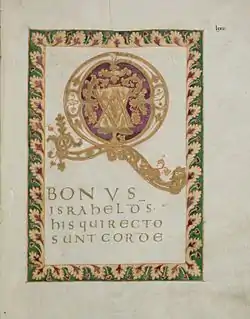 Initial for the Gallican version of Psalm 73 (Psalm 72 Vulgate), Quam bonus Israhel Deus his qui recto sunt corde, from the Golden Psalter of St. Gall (c. 890). | |
| Book | Book of Psalms |
| Hebrew Bible part | Ketuvim |
| Order in the Hebrew part | 1 |
| Category | Sifrei Emet |
| Christian Bible part | Old Testament |
| Order in the Christian part | 19 |
Analysis
In the opinion of Walter Brueggemann (1984), "in the canonical structuring of the Psalter, Psalm 73 stands at its center in a crucial role. Even if the Psalm is not literarily in the center, I propose that it is centre theologically as well as canonically".[2] It was the favourite psalm of Martin Buber, who said about it: "What is it that so draws me to this poem that is pieced together out of description, report and confession, and draws me ever more strongly the older I become? I think it is this, that here a person reports how he attained to the true sense of his life experience and that this sense touches directly on the eternal."[3]
References
- Asaph (2007), Alter, Robert (ed.), The Book of Psalms: A Translation with Commentary, et al., New York & London: W.W. Norton & Co, pp. 252–56.
- W. Brueggemann, Message of the Psalms (1984).
- J. Clinton McCann, Jr., A Theological Introduction to the Book of Psalms: The Psalms as Torah, Abingdon Press, 2011, 144.