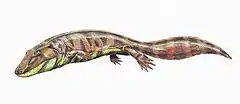
Pseudophlegethontia
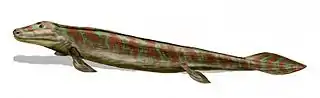
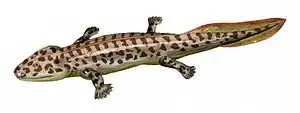
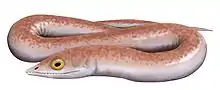
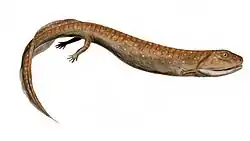
Pseudophlegethontia is an extinct genus of aïstopod stegocephalians. It is the only member of the family Pseudophlegethontiidae. The only species is the type species P. turnbullorum, named in 2003.[1] Fossils of Pseudophlegethontia have been found from the Mazon Creek fossil beds in Grundy County, Illinois, a conservation lagerstätte well known for the exceptional preservation of middle Pennsylvanian taxa.
| Pseudophlegethontia Temporal range: Late Carboniferous, | |
|---|---|
Scientific classification  | |
| Kingdom: | Animalia |
| Phylum: | Chordata |
| Order: | †Aistopoda |
| Clade: | †Phlegethontioidea |
| Family: | †Pseudophlegethontiidae Anderson, 2003 |
| Genus: | †Pseudophlegethontia Anderson, 2003 |
| Species: | †P. turnbullorum |
| Binomial name | |
| †Pseudophlegethontia turnbullorum Anderson, 2003 | |
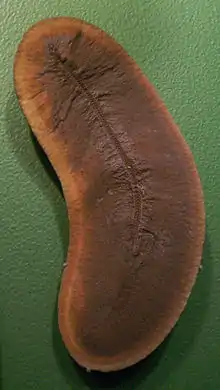
Pseudophlegethontia has been considered to be morphologically intermediate between derived phlegethontiids and more basal "ophiderpetontids" such as Ophiderpeton. It possesses basal characters such as a relatively short body, "k shaped" ribs, and distinctive skull roof bones while also possessing several more derived features such as a pointed snout, thin gastralia, and a lack of dorsal osteoderms.[1]
References
- Anderson, J. S. (2002). "A new aïstopod (Tetrapoda:Lepospondyli) from Mazon Creek, Illinois". Journal of Vertebrate Paleontology. 23 (1): 79–88. doi:10.1671/0272-4634(2003)23[79:anatlf]2.0.co;2.