Qalipu First Nation
The Qalipu First Nation (Pronounced: ha-lee-boo, meaning: Caribou),[4] is a Mi’kmaq band government, created by order-in-council in 2011 pursuant to the Agreement for the Recognition of the Qalipu Mi’kmaq Band. After the band was approved as a First Nation, nearly 100,000 people applied for membership, and a total of 23,000 were approved. The government was then taken by surprise. Some representatives of other Mi'kmaq nations have opposed the enrollment of so many individuals. This band is based on the island of Newfoundland and does not control any reserve lands. The Qalipu First Nation is accepted by the Mi'kmaq Grand Council.[5] However, the Grand Council of Mi'kmaq Chiefs wrote a letter to the UN outlining their concerns about the Qalipu enrolment criteria. They had not been consulted.
 | |
| People | Miꞌkmaq |
|---|---|
| Headquarters | Corner Brook |
| Province | Newfoundland and Labrador |
| Land[1] | |
| Reserve(s) | None
|
| Population (2019)[2] | |
| Off reserve | 22,638 |
| Total population | 22,638 |
| Government[3] | |
| Chief | Brendan Mitchell |
| Council |
|
| Website | |
| qalipu.ca | |
Canada has passed UNDRIP- the UN Declaration on the Rights of Indigenous People. Article 9 of UNDRIP reads: Indigenous peoples and individuals have the right to belong to an Indigenous community, or nation in accordance with the traditions and customs of the nation or community concerned. No discrimination of any kind may arise from the exercise of such a right.
Mi'kmaq nations that oppose this dramatic scale of the Qalipu First Nation question the cultural identity and commitment of many of the members. They do not consider most of the applicants to be historically Indigenous in identity nor a part of the larger Mi'kmaq confederacy of nations.[6][7][8]
History prior to recognition
Pre-contact
The Mi'kmaq people historically occupied territory including modern Nova Scotia, New Brunswick and Prince Edward Island. This area had been occupied by earlier successive cultures of indigenous peoples for 10,000 years.
By the 17th century, the Mi'kmaq would often visit the island they called Taqamkuk (present-day Newfoundland) by crossing the Cabot Strait by boat, shallops that they adopted from European traders.[9] They visited the island and hunted along the south coast as far east as Placentia Bay before returning to Unamaki. They gradually made Taqamkuk among their "domain of islands".[9] Some Mi'kmaq have argued that in addition, a group of Mi'kmaq lived on the island for hundreds of years.
Permanent settlement in Newfoundland
During the colonial period, when the French and British competed for claims to land in North America, the Mi'kmaq became allied with France with whom they traded. Together they raided settlements of the English in New England and in the Maritime provinces of the future Canada. In 1763, after France was defeated by Britain in the Seven Years' War, it ceded all its land east of the Mississippi River to Great Britain, including the Mi'kmaq's traditional land. After this, numerous British colonists entered that territory and tried to settle.
Newfoundland, however, was still sparsely populated, and most Europeans lived on the eastern portion of the island and only in small isolated coastal settlements. The Mi'kmaq living on the island were essentially able to continue their traditional way of life on the island's west coast and in the interior. After the Beothuk people declined in the 1800s, the Mi'kmaq no longer shared Newfoundland's interior with anyone. In 1857, a colonial census of Newfoundland recorded Mi'kmaq settlements at St. George's Bay, Codroy Valley, Bay d'Espoir, and the Bay of Exploits.[9]
The English and other Europeans had little knowledge of the interior and relied on the Mi'kmaq as guides. In 1822, explorer William Cormack traversed Newfoundland's interior from Trinity Bay to St. George's Bay. He was guided by a Mi'kmaw man named Sylvester Joe. In the 1860s, the British hired some Mi'kmaq men to deliver the mail overland through a network of trails reaching the northern communities.
Late 19th century decline
In 1898, a railway was constructed across the island, giving Europeans greater access to Newfoundland's interior. Numerous Europeans came to hunt the caribou herds, causing a sharp decline in the species population. The caribou had served as one of the main sources of food for the Mi'kmaq and their decline adversely affected the survival of the Mi'kmaq. Starting in the 1920s, global fur prices began to decline as well, and some Mi'kmaq left trapping to work for Europeans as loggers.
Post-confederation
When the Dominion of Newfoundland became a province of Canada in 1949, the Indian Act of 1876 was not applied there. When elected, Premier Joey Smallwood told the federal government that no Mi'kmaq lived in the province.[10] The unrecognized Mi'kmaq in the province were able to vote, unlike other Indigenous people in the rest of the Canada.
But the Mi'kmaq in Newfoundland had to confront discrimination in other ways that were similar to those facing aboriginals in other parts of Canada. Many Mi'kmaq lived alongside European-Canadian settlers on the island's west coast, where they encountered racism. To hide their identities, many anglicized their names (ex. the French name "Aucoin", acquired in days of the French alliance and intermarriages, was often changed to "O'Quinn") and denied their Mi'kmaq heritage. Mi'kmaq children were often not told about their heritage. As had long been the case, starting with traders who married Mi'kmaq women, there was continuing intermarriage with Europeans. In 2013 Angela Robinson, a Memorial University anthropologist, said that because of this history, the majority of Newfoundlanders living west of the Avalon Peninsula and St. John's likely have some Mi'kmaq ancestry.[10] But most of such persons who have some native ancestry have not been raised in Mi'kmaq culture, and people working on issues of First Nations identity do not think they should qualify as members of the band unless they have a real connection to the culture.
Drive for recognition
In 1972 activists formed the Native Association of Newfoundland and Labrador as the main organization representing the Mi'kmaq, Innu and Inuit peoples of Newfoundland and Labrador.[11] After the Labrador Innu and Inuit left the Association in 1975, the organization was renamed as the Federation of Newfoundland Indians. The FNI included six Mi'kmaq bands (Elmastogoeg First Nations, Corner Brook Indian Band, Flat Bay Indian Band, Gander Bay Indian Band, Glenwood Mi'kmaq First Nation and the Port au Port Indian Band). The provincial government supported the FNI.[12]
The federal government approved only the petition for recognition made by the Mi'kmaq at Conne River. In 1987, the Miawpukek Mi'kmaq First Nation was recognized under the Indian Act, and their community of Conne River was classified as reserved land for the Mi'kmaq.
Recognition for the remainder of Newfoundland's Mi'kmaq was a much longer process. Minister David Crombie was willing to work with the FNI and the government of Newfoundland, but the provincial government considered it to be a federal matter.[12]
In 2003, Minister Andy Scott was presented with a report that recommended a First Nations band without any reserved land to represent the Mi'kmaq of Newfoundland. An Agreement-in-principle was reached in 2006, which the FNI accepted in 2007. The federal government ratified it in 2008.
Membership
The Government of Canada had expected band membership to be similar to the membership of the Federation of Newfoundland Indians, around 5,000 people. Instead, around 100,000 people, or the equivalent of one-fifth of the population of Newfoundland, applied to become band members. After the first round of enrollment, 23,000 of 30,000 applicants were accepted. Although not yet functional, the band became the second largest by membership in Canada.[13]
In response, parliament passed Bill C-25, authorizing it to review all applications and retroactively reject some, based on criteria similar to those used in the R v Powley case that defined rights for the Métis people.[14] The government had already excluded certain Mi'kmaq bands, including the Bartletts Harbour Indian Band[15] and the Kitpu Indian Band from applying for membership in the Qalipu.[16]
The rest of the outstanding applications were put in indefinite storage. In 2013 applicants organized a new group, the Mi’kmaq First Nations Assembly of Newfoundland to lobby to continue the enrollment process. They began to prepare for a legal action regarding the enrollment process should lobbying fail.[17]
Questions of legitimacy
In 2013, Chiefs Terrance Paul and Gerard Julian, co-chairs of the Assembly of Nova Scotia Chiefs, sent a joint letter to the Minister of Aboriginal Affairs and Northern Development Canada. They presented their concerns regarding the legitimacy of the Qalipu band, and asked for further clarification and explanation by the federal government. They disputed the authority of the federal government to determine who qualifies as Mi’kmaq. They said that, while the government of Canada may have jurisdiction over who is an Indian, they do not have the constitutional right to determine who is a Mi’kmaw.[18]
Later in 2013, the Mi’kmaq Grand Council, the traditional government of the Mi'kmaq people, issued a statement to the United Nations denouncing the Qalipu band as illegitimate. The letter stated, "These new Qalipu members we simply do not know and do not recognize as Mi’kmaq."[19]
The Mi'kmaq Rights Initiative assert that the Qalipu were created as an entity by the federal government, and they do not consider them as part of the broader Mi'kmaq nation.[20]
Opponents to the Qalipu believe that some applicants falsified documents or exaggerated claims of Indigenous ancestry in order to gain Indian Status and what are now perceived as its associated benefits. They argue that there were never that many people maintaining Mi'kmaq culture among the population of Newfoundland, and that being Mi'kmaq was more than a list of ancestors.[21]
The Friends of Qalipu Advocacy Association is currently taking Qalipu First Nation (and its precursor) to court over the enrolment process.[22]
Governance
A band council is elected under the Qalipu Mi’kmaq First Nation Band Custom Election Rules, which were a part of the agreement with the Canadian government. Changes to the Custom Election Rules can be made only after a referendum voted on by the whole band membership.[23]
Council
Members of the Qalipu Mi'kmaq First Nation elect a Chief (currently Brendan Mitchell), 2 Vice Chiefs, and councillors representing a total of 9 wards.[24]
Wards and Councillors
Shown below are the electoral districts and the results from the 2015 election.[25]
| Benoits Cove Elmastukwek (Mi'kmaq)[26] 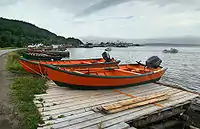 |
Corner Brook.jpg.webp) |
Exploits Sple'tk (Mi'kmaq)[26] 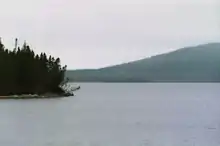 |
|---|---|---|
Councillor: Bernard White
|
Councillor: Brian Dicks
|
Councillor: Andrew Barker
|
Flat Bay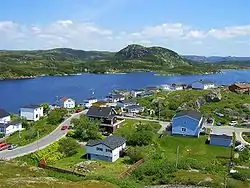 |
Gander Bay |
Glenwood.jpg.webp) |
Councillor: Ivan White Sr.
|
Councillor: Calvin Francis
|
Councillor: Francis Skeard
|
| Port au Port Kitpu (Mi'kmaq) 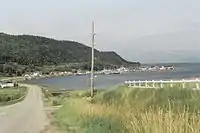 |
Stephenville |
St. George's Nujio'qon (Mi'kmaq)[26] |
Councillor: Jasen Benwah
|
Councillor: Gerard Alexander
|
Councillor: Ivan J White Jr
|
References
- "Qalipu First Nation members vote in record numbers, re-electing Brendan Mitchell as chief". CBC News. October 23, 2021.
- "Qalipu First Nation members vote in record numbers, re-electing Brendan Mitchell as chief". CBC News. October 23, 2021.
- "Qalipu First Nation members vote in record numbers, re-electing Brendan Mitchell as chief". CBC News. October 23, 2021.
- http://qalipu.ca/about/background/
- "Mi'kmaq First Nation". Cape Breton University. Retrieved 2021-07-22.
- Battiste, Jaimie. "Nova Scotia Chiefs Raise Concerns over Qalipu Miꞌkmaq Band" (PDF). mikmaqrights.com. Miꞌkmaq Rights Initiative. Retrieved 4 January 2019.
- Grand Council of Micmacs (4 October 2013). "STATEMENT TO UNITED NATIONS SPECIAL RAPPORTEUR ANAYA" (PDF). Retrieved 4 January 2019. Cite journal requires
|journal=(help) - Battiste, Jaime. "Defining Aboriginal Identity: What the Courts Have Stated" (PDF). Mikmaqrights.com. Retrieved 4 January 2019.
- "The History of the Newfoundland Mi'kmaq", Heritage Newfoundland and Labrador, Memorial University of Newfoundland, 1998
- https://www.thestar.com/news/insight/2013/05/05/in_newfoundland_too_many_want_recognition_as_mikmaq_indians_federal_government_says.html
- http://www.heritage.nf.ca/articles/aboriginal/mikmaq.php
- http://qalipu.ca/enrolment/
- "Ottawa Moves to Tighten Aboriginal Membership Criteria", The Globe and Mail
- http://www.thewesternstar.com/News/Local/2014-03-07/article-3641400/Bill-C-25-reflects-information-already-provided-to-Qalipu-applicants%3A-Sheppard/1
- "No status", The Western Star, 14 December 2007
- "Kitpu Mi'kmaq seeking equality with other First Nations peoples", The Western Star, 03 March 2008
- http://www.mfnan.org/?page_id=310
- Battiste, Jaimie. "Nova Scotia Chiefs Raise Concerns over Qalipu Mi'kmaq Band" (PDF). mikmaqrights.com. Mi'kmaq Rights Initiative. Retrieved 4 January 2019.
- Grand Council of Micmacs (4 October 2013). "STATEMENT TO UNITED NATIONS SPECIAL RAPPORTEUR ANAYA" (PDF). Retrieved 4 January 2019. Cite journal requires
|journal=(help) - Battiste, Jaime. "Defining Aboriginal Identity: What the Courts Have Stated" (PDF). mikmaqrights.com. Retrieved 4 January 2019.
- Brake, Justin (9 January 2018). "Chief to explore separation from controversial Mi'kmaq band". aptnnews.ca. APTN News. Retrieved 3 January 2020.
- Meloney, Nic (April 25, 2018). "Canada signed private agreement with Qalipu Mi'kmaq days before contentious changes to application process". Retrieved 9 November 2021.
- "Governance", Qalipu First Nation
- "Archived copy". Archived from the original on 2016-06-07. Retrieved 2016-07-02.CS1 maint: archived copy as title (link)
- http://qalipu.ca/site/wp-content/uploads/2015/10/Counts.pdf
- http://www.oocities.org/pilip/land.htm