Qartaba
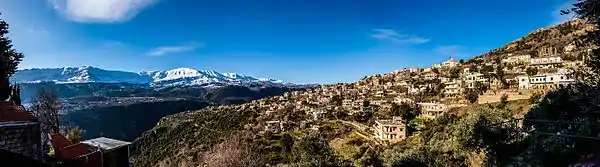
Qartaba (Arabic: قرطبا, also spelled Kartaba or Artaba) is a mountainous village in the Byblos District of the Keserwan-Jbeil Governorate, Lebanon. In Syriac, Qartaba means either " a good place ܟܘܪ ܛܒܐ " or " nice chillness ܩܪܛܒܐ " reflecting its good, curing, and balanced weather. The town is often referred to as "Byblos' Bride".
Qartaba
قرطبا | |
|---|---|
Village | |
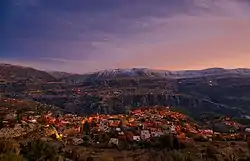 Qartaba From Above | |
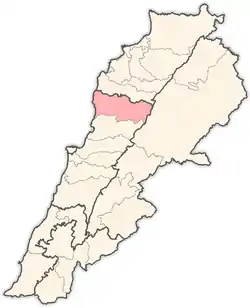
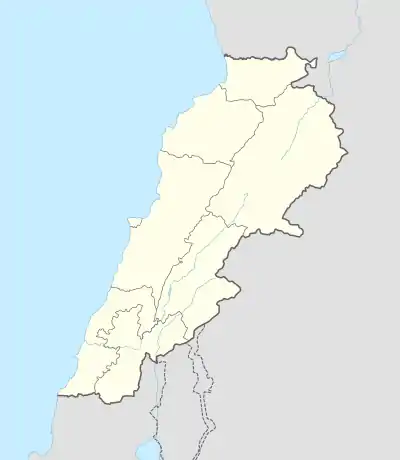  Qartaba Location within Lebanon | |
| Coordinates: 34°06′N 35°51′E | |
| Country |  Lebanon Lebanon |
| Governorate | Keserwan-Jbeil |
| District | Byblos District |
| Government | |
| • Mayor | Fadi Martinos |
| Area | |
| • Total | 8.92 km2 (3.44 sq mi) |
| Elevation | 1,250 m (4,100 ft) |
| Highest elevation | 1,500 m (4,900 ft) |
| Lowest elevation | 1,000 m (3,000 ft) |
| Population | |
| • Total | ~5,000 (Summer) |
| Time zone | UTC+2 (EET) |
| • Summer (DST) | UTC+3 (EEST) |
| Dialing code | +961 |
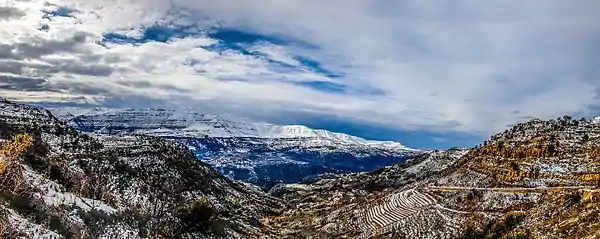
It is located 54 kilometers north Beirut on the mountains above Byblos at an average altitude of 1,250 meters.[1] Qartaba is surrounded by olive groves, apple orchards, and vineyards.[2]
History
Qartaba was once considered an important village in the Byblos highland, a trade point for surrounding villages.[1] Silk manufacturing flourished and in 1918, seven factories employed more than 500 people and much of the silk was exported to Lyon, France.[1]
Demographics
The inhabitants of Qartaba are predominantly Maronite Catholics.[3] As of 2010, there were 6,023 registered voters in Qartaba.[3]
The main families of Qartaba are: Acar, Atallah, Beyrouthy, Challita, Gharios, Karam, Khoury, Sakr, Sawaya, Sokhen and Soueid.
Directions
Some of the roads leading up to Qartaba are:
• Beirut - Jounieh - Nahr Ibrahim - Fatre - Balhos -Qartaba.
• Byblos - Tourzaiyya - Balhos - Qartaba.
• Byblos - Tourzaiyya - Ehmej - Laqlouq - Qartaba.
• Jounieh - Jeita - Faitroun - Mayrouba - Qehmez - Lassa - Yanouh - Qartaba.
• Baalbek - Hadath Baalbek - Yammoune - Afqa - Mejdel - Mgheiri - Qartaba.
Churches and monasteries
There are 16 places of Christian worship in Qartaba, including churches, monasteries and shrines, such as:
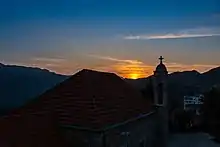
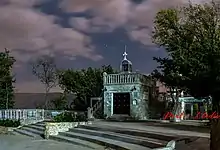
Monasteries
• Saint Sarkis and Bakhos Monastery, which was built in 1536 when the children of Sheikh Gerges fled from Aqoura to Qartaba, carrying with them the image of the two holy martyrs, Sergius and Bacchus. In cooperation with the townspeople, they built a church in the name of the aforementioned saints, which was exposed to fire and was rebuilt in 1717. In the year 1815, the people of Qartaba, by virtue of a deed, presented the Church with its livelihood and property as an “eternal endowment” to the Lebanese Maronite Order, in order to set up a school next to it to “teach children reading, Christian education, guidance, and service of spiritual matters free of charge.” And that was through an agreement with the General Father Ignatius Blebel and with the approval of Bishop Germanos Tabet. The Order agreed, and completed the construction of the school in a short time. And it worked to buy the lands adjacent to it to expand the construction, so that it later became a legal monastery in 1823.
Cathedrals
• Cathedral of Saint Elias, built in 1903.
Churches
• Church of Our Lady of Herezmeny, which was built in 1827 when the Karam family moved from Yanouh to Qartaba. The family made a deal with the sheikhs of the Hamade family to build a church in the Herezmeny land where stood some roman ruins. In the late 19th century a vault was added to the main building that ended up with an L shape.
• Church of Saint Joseph, which was built in 1898 when Joseph Rafael Jabbour gave the land of Al Malaha to build a church.
• Church of Saint Teddy, which was built in 1607 when the family of the priest Teddy came to Qartaba from Edessa. It was built upon a parcel of land that was donated by the Hamade sheikhs. It is the only church in Lebanon dedicated to Saint Teddy. The church was rebuilt in 1868 and restored in 2004.
• Church of Our Lady of Annunciation
• Church of Saint Challita - Hjarta, built in 1925.
• Church of Sainte Thérèse
• Church of Saint Semaan Al Aamoudy, built in 2004.
• Church of Saint Charbel - Al khalle
• Church of Saint Charbel - Charbineh
• Church of Saint Elias - Hsayya
Some other Churches built on private properties, such as:
• Church of Saint Georges, which was built as a private chapel for the family of Moufarrej Geryes in the late XIXth century, and is located in Haret El Tahta street.
• Church of Our Lady of Tenderness
• Church of Sainte Rita - Hjarta
• Church of Saint Charbel - Chmis street, built in 2017.
Some Shrines may include:
• Shrine of Our Lady of Peace
• Shrine of Saint Challita
• Shrine of Sainte Veronica Giuliani, built in 2019.
Carnivals
Kartaba Carnival is a traditional and annual event in the town of Qartaba, which is organized by "The Qartaba Touristic and Traditional festivals" committee and is supported by the Municipality of Qartaba. It is attended by political, military, judicial, religious people and social media figures, in addition to presidents of municipalities and personalities of the town and the area of the Jbeil District. The carnival first started in the 1960s, and is still held to this day in the square of the village, with the attendance of people coming from all regions. The townspeople, of all ages, participate and cooperate together to create exhibition boards that combine traditional Lebanese music, art and culture. This event is free of charge. The carnival ends with a musical evening held by Lebanese artists.
Gallery
References
- "Kartaba". Linking Lebanon. Retrieved 2007-12-08.
- Ivan Mannheim (2001). Syria & Lebanon Handbook: The Travel Guide. Footprint Travel Guides. p. 502. ISBN 1-900949-90-3.
- "Elections municipales et ikhtiariah au Mont-Liban" (PDF). Localiban. Localiban. 2010. p. 19. Archived from the original (pdf) on 2015-07-24. Retrieved 2016-02-12.
External links
Capital: Byblos | ||
| Towns and villages |
|  |
| Landmarks |
| |