Qerandiqo Berzeg
Hajji Qerandiqo Berzeg (Adyghe: Джэрандыкъо Бэрзэдж Хьаджэ, romanized: Dɉərandıqo Bərzədɉ Hadɉə; Ubykh: Гьарандыхъва Барзагь ХӀаджы, romanized: Gârandıqua Barzagy Hadɉı; Russian: Хаджи Керендуко Берзек; also known as Ubykh Shamil, due to his similarity in courage and skill to Imam Shamil) was a Circassian military commander, princely leader of the Ubykh region, and the first chief of the Circassian Majlis. Most of his life, including his late childhood, was spent in the Russo-Circassian War (1763-1864) fronts. He met his son in the battlefield, where he lost two of his other sons. After the Circassian genocide, he was exiled to the Ottoman Empire, volunteered in the Ottoman army, established Circassian communities, and died there of old age.[1][2]
Qerandiqo Berzeg | |
|---|---|
Гьарандыхъва Барзагь ХӀаджы Джэрандыкъо Бэрзэдж Хьаджэ Къэрандыкъо Бэрзэдж Хьаджэ | |
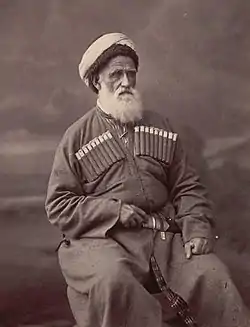 Qerandiqo Berzeg in exile. Photograph taken in Constantinople, Ottoman Empire | |
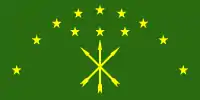 Princely Leader of the Ubykh Princely Leader of the Ubykh  | |
| Preceded by | Ismail Berzeg |
| Succeeded by | Office abolished |
| In office 1846–1860 | |
| President of Circassia | |
| In office 13 June 1860 – 21 May 1864 | |
| Preceded by | Office established |
| Succeeded by | Office abolished |
 Leader of the Circassian Majlis Leader of the Circassian Majlis | |
| In office 13 June 1860 – 21 May 1864 | |
| Preceded by | Office established |
| Succeeded by | Office abolished |
| Personal details | |
| Born | 1804 Mytykhuasua, Ş̂açə, Circassia |
| Died | 1881 (aged 76–77) Yeniköy, Balıkesir, Ottoman Empire |
| Relations | Associate of Sultan Abdulaziz |
| Children | İslam Bey, Tevfik Bey, two unnamed children dead in battle |
| Parent(s) | Hatajuq Berzeg (father) |
| Awards |  Order of Osmaniye |
| Nickname(s) | Ubykh Shamil |
| Military service | |
| Allegiance | Circassian Confederation
.svg.png.webp) Ottoman Empire Ottoman Empire |
| Years of service | 1841-1881 |
| Battles/wars | Russo-Circassian War Russo-Turkish War (1877–1878) |
Biography
Qerandiqo Berzeg was born in the Mytykhuasua village of Ş̂açə (Sochi). His father was Hatajuq Berzeg, and his uncle was Ismail Berzeg, the prince of Ubykhia. He was a religious Muslim, and he went to Mecca for hajj in 1839. His first big military success was in Sukhumi, 1841, when he freed the Sadz region from Russian occupation. In 1846, with the death of Ismail Berzeg, he was elected as the prince of Ubykhia. In 1857, he unified his forces with Ishamil Zayush and attacked the Russian forces in Gagra. His biggest campaign was in 1854 when he set out to re-capture areas and forts invaded by the Russian army, and vastly succeeded.[2]
In 1860, when he was 60 years old, he helped unite Circassia and was elected the president of the Independence Majlis of Circassia (Adyghe: Шъхьафитныгъэ Хасэ, romanized: Şhafitnığə Xasə). After the defeat in 1864, he could not decide whether to accept defeat or fight one last battle and die. He went to meet with Mikhail Chacba, prince of Abkhazia to ask for advice. When he was absent, his army of 3 thousand were attacked by the Russian army, and caught without a leader, were completely destroyed. After this, to avoid further bloodshed, Berzeg decided to admit defeat. On March 24, 1864, Berzeg declared full surrender on behalf of the Circassian people and was exiled to Ottoman territory.
After the Circassian genocide, he was personally invited by Sultan Abdulaziz of the Ottoman Empire and honored. He was offered a noble house in Istanbul but he formally rejected this offer and moved to a small village in Manyas instead.[3] During the Russo-Turkish war of 1877-1878, he assembled an army of Circassians and returned to fight against the Russians once again.[4] He died in 1881.
Quotes
We may have lost the war, but we will never lose our humanity and decency. Traitors among us made us lose this war. And so, on this day, we stand defeated forced to leave our homeland, however it shall never leave our hearts, it is inside us and by God, we will never forget it.
— Hajji Qerandiqo Berzeg
I spent my life burning with passion for the independence of my homeland. When I was not in battle against the Russians, I spent most of my time curing my wounds and feeding the children. Since my life was spent defending my homeland in battle, I met my own son properly when he was old enough to come and join my army. Even just right now, I have sixteen different wounds on my body, acquired during the thirty five years of honorful battle against the inhumane invaders.
— Hajji Qerandiqo Berzeg
Now, I see that the people who I struggled for are begging me, "For the sake of God, do not leave us!" One day, surely I shall return to my homeland on top of my horse, standing victorious, and if I can not, at least bury me in my homeland.
— Hajji Qerandiqo Berzeg
Sources
- "Giranduko Berzeg". Muammer Dursun Erer. 2013. Archived from the original on 24 April 2020.
- "Giranduko Berzeg". Archived from the original on 31 July 2019.
- Фильм о покорении Кавказа, содержащий биографию Хаджи Догомуко Керендуко Берзек
- В. И. Ворошилов. История убыхов. Майкоп, 2006.