Circassian Majlis
The Circassian Majlis[2] (Adyghe: Адыгэ Хасэ, romanized: Adıgə Xasə; also called the Majlis of Independence Adyghe: Шъхьафитныгъэ Хасэ, romanized: Şhafitnığə Xasə)[2] was the legislature of Circassia and a political resistance council formed in 1860 after a meeting in Sochi between the leaders of the Circassian regions, most notably the Shapsug, the Natukhaj, and the Ubykh.[3][4][5][6][7]
The Circassian Majlis Шъхьафитныгъэ Хасэ Şhafitnığə Xasə | |
|---|---|
| 1st Parliament of Circassia | |
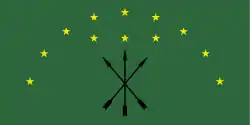 The Circassian flag variant used by the Majlis | |
 The Circassian hammer-cross | |
| Type | |
| Type | |
| History | |
| Founded | 13 June 1860 |
| Disbanded | 21 May 1864 |
| Leadership | |
Majlis Elder | |
Important Members | Qarabatir Zanuqo (son of Sefer Bey Zanuqo)[1] |
Ismail Braqiy[1] | |
Hasan Effendi | |
Ibrahim Effendi | |
Khusht Muhammad[1] | |
| Motto | |
| Псэм ипэ напэ Psəm yipə napə "Honor before life" | |
| Meeting place | |
| Ş̂açə (Modern-day Sochi) (1861-1862) | |
| Mutıxwa (Modern-day Plastunki) (1862-1864) | |
| Qbaada (Modern-day Krasnaya Polyana) (1864) | |
| Part of a series on the |
| Circassians Адыгэхэр |
|---|
 List of notable Circassians |
| Circassian diaspora |
| Circassian tribes |
|
Surviving Destroyed or barely existing |
| Religion |
|
Religion in Circassia |
| Languages and dialects |
|
| History |
|
Ancient Medieval Modern Contemporary Key battles |
| Culture |

The Majlis consisted of the leaders of the tribal confederations with the intention to defend the Western part of Circassia from Russian invasion,[8] and to liberate the occupied Eastern Circassia from the Russian Empire and their Cossack troops during the Russian-Circassian War.[9] It also sent delegates abroad to gain support for the Circassian struggle internationally.[5]
History
Being a political resistance council and the legislature of Circassia,[5][6][7] the Majlis was established in the capital city of Sochi (Adyghe: Шъачэ, romanized: Ş̂açə) on June 13, 1860 and Qerandiqo Berzeg was elected as the head of the Majlis.[10]
Although the Shapsug, Natukhaj, and Ubykh were the main founders, volunteers from the fallen Hatuqwai, Abdzakh, Bzhedug, Kabardian and Chemguy regions were also present. Abkhazians and Abazins also took part in the construction of the Majlis building.
Nobles, elders and commanders of all social backgrounds gathered to discuss the immediate need to collaborate and work together regardless of their ideological, ethnic, religious or social divisions for the sake of survival.
In an effort to raise awareness, the council formally drafted and declared the independent state of Circassia and immediately sought to have the Circassian nation recognized, as well as redouble efforts to secure arms and material support to finance their self-defense campaigns. They discussed tactics, planned alliances and made efforts to prepare for a last stand (see Qbaada last stand).
The first decisions
The decisions taken by the Majlis were the following:
- A new leader for all of Circassia will be elected. (Qerandiqo Berzeg was elected)
- All of Circassia will be officially united as opposed to the previous system where tribal regions banded together as allies, but were not one unified state.
- Tribal divisions will be completely removed.
- Abkhazian, Abazin, and Karachay-Balkar people will be accepted as legitimate equal citizens of Circassia along with Circassians.
- Proper contact with the Circassian and Muslim communities in Constantinople and London will be established.
- Diplomatic messages to Europe will be sent, and help will be asked. Similar messages will also be sent to the Ottoman Caliph.
- The state will be divided into 12 states (Wilayah) and for each of them, a scholar, judge and governor will be appointed.
- A delegation will be sent to Russia for peace, and if the Russians decline, military plans will be prepared:
- Mandatory service of all males and able females over 15 will serve in the army.
- New tax laws will be made, primarily in order to create a defense fund.
- Military command will be unified, all Circassian armies will take orders from central command.
Negotiations with Russia
The Majlis government negotiated with the Russian Tsar Alexander II in September 1861 to establish peace, expressing their readiness to accept Russian citizenship.
These lands are ours, and we want to rule them with absolute justice. We strive to administer our country fairly, therefore we treat our people fairly and respect the lives and property of those who visit us. What is the objective of a powerful nation like yours: to destroy a people like us? Be fair to us and do not destroy our property or mosques; it is disgraceful for a powerful state to take lives unjustly. You are deceiving the entire world by circulating myths about us being a savage people; nonetheless, we are human, just like you. Do not strive to spill our blood; instead, allow us to exist here.
.jpg.webp)
However, the annexation of Circassia was not enough for Russia, the Tsarist government sought to evict the Circassians from the ethnic territory. The Tsar consistently continued the policy of his father, Nicholas I, and rejected the Circassian compromise proposals.[2]
After being convinced by his generals, the Russian Tsar declared that Circassia will not only be annexed to Russia unconditionally, but the Circassians will leave, and if the Circassian people do not accept forcefully migrating to Turkey, the Russian generals will see no problem in killing all Circassians. He gave the Circassian representatives a month to decide.[10]
Delegations to major powers
The Majlis did not accept leaving their lands and sent delegations to the Ottoman Empire and the United Kingdom to gain support from both countries, arguing that they are being massacred and they would be forced into exile soon.
In England, supporters of the Circassians organized rallies, even appealed to the queen with a request to support the Circassians. However, the British government did not respond.[2]
In Turkey, a special committee on Circassian affairs was created, and received donations from the local Muslim folk, and allegedly even from the sultan himself, secretly. However, the economically and politically weakened Ottoman Empire could not contribute in protecting the Circassians.[2]
Before any result was achieved, in 1862, as a result of the fall of Sochi, the Majlis was dissolved and almost all of its leaders eliminated, and the resistance moved to the Caucasus mountains, new Majlis meetings started to be held in Mutikhwa (Мутыхуа, now in the village of "Plastunki"), the last meeting was held in Qbaada before the Majlis took its last decision, which was to not surrender, and the Battle of Qbaada was fought. The area fell, all insurgents were massacred by the Russian army, which announced its victory on 21 May 1864.[11]
See also
References
- 2. Российский государственный военно-исторический архив (далее – РГВИА). Ф. 38. Оп. 7. Д. 422.
- "А.Д. Панеш: "Меджлис вольности черкесской" »". natpressru.info. Retrieved 2021-04-25.
- Владимировна, Чунтыжева Рима (2014). "Сочинский меджлис: опыт общественно-политического творчества адыгов в XIX веке". Вестник Майкопского государственного технологического университета (4): 15–19. ISSN 2078-1024.
- Трагические последствия Кавказской войны для адыгов (вторая половина XIX – начало XX в.). – Нальчик., 2000.
- Фадеев А.В. Указ. соч.
- Фадеев А.В. Убыхи в освободительном движении на Западном Кавказе //Исторический сборник. – М.; Л., 1935. – № 4.
- Блиев М.М., Дегоев В.В. Кавказская война. – М., 1994.
- "Archived copy". Archived from the original on 2010-11-29. Retrieved 2010-10-22.CS1 maint: archived copy as title (link) Via UNPO
- English RUVR - Archived 2012-03-18 at the Wayback Machine via the Voice of Russia
- Ruslan, Yemij (August 2011). Soçi Meclisi ve Çar II. Aleksandr ile Buluşma.
- Anzor, Nıbe. Çerkes Meclisi'nin 150. Kuruluşu.
Further reading
- Richmond, Walter. The Circassian Genocide, Rutgers University Press, 2013. ISBN 9780813560694