Fully fashioned stockings
Fully fashioned stockings (FFS), are stockings with characteristic reinforcements on the heel and top, a so-called keyhole at the back of the top, and a stitched back seam in between. They are made to be worn with a garter belt and are today considered a vintage design of hosiery after largely having been replaced by seamless stockings and pantyhose from the 1960s onwards.[1] It's considered the height of hosiery luxury,[2] and remain the favourite nylons of stocking aficionados.[3] Fully fashioned stockings are usually made from nylon and thus have very little stretch compared with modern stockings and pantyhose.
There is a similar form of stockings called "RHT stockings". Reinforced heel and toe stockings, or RHT stockings, as they are more commonly referred to, offer an ultra-robust stocking which is crafted using a folding technique at both the heel and toe. This gives these areas a darker appearance and also strengthens these areas, making them less likely to hole and allowing them to last longer.[4] This means that the heel and toe areas have a slightly more dense weave to improve wear and to prevent runs. The heel and toe area will appear slightly darker.[5] An RHT stocking is made of nylon, just like a fully-fashioned stocking but exhibits several major differences. The RHT has no keyhole, no fancy heel style and most importantly, no seam, (although seamed RHTs are available where the seam is purely decorative as mentioned above). RHT stockings have been in existence since the 1940s when Hanes began marketing “no-seam stockings” with reinforced heel and toe produced on circular knitting machines where the leg shape could be achieved by tightening the stitches over a conical mould.[6]
Description
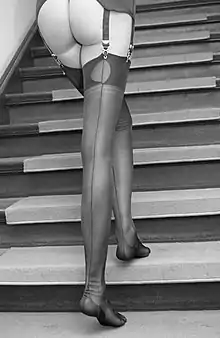
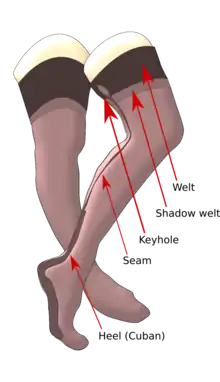
Fully fashioned stockings are usually knitted from sheer nylon yarn. To support the attachment of suspenders, they have a darker section of double fabric at the top, called the welt. This is followed by a lighter transitional section called the shadow welt. The keyhole is visible in the middle of the seam at the back of the welt.[7] The back seam is an integral part of the stocking and not sewn on afterwards.[8]
Fully fashioned stockings are sized to the height and shoe size (generally) of the wearer and have little or no stretch in them as they have no lycra (spandex) contained within the yarn.[9] In addition to the distinctive seam they also come in a number of heel designs. The most common are the French or Point Heel, where the reinforcement ends in a sharp point, and the Cuban Heel, which ends in a truncated point.
Names and meanings of parts
The key features of full-fashioned nylon stockings include.[10]
- Welt:Traditionally stockings are knitted from the top down. The top of the stockings (or the band) is called the welt, and it is created by stitching two layers of fabric together. As a result, the welt tends to be slightly darker than the rest of the hosiery.
- Shadow welt:A shadow welt is created below the welt where it is created with a single layer of fabric. The purpose of the shadow welt is to transition the welt to the rest of the stockings.
- Keyhole:As the top of the stockings are folded and sewn back on itself, a distinct hole is created in the back of the stockings. This hole is called a keyhole.
- Seam:Since this style of stockings are sewn together; a back seam is formed.
- Reinforced Heel:A darkened area around the heel is also created to secure the heel and sole of the stockings together. This area is called reinforced heel.
Heel Types
Where the seams at the heel are reinforced with folded fabric for robustness, the heel takes on a darker colour, the shape of which has changed and evolved over the decades and been given their very own names for preference.[4]
- French Heel:Perhaps inspired by the Eiffel Tower itself, the French heel (also referred to as a Point heel, is where the reinforced seam rises up past the back of the heel into a sharp point.
- Cuban Heel:One of the most common heel designs and one that was very prominent in the ‘40s and ‘50s was the Cuban heel stocking. Where the reinforced seam is seen at the back of the heel, rising into a point, the top is then sharpened off into a square shape, instead of finishing with a point.
- Manhattan Heel:Inspired by the NYC skyline, a Manhattan heel is very similar to the French heel and also referred to sometimes as a Point heel. The main difference is that it’s slightly wider and shorter than the French heel design.
- Havana Heel:The Cuban heel’s cousin, the Havana heel has a similar squared-off shape but is wider than the Cuban and rises slightly higher at the back of the ankle.
- Memphis Heel:A unique heel, perfect for a statement look is the lesser known Memphis heel. The darker reinforced heel is crafted in stacks of diamonds, creating a head-turning finish.
- Susan (& Roma):The Cuban heel’s other “cousin”. Similar squared-off shape but thinner, more elegant and rising higher.[11]
- Harmony Point:Close replication of the original Aristoc design. Combining an elongated point heel with a subtle outlining shadow. Created in 2019 by UK hosiery house, Gio.
How to wear
While there are many ways to put on hosiery, here’s our recommended method to extend the life of stockings.[12]
- Remove any jewelry you may be wearing on your hands (watches, rings, and bracelets).
- Put garter belt on, make sure all of your hook and eyes are securely closed.
- Adjust your garter belt as necessary so that the straps are aligned with your legs.
- Sit down on a chair.
- Bunch and gather your stocking together.
- Put your toes into the stocking.
- Pull your hosiery up your leg.
- Attach the buckles from your garter belt to the welt of your hosiery (Note: Do not attach your garter belt to the keyhole).
- Repeat for your other leg.
History
Fully fashioned stockings rose to prominence in the market during the 1940s (peaking in the 1950s) with the introduction of Nylon, with over 780,000 pairs sold on the first day and 64 million in the first year of North American sales alone.[8][13][14] They remained popular until the introduction of Lycra in 1958 and mini-skirts shortly after.[8][15][13][14]
Heel styles now vary from the original French (pyramidal) or point heel which was made most famous by the Aristoc Point Heel design to the Cuban and Havana heels — darkened reinforced heel design finishing in a square top rather than pointed top — the Cuban heel being defined by being much thinner and finishing higher up the calf than the Havana heel.
More recently a number of manufacturers have also started manufacturing different heel styles — most specifically the Manhattan heel which is a cross between the two above and French brand Gerbe coming out with some more distinctive designs around the heel.
Manufacturing
Fully fashioned knitting means that a garment is shaped by increasing and decreasing the number of stitches in a row.[16]
Fully fashioned stockings are made from sections of nylon fabric that are knitted flat from the top down in the shape of a profile view of a leg. These are then sewn together in the back forming the seam. The top is folded and sewn back on itself forming the welt and the shadow welt, with a finishing loop applied, forming the keyhole, to allow the needle sewing the seam to be withdrawn. Additional layers of nylon are added to reinforce the sole and heel.[7]
Fully fashioned stockings are becoming increasingly rare; only a handful of manufacturers worldwide now make them regularly.[8][14]
References
- "Your Opinions Please – Fully Fashioned Stockings". blog.americanduchess.com. Jun 11, 2013.
- "Fully-Fashioned Stockings for Vintage Glamour". mayfairstockings.com. Jun 17, 2019.
- "OUR GUIDE TO FULLY FASHIONED STOCKINGS". whatkatiedid.com. Mar 13, 2018.
- "The Complete Stockings Guide". truecorset.com. Retrieved 2021-11-02.
- "Glossary of Hosiery Terms". mayfairstockings.com. Retrieved 2021-10-31.
- "NYLON NOSTALGIA VINTAGE SLIPS". nylonnostalgia.com. Retrieved 2021-10-31.
- "The Story of Nylon Stockings - DreamDate: Vintage slips for sale online". Retrieved 2020-09-25.
- Spencer (2001). Knitting Technology: A Comprehensive Handbook and Practical Guide. CRC Press. p. 196. ISBN 978-1-58716-121-6.
- Freeth (2005). Made in America: From Levi's to Barbie to Google. MBI Publishing Company. p. 208. ISBN 978-0-7603-2270-3.
- "History Of Full Fashion Stockings". viennemilano.com. 2018-10-26.
- "FULLY FASHIONED HEEL TYPES". missfifty.com.au. Retrieved 2021-11-20.
- "What are fully fashioned stockings?". viennemilano.medium.com. Oct 27, 2018.
- Brown, Jonathan (2007-07-19). "Sales Shock: A Last Glimpse of Stockings". Belfast Telegraph. HighBeam Research. Archived from the original on 2014-06-10. Retrieved 2014-01-06. (subscription required)
- Lockhart, Mary (2000-02-05). "Working a seam". The Scotsman. HighBeam Research. Archived from the original on 2014-06-10. Retrieved 2014-01-06. (subscription required)
- Cicolini, Alice (2005-01-01). "Stockings, Women's". Encyclopedia of Clothing and Fashion. HighBeam Research. Archived from the original on 2014-06-10. Retrieved 2014-01-06. (subscription required)
- Hallett, Clive; Johnston, Amanda (2014-02-03). Fabric for Fashion: The Complete Guide: Natural and Man-made Fibres. Laurence King Publishing. ISBN 978-1-78067-421-6.
 | Lower leg | |
|---|---|---|
| Full leg | ||
| Historical | ||
| Brands | ||