RW Aurigae
RW Aurigae is a young binary system in the constellation of Auriga about 530 light years away, belonging to the Taurus-Auriga association of the Taurus Molecular Cloud. RW Aurigae B was discovered in 1944.[7]
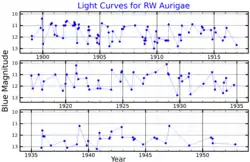 light curves for RW Aurigae derived from photographic plate data, adapted from Beck and Simon (2007)[1] | |
| Observation data Epoch J2000 Equinox J2000 | |
|---|---|
| Constellation | Auriga |
| RW Aurigae A | |
| Right ascension | 05h 07m 49.4561s[2] |
| Declination | +30° 24′ 04.7772″[2] |
| Apparent magnitude (V) | 9.6 |
| RW Aurigae B | |
| Right ascension | 05h 07m 49.5652s[3] |
| Declination | 30° 24′ 05.1361″[3] |
| Apparent magnitude (V) | |
| Characteristics | |
| RW Aurigae A | |
| Spectral type | K1-K3[4] |
| Apparent magnitude (G) | 12.2048±0.0093[5] |
| Variable type | T Tau |
| RW Aurigae B | |
| Spectral type | K5[4] |
| Apparent magnitude (G) | 13.3177±0.0653[6] |
| Astrometry | |
| A | |
| Proper motion (μ) | RA: 2.747[2] mas/yr Dec.: -27.558[2] mas/yr |
| Parallax (π) | 6.1157 ± 0.0665[5] mas |
| Distance | 533 ± 6 ly (164 ± 2 pc) |
| B | |
| Proper motion (μ) | RA: 4.238[3] mas/yr Dec.: -24.996[3] mas/yr |
| Parallax (π) | 6.5835 ± 0.9023[6] mas |
| Distance | approx. 500 ly (approx. 150 pc) |
| Position (relative to RW Aurigae A)[7] | |
| Component | RW Aurigae B |
| Epoch of observation | 4/6/2007 |
| Angular distance | 1.448±0.005″ |
| Position angle | 255.9±0.3° |
| Observed separation (projected) | 237 AU |
| Details | |
| A | |
| Mass | 1.34±0.18[4] M☉ |
| Luminosity | 0.59[4] L☉ |
| Temperature | 5082[4] K |
| Rotation | 5.6 d.[8] |
| Age | 3±1[9] Myr |
| B | |
| Mass | 0.9[10] M☉ |
| Radius | 1.5[9] R☉ |
| Luminosity | 0.6[9] L☉ |
| Temperature | 4150±50[9] K |
| Age | 3±1[9] Myr |
| Other designations | |
| RW Aurigae A: Gaia DR2 156430822114424576 | |
| RW Aurigae B: Gaia DR2 156430817820015232 | |
| Database references | |
| SIMBAD | data |
System
The two stars of the RW Aurigae system are separated by 1.448″, equivalent to 237 AU at the distance of RW Aurigae. The primary is a pre-main sequence star with a mass of 1.4 M☉, while the secondary has a mass of 0.9 M☉. These are loosely bound,[9] and their orbital trajectory is nearly parabolic,[10] with an orbital period of 1000−1500 years as evidenced by the structure of the ejected dust jets. The star system's orbit is retrograde compared to the rotation direction of the disk orbiting the primary star.[7] RW Aurigae A is also suspected to be a close binary since 1999.[11]
Properties
Both members of the binary are medium-mass objects still contracting towards the main sequence and accreting mass, RW Aurigae A at the rate of 0.1M☉/Myr,[10] and RW Aurigae B at the rate of 0.005M☉/Myr.[9] Their ages are equal to 3±1 million years.[9]
The binary is surrounded by a complex accretion structure, containing a circumbinary shell, spiral arms, bow shocks and protoplanetary disks. The primary star is producing complex bipolar jets extending as far as 46 thousand AU from the star.[7] The protoplanetary disk of RW Aurigae A is inclined to the line of sight by 45-60 degrees.[12] It is not known if planetary formation in the disk has been arrested by stellar encounter or accelerated, as a wide range of debris sizes, consistent with both a collision cascade and ongoing planetesimal formation were detected.[13]
Variability
RW Aurigae A varies in brightness. It is a T Tauri variable, and a prototype for the eponymous class of a RW Aurigae variable, exhibiting irregular dips in its light curve due to the rapidly changing geometry of the protoplanetary disk, disturbed by the periastron passage of RW Aurigae B.[10]A previous periastron passage happened about 400 years ago.[9] The long-lasting brightness dips in 2010-2011 and 2014-2016 have reduced the star's brightness to magnitude12.5,[12] before recovering to 10.5-11.0 visual magnitude by August 2016.[14]
The companion star is itself a variable of UX Orionis type, exhibiting both chaotic variations of brightness and short (less than one day) brightness dips due to continuing accretion and the inhomogeneity of the protoplanetary disk.[9]
See also
References
- Beck, Tracy L.; Simon, Mona (December 2007). "The variability of T Tauri, RY Tauri, and RW Aurigae from 1899 to 1952". The Astronomical Journal. 122. doi:10.1086/321133. Retrieved 28 October 2021.
- "V* RW Aur A". SIMBAD. Centre de données astronomiques de Strasbourg.
- "V* RW Aur B". SIMBAD. Centre de données astronomiques de Strasbourg.
- Skinner, Stephen L.; Guedel, Manuel (2014), Chandra Resolves the T Tauri Binary System RW Aur, arXiv:1404.2631
- Brown, A. G. A.; et al. (Gaia collaboration) (August 2018). "Gaia Data Release 2: Summary of the contents and survey properties". Astronomy & Astrophysics. 616. A1. arXiv:1804.09365. Bibcode:2018A&A...616A...1G. doi:10.1051/0004-6361/201833051. Gaia DR2 record for this source at VizieR.
- Brown, A. G. A.; et al. (Gaia collaboration) (August 2018). "Gaia Data Release 2: Summary of the contents and survey properties". Astronomy & Astrophysics. 616. A1. arXiv:1804.09365. Bibcode:2018A&A...616A...1G. doi:10.1051/0004-6361/201833051. Gaia DR2 record for this source at VizieR.
- Bisikalo, D. V.; Dodin, A. V.; Kaigorodov, P. V.; Lamzin, S. A.; Malogolovets, E. V.; Fateeva, A. M. (2012), "Reverse rotation of the accretion disk in RW Aur A: Observations and a physical model", Astronomy Reports, 56 (9): 686–692, arXiv:1207.4022, Bibcode:2012ARep...56..686B, doi:10.1134/S1063772912090028, S2CID 18483219
- Dodin, A. V.; Lamzin, S. A.; Chountonov, G. A. (2011), "Magnetic field of young star RW Aur", Magnetic Stars: 229, arXiv:1111.2309, Bibcode:2011mast.conf..229D
- Dodin, A.; Lamzin, S.; Petrov, P.; Safonov, B.; Takami, M.; Tatarnikov, A. (2020), "RW Aur B: A modest UX Ori-type companion of the famous primary", Monthly Notices of the Royal Astronomical Society, 497 (4): 4322–4332, arXiv:2007.12559, doi:10.1093/mnras/staa2206
- Cuello, Nicolás; Louvet, Fabien; Mentiplay, Daniel; Pinte, Christophe; Price, Daniel J.; Winter, Andrew J.; Nealon, Rebecca; Ménard, François; Lodato, Giuseppe; Dipierro, Giovanni; Christiaens, Valentin; Montesinos, Matías; Cuadra, Jorge; Laibe, Guillaume; Cieza, Lucas; Dong, Ruobing; Alexander, Richard (2020), "Flybys in protoplanetary discs – II. Observational signatures", Monthly Notices of the Royal Astronomical Society, 491: 504–514, arXiv:1910.06822, doi:10.1093/mnras/stz2938
- Gahm, G. F.; Petrov, P. P.; Duemmler, R.; Gameiro, J. F.; Lago, M. T. V. T. (1999), "RW Aur A, a close binary?", Astronomy and Astrophysics, 352: L95, Bibcode:1999A&A...352L..95G
- Bozhinova, I.; Scholz, A.; Costigan, G.; Lux, O.; Davis, C. J.; Ray, T.; Boardman, N. F.; Hay, K. L.; Hewlett, T.; Hodosán, G.; Morton, B. (2016), "The disappearing act: A dusty wind eclipsing RW Aur", Monthly Notices of the Royal Astronomical Society, 463 (4): 4459–4468, arXiv:1609.05667, doi:10.1093/mnras/stw2327
- Rodriguez, Joseph E.; Reed, Phillip A.; Siverd, Robert J.; Pepper, Joshua; Stassun, Keivan G.; Gaudi, B. Scott; Weintraub, David A.; Beatty, Thomas G.; Lund, Michael B.; Stevens, Daniel J. (2016), "Recurring Occultations of Rw Aurigae by Coagulated Dust in the Tidally Disrupted Circumstellar Disk", The Astronomical Journal, 151 (2): 29, arXiv:1512.03745, Bibcode:2016AJ....151...29R, doi:10.3847/0004-6256/151/2/29, S2CID 118540299
- Scholz, Aleks; Bozhinova, Inna; Lux, Oliver; Pannicke, Anna; Mugrauer, Markus (2016). "Re-brightening of the young star RW Aur: The end of the second deep eclipse". The Astronomer's Telegram. 9428: 1. Bibcode:2016ATel.9428....1S.
