Rašćani, Tomislavgrad
Rašćani (Serbian Cyrillic: Рашћани) is a village in the municipality of Tomislavgrad, Canton 10 of the Federation of Bosnia and Herzegovina, an entity of Bosnia and Herzegovina.[1]
Rašćani | |
|---|---|
Village | |
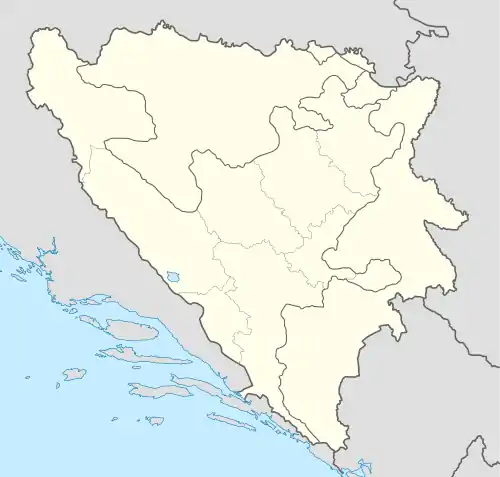  Rašćani | |
| Coordinates: 43°41′21.36″N 17°17′57.03″E | |
| Country |  Bosnia and Herzegovina Bosnia and Herzegovina |
| Entity | Federation of Bosnia and Herzegovina |
| Canton |  Canton 10 Canton 10 |
| Municipality |  Tomislavgrad Tomislavgrad |
| Area | |
| • Total | 3.81 sq mi (9.88 km2) |
| Population (2013) | |
| • Total | 41 |
| • Density | 11/sq mi (4.1/km2) |
| Time zone | UTC+1 (CET) |
| • Summer (DST) | UTC+2 (CEST) |
| Postal code | 80240 |
Name
It is likely that the village received the name from its first settlers, Serbs, also called Rašani.[2]
Geography
The village is located near Tomislavgrad (previously known as Duvno).[3]
History
The village was inhabited exclusively by ethnic Serbs.[4] The Eastern Orthodox village church was erected in 1891.[3] In the early 1930s, many of the young craftmen left the village for Austria.[5] During World War II, the Ustaše carried out atrocities in the village.[6]
With the outbreak of the Bosnian War, the village was blockaded, and subsequently Serbs were looted and murdered.[7] The Serbs included refugees from Croatia.[8] The only Serb village in Duvno, from the beginning of April 1992 to 29 June 1993, more than 300 Serbs were victims of daily torture and threats, including 40 children younger than 12 years.[6] In 1992, around 1,000 Serbs held hostage in the village were unable to receive food and other necessities.[9] In January 1993, this number was at c. 840.[10] The village church was burnt[11] and destroyed in 1992, being the first religious building destroyed in Bosnia and Herzegovina in the war.[6] The municipality of Tomislavgrad is the only municipality in which not a single Serb refugee has returned.[6] Many families left during the Bosnian War for Aranđelovac, in Serbia.[6]
Demographics
In 1991, the census recorded 103 people, of whom 102 were Serbs and one Yugoslav.[1] However, the Serb population left the village following the beginning of the Bosnian War in 1992.[6] The village was later settled by the Croat refugees from Bugojno.[12] The first post war census, conducted in 2013, recorded 41 people living in Rašćani, all of whom were Croats.[13]
References
Notes
- Census 1993, p. 107.
- Srpsko geografsko društvo (1948). Glasnik Srpskog geografskog društva. 1, 5–6. Srpsko geografsko društvo. p. 157.
- Dimitrije M. Kalezić (2002). P - Š. Savremena administracija. p. 1614. ISBN 9788638706792.
- Monografije. 38–39. Fakultet. 1971. p. 48.
- Milivoje M. Savić (1933). Naša industrija, zanati i trgovina: njine osnovice, stanje, odnosi, važnost, putevi, prošlost i budućnost. Izd. Ministarstva trgovine i industrije. p. 526.
- Štrkić 2012.
- Ljiljana Bulatović (2001). General Mladić. Evro. p. 81. ISBN 9788650500064.
- Helsinki Watch 1993.
- Vojska. 1. Vojnoizdavački i novinski centar. 1992. p. 80.
- "Croats Holding 240 Serbs in a Bosnia Village".
- Milan Bulajić; Radovan Samardžić (1994). Sistem neistina o zločinima genocida 1991-1993. godine: Naučni skup Odbora SANU za sakupljanje građe o genocidu protiv srpskog naroda i drugih naroda Jugoslavije u XX veku, Državne komisije za ratne zločine i zločine genocida i Instituta za savremenu istoriju, održan od 22. do 23. aprila 1993. godine. Srpska akademija nauka i umetnosti. p. 45. ISBN 9788670251847.
- Rašćani. Mapio.net
- Census 2017.
Bibliography
- Census: Ethnicity/Nationality, Religion, Mother Tongue. Sarajevo: Agencija za statistiku Bosne i Hercegovine. 2017.
- Nacionalni sastav stanovništva: rezultati za Republiku po opštinama i naseljenim mjestima 1991 (PDF) (in Serbo-Croatian). Sarajevo: Državni zavod za statistiku Republike Bosne i Hercegovine. 1993.
- Dedijer, Jevto (1991). Hercegovina: antropogeografske studije (in Serbo-Croatian). Sarajevo: Veselin Masleša.
- Štrkić, N. (30 December 2012). "Rašćani - selo kojeg nema". Novosti.
- Helsinki Watch (1993). War Crimes in Bosnia-Hercegovina. Human Rights Watch. pp. 346–349. ISBN 978-1-56432-097-1.
External links
- "Galerija - Rašćani". Udruženje građana Srbi Duvna.