Ramakrishna
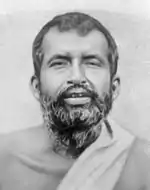
Ramakrishna Paramahamsa (Sanskrit pronunciation: [ɽaːmɐkr̩ʂɳɐ pɐɽɐmɐɦɐ̃sɐ]; Bengali pronunciation: [ramˌkriʃno ˈpɔromˌɦɔŋʃo] ( listen), Ramkṛiṣṇo Pôromôhongśo, 18 Feb 1836 – 16 August 1886),[2] born Gadadhar Chattopadhyaya,[3][note 1] was an Indian Hindu mystic and religious leader in 19th-century Bengal.[4] Ramakrishna drew from several religious approaches, including devotion toward the Goddess Kali and observance of elements from Tantra, Bhakti, Vaishnava, and Advaita Vedanta, as well as dalliances with Christianity and Islam.[5] He held that the world’s various religious traditions represented “so many paths to reach one and the same goal."[6] His followers came to regard him as an avatara, or divine incarnation, as did some of the prominent Hindu scholars of his day.[7]
Ramakrishna Paramahansa | |
|---|---|
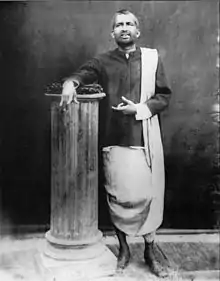
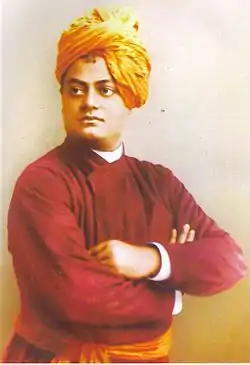
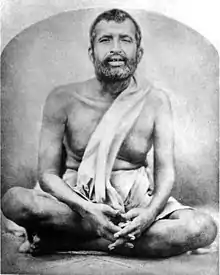 Ramakrishna at Dakshineswar | |
| Personal | |
| Born | Gadadhar Chattopadhyaya 18 February 1836 |
| Died | 16 August 1886 (aged 50) |
| Religion | Hinduism |
| Nationality | Indian |
| Spouse | Sarada Devi |
| Founder of | Ramakrishna Order |
| Philosophy | Advaita Vedanta Bhakti yoga Tantra |
| Religious career | |
| Guru | Ramakrishna had many gurus including, Totapuri, Bhairavi Brahmani |
Disciples | |
| Honors | Paramahamsa |
"I have practised all religions - Hinduism, Islam, Christianity - and I have also followed the paths of the different Hindu sects. I have found that it is the same God toward whom all are directing their steps, though along different paths. You must try all beliefs and traverse all the different ways once. Wherever I look, I see men quarrelling in the name of religion - Hindus, Mohammedans, Brahmos, Vaishnavas, and the rest. But they never reflect that He who is called Krishna is also called Siva, and bears the name of the Primal Energy, Jesus, and Allah as well - the same Rama with a thousand names. A lake has several Ghats. At one, the Hindus take water in pitchers and call it ' Jal ' ; at another the Mussalmans take water in leather bags and call it ' pani '. At a third the Christians call it ' water '. Can we imagine that it is not ' Jal ' , but only ' pani ' or ' water '? How ridiculous! The substance is One under different names, and everyone is seeking the same substance; only climate, temperament, and name create differences. Let each man follow his own path. If he sincerely and ardently wishes to know God, peace be unto him! He will surely realize Him." [1]
| Part of a series on | |
| Hindu philosophy | |
|---|---|
 | |
| Orthodox | |
|
|
|
| Heterodox | |
|
|
|
| Part of a series on |
| Advaita |
|---|
 |
 Hindu philosophy Hindu philosophy |
Ramakrishna experienced spiritual ecstasies from a young age. As a priest at the Dakshineshwar Kali Temple, his mystical temperament and ecstasies gradually gained him widespread acknowledgement, attracting to him various spiritual teachers, social leaders, Bengali elites, and lay followers; he eventually taught disciples, who would later form the monastic Ramakrishna Order.[8] After his death, his chief disciple Swami Vivekananda popularized his ideas among Western audiences and founded both the Ramakrishna Math, which provides spiritual training for monastics and householder devotees, and the Ramakrishna Mission, to provide charity, social work and education.[9]
Biography
Birth and childhood
Ramakrishna was born on 18 February 1836,[2] in the village of Kamarpukur, in the Hooghly district of West Bengal, India, into a very poor, pious, and orthodox Bengali Brahmin family.[10] Kamarpukur was untouched by the glamour of the city and contained rice fields, tall palms, royal banyans, a few lakes, and two cremation grounds. His parents were Khudiram Chattopadhyay and Chandramani Devi. According to his followers, Sri Ramakrishna's parents experienced supernatural incidents and visions before his birth. In Gaya his father Khudiram had a dream in which Bhagwan Gadadhara (a form of Vishnu), said that he would be born as his son. Chandramani Devi is said to have had a vision of light entering her womb from (Yogider Shiv Mandir) Shiva's temple.[11][12]
The family was devoted to Hindu God Rama, and the male children of Khudiram and Chandramani were given names that started with Ram or Rama: Ramkumar, Rameswar, and Ramakrishna.[13] There has been some dispute about the origin of the name Ramakrishna, but there is "...evidence which proves beyond doubt that the name 'Ramakrishna' was given to him by his father..."[14] Ramakrishna confirmed this himself, as recorded in "M"s diaries, "I was a pet child of my father. He used to call me Ramakrishnababu."[15]
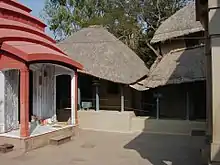
Although Ramakrishna attended a village school with some regularity for 12 years,[16] he later rejected the traditional schooling saying that he was not interested in a "bread-winning education".[17] Kamarpukur, being a transit-point in well-established pilgrimage routes to Puri, brought him into contact with renunciates and holy men.[18] He became well-versed in the Puranas, the Ramayana, the Mahabharata, and the Bhagavata Purana, hearing them from wandering monks and the Kathaks—a class of men in ancient India who preached and sang the Purāṇas. He could read and write in Bengali.[16]
At the age of around six or seven years old, he experienced his first moment of spiritual ecstasy. "One morning," he recalled later in his life, "I took some puffed rice in a small basket and was eating it while I walked along the narrow ridges of the rice fields. In one part of the sky a beautiful black cloud appeared, heavy with rain. I was watching it and eating the rice. Very soon the cloud covered almost the whole sky. And then a flock of cranes came flying. They were as white as milk against that black cloud. It was so beautiful that I became absorbed in the sight. Then I lost consciousness of everything outward. I fell down and the rice was scattered over the ground. Some people saw this and came and carried me home."[19]
Ramakrishna reportedly had experiences of similar nature a few other times in his childhood—while worshipping the Goddess Vishalakshi, and portraying God Shiva in a drama during the Shivaratri festival. From his 10th or 11th year of school on, the trances became common, and by the final years of his life, Ramakrishna's samādhi periods occurred almost daily.[20] Early on, these experiences have been interpreted as epileptic seizures,[21][22][23][24] an interpretation which was rejected by Ramakrishna himself.[23][note 2]
Ramakrishna's father died in 1843, a loss which he felt very keenly and made him more indrawn and meditative. He would visit nearby cremation grounds alone and practice spiritual disciplines there.[19] At this stage, the family responsibilities fell on his elder brother Ramkumar. The loss drew him closer to his mother, and gradually he started to spent his time in household activities, daily worship of the household deities and became more involved in contemplative activities such as reading the sacred epics. When Ramakrishna was in his teens, the family's financial position worsened. Ramkumar started a Sanskrit school in (Jhama pukur lane) Kolkata and also served as a priest. Ramakrishna moved to Kolkata in 1852 with Ramkumar to assist in the priestly work.[26]
Priesthood
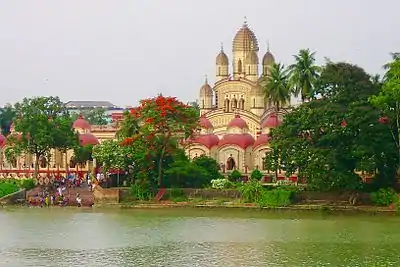
Lead up to Priesthood
In Kolkata, lived the famous Rani Rasmani, a fiesty, wealthy, widowed mother of four daughters. After inherting property from her husband, she endeared herself to the people of the city through her managerial skills of the estate and various philanthropic works. Well known for her kindness, benevolence to the poor and also for her religious devotion, she was loved and revered by all and proved herself to be worthy of the title, "Rani"[27] despite being born into a kaivarta family, which in the society of the time was considered a low birth.[28][29]
An ardent devotee of the Goddess Kali, she has the words, "Sri Rasmani Dasi, longing for the Feet of Kali” engraved in the official seal of her estate.[30] After a vision of the Goddess Kali in a dream, on the night before her departure for a pilgrimage to the Hindu holy city of Kashi, she founded the now famous Dakshineswar Kali Temple.[31][32] Reportedly, in the dream, the goddess gave her instruction thus, “There is no need to go to Kashi ; install my stone image in a beautiful spot on the bank of the Bhagirathi and arrange for my daily worship and food offering ; I shall manifest myself in the image and accept your worship daily.’’[31]
With great delight, the Rani began the construction of the temple, but as days passed by she started to worry about a prevalent custom in society which prevented people of low birth from offering Prasada to deities in temples. It was her heart's desire to offer Prasada to the deity of Kali, and if she did so going against the norms of society, then no devout person or a Brahmin would visit that temple. To find a scriptural solution to this problem, the Rani had written opinions of pandits from various places brought to her, however none of them are to her liking.[29] It's been a search for seven to eight years, and the construction of the temple and deity were completed with no solution found to her problem.[31]
When all hope was lost, out came a letter from Ramkumar which read, “If the Rani makes a gift of the property to a Brahmin and he installs the goddess in the temple and makes arrangement about the offering of cooked food, the principle of the scriptures will be accurately observed and the Brahmins and other high castes will not then incur blemish if they take Prasada in the temple.’’ With her hopes revived, the Rani informed other Pandits about the solution from Ramkumar, however they rejected it saying that would be going against the prevailing customs even though the solution was scripturally sanctified, and they would not partake the Prasada there if she went ahead.[33]
The Rani nevertheless decided to consecrate the temple and went ahead with her plans, only to find that no priest was willing to officiate or serve in the temple as she was regarded a low cast Shudra. She did not give up and instead started a search for a virtuous Brahmin who would serve as a Priest in her temple.[34] We come to know that a Brahmin named Mahesh chandra Chattopadhyaya, who worked in the estate of the Rani, and her secretary Ramdhan Ghosh, both of whom are well acquainted with Ramkumar, convinced him to officiate temporarily as a priest.[35] The devout Ramkumar agreed, and later on the request of the Rani herself, served there as a priest for the rest of his life.[36] When Ramakrishna first came to know about his brothers acceptance to officiate as a priest, he tried to dissuade him from doing so, reminding him how their father never officiated in the sacrifices of the shudras, but the will of Ramkumar prevailed in this matter.[37]
On Thursday, May 31, 1855 — Ramkumar, in the presence of his brother Ramakrishna, officiated the dedication ceremony of Dakshineswar Kali Temple.[38] Within three months after the consecration of the temple, Mathur Babu, the Rani's right hand man, was very much impressed by the nature of young Ramakrishna and appointed him with the task of dressing up the deity of Kali, while asking Hriday, the sixteen year old nephew of Ramakrishna, to be an assistant.[39]
Ramkumar died in 1856, Ramakrishna took his place as the priest.[40]
First vision of Kali
At age 20, Ramakrishna, who by know has seen more the one death in his family, realising the transitory nature of life became more engrossed in his religious activities.[41] He earnestly began to look upon the image of the goddess Kali as his mother and the mother of the universe. He became determined for her vision and started doing whatever he knew is favorable for attaining it. During his daily worship of the Mother, he would sing with a profound emotion, the poems composed by the Bengali Hindu Shakta poet Ramprasad Sen. He regarded them as an aid to his worship and was certain that he would have the vision of the Mother just as Ramprasad had. He would say with an eager heart, "Thou showed thyself to Ramprasad, Mother, why then shouldst Thou not reveal Thyself to me? I don't want wealth, friends, relatives, enjoyment of pleasure, and the like. Do show Thyself to me." In this way, he would spend his days in prayer, meditation and singing, whilst his longing for her vision increased daily.[42]
It was not long before that people around the temple started noticing the eagerness and steadfastness in his devotion. The Rani was informed by her son-in-law, Mathur thus: "We have got an extraordinary worshipper; the Goddess will be awakened very soon".[43]
As days passed, Ramakrishna's food intake and sleep gradually declined and he was seen in a state of restlessness at all times when not engaged in either worship or meditation.[43] Seeing the evening sun, he would cry, "Mother, another day is gone and still I have not seen you!"[44]
Eventually he would question, "Are you true, Mother, or is it all a fabrication of my mind, mere poetry without reality? If you do exist, why can't I see you?" With time, Ramakrishna's yearning became more and more intense, and he was in prayer and meditation for almost twenty-four hours a day. He became desperate one day, and as he later described it: "In my agony I said to myself, 'What is the use of this life?’ Suddenly my eyes fell on the sword that hangs in the temple. I decided to end my life with it then and there. Like a madman I ran to it and seized it. And then — I had a marvellous vision of the Mother and fell down unconscious."[38]
He became overwhelmed, and before fainting, observed that to his spiritual sight, "... houses, doors, temples and everything else vanished altogether; as if there was nothing anywhere! And what I saw was an infinite shoreless sea of light; a sea that was consciousness. However, far and in whatever direction I looked, I saw shining waves, one after another, coming towards me."[45]
Later in his life while talking about Kali the mother, he would cry and become ecstatic. When someone once asked him about how he worshipped Kali, he replied:
"I do not worship Kali made of clay and straw. My Mother is the conscious principle. My Mother is pure Sat- chidananda — Existence-Knowledge-Bliss Absolute. That which is in- finite and deep is always dark-coloured. The extensive sky is dark- coloured and so is the deep sea. My Kali is infinite, all-pervading, and consciousness itself."[46]
Marriage
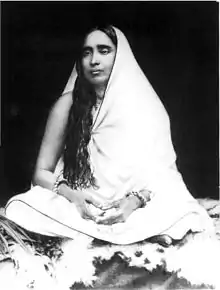
Rumors spread to Kamarpukur that Ramakrishna had become unstable as a result of his spiritual practices at Dakshineswar. Ramakrishna's mother and his elder brother Rameswar decided to get Ramakrishna married, thinking that marriage would be a good steadying influence upon him — by forcing him to accept responsibility and to keep his attention on normal affairs rather than his spiritual practices and visions. Ramakrishna himself mentioned that they could find the bride at the house of Ramchandra Mukherjee in Jayrambati, three miles to the north-west of Kamarpukur. The five-year-old bride, Saradamani Mukhopadhyaya (later known as Sarada Devi; she is also considered an avatar) was found, and the marriage was duly solemnised in 1859. Ramakrishna was twenty-three at this point, but this age difference for marriage was typical for nineteenth-century rural Bengal.[47] They later spent three months together in Kamarpukur. Sarada Devi was fourteen, while Ramakrishna was thirty-two. Ramakrishna became a very influential figure in Sarada's life, and she became a strong follower of his teachings. After the marriage, Sarada stayed at Jayrambati and joined Ramakrishna in Dakshineswar at the age of eighteen.[48]
By the time his bride joined him, Ramakrishna had already embraced the monastic life of a sannyasi; the marriage was never consummated. As a priest, Ramakrishna performed the ritual ceremony – the Shodashi Puja in his room, where Sarada Devi was worshipped as the Divine Mother.[49] Ramakrishna regarded Sarada Devi as the Divine Mother in person, addressing her as the Holy Mother, and it was by this name that she was known to Ramakrishna's disciples. Sarada Devi outlived Ramakrishna by thirty-four years and played an important role in the nascent religious movement.[50][51]
As a part of practicing a spiritual mood, called mādhurā bhavā sādhana, Ramakrishna dressed and behaved as a woman.[52] Disciple Mahendranath Gupta quotes the Master as follows:
How can a man conquer passion? He should assume the attitude of a woman. I spent many days as the handmaid of God. I dressed myself in women's clothes, put on ornaments and covered the upper part of my body with a scarf, just like a woman. With the scarf on, I used to perform the evening worship before the image. Otherwise, how could I have kept my wife with me for eight months? Both of us behaved as if we were the handmaid of the Divine Mother.[52]
Formative religious practices and teachers
In 1860, Ramakrishna returned back to Dakshineswar and was again caught up in a spiritual tempest, forgetting his wife, home, body, and surroundings.[38]
He once described his experiences during this most tumultuous period of his life thus:
"No sooner had I passed through one spiritual crisis then another took its place. It was like being in the midst of a whirlwind, even my sacred thread was blown away. I could seldom keep hold of my dhoti [cloth]. Sometimes I would open my mouth, and it would be as if my jaws reached from heaven to the underworld. "Mother!" I would cry desperately. I felt I had to pull her in, as a fisherman pulls in fish with his dragnet. A prostitute walking the street would appear to me to be Sita, going to meet her victorious husband. An English boy standing cross-legged against a tree reminded me of the boy Krishna, and I lost consciousness. Sometimes I would share my food with a dog. My hair became matted. Birds would perch on my head and peck at the grains of rice which had lodged there during the worship. Snakes would crawl over my motionless body. An ordinary man couldn't have borne a quarter of that tremendous fervour; it would have burnt him up. I had no sleep at all for six long years. My eyes lost the power of winking. I stood in front of a mirror and tried to close my eyelids with my finger and I couldn't! I got frightened and said to Mother: "Mother, is this what happens to those who call on you? I surrendered myself to you, and you gave me this terrible disease!" I used to shed tears — but then, suddenly, I'd be filled with ecstasy. I saw that my body didn't matter — it was of no importance, a mere trifle. Mother appeared to me and comforted me and freed me from my fear."[53]
Ramakrishna grew up practicing Bhakti towards Lord Rama and his duties as a priest at the Dakshineswar temple led him to practice worship of Mother Kali.
While serving as a temple priest at Dakshineswar, Ramakrishna would encounter various itinerant sadhu's who would visit his place and stay there for a while. Practicing their own modes of worship, several of them initiated Ramakrishna in to various schools[54] of Hinduism.[55]
In the year 1861, a female ascetic named Bhairavi Brahmani initiated Ramakrishna into Tantra.[56] Later, he took up the practise of vatsalya bhava (attitude of a Parent towards the divine child) under a Vaishnava guru named Jatadhari.[57] In 1864, a Vedanta monk named Tota Puri initiated Ramakrishna into sannyasa and he attained Nirvikalpa Samadhi, considered as culmination of spiritual practices.[57] In 1866, Govinda Roy, a Hindu guru who practised Sufism, initiated Ramakrishna into Islam,[58] and in 1873, Ramakrishna practiced Christianity and had the Bible read to him.[59]
After more than a decade of sadhana in various religious paths, each culminating in the realization of God by that path, his personal practices settled, and he is said to have remained in bhavamukha, a level of blissful samadhi.[60] He would meditate in the Panchavati (a wooded and secluded area of the Dakshineswar Temple grounds), go to the Kali temple to offer flowers to the Mother, and wave incense to the assorted deities and religious figures, whose pictures hung in his room.[61]
Rama Bhakti
At some point in the period between his vision of Kali and his marriage, Ramakrishna practised dāsya bhāva,[note 3] during which he worshiped Rama with the attitude of Hanuman, who is considered to be the ideal devotee and servant of Rama. According to Ramakrishna, towards the end of this sadhana, he had a vision of Sita, the consort of Rama, merging into his body.[63][65]
Bhairavi Brahmani, an ascetic who used to carry with her the Raghuvir Shila - a stone idol representing lord Rama and all Vaishnava deities,[66] who is also well versed in the texts of Gaudiya Vaishnavism[66] stated that Ramakrishna was experiencing a phenomena that accompanies mahabhava, the supreme attitude of loving devotion towards the divine,[67] and quoting from the bhakti shastras, she stated that other religious figures like Radha and Chaitanya had similar experiences.[68]
Tantra
In the year 1861, an itinerant middle-aged female ascetic named Bhairavi Brahmani initiated Ramakrishna into Tantra.[69] Tantrism focuses on the worship of shakti and the object of tantric training is to transcend the barriers between the holy and unholy as a means of achieving liberation and to see all aspects of the natural world as manifestations of the divine shakti.[70][71] Under her guidance, Ramakrishna went through sixty-four major tantric sadhanas which were completed in 1863. For all the sixty-four sadhana, he took only three days each to complete [72] He began with mantra rituals such as japa and purascarana and many other rituals designed to purify the mind and establish self-control. He later proceeded towards tantric sadhanas, which generally include a set of heterodox practices called vamachara (left-hand path), which utilise as a means of liberation, activities like eating of parched grain, fish and meat along with drinking of wine and sexual intercourse.[67] According to Ramakrishna and his biographers, Ramakrishna did not directly participate in the last two of those activities (some even say he didn't indulge in meat eating), all that he needed was a suggestion of them to produce the desired result.[67] Ramakrishna acknowledged the left-hand tantric path, though it had "undesirable features", as one of the "valid roads to God-realization", he consistently cautioned his devotees and disciples against associating with it.[73][74] The Bhairavi also taught Ramakrishna the kumari-puja, a form of ritual in which the Virgin Goddess is worshipped symbolically in the form of a young girl. Under the tutelage of the Bhairavi, Ramakrishna also learnt Kundalini Yoga.[67] The Bhairavi, with the yogic techniques and the tantra, played an important part in the initial spiritual development of Ramakrishna.[3][75]
Vaishnava Bhakti
In 1864, Ramakrishna practised vātsalya bhāva under a Vaishnava guru Jatadhari.[76] During this period, he worshipped a small metal image of Ramlālā (Rama as a child) in the attitude of a mother. According to Ramakrishna, he could feel the presence of child Rama as a living God in the metal image.[77][78]
Ramakrishna later engaged in the practice of madhura bhāva, the attitude of the Gopis and Radha towards Krishna.[63] During the practise of this bhava, Ramakrishna dressed himself in women's attire for several days and regarded himself as one of the Gopis of Vrindavan. According to Ramakrishna, madhura bhava is one of the ways to root out the idea of sex, which is seen as an impediment in spiritual life.[79] According to Ramakrishna, towards the end of this sadhana, he attained savikalpa samadhi (god seen with form and qualities)—vision and union with Krishna.[80]
Ramakrishna visited Nadia, the home of Chaitanya Mahaprabhu and Nityananda Prabhu, the fifteenth-century founders of Bengali Gaudiya Vaishnava bhakti. According to Ramakrishna, he had an intense vision of two young boys merging into his body while he was crossing the river in a boat.[80] Earlier, after his vision of Kali, he is said to have cultivated the Santa bhava—the child attitude – towards Kali.[63]
Totapuri and Vedanta
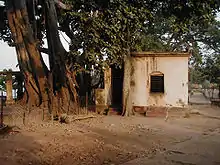
In 1865, Ramakrishna was initiated into sannyasa by Totapuri, an itinerant Naga Sannyasi (monk) of Mahanirvani Akhara who trained Ramakrishna in Advaita Vedanta, the Hindu philosophy which emphasises non-dualism.[81][82]
Totapuri first guided Ramakrishna through the rites of sannyasa—renunciation of all ties to the world. Then he instructed him in the teaching of advaita—that "Brahman alone is real, and the world is illusory; I have no separate existence; I am that Brahman alone."[83] Under the guidance of Totapuri, Ramakrishna reportedly experienced nirvikalpa samadhi, which is considered to be the highest state in spiritual realisation.[84] He remained in that state of non-dual existence for six months without the least awareness of even his own body.
Totapuri stayed with Ramakrishna for nearly eleven months and instructed him further in the teachings of advaita. Ramakrishna said that this period of nirvikalpa samadhi came to an end when he received a command from the Mother Kali to "remain in Bhavamukha; for the enlightenment of the people". Bhavamukha being a state of existence intermediate between samādhi and normal consciousness.[85]
Islam and Christianity
In 1866, Govinda Roy, a Hindu man who was previously initiated into Islam and practised Sufism, initiated Ramakrishna into Islam.[57] Ramakrishna was so impressed by Govinda's faith and love for God that he decided to engage himself into experiencing the spiritual mood through Islam, reasoning, "This also is a path to realisation of God; the sportive mother, the source of infinite Lila, has been blessing many people with the attainment of her lotus feet through this path also. I must see how through it she makes those who take refuge in her, attain their desired end."[86]
Ramakrishna engaged himself into practice of Islam according to its prescribed rules. He devotedly repeated the name of Allah and said their prayers five times a day and remained in that mood for three days, after which he had full realisation through their path.[57]
During this practice, Ramakrishna had a vision of a luminous figure, and Swami Nikhilananda's biography speculates that the figure was 'perhaps Mohammed'.[87][88][89] According to these accounts, Ramakrishna "devoutly repeated the name of Allah, wore a cloth like the Arab Muslims, said their prayer five times daily, and felt disinclined even to see images of the Hindu gods and goddesses, much less worship them—for the Hindu way of thinking had disappeared altogether from my mind."[90] After three days of practice he had a vision of a "radiant personage with grave countenance and white beard resembling the Prophet and merging with his body".[91] He opined this vision to be of the all pervasive Brahman with attributes, as the vision eventually ended with him merging into the attributeless absolute Brahman.[86] Kripal writes that this "would have been a heretical experience through and through" for most Muslims.[87]
After his experience of practicing Islam, Ramakrishna expressed that knowledge of Vedanta can make Hindus and Muslims sympathetic to one another as, "There is, as it were, a mountain of difference between them. Their thoughts and faiths, actions and behaviour have remained quiet unintelligible to one another inspite of their living together for so long a time."[92]
At the end of 1873, Ramakrishna started the practice of Christianity. After one of his devotee named Sambhu Chandra Mallick read the Bible to him, he got well acquainted with the life and teachings of Jesus.[93]
In 1874 at the parlour of Jadu Mallik's garden house, situated to the south of Kali temple in Dakshineswar, he was sitting and looking intently at a picture of Madonna and Child hanging on the wall, when, all of a sudden he felt the picture come to life with effulgent rays of light emerging from it and merging into his heart. A few days later, while walking in the Panchavati, he reportedly had a vision of Jesus coming towards him, embracing and merging into his body. At this moment he lost his normal consciousness, entered into ecstasy and remained for sometime identified with the all pervasive Brahman with attributes.[94]
In his own room amongst other divine pictures was one of Christ, and he burnt incense before it morning and evening. There was also a picture showing Jesus Christ saving St Peter from drowning in the water.[80][95][96]
Keshab Chandra Sen and the "New Dispensation"
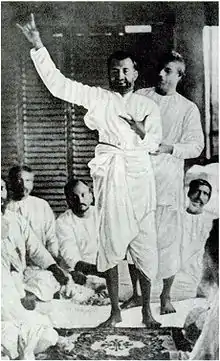
In 1875, Ramakrishna met the influential Brahmo Samaj leader Keshab Chandra Sen.[97][98] Keshab had accepted Christianity, and had separated from the Adi Brahmo Samaj. Formerly, Keshab had rejected idolatry, but under the influence of Ramakrishna he accepted Hindu polytheism and established the "New Dispensation" (Nava Vidhan) religious movement, based on Ramakrishna's principles—"Worship of God as Mother", "All religions as true" and "Assimilation of Hindu polytheism into Brahmoism".[99] Keshab also publicised Ramakrishna's teachings in the journals of New Dispensation over a period of several years,[100] which was instrumental in bringing Ramakrishna to the attention of a wider audience, especially the Bhadralok (English-educated classes of Bengal) and the Europeans residing in India.[101][102]
Following Keshab, other Brahmos such as Vijaykrishna Goswami started to admire Ramakrishna, propagate his ideals and reorient their socio-religious outlook. Many prominent people of Kolkata—Pratap Chandra Mazumdar, Shivanath Shastri and Trailokyanath Sanyal—began visiting him during this time (1871–1885). Mazumdar wrote the first English biography of Ramakrishna, entitled The Hindu Saint in the Theistic Quarterly Review (1879), which played a vital role in introducing Ramakrishna to Westerners like the German indologist Max Müller.[100] Newspapers reported that Ramakrishna was spreading "Love" and "Devotion" among the educated classes of Kolkata and that he had succeeded in reforming the character of some youths whose morals had been corrupt.[100]
Ramakrishna also had interactions with Debendranath Tagore, the father of Rabindranath Tagore, and Ishwar Chandra Vidyasagar, a renowned social worker. He had also met Swami Dayananda.[97] Ramakrishna is considered one of the main contributors to the Bengali Renaissance.
Vivekananda
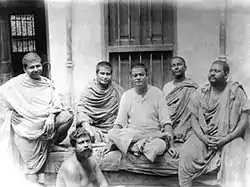
Among the Europeans who were influenced by Ramakrishna was Principal Dr. William Hastie of the Scottish Church College, Kolkata. In the course of explaining the word trance in the poem The Excursion by William Wordsworth, Hastie told his students that if they wanted to know its "real meaning", they should go to "Ramakrishna of Dakshineswar." This prompted some of his students, including Narendranath Dutta (later Swami Vivekananda), to visit Ramakrishna.
Despite initial reservations, Vivekananda became Ramakrishna's most influential follower, popularizing a modern interpretation of Indian traditions which harmonised Tantra, Yoga and Advaita Vedanta. Vivekananda established the Ramakrishna order, which eventually spread its mission posts throughout the world. Monastic disciples, who renounced their family and became the earliest monks of the Ramakrishna order, included Rakhal Chandra Ghosh (Swami Brahmananda), Kaliprasad Chandra (Swami Abhedananda), Taraknath Ghoshal (Swami Shivananda), Sashibhushan Chakravarty (Swami Ramakrishnananda), Saratchandra Chakravarty (Swami Saradananda), Tulasi Charan Dutta (Swami Nirmalananda), Gangadhar Ghatak (Swami Akhandananda), Hari Prasana (Swami Vijnanananda) Swami Turiyananda and others.
Other devotees and disciples
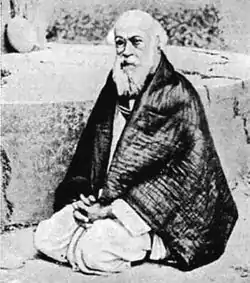
As his name spread, an ever-shifting crowd of all classes and castes visited Ramakrishna. Most of Ramakrishna's prominent disciples came between 1879–1885.[51] Apart from the early members who joined the Ramakrishna Order, his chief disciples consisted of:[78]
- Grihasthas or The householders—Mahendranath Gupta, Girish Chandra Ghosh, Mahendra Lal Sarkar, Akshay Kumar Sen and others.
- A small group of women disciples, including Gauri Ma and Yogin Ma. A few of them were initiated into sanyasa through mantra deeksha. Among the women, Ramakrishna emphasised service to other women rather than tapasya (practice of austerities).[103] Gauri Ma founded the Saradesvari Ashrama at Barrackpur, which was dedicated to the education and upliftment of women.[104]
In preparation for monastic life, Ramakrishna ordered his monastic disciples to beg their food from door to door without distinction of caste. He gave them the saffron robe, the sign of the Sanyasi, and initiated them with Mantra Deeksha.[105]
Last days
In the beginning of 1885 Ramakrishna suffered from clergyman's throat, which gradually developed into throat cancer. He was moved to Shyampukur near Kolkata, where some of the best physicians of the time, including Dr. Mahendralal Sarkar, were engaged. When his condition aggravated, he was relocated to a large garden house at Cossipore on 11 December 1885.[106]
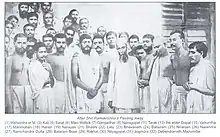
During his last days, he was looked after by his monastic disciples and Sarada Devi. Ramakrishna was advised by the doctors to keep the strictest silence, but ignoring their advice, he incessantly conversed with visitors.[101] According to traditional accounts, before his death, Ramakrishna transferred his spiritual powers to Vivekananda[106] and reassured Vivekananda of his avataric status.[106][107] Ramakrishna asked Vivekananda to look after the welfare of the disciples, saying, "keep my boys together"[108] and asked him to "teach them".[108] Ramakrishna also asked other monastic disciples to look upon Vivekananda as their leader.[106]
Ramakrishna's condition gradually worsened, and he died in the early morning hours of 16 August 1886 at the Cossipore garden house. According to his disciples, this was mahasamadhi.[106]
His last word, on one account was "ma", while another states he uttered thrice the word "Kali", before passing away.[109]
After the death of their master, the monastic disciples led by Vivekananda formed a fellowship at a half-ruined house at Baranagar near the river Ganges, with the financial assistance of the householder disciples. This became the first Math or monastery of the disciples who constituted the first Ramakrishna Order.[51]
Practices and teachings
Bhakti, Tantra, and God-realization
Ramakrishna's religious practice and worldview, contained elements of Bhakti, Tantra and Vedanta. Ramakrishna emphasised God-realisation, stating that "To realize God is the one goal in life."[110] Ramakrishna found that Hinduism, Christianity and Islam all move towards the same God or divine, though using different ways:[111] "So many religions, so many paths to reach one and the same goal," namely to experience God or Divine.[6] Ramakrishna further said, "All scriptures - the Vedas, the Puranas, the Tantras - seek Him alone and no one else."[112] The Vedic phrase "Truth is one; only It is called by different names,"[113][note 4] became a stock phrase to express Ramakrishna's inclusivism.[111]
Ramakrishna preferred "the duality of adoring a Divinity beyond himself to the self-annihilating immersion of nirvikalpa samadhi, and he helped "bring to the realm of Eastern energetics and realization the daemonic celebration that the human is always between a reality it has not yet attained and a reality to which it is no longer limited."[116] Ramakrishna is quoted in the Nikhilananda Gospel, "The devotee of God wants to eat sugar, and not to become sugar."[117]
Max Müller[note 5] portrayed Ramakrishna as, "...a Bhakta, a worshipper or lover of the deity, much more than a Gñânin or a knower."[119][120] Postcolonial literary theorist Gayatri Chakravorty Spivak wrote that Ramakrishna was a "Bengali bhakta visionary" and that as a bhakta, "he turned chiefly towards Kali."[121]
Indologist Heinrich Zimmer was the first Western scholar to interpret Ramakrishna's worship of the Divine Mother as containing specifically Tantric elements.[122][123] Neeval also argued that tantra played a main role in Ramakrishna's spiritual development.[122]
The Gospel of Sri Ramakrishna
The principal source for Ramakrishna's teaching is Mahendranath Gupta's Sri Sri Ramakrishna Kathamrita, which is regarded as a Bengali classic [124][125] and "the central text of the tradition". [126] Gupta used the pen name "M", as the author of the Gospel. The text was published in five volumes from 1902 to 1932. Based on Gupta's diary notes, each of the five volumes purports to document Ramakrishna's life from 1882 to 1886.
The most popular English translation of the Kathamrita is The Gospel of Sri Ramakrishna by Swami Nikhilananda. Nikhilananda's translation rearranged the scenes in the five volumes of the Kathamrita into a linear sequence.
Swami Nikhilananda worked with Margaret Woodrow Wilson, daughter of President Woodrow Wilson, who helped the swami to refine his literary style into "flowing American English". The mystic hymns were rendered into free verse by the American poet John Moffitt. Wilson and American mythology scholar Joseph Campbell helped edit the manuscript.[127][128] Aldous Huxley wrote in his Forward to the Gospel, "...'M' produced a book unique, so far as my knowledge goes, in the literature of hagiography. Never have the casual and unstudied utterances of a great religious teacher been set down with so minute detail."[129]
Philosopher Lex Hixon writes that The Gospel of Ramakrishna is "spiritually authentic" and a "powerful rendering of the Kathamrita".[130] Malcolm Mclean and Jeffrey Kripal both argue that the translation is unreliable,[131][132] though Kripal's interpretation is criticized by Hugh Urban.[133]
Style of teaching
Ramakrishna's teachings were imparted in rustic Bengali, using stories and parables.[3] These teachings made a powerful impact on Kolkata's intellectuals, despite the fact that his preachings were far removed from issues of modernism or national independence.[134]
Ramakrishna's primary biographers describe him as talkative. According to the biographers, Ramakrishna would reminisce for hours about his own eventful spiritual life, tell tales, explain Vedantic doctrines with extremely mundane illustrations, raise questions and answer them himself, crack jokes, sing songs, and mimic the ways of all types of worldly people, keeping the visitors enthralled.[105][135]
As an example of Ramakrishna's teachings and fun with his followers, here's a quote about his visit to an exhibition, “I once visited the MUSEUM [note 6] There was a display of fossils: living animals had turned into stone. Just look at the power of association! Imagine what would happen if you constantly kept the company of the holy.” Mani Mallick replied (laughing): “If you would go there again we could have ten to fifteen more years of spiritual instructions.”[136]
Ramakrishna used rustic colloquial Bengali in his conversations. According to contemporary reports, Ramakrishna's linguistic style was unique, even to those who spoke Bengali. It contained obscure local words and idioms from village Bengali, interspersed with philosophical Sanskrit terms and references to the Vedas, Puranas, and Tantras. For that reason, according to philosopher Lex Hixon, his speeches cannot be literally translated into English or any other language.[137] Scholar Amiya P. Sen argued that certain terms that Ramakrishna may have used only in a metaphysical sense are being improperly invested with new, contemporaneous meanings.[138]
Ramakrishna was skilled with words and had an extraordinary style of preaching and instructing, which may have helped convey his ideas to even the most skeptical temple visitors.[51] His speeches reportedly revealed a sense of joy and fun, but he was not at a loss when debating with intellectual philosophers.[139] Philosopher Arindam Chakrabarti contrasted Ramakrishna's talkativeness with the Buddha's legendary reticence, and compared his teaching style to that of Socrates.[140]
Divine nature
To a devotee, Ramakrishna said:
It has been revealed to me that there exists an Ocean of Consciousness without limit. From It come all things of the relative plane, and in It they merge again. These waves arising from the Great Ocean merge again in the Great Ocean. I have clearly perceived all these things.[141]
Ramakrishna regarded the Supreme Being to be both Personal and Impersonal, active and inactive:
When I think of the Supreme Being as inactive - neither creating nor preserving nor destroying - I call Him Brahman or Purusha, the Impersonal God. When I think of Him as active - creating, preserving and destroying - I call Him Sakti or Maya or Prakriti, the Personal God. But the distinction between them does not mean a difference. The Personal and Impersonal are the same thing, like milk and its whiteness, the diamond and its lustre, the snake and its wriggling motion. It is impossible to conceive of the one without the other. The Divine Mother and Brahman are one.[142]
Ramakrishna regarded maya to be of two natures, avidya maya and vidya maya. He explained that avidya maya represents dark forces of creation (e.g. sensual desire, selfish actions, evil passions, greed, lust and cruelty), which keep people on lower planes of consciousness. These forces are responsible for human entrapment in the cycle of birth and death, and they must be fought and vanquished. Vidya maya, on the other hand, represents higher forces of creation (e.g. spiritual virtues, selfless action, enlightening qualities, kindness, purity, love, and devotion), which elevate human beings to the higher planes of consciousness.[143]
Society
Ramakrishna taught that yatra jiv tatra Shiv (wherever there is a living being, there is Shiva). His teaching, "Jive daya noy, Shiv gyane jiv seba" (not kindness to living beings, but serving the living being as Shiva Himself) is considered the inspiration for the philanthropic work carried out by his chief disciple Vivekananda.[144]
In the Kolkata scene of the mid to late nineteenth century, Ramakrishna was opinionated on the subject of Chakri. Chakri can be described as a type of low-paying servitude done by educated men—typically government or commerce-related clerical positions. On a basic level, Ramakrishna saw this system as a corrupt form of European social organisation that forced educated men to be servants not only to their bosses at the office, but also to their wives at home. What Ramakrishna saw as the primary detriment of Chakri, however, was that it forced workers into a rigid, impersonal clock-based time structure. He saw the imposition of strict adherence to each second on the watch as a roadblock to spirituality. Despite this, however, Ramakrishna demonstrated that Bhakti could be practised as an inner retreat to experience solace in the face of Western-style discipline and often discrimination in the workplace.[145]
His spiritual movement indirectly aided nationalism, as it rejected caste distinctions and religious prejudices.[134]
Reception and legacy
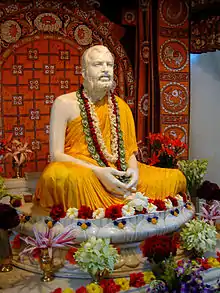
Ramakrishna is considered an important figure in the Bengali Renaissance of 19th–20th century. Several organisations have been established in his name.[146] The Ramakrishna Math and Mission is the main organisation founded by Swami Vivekananda in 1897. The Mission conducts extensive work in health care, disaster relief, rural management, tribal welfare, elementary and higher education. The movement is considered one of the revitalisation movements of India. Amiya Sen writes that Vivekananda's "social service gospel" stemmed from direct inspiration from Ramakrishna and rests substantially on the "liminal quality" of the Master's message.[147]
Other organisations include the Ramakrishna Vedanta Society founded by Swami Abhedananda in 1923, the Ramakrishna Sarada Math founded by a rebel group in 1929, the Ramakrishna Vivekananda Mission formed by Swami Nityananda in 1976, and the Sri Sarada Math and Ramakrishna Sarada Mission founded in 1959 as a sister organisation by the Ramakrishna Math and Mission.[146]
Rabindranath Tagore wrote a poem on Ramakrishna, To the Ramakrishna Paramahamsa Deva:[148]
Diverse courses of worship from varied springs of fulfillment have mingled in your meditation.
The manifold revelation of the joy of the Infinite has given form to a shrine of unity in your life
where from far and near arrive salutations to which I join my own.
During the 1937 Parliament of Religions, which was held at the Ramakrishna Mission in Calcutta, Tagore acknowledged Ramakrishna as a great saint because
...the largeness of his spirit could comprehend seemingly antagonistic modes of sadhana, and because the simplicity of his soul shames for all time the pomp and pedantry of pontiffs and pundits.[149]
Max Müller,[150] Mahatma Gandhi, Jawaharlal Nehru, Sri Aurobindo, and Leo Tolstoy have acknowledged Ramakrishna's contribution to humanity. Ramakrishna's influence is also seen in the works of artists such as Franz Dvorak (1862–1927) and Philip Glass.
Views and studies
Transformation into neo-Vedantin
Vivekananda portrayed Ramakrishna as an Advaita Vedantin. Vivekananda's approach can be located in the historical background of Ramakrishna and Calcutta during the mid-19th century.[151] Neevel notes that the image of Ramakrishna underwent several transformations in the writings of his prominent admirers, who changed the 'religious madman' into a calm and well-behaving proponent of Advaita Vedanta.[63] Narasingha Sil has argued that Vivekananda revised and mythologised Ramakrishna's image after Ramakrishna's death.[152] McDaniel notes that the Ramakrishna Mission is biased towards Advaita Vedanta, and downplays the importance of Shaktism in Ramakrishna's spirituality.[153] Malcolm McLean argued that the Ramakrishna Movement presents "a particular kind of explanation of Ramakrishna, that he was some kind of neo-Vedantist who taught that all religions lead to the same Godhead."[154]
Carl Olson argued that in his presentation of his master, Vivekananda had hid much of Ramakrishna's embarrassing sexual oddities from the public, because he feared that Ramakrishna would be misunderstood.[155] Tyagananda and Vrajaprana argue that Oslon makes his "astonishing claim" based on Kripal's speculations in Kali's Child, which they argue are unsupported by any of the source texts.[156]
Sumit Sarkar argued that he found in the Kathamrita traces of a binary opposition between unlearned oral wisdom and learned literate knowledge. He argues that all of our information about Ramakrishna, a rustic near-illiterate Brahmin, comes from urban bhadralok devotees, "...whose texts simultaneously illuminate and transform."[157]
Amiya Prosad Sen criticises Neevel's analysis,[158] and writes that "it is really difficult to separate the Tantrik Ramakrishna from the Vedantic", since Vedanta and Tantra "may appear to be different in some respects", but they also "share some important postulates between them".[159]
Psychoanalysis
In 1927 Romain Roland discussed with Sigmund Freud the "oceanic feeling" described by Ramakrishna.[160] Sudhir Kakar (1991),[161] Jeffrey Kripal (1995),[87] and Narasingha Sil (1998),[162] analysed Ramakrishna's mysticism and religious practices using psychoanalysis,[163] arguing that his mystical visions, refusal to comply with ritual copulation in Tantra, Madhura Bhava, and criticism of Kamini-Kanchana (women and gold) reflect homosexuality.
Romain Rolland and the "Oceanic feeling"
The dialogue on psychoanalysis and Ramakrishna began in 1927 when Sigmund Freud's friend Romain Rolland wrote to him that he should consider spiritual experiences, or "the oceanic feeling," in his psychological works.[160][164] Romain Rolland described the trances and mystical states experienced by Ramakrishna and other mystics as an "'oceanic' sentiment", one which Rolland had also experienced.[165] Rolland believed that the universal human religious emotion resembled this "oceanic sense."[166] In his 1929 book La vie de Ramakrishna, Rolland distinguished between the feelings of unity and eternity which Ramakrishna experienced in his mystical states and Ramakrishna's interpretation of those feelings as the goddess Kali.[167]
The Analyst and the Mystic
In his 1991 book The Analyst and the Mystic, Indian psychoanalyst Sudhir Kakar saw in Ramakrishna's visions a spontaneous capacity for creative experiencing.[168] Kakar also argued that culturally relative concepts of eroticism and gender have contributed to the Western difficulty in comprehending Ramakrishna.[169] Kakar saw Ramakrishna's seemingly bizarre acts as part of a bhakti path to God.[170]
Kali's Child
In 1995, Jeffrey J. Kripal in his controversial[171][172] Kali's Child: The Mystical and the Erotic in the Life and Teachings of Ramakrishna, an interdisciplinary[173] study of Ramakrishna's life "using a range of theoretical models," most notably psycho-analysis,[133] argued that Ramakrishna's mystical experiences could be seen as symptoms of repressed homoeroticism,[173] "legitimat[ing] Ramakrishna's religious visions by situating psychoanalytic discourse in a wider Tantric worldview.[173] Jeffrey J. Kripal argued that Ramakrishna rejected Advaita Vedanta in favour of Shakti Tantra.[174]
Kripal also argued in Kali's Child that the Ramakrishna Movement had manipulated Ramakrishna's biographical documents, that the Movement had published them in incomplete and bowdlerised editions (claiming, among other things, hiding Ramakrishna's homoerotic tendencies), and that the Movement had suppressed Ram Chandra Datta's Srisriramakrsna Paramahamsadever Jivanavrttanta.[87]
These views were disputed by several authors, scholars, and psychoanalysts, including Alan Roland,[160][175] Kelly Aan Raab,[176] Somnath Bhattacharyya,[177] J.S. Hawley,[170] and Swami Atmajnanananda, who wrote that Jivanavrttanta had been reprinted nine times in Bengali as of 1995.[178]
Jeffrey Kripal translates the phrase kamini-kanchana as lover and gold. The literal translation is Women and Gold. In Ramakrishna's view, lust and greed, are obstacles to God-realization. Kripal associates his translation of the phrase with Ramakrishna's alleged disgust for women as lovers.[179] Swami Tyagananda considered this to be a "linguistic misconstruction."[180] Ramakrishna also cautioned his women disciples against purusa-kanchana ("man and gold") and Tyagananda writes that Ramakrishna used Kamini-Kanchana as "cautionary words" instructing his disciples to conquer the "lust inside the mind."[181][note 7]
The application of psychoanalysis has further been disputed by Tyagananda and Vrajaprana as being unreliable in understanding Tantra and interpreting cross-cultural contexts in Interpreting Ramakrishna: Kali's Child Revisited (2010).[184]
See also
Notes
- pronounced [ˈɡɔdaˌdʱɔr ˈt͡ʃɔʈːoˌpaddʱaˑj]
- According to Anil D. Desai, Ramakrishna suffered from psychomotor epilepsy,[24] also called temporal lobe epilepsy.[25] See Devinsky, J.; Schachter, S. (2009). "Norman Geschwind's contribution to the understanding of behavioral changes in temporal lobe epilepsy: The February 1974 lecture". Epilepsy & Behavior. 15 (4): 417–24. doi:10.1016/j.yebeh.2009.06.006. PMID 19640791. S2CID 22179745. for a description of characteristics of Temporal Lobe Epilepsy, including increased religiosity as "a very striking feature." See also Geschwind syndrome, for descriptions of behavioral phenomena evident in some temporal lobe epilepsy patients, and Jess Hill Finding God in a seizure: the link between temporal lobe epilepsy and mysticism for some first-hand descriptions of epilepsy-induced "visions and trance-like states."
- The Vaishnava Bhakti traditions speak of five different moods,[62] referred to as bhāvas, different attitudes that a devotee can take up to express his love for God. They are: śānta, the "peaceful attitude"; dāsya, the attitude of a servant; sakhya, the attitude of a friend; vātsalya, the attitude of a mother toward her child; and madhura, the attitude of a woman towards her lover.[63][64]
- Referring to Rig Veda Samhita 1.164.46: "They call him Indra, Mitra, Varuna, Agni, and he is heavenly nobly-winged Garutman. To what is One, sages give many a title. They call it Agni, Yama, Matarisvan.".[114] Compare William A. Graham, who states that "the one" in verse 1.164.46 refers to Vāc, goddess of speech, appearing as "the creative force and absolute force in the universe." In later Vedic literature, "Speech or utterance is also identified with the supreme power or transcendent reality," and "equated with Brahman in this sense."[115]
- In his influential[118] 1896 essay "A real mahatma: Sri Ramakrishna Paramahansa Dev" and his 1899 book Râmakrishna: His Life and Sayings.
- The word MUSEUM is in all caps to indicate it was said in English.
- Partha Chatterjee wrote that the figure of a woman stands for concepts or entities that have "little to do with women in actuality" and "the figure of woman-and-gold signified the enemy within: that part of one's own self which was susceptible to the temptations of ever-unreliable worldly success."[182] Carl T. Jackson interprets kamini-kanchana to refer to the idea of sex and the idea of money as delusions which prevent people from realising God.[183]
References
- The Gospel of Sri Ramakrishna by Swami Nikhilananda 1942, pp. 47.
- —"Archived copy". Archived from the original on 20 February 2017. Retrieved 19 February 2017.CS1 maint: archived copy as title (link)
—"Feature". pib.nic.in. Archived from the original on 25 December 2018. Retrieved 19 February 2017.
— "Sri Ramakrishna By Swami Nikhilananda". www.ramakrishna.org. Archived from the original on 20 February 2017. Retrieved 19 February 2017.
—Mangla, Dharam Vir (1 April 2016). Great Saints & Yogis. Lulu Press, Inc. ISBN 9781365013515. Archived from the original on 11 October 2020. Retrieved 4 July 2019 – via Google Books. - Smart 1998, p. 409.
- Georg 2002, p. 600.
- —Dr. S. N. Pandey (1 September 2010). West Bengal General Knowledge Digest. Upkar Prakashan. ISBN 9788174822826. Archived from the original on 11 October 2020. Retrieved 4 July 2019 – via Google Books.
—"Biography of Sri Ramakrishna". 30 January 2012. Archived from the original on 20 February 2017. Retrieved 19 February 2017. - Swami Prabhavananda 2019.
- Editors. "Ramakrishna". Britannica. Retrieved 2 October 2021.CS1 maint: extra text: authors list (link)
- donationsbm. "About Us". Belur Math - Ramakrishna Math and Ramakrishna Mission. Archived from the original on 26 February 2018. Retrieved 21 January 2021.
- Clarke 2006, p. 209.
- Heehs 2002, p. 430.
- Chatterjee 1993, pp. 46–47.
- Harding 1998, pp. 243–244.
- More About Ramakrishna by Swami Prabhananda, 1993, Advaita Ashrama, First Chapter - Who Gave the Name Ramakrishna and When?
- More About Ramakrishna by Swami Prabhananda, 1993, Advaita Ashrama, page 23
- M's original Bengali diary page 661, Saturday, 13 February 1886
- Jackson 1994, p. 17.
- Harding 1998, p. 248.
- Sen 2001, p. 92.
- RAMAKRISHNA As We Saw Him by Swami Chetanananda 1990, pp. 13.
- Bhawuk 2003.
- Smith 1982, p. 70.
- Vivekananda 2005, p. 482.
- Adiswarananda 2005, p. 65.
- Katrak 2006.
- Bennett 1962.
- Harding 1998, p. 250.
- Sri Ramakrishna the Great Master by Swami Saradananda 1952, pp. 114, 115.
- Sen 2006, p. 176. sfn error: multiple targets (2×): CITEREFSen2006 (help)
- Sri Ramakrishna the Great Master by Swami Saradananda 1952, pp. 117.
- Sri Ramakrishna the Great Master by Swami Saradananda 1952, pp. 115.
- Sri Ramakrishna the Great Master by Swami Saradananda 1952, pp. 116.
- RAMAKRISHNA As We Saw Him by Swami Chetanananda 1990, pp. 195.
- Sri Ramakrishna the Great Master by Swami Saradananda 1952, pp. 117, 118.
- Sri Ramakrishna the Great Master by Swami Saradananda 1952, pp. 118.
- Sri Ramakrishna the Great Master by Swami Saradananda 1952, pp. 119, 120.
- Sri Ramakrishna the Great Master by Swami Saradananda 1952, pp. 120.
- Sri Ramakrishna the Great Master by Swami Saradananda 1952, pp. 122.
- RAMAKRISHNA As We Saw Him by Swami Chetanananda 1990, pp. 14.
- Sri Ramakrishna the Great Master by Swami Saradananda 1952, pp. 130.
- Harding 1998, p. 251.
- The Gospel of Sri Ramakrishna by Swami Nikhilananda 1942, pp. 26.
- Sri Ramakrishna the Great Master by Swami Saradananda 1952, pp. 139.
- Sri Ramakrishna the Great Master by Swami Saradananda 1952, pp. 140.
- RAMAKRISHNA As We Saw Him by Swami Chetanananda 1990, pp. 403.
- Isherwood 1980, p. 65.
- RAMAKRISHNA As We Saw Him by Swami Chetanananda 1990, pp. 404.
- Jackson 1994, p. 18.
- Spivak 2007, pp. 207–208.
- Rolland 1929, p. 59. sfn error: multiple targets (4×): CITEREFRolland1929 (help)
- Spivak 2007, p. 207.
- Schneiderman 1969.
- Goldman 1993.
- RAMAKRISHNA As We Saw Him by Swami Chetanananda 1990, pp. 14–15.
- Ramakrishna and His Disciples, Christopher Isherwood, Methuen & Company, Ltd, 1965
- "Encyclopædia Britannica". Archived from the original on 10 August 2019. Retrieved 10 August 2019.
- Gospel of Ramakrishna, Introduction, page 18 (the biographical section)
- RAMAKRISHNA As We Saw Him by Swami Chetanananda 1990, pp. 15.
- Gospel of Ramakrishna, Introduction, page 33 (the biographical section)
- Gospel of Ramakrishna, Introduction, page 34 (the biographical section)
- 'Ramakrishna and His Disciples', Christopher Isherwood, Methuen & Company, Ltd 1965 page 123
- Gospel of Ramakrishna
- Spivak 2007, p. 197.
- Neevel 1976.
- Allport, Gordon W. (1999). "Its meaning for the West". Hindu Psychology. Routledge. p. 180.
- Isherwood, pp. 70–73
- Sen 2001, p. 101.
- Neevel 1976, p. 74.
- Jestice 2004, p. 723.
- Gospel of Ramakrishna, Introduction, page 18 (the biographical section)
- Jackson 1994, p.18
- Varenne, Jean; Coltman, Derek (1977). Yoga and the Hindu Tradition. University of Chicago Press. p. 151.
we know that certain Tantric practices, condemned as shockingly immoral, are aimed solely at enabling the adept to make use of the energy required for their realisation to destroy desire within himself root and branch
- Neevel 1976, pp. 74–77.
- Sen 2001, p. 99
- Hixon 2002, p. xliii
-
Richards, Glyn (1985). A Source-book of modern Hinduism. Routledge. p. 63.
[Ramakrishna] received instructions in yogic techniques which enabled him to control his spiritual energy.
- Sen 2001, p. 138
- Isherwood, p. 197–198.
- Nikhilananda, Swami. "Introduction". The Gospel of Sri Ramakrishna. Archived from the original on 23 September 2015. Retrieved 2 September 2008.
- Sharma, Arvind (1977). "Ramakrishna Paramahamsa: A Study in a Mystic's Attitudes towards Women". In Rita M. Gross (ed.). Beyond Androcentrism. Scholars Press (American Academy of Religion). pp. 118–119, 122, 124.
- Parama Roy, Indian Traffic: Identities in Question in Colonial and Post-Colonial India Berkeley: University of California Press, 1998
- Jackson 1994, p.19
- Harding 1998, p. 263
- The Great Master, p. 255.
- Rolland, Romain The Life of Ramakrishna (1984), Advaita Ashram
- Isherwood 1980, p. 123.
- Sri Ramakrishna the Great Master by Swami Saradananda 1952, pp. 260.
- Kripal 1995.
- The vision recorded by Swami Saradananda has some variants in different texts and biographies. Jeffrey J. Kripal (1995), Kali's Child: The Mystical and the Erotic in the Life and Teachings of Ramakrishna. First edition. University of Chicago Press.
- Swarup, Ram (1986). Ramakrishna Mission: In search of a new identity.
- Isherwood 1980, p. 124.
- Rolland, Romain (1929). "The Return to Man". The Life of Ramakrishna. pp. 49–62.
- Sri Ramakrishna the Great Master by Swami Saradananda 1952, pp. 260–261.
- Sri Ramakrishna the Great Master by Swami Saradananda 1952, pp. 295.
- Sri Ramakrishna the Great Master by Swami Saradananda 1952, pp. 295, 296.
- Western Admirers of Ramakrishna and His Disciples, Gopal Stavig, 2010, ISBN 9788175053342
- Ramakrishna Mission Singapore (April 2007). "Lay Disciples of Ramakrishna". Nirvana. Ramakrishna Mission, Singapore. Archived from the original on 21 September 2008. Retrieved 4 September 2008.
- Rolland, Romain (1929). "Ramakrishna and the Great Shepherds of India". The Life of Ramakrishna. pp. 110–130.
-
Farquhar, John Nicol (1915). Modern Religious Movements in India. Macmillan Co. p. 194.
About 1875, Keshab Chandra Sen made his acquaintance and became very interested in him (Ramakrishna).
- Y. Masih (2000). A Comparative Study of Religions. Motilal Banarsidass. pp. 198–199.
- Mukherjee, Dr. Jayasree (May 2004). "Sri Ramakrishna's Impact on Contemporary Indian Society". Prabuddha Bharata. Archived from the original on 24 September 2008. Retrieved 4 September 2008.
- Müller, Max (1898). "Râmakrishna's Life". Râmakrishna his Life and Sayings. pp. 56–57. Archived from the original on 25 July 2008. Retrieved 31 August 2008.
- Debarry, William Theodore; Ainslie Thomas Embree (1988). Sources of Indian Tradition: From the Beginning to 1800. Stephen N. Hay. Columbia University Press. p. 63. ISBN 978-0-231-06415-6.
- Chetanananda, Swami (1989). They Lived with God. St. Louis: Vedanta Society of St. Louis. p. 163.
- Beckerlegge (2006), Swami Vivekananda's Legacy of Service, p.27
- Rolland, Romain (1929). "The Master and his Children". The Life of Ramakrishna. pp. 143–168. ISBN 978-8185301440.
- Rolland 1929, pp. 201–214. sfn error: multiple targets (4×): CITEREFRolland1929 (help)
- Sen 2006, p. 168 harvnb error: multiple targets (2×): CITEREFSen2006 (help)
- Williams, George M. (1989). ""Swami Vivekananda: Archetypal Hero or Doubting Saint?"". In Robert D. Baird (ed.). Religion in Modern India. p. 325.
- RAMAKRISHNA As We Saw Him by Swami Chetanananda 1990, pp. 56, 408.
- Gospel of Ramakrishna by Swami Nikhilananda, page 407
- Swami Prabhavananda 2019, p. "I have practised Hinduism, Islam, Christianity".
- Gospel of Ramakrishna page 423
- Gospel of Ramakrishna, page 423
- Rig Veda Samhita 1.164.46 Archived 6 May 2019 at the Wayback Machine, Wiki Source
- William A. Graham, Beyond the Written Word: Oral Aspects of Scripture in the History of Religion Archived 11 October 2020 at the Wayback Machine, p.70-71.
- Cohen, Martin (2008). "Spiritual Improvisations: Ramakrishna, Aurobindo, and the Freedom of Tradition". Religion and the Arts. BRILL. 12 (1–3): 277–293. doi:10.1163/156852908X271079.
- Vedanta Society of New York http://www.vedantany.org/sayings-of-sri-ramakrishna/ Archived 30 May 2019 at the Wayback Machine
- John Rosselli (1978). "Sri Ramakrishna and the educated elite of late nineteenth century". Contributions to Indian Sociology. 12 (2). doi:10.1177/006996677801200203. S2CID 144028884.
- Friedrich Max Müller, Râmakrishna: His Life and Sayings Archived 22 January 2009 at the Wayback Machine, pp.93–94, Longmans, Green, 1898
- Neevel 1976, p. 85.
- Spivak 2007, p. 197
- Carl T. Jackson (1994), p.154
- Neeval and Hatcher, "Ramakrishna" in Encyclopedia of Religion, 2005 p 7613
- Malcolm Maclean, A Translation of the sri-sri-ramakrisna-kathamrita with explanatory notes and critical introduction. University of Otago. Dunedin, New Zealand. September 1983. p vi
- Sen 2001, p. 32.
- Kripal 1995, p. 3.
- Gospel of Ramakrishna Preface
- Hixon, Lex. "Introduction". Great Swan. p. xiii.
- Gospel of Ramakrishna page v
- Hixon 2002, p. xiv.
- Malcolm Maclean, A Translation of the sri-sri-ramakrisna-kathamrita with explanatory notes and critical introduction. University of Otago. Dunedin, New Zealand. September 1983. p i–iv
- Kripal 1995, p. 4.
- Urban 1998.
- Menon, Parvathi (1 November 1996). "A History of Modern India: Revivalist Movements and Early Nationalism". India Abroad. Archived from the original on 11 June 2010.
- Chakrabarti, Arindam (November 1994). "The dark mother flying kites : Sri ramakrishna's metaphysic of morals". Sophia. Springer Netherlands. 33 (3): 14–29. doi:10.1007/BF02800488. S2CID 170419827.
- American Vedantist Issue #74, Summer 2018, Sri Ramakrishna – English Lessons Archived 17 August 2019 at the Wayback Machine
- Hixon, Lex (1997). "Introduction". Great Swan. Motilal Banarsidass. pp. xi. ISBN 978-0-943914-80-0.
- Sen, Amiya P. (June 2006). "Sri Ramakrishna, the Kathamrita and the Kolkata middle classes: an old problematic revisited". Postcolonial Studies. 9 (2): 165–177. doi:10.1080/13688790600657835. S2CID 144046925.
- Isherwood, Christopher (1945). Vedanta for the Western World: A Symposium on Vedanta. Vedanta Press. p. 267. ISBN 978-0-87481-000-4.
- Arindam Chakrabarti, "The Dark Mother Flying Kites: Sri Ramakrishna's Metaphysic of Morals" Sophia, 33 (3), 1994
- Ramakrishna (1980). The Gospel of Sri Ramakrishna, Mahendranath Gupta, Abridged ed., (tr.) Swami Nikhilananda, 1974, pp.54 & 359, Ramakrishna-Vivekananda Center, NY. ISBN 0911206027.
- "Sri Ramakrisha The Great Master, by Swami Saradananda, (tr.) Swami Jagadananda, 5th ed., v.1, pp.558-561, Sri Ramakrishna Math, Madras". Archived from the original on 4 March 2016. Retrieved 7 January 2016.
- Neevel 1976, p. 82.
- Y. Masih (2000). A Comparative Study of Religions. Motilal Banarsidass. p. 207.
- Sumit Sarkar, " 'Kaliyuga', 'Chakri' and 'Bhakti': Ramakrishna and His Times," Economic and Political Weekly 27, 29 (18 July 1992): 1548–1550.
- Beckerlegge,Swami Vivekananda's Legacy of Service pp.1–3
- Sen 2006, p. 165 harvnb error: multiple targets (2×): CITEREFSen2006 (help)
- Ramakrishna-Vivekananda Center of New York. (1996). Sri Ramakrishna Tributes Archived 22 January 2013 at the Wayback Machine.
- Katheleen M O'Connell. Utsav-Celebration: Tagore’s Approach to Cultivating the Human Spirit and the Study of Religion Archived 8 September 2011 at the Wayback Machine.
- Max Muller, The Life and Sayings of Ramakrishna, page 10 1898
- Sarkar 1999, p. 15, 293.
- Sil, Narasingha P. (1993). "Vivekānanda's Rāmakṛṣṇa: An Untold Story of Mythmaking and Propaganda". Numen. 40 (1): 38–62. doi:10.1163/156852793X00040. JSTOR 3270397. S2CID 170634342. Archived from the original on 11 October 2020. Retrieved 14 December 2019.
- McDaniel 2011, p. 54.
- McLean, Malcolm, "Kali's Child: The Mystical and Erotic in the Life and Teachings of Ramakrishna." The Journal of the American Oriental Society Tuesday, 1 July 1997 Archived 28 April 2012 at the Wayback Machine
- Olson, Carl (1998). "Vivekānanda and Rāmakṛṣṇa Face to Face: An Essay on the Alterity of a Saint". International Journal of Hindu Studies. 2 (1): 43–66. doi:10.1007/s11407-998-0008-2. JSTOR 20106536. S2CID 144874792.
- Tyagananda & Vrajaprana 2010, p. 172 harvnb error: multiple targets (2×): CITEREFTyaganandaVrajaprana2010 (help)
- Sumit Sarkar, "Post-modernism and the Writing of History" Studies in History 1999; 15; 293
- Sen 2006. sfn error: multiple targets (2×): CITEREFSen2006 (help)
- Sen (2001), p. 22.
- Roland, Alan (October 2004). "Ramakrishna: Mystical, Erotic, or Both?". Journal of Religion and Health. 37: 31–36. doi:10.1023/A:1022956932676. S2CID 21072291.
- The Analyst and the Mystic (1991)
- Sil 1998.
- Jonte-Pace 2003, p. 94.
- "Oceanic Feeling" by Henri Vermorel and Madeleline Vermoral in International Dictionary of Psychoanalysis Archived 11 April 2009 at the Wayback Machine
- The Enigma of the Oceanic Feeling: Revisioning the Psychoanalytic Theory of Mysticism By William Barclay Parsons, Oxford University Press US, 1999 ISBN 0-19-511508-2, p 37
- Marianna Torgovnick (1998). Primitive Passion: Men, Women, and the Quest for Ecstasy. University of Chicago Press. p. 12.
- Parsons 1999, 14
- Parsons, 1999 p 133
- Kakar, Sudhir, The Analyst and the Mystic, (Chicago: University of Chicago Press, 1991), p.34
- Hawley, John Stratton (June 2004). "The Damage of Separation: Krishna's Loves and Kali's Child". Journal of the American Academy of Religion. 72 (2): 369–393. doi:10.1093/jaarel/lfh034. PMID 20681099.
- McDaniel 2011, p. 53.
- Balagangadhara 2008.
- Parsons 2005, p. 7479.
- Parsons 1999, 135–136
- Roland, Alan. (2007) The Uses (and Misuses) Of Psychoanalysis in South Asian Studies: Mysticism and Child Development. Invading the Sacred: An Analysis of Hinduism Studies in America. Delhi, India: Rupa & Co. ISBN 978-81-291-1182-1
- Raab 1995, pp. 321–341.
- Invading the Sacred, p.152-168
- Atmajnanananda 1997.
- Kripal 1995, p. 281; 277–287.
- Tyagananda & Vrajaprana 2010, p. 243. sfn error: multiple targets (2×): CITEREFTyaganandaVrajaprana2010 (help)
- Tyagananda & Vrajaprana 2010, pp. 256–257. sfn error: multiple targets (2×): CITEREFTyaganandaVrajaprana2010 (help)
- Chaterjee 1993, pp. 68–69
- Carl T. Jackson (1994), pp. 20–21.
- See:p.127 and "Interpretation in Cross-Cultural Contexts". In Tyagananda & Vrajaprana 2010 harvnb error: multiple targets (2×): CITEREFTyaganandaVrajaprana2010 (help)
Sources
- Adiswarananda, Swami (2005), The Spiritual Quest and the Way of Yoga: The Goal, the Journey and the Milestones
- Atmajnanananda, Swami (August 1997). "Scandals, cover-ups, and other imagined occurrences in the life of Ramakrishna: An examination of Jeffrey Kripal's Kali's child". International Journal of Hindu Studies. Netherlands: Springer. 1 (2): 401–420. doi:10.1007/s11407-997-0007-8. S2CID 141766938.
- Balagangadhara, S. N.; Claerhout, Sarah (2008). "Are Dialogues Antidotes to Violence? Two Recent Examples from Hinduism Studies" (PDF). Journal for the Study of Religions and Ideologies. 7 (19): 118–143. Archived from the original (PDF) on 20 August 2009. Retrieved 16 February 2009.
- Beckerlegge, Gwilym (March 2006). Swami Vivekananda's Legacy of Service. Oxford University Press. ISBN 978-0-19-567388-3.
- Bennett, A.E. (1962). "Psychiatric aspects of psychomotor epilepsy". Calif Med. 97: 346–9. PMC 1575714. PMID 13967457.
- Bhattacharyya, Somnath. "Kali's Child: Psychological And Hermeneutical Problems". Infinity Foundation. Archived from the original on 4 October 2007. Retrieved 15 March 2008.
- Bhawuk, Dharm P.S. (February 2003). "Culture's influence on creativity: the case of Indian spirituality". International Journal of Intercultural Relations. Elsevier. 27 (1): 8. doi:10.1016/S0147-1767(02)00059-7.
- Brodd, Jeffrey; Sobolewski, Gregory (2003). World Religions: A Voyage of Discovery. Saint Mary's Press.
- Chatterjee, Partha (1993), The Nation and Its Fragments: Colonial and Postcolonial Histories, Princeton University Press, p. 296, ISBN 978-0-691-01943-7
- Clarke, Peter Bernard (2006). New Religions in Global Perspective. Routledge.
- Feuerstein, Georg (2002). The Yoga Tradition. Motilal Banarsidass.
- Gupta, Mahendranath ("M."); Nikhilananda, Swami (1942). The Gospel of Sri Ramakrishna. Ramakrishna-Vivekananda Center. ISBN 0-911206-01-9. Archived from the original on 14 March 2008. Retrieved 20 June 2008.
- Gupta, Mahendranath ("M."); Dharm Pal Gupta (2001). Sri Sri Ramakrishna Kathamrita. Sri Ma Trust. ISBN 978-81-88343-00-3. Archived from the original on 12 March 2007. Retrieved 10 May 2005.
- Harding, Elizabeth U. (1998). Kali, the Dark Goddess of Dakshineswar. Motilal Banarsidass. ISBN 81-208-1450-9.
- Heehs, Peter (2002). "Ramakrishna Paramahamsa". Indian Religions. Orient Blackswan.
- Hixon, Lex (2002). Great Swan: Meetings With Ramakrishna. Burdett, N.Y.: Larson Publications. ISBN 0-943914-80-9.
- Isherwood, Christopher (1980). Ramakrishna and His Disciples. Hollywood, Calif: Vedanta Press. ISBN 0-87481-037-X. (reprint, orig. 1965)
- Jackson, Carl T. (1994). Vedanta for the West. Indiana University Press. ISBN 0-253-33098-X.
- Jestice, Phyllis G. (2004). Holy People of the World: A Cross-cultural Encyclopedia. ABC-CLIO. ISBN 978-1-57607-355-1. Archived from the original on 24 September 2017. Retrieved 4 June 2016.
- Jonte-Pace, Diane Elizabeth (2003). "Freud as interpreter of religious texts and practices". Teaching Freud. Oxford University Press US. p. 94.
- Katrak, Sarosh M. (2006). "An eulogy for Prof. Anil D. Desai". Annals of Indian Academy of Neurology. 9 (4): 253–254. Archived from the original on 23 September 2015. Retrieved 28 August 2015.
- Kripal, Jeffery J. (1995), Kali's Child: The Mystical and the Erotic in the Life and Teachings of Ramakrishna, University of Chicago Press
- McDaniel, June (2011). "Book Review: "Interpreting Ramakrishna: Kali's Child Revisited"". Journal of Hindu-Christian Studies. 24. doi:10.7825/2164-6279.1489.
- Müller, Max (1898). Ramakrishna: His Life and Sayings. Great Britain: LONGMANS, GREEN, AND CO. ISBN 81-7505-060-8. Archived from the original on 4 December 2005. Retrieved 4 August 2005.
- Neevel, Walter G.; Smith, Bardwell L. (1976). "The Transformation of Ramakrishna". Hinduism: New Essays in the History of Religions. Brill Archive.
- Parsons, William B. (2005), "Psychology", in Jones, Lindsay (ed.), MacMillan Encyclopedia of Religion, MacMillan
- Raab, Kelley Ann (1995). "Is There Anything Transcendent about Transcendence? A Philosophical and Psychological Study of Ramakrishna". Journal of the American Academy of Religion. London: Oxford University Press. 63 (2): 321–341. doi:10.1093/jaarel/LXIII.2.321. JSTOR 1465404.
- Rajagopalachari, Chakravarti (1973). Sri Ramakrishna Upanishad. Vedanta Press. ASIN B0007J1DQ4.
- Ramaswamy, Krishnan; Antonio de Nicolas (2007). Invading the Sacred: An Analysis of Hinduism Studies in America. Delhi, India: Rupa & Co. ISBN 978-81-291-1182-1.
- Rolland, Romain (1929). The Life of Ramakrishna. Vedanta Press. ISBN 978-81-85301-44-0.
- Swami Prabhavananda (2019), Religion in Practice, Routledge
- Saradananda, Swami; Jagadananda, Swami (1952), Sri Ramakrishna The Great Master, Sri Ramakrishna Math, ASIN B000LPWMJQ
- Saradananda, Swami; Chetanananda, Swami (2003). Sri Ramakrishna and His Divine Play. St. Louis: Vedanta Society. ISBN 978-0-916356-81-1.
- Schneiderman, Leo (1969). "Ramakrishna: Personality and Social Factors in the Growth of a Religious Movement". Journal for the Scientific Study of Religion. London: Blackwell Publishing. 8 (1): 60–71. doi:10.2307/1385254. JSTOR 1385254.
- Sen, Amiya P. (2001). Three essays on Sri Ramakrishna and his times. Indian Institute of Advanced Study. ISBN 8185952876.
- Sen, Amiya P. (June 2006). "Sri Ramakrishna, the Kathamrita and the Calcutta middle classes: an old problematic revisited". Postcolonial Studies. 9 (2): 165–177. doi:10.1080/13688790600657835. S2CID 144046925.
- Sil, Narasingha (1998). Ramakrishna Revisited. Lanham: University Press of America. ISBN 978-0761810520.
- Sen, Amiya P. (2010). Ramakrishna Paramahamsa: Sadhaka of Dakshineswar. Penguin Books Limited. ISBN 978-81-8475-250-2. Archived from the original on 7 July 2014. Retrieved 4 June 2016.
- Smart, Ninian (28 June 1998). The World's Religions. Cambridge University Press. ISBN 978-0-521-63748-0. Archived from the original on 7 July 2014. Retrieved 4 June 2016.
- Smith, Bardwell L. (1976). Hinduism: New Essays in the History of Religions. Brill Archive.
- Smith, Bardwell L. (1982), Hinduism: New Essays in the History of Religions, BRILL
- Spivak, Gayatri Chakravorty (2008). Other Asias. Wiley-Blackwell. ISBN 978-1-405-10206-3.
- Tyagananda; Vrajaprana (2010). Interpreting Ramakrishna: Kali's Child Revisited. Delhi: Motilal Banarsidass. p. 410. ISBN 978-81-208-3499-6. Archived from the original on 2 February 2011. Retrieved 1 August 2010.
- Urban, Hugh (1998). "Review of Kripal's "Kālī's Child: The Mystical and the Erotic in the Life and Teachings of Ramakrishna"". The Journal of Religion. 78 (2): 318–320. doi:10.1086/490220. JSTOR 1205982.
- Vivekananda (2005), Prabuddha Bharata, 110, Advaita Ashrama
- Zaleski, Philip (2006). "The Ecstatic". Prayer: A History. Mariner Books.
Further reading
- Gupta, Mahendranath (1902–1932). Sri Sri Ramakrishna Kathamrita. Kathamrita Bhavan.
- Gupta, Mahendranath (1942), The Gospel of Sri Ramakrishna, translated by Nikhilananda, Swami, Chennai: Sri Ramakrishna Math, ISBN 978-0-911206-01-2
- Saradananda, Swami (1952) [1909-1919]. Sri Ramakrishna Leela Prasanga [Sri Ramakrishna, the Great Master]. Ramakrishna Mission.
- Neevel, Walter G.; Smith, Bardwell L. (1976). "The Transformation of Ramakrishna". Hinduism: New Essays in the History of Religions. Brill Archive.
- Sen, Amiya P. (2010). Ramakrishna Paramahamsa: Sadhaka of Dakshineswar. Penguin Books Limited. ISBN 978-81-8475-250-2.
- Jeffrey J. Kripal (1995), Kali's Child: The Mystical and the Erotic in the Life and Teachings of Ramakrishna. First edition. University of Chicago Press.
- Shourie, Arun (2017), Two Saints: Speculations around and about Ramakrishna Paramahamsa and Ramana Maharishi., Harper Collins.
- Tyagananda; Vrajaprana (2010). Interpreting Ramakrishna: Kali's Child Revisited. Delhi: Motilal Banarsidass. ISBN 978-81-208-3499-6.
- Ramakrishna on Himself. Advaita Ashrama. 2019. ISBN 978-81-7505-812-5.
External links
| Life |
|  | ||||||
|---|---|---|---|---|---|---|---|---|
| Philosophy |
| |||||||
| Disciples |
| |||||||
| Memorials | ||||||||
| Studies | ||||||||




Authority control  | |
|---|---|
| General | |
| National libraries | |
| Other | |