Cahokia polity
The Cahokia polity was a political entity that existed with Cahokia as its center and exercising control over outlying areas. Unlike other Mississippian chiefdoms, the Cahokia polity had an unusual early emergence, high population, and noted greater regional influence. The majority opinion that a Cahokia chiefdom or a proto-state existed is due to the fact that certain indicators of a state are not apparent in Cahokia's ruins. Despite Cahokia's large size, certain determining technological and political advances indicating a typical state have not been found in studies of Cahokia.[1][2]
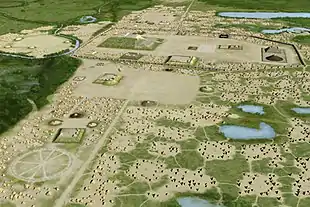
The term Ramey state was coined by scholars Conrad and Harn in 1972 to refer to a theorized state controlled by the capital city of Cahokia, believed to hold influence in all places where ancient Ramey pottery has been found. [3] Scholars who hold that the Ramey state existed purport it held territorial control of the American Bottom, and had its capital at the ancient city of Cahokia. According to the theory, the state's economy was derived from mostly agricultural labor, with unskilled workers building large ceremonial structures for a small elite. A class of traders existed as well as a tribute system.[4]
Structure
Archeologists who point to an existence of a state at Cahokia use the evidence of urban planning and vast Cahokian trade influence as evidence that Cahokia must have been the center of a state.[5]
Various models of how the theorized Ramey state functioned exist. Most of the models differ due to different interpretations of existing archaeological finds. One model believes Cahokia was the center of a trade and tribute system with a territory of farmers that consistently fed the city. This territory spanned much of the American Midwest.[3] Evidence of an elite with political power and a legitimate use of force comes from evidence of massive human sacrifices at Cahokia.[6]
Another model is that Cahokia was the center of a Theatre state where important religious rituals performed at Cahokia wielded influence over the state's common people.[3]
In popular culture
Writer Alan Smale wrote a trilogy of novels set in an alternate past where the Roman Empire attempted to conquer Cahokia ca. 1218 AD. In the book, Cahokia won with its Air Force! [7]
References
- "The Cahokia question: Small state or jumbo chiefdom?". Santa Fe Institute. Retrieved 2020-04-06.
- Emerson, Thomas (2000). Cahokia Domination and Ideology in the Mississippian World. University of Nebraska Press. p. 249-250.
- Holt, Julie Zimmermann (2009). "Rethinking the Ramey State: Was Cahokia the Center of a Theater State?". American Antiquity. Cambridge University Press. 74 (2): 231–254. doi:10.1017/S0002731600048587. JSTOR 20622425. S2CID 141519298.
- o'Brien, Patricia J. (2017). "Early State Economics: Cahokia, Capital of the Ramey State". Early State Economics. Taylor and Francis Group: 143–175. doi:10.4324/9781351316606-7. ISBN 9781351316606.
- Ancient Cahokia and the Mississippians. Cambridge University Press. 2004. p. 167-170.
- O'Brien, Patricia J. (1990). "Cahokia: The Political Capital of the "Ramey" State?". North American Archaeologist. SAGE Journals. 10 (4): 275–292. doi:10.2190/RDK3-QFFN-MPJ9-WTEK. S2CID 145501325.
- [https://www.penguinrandomhouse.com/series/3CE/the-clash-of-eagles-trilogy The Clash of Eagles Trilogy Series} at Penguin Random House
| Middle Mississippian |
| ||||||||||
|---|---|---|---|---|---|---|---|---|---|---|---|
| South Appalachian Mississippian |
| ||||||||||
| Fort Walton culture | |||||||||||
| Pensacola culture | |||||||||||
| Plaquemine Mississippian | |||||||||||
| Caddoan Mississippian | |||||||||||
| Upper Mississippian cultures |
| ||||||||||
| Culture |
| ||||||||||
| |||||||||||