Repast (film)
Repast (めし, Meshi) is a 1951 Japanese drama and shomin-geki film directed by Mikio Naruse and starring Setsuko Hara.[2] It is based on the final unfinished novel by Fumiko Hayashi[3] and was the first in a series of adaptations of her work by the director.
| Meshi | |
|---|---|
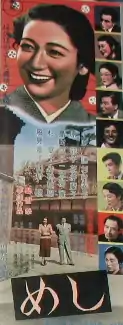 Japanese theatrical release poster | |
| Japanese | めし |
| Directed by | Mikio Naruse |
| Written by |
|
| Produced by | Sanezumi Fujimoto |
| Starring | |
| Cinematography | Masao Tamai |
| Music by | Fumio Hayasaka |
Production company | |
| Distributed by | Toho |
Release date | November 23, 1951[1] |
Running time | 98 minutes[1] |
| Country | Japan |
| Language | Japanese |
Plot
Michiyo has moved from Tokyo to settle down in Osaka with her salaryman husband, whom she married against her parents' wishes. A few years later into the marriage, her husband treats her carelessly, and she is slowly worn down by domestic drudgery. The situation worsens when her pretty niece, fleeing from her parents' plans for an arranged marriage, comes to stay and the husband responds to her flirtatious behaviour. Dissatisfied with his efforts to improve their household life, she leaves with her niece for Tokyo to stay with her family for a time, but finally returns, resigning to marital conventions.
Cast
| Actor | Role |
|---|---|
| Ken Uehara | Hatsunosuke Okamoto |
| Setsuko Hara | Michiyo Okamoto |
| Yukiko Shimazaki | Satoko Okamoto |
| Yoko Sugi | Mitsuko Murata, Michiyo's sister-in-law |
| Akiko Kazami | Seiko Tomiyasu |
| Haruko Sugimura | Matsu Murata, Michiyo's mother |
| Ranko Hanai | Koyoshi Dohya |
| Hiroshi Nihon'yanagi | Kazuo Takenaka |
| Keiju Kobayashi | Shinzo Murata, Michiyo's brother |
| Akira Oizumi | Yoshitaro Taniguchi |
| Ichiro Shimizu | Hatsunosuke's colleague |
| Haruo Tanaka | Jihei Maruyama |
| So Yamamura | Ryuichiro Okamoto |
Production
Repast was the first of a series of six films directed by Naruse based on works by Fumiko Hayashi, "a novelist whose pessimistic outlook matched his own" (Alexander Jacoby).[4] It also marked a successful return for Naruse, whose films of the preceding 15 years were regarded as lesser works by critics.[2][5] According to screenwriter Toshirō Ide, he and his co-writer Sumie Tanaka had wanted to finish the story with the couple's divorce, but this was vetoed by the studio in favour of a conclusion with, as contemporary critic Takao Toda put it, "mass appeal".[3]
Awards
- Blue Ribbon Award for Best Film, Best Actress (Setsuko Hara), Best Supporting Actress (Haruko Sugimura) and Best Screenplay (Sumie Tanaka)[6]
- Mainichi Film Concours for Best Film, Best Actress (Setsuko Hara), Best Director (Mikio Naruse), Best Cinematography (Masao Tamai) and Best Sound Recording (Masao Fujiyoshi)[7]
References
- "Repast at the Japanese Movie Database" (in Japanese). Retrieved 28 January 2021.
- Anderson, Joseph L.; Richie, Donald (1959). The Japanese Film – Art & Industry. Rutland, Vermont and Tokyo: Charles E. Tuttle Company.
- Russell, Catherine (2011). Classical Japanese Cinema Revisited. New York and London: Continuum International. pp. 106f. ISBN 978-1-4411-1681-9.
- Jacoby, Alexander (2008). A Critical Handbook of Japanese Film Directors. Berkeley, California: Stone Bridge Press. pp. 268–273. ISBN 978-1-933330-53-2.
- Thrift, Matthew. "Repast in The best Japanese film of every year – from 1925 to now". British Film Institute. Retrieved 17 February 2021.
- "2nd Blue Ribbon Awards" (in Japanese). Cinema Hochi. Archived from the original on 2009-02-07. Retrieved 28 January 2021.
- "6th Mainichi Film Awards" (in Japanese). Retrieved 28 January 2021.
