Rhodesian Front
The Rhodesian Front was a right-wing conservative political party in Southern Rhodesia,[13][14][15] subsequently known as Rhodesia. It was the last ruling party of Southern Rhodesia prior to that country's unilateral declaration of independence, and the ruling party of Rhodesia from 1965 until 1979. Led first by Winston Field, and, from 1964, by Ian Smith, the Rhodesian Front was the successor to the Dominion Party, which was the main opposition party in Southern Rhodesia when that territory was a part of the Federation of Rhodesia and Nyasaland. The RF was formed in March 1962 by conservative white Rhodesians who opposed regional decolonisation and majority rule. It carried the general election in Southern Rhodesia that December, and remained in power until 1979. In successive elections between 1964 and 1979, the RF was returned to office, with a large majority.
Rhodesian Front | |
|---|---|
 | |
| Abbreviation | RF |
| Historical leader | Ian Smith |
| Founded | 1 March 1962 |
| Dissolved | 6 June 1981 |
| Preceded by | Dominion Party[1] Southern Rhodesia Liberal Party |
| Succeeded by | Republican Front |
| Headquarters | Salisbury, Rhodesia |
| Ideology | White minority interests[2] White nationalism[3][4] Rhodesian nationalism[5][6] Conservatism[7] Social conservatism[8][9] Colonialism[10][11] Anti-communism[3] |
| Political position | Right-wing[12] |
| Religion | Anglicanism |
| Colours | Purple White |
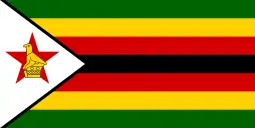
| Party flag | |
 | |
.svg.png.webp) |
|---|
History
The RF had fifteen founding principles, which included the preservation of each racial group's right to maintain its own identity, the preservation of 'proper standards' through a policy of advancement through merit, the maintenance of the Land Apportionment Act, which formalised the racial imbalance in the ownership and distribution of land, opposition to compulsory racial integration, job protection for white workers, and maintenance of the government's right to provide separate amenities for different races.
Following the elections leading to the country's independence in 1980, as the Republic of Zimbabwe, the RF won all 20 parliamentary seats reserved for whites in the power-sharing agreement that it had forged. On June 6, 1981, the party changed its name to the Republican Front, and on July 21, 1984, it became the Conservative Alliance of Zimbabwe. Eleven of its twenty parliamentarians defected over the following four years, but the party again won 15 of the 20 parliamentary seats reserved for whites in the 1985 election. In 1986, the CAZ opened its membership to Zimbabweans of all races.[16] In 1987 the ruling government abolished all reserved seats for whites.[17] When these were abolished many white MPs became independents or joined the ruling ZANU party.
Electoral history
See also
Further reading
- Rhodesians Never Die, Godwin, P. & Hancock, I., 1995. Baobab Books, Harare, Zimbabwe.
- Pollard, William C. A Career of Defiance: The Life of Ian Smith, Agusan River Publishing Co., 1992. Topeka, KS.
- McLaughlin, John . "Ian Smith and the Future of Zimbabwe," The National Review, October 30, 1981, pp. 2168–70.
- Facts on File, 1984 ed., p. 574.
References
- Lipschutz, Mark R.; Rasmussen, R. Kent (1989). University of California Press (ed.). Dictionary of African Historical Biography. p. 265.
- Leaver, John David (2006). "Multiracialism and nationalisms: A political retrospective on 1950s Southern Rhodesia ('Colonial Zimbabwe')". Journal of Third World Studies. 23 (2): 167–188. JSTOR 45194313.
- Donal Lowry (2009). "The impact of anti-communism on white Rhodesian political culture, c.1920s-1980". In Onslow, Sue (ed.). Cold War in Southern Africa: White Power, Black Liberation. New York: Routledge. p. 84. ISBN 978-0-415-47420-7. Retrieved 7 April 2020.
- Cilliers, Jakkie (April 17, 2015). Counter-Insurgency in Rhodesia (e-Book 1st ed.). London: Routledge. p. 18. ISBN 9781315713854. Retrieved 9 April 2020.
- Preston, Matthew (2004). I.B.Tauris (ed.). Ending Civil War: Rhodesia and Lebanon in Perspective. p. 107. ISBN 9781850435792.
- West, Michael O. (2002). Indiana University Press (ed.). The Rise of an African Middle Class: Colonial Zimbabwe, 1898-1965. p. 229. ISBN 0253215242.
- https://www.mdpedia.net/view_html.php?sq=Obama%20Care&lang=en&q=Rhodesian_Front
- Hume, Ian (2018). Outskirts Press (ed.). From the Edge of Empire: A Memoir. p. 149. ISBN 9781478794554.
- Roscoe, Adrian (2007). Columbia University Press (ed.). The Columbia Guide to Central African Literature in English Since 1945. p. 35. ISBN 9780231503792.
- Good, Kenneth (1974). "Settler Colonialism in Rhodesia". African Affairs. 73 (290): 10–36. doi:10.1093/oxfordjournals.afraf.a096439. JSTOR 720978.
- The Rhodesian Front generally kept policies from British Colonial rule
- Evans, Michael (2007). "The Wretched of the Empire: Politics, Ideology and Counterinsurgency in Rhodesia, 1965–80". Small Wars & Insurgencies. 18 (2): 175–195. doi:10.1080/09574040701400601. S2CID 144153887.
- Hsu, Chia Yin; Luckett, Thomas M.; Vause, Erika (2015). The Cultural History of Money and Credit: A Global Perspective. Lexington Books. p. 142. ISBN 9781498505932.
- Onslow, Sue (2009). Cold War in Southern Africa: White Power, Black Liberation. Routledge. p. 92. ISBN 9781135219338.
- Butler, L. J. (2002). Britain and Empire: Adjusting to a Post-Imperial World. I.B.Tauris. p. 164. ISBN 9781860644481. Retrieved 19 February 2017.
- Ian Smith Invites Blacks to Join His Party, The New York Times, July 23, 1984, p. A5.
- Zimbabwe whites lose special political status. End of reserved seats in Parliament brings one-party state closer, Christian Science Monitor, August 25, 1987

Authority control  | |
|---|---|
| General | |
| National libraries | |