Rif
The Rif (Berber languages: ⴰⵔⵔⵉⴼ, ⴰⵔⵉⴼ, romanized: Arrif, Arif; Arabic: الريف) is a geographic and cultural region in northern Morocco. The region covers all the north of Morocco wich was colonized by Spain and France from 1912 to 1956 and an independent state from 1921 to 1926 under the Republic of the Rif. The region has been inhabited by Amazigh Riffian tribes since prehistoric times.
Rif
| |
|---|---|
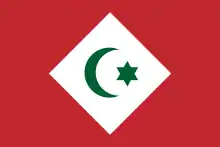 Flag | |
| Anthem: Anthem of the Rif (unofficial) | |
.png.webp) Map of the Rif region | |
| Country | Kingdom of Morocco |
| Formation | 710 (Kingdom of Nekor) 1040 (Almoravid dynasty) 1121 (Almohad Caliphate 1244 (Marinid Sultanate) 1472 Wattasid dynasty 1510 (Saadi Sultanate) 1631 (Alaouite dynasty) 1912 (French protectorate in Morocco) 1912 (Spanish protectorate in Morocco) 1921 (Republic of the Rif) |
| Current version | 7 April 1956 Kingdom of Morocco |
| Capital and largest city | Al-Hoceima 35°14′50″N 3°55′56″W |
| Population (2020) | |
| • Total | 7.5 million |
| Demonyms | Riffian or Riffians (Irifyien in Tarifit) |
| Languages | Tarifit, Tamazight, Moroccan Arabic and French |
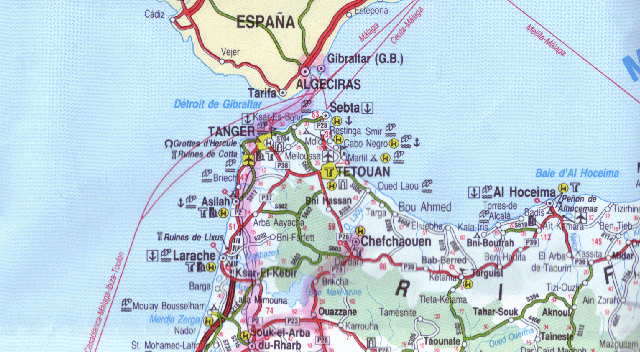
This mountainous and fertile region is bordered by Cape Spartel and Tangier to the west, by Berkane and the Moulouya River to the east, by the Mediterranean to the north, and by the Ouergha River to the south. The Rif mountains are separated into the eastern Rif mountains (Nador, Driouch, Al Hoceima) and western Rif mountains (Tangier, Tetouan, Chefchaouen, Taounate).
Geography
Geologically the Rif mountains belong to the Gibraltar Arc or Alborán Sea geological region. They are an extension of the Baetic System that includes the mountains of the southern Iberian Peninsula across the strait.[1] Thus the Rif mountains are not part of the Atlas Mountain System.
Major cities in the greater Rif region include Nador, Berkane, Tangier, Tetouan, Al Hoceima (also called Villa), Imzouren, Driouch, Ben Taieb, Midar, Al Aaroui and a few (small) towns Segangan, Selwan, Ajdir, Targuist (Targist).
History
The Rif has been inhabited by Amazigh tribes since prehistoric times. As early as the 11th century BCE, the Phoenicians began to establish trading posts, with approval of or partnership with the local Riffians and started interbreeding thus starting a Punic language on the Mediterranean and Atlantic coasts, and founded cities such as Tetouan, Melilla (Rusadir) and, in the 5th century BCE, Tangier (called Tingi back then). Later the Phoenician power gave way to an independent Carthage city-state, as the major power in the region. After the Third Punic War, Carthage was supplanted by Rome, and the Rif became part of the province of Mauretania. When the latter was divided during the rule of Emperor Claudius, Tangier became the capital of Mauretania Tingitana. In the 5th century CE, the region was raided by the Vandals, and Roman rule came to an end. The region remained under Vandal control until the 6th century when the Byzantines reconquered parts of it.
In 710, Salih I ibn Mansur founded the kingdom of Nekor and the Riffian Imazighen started slowly converting to Islam. Amazigh Muslim kingdoms started establishing more cities. By the 15th century, many Spanish Moors were exiled from Spain and most of them settled in Western Rif, bringing their culture, Andalusian music, and even establishing the city of Ashawen or Chefchaouen (Accawen meaning "horns" in Tamazight).
Since then, the Rif has suffered numerous battles between Riffian tribes, Spain and Portugal. In 1415, Portugal invaded Ceuta (Sebta), and in 1490 Spain invaded Melilla (Mlilt). There was a period of peace afterwards, but war between Spain and the Riffians broke out again in 1859 in Tetouan, where Morocco was defeated. The Spanish-Riffian conflicts continued in the 20th century, under the leadership of Amghar Abd el-Krim, the Riffian guerrilla leader who proclaimed the Republic of the Rif in 1921.
The Riffian Imazighen won several victories over the Spanish in the Rif War of the 1920s before being eventually defeated. The region was decolonised and restored to Morocco by Spain in April 1956, a month after the former gained its independence from France.
Tribes and tribal groups
The Rifians are divided into these tribes and tribal groups:[2]
- Ait Touzine, a tribal group
- Ayt Uryaɣel, a tribal group
- Ayt Bu Frah, partly arabic-speaking
- Mestassa, partly arabic-speaking
- Mtiwa, partly arabic speaking
- Targuist, partly arabic speaking
- Oulad Stout, partly arabic speaking
- Ayt Bu Yihyi
- Ayt Ɛammart, a tribal group
- Ayt Sɛid, a tribe
- Ayt Tourich, a tribal group
- Ayt Yittuft
- Igzinnayen, a tribal group
- Ibdarsen (or Mtalsa), a tribe
- Ibuqquyen, a tribal group
- Ikebdanen (or Kebdana)
- Iqarɛayen, five tribal confederacies
- Tafarsit, a tribe
- Timsaman, a tribal group
Economy
Farmers in the Rif produce most of Morocco's supply of cannabis. The region is economically underdeveloped.[3]
Environment
_-_Air_Photo_by_sebaso.jpg.webp)
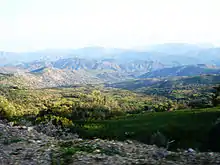
According to C. Michael Hogan, there are between five and eight separate subpopulations of the endangered primate Barbary macaque, Macaca sylvanus.[4] The Rif mountains are also home to the honey bee subspecies Apis mellifera major.
The Rif region receives more rainfall than any other region in Morocco, with some portions receiving upwards of 2,000 mm (78.74 in) of precipitation a year. The western and central portions are more rainy and are covered in forests of Atlas cedar, cork oak and holm oak, as well as the only remaining forests of Moroccan fir, a subspecies of the Spanish fir. The eastern slopes receive less rainfall, and there forests consist mainly of pines, particularly the Aleppo pine and the maritime pine, as well as tetraclinis.
Massive deforestation due to overgrazing, forest fires, and forest clearing for agriculture, particularly for the creation of cannabis plantations, has taken place over the last 60 years. This deforestation has led to soil degradation due to the washing away of topsoil, which has aggravated the process.
See also
- Ghomara people
- Hirak Rif
- Jebala people
- Kif, the marijuana associated with Tangier and the Rif
- Nekor
- Oriental (Morocco)
- Rifian people
Footnotes
- Davis, Dan. "Dissertation (Univ. of Texas at Austin): Commercial Navigation in the Greek and Roman World". Cite journal requires
|journal=(help) - Coon, Charleton S. (1931). Tribes of the Rif. Harvard African studies.v. 9. University of Harvard. p. 38.
- "Morocco moves to legalise some cannabis cultivation". The Economist. 2021-07-10. ISSN 0013-0613.
- C. Michael Hogan, 2008
References
- Pierre-Arnaud Chouvy (2005). "Morocco said to produce nearly half of the world's hashish supply", Jane's Intelligence Review
- C. Michael Hogan (2008). "Barbary Macaque: Macaca sylvanus", Globaltwitcher.com, ed. Nicklas Stromberg
External links
 |
Wikimedia Commons has media related to Rif. |
- Galerie Rif (Arrif) (in French)
- Rif Map
Authority control  | |
|---|---|
| General | |
| National libraries | |