Rink bandy
Rink bandy is a variant of the larger sport of bandy and is played on significantly smaller ice rinks. Rinkball is sometimes still considered a variant of rink bandy by some due to its combination of rink bandy and ice hockey elements, but now qualifies as an official organized sport after having codified its own rules and designed its own equipment. While a bandy rink is about the same size as a football pitch, rink bandy and rinkball are both played on ice hockey rinks.
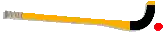 A bandy stick and ball | |
| First played | 1960's in Sweden |
|---|---|
| Characteristics | |
| Contact | No |
| Team members | 5-6 players per side |
| Type | Team sport, winter sport |
| Equipment | Bandy ice skates, bandy ball, bandy sticks, protective gear |
| Venue | Ice rink |
| Presence | |
| Country or region | Sweden, Russia, Finland, USA |
| Olympic | No |
| Paralympic | No |
.JPG.webp)
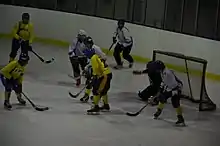
Rink bandy originated in Sweden in the 1960s and was originally called hockeybockey.[1] With the arrival of indoor ice hockey arenas, it was a way for bandy players to practice on ice for a longer time of the year by making use of the new indoor facilities. Due to the fact that bandy fields are larger than ice hockey rinks, bandy-ready playing surfaces were still only made outdoors in the wintertime when artificial freezing was unnecessary.
The game of rink bandy uses a bandy ball and bandy sticks. The goalkeeper has no stick. A rink bandy game lasts 60 minutes but is composed of either two 30 minute halves or three 20 minute periods. Similar rules to bandy are used, but they are simplified to increase the pace of the game. Checking is prohibited, making the sport relatively safer than its relatives.
Because of the smaller playing area used in rink bandy compared to its larger parent sport, there are fewer players, normally six a side. In America, the USA Rink Bandy League, uses five players instead of the usual six because of the smaller ice hockey rinks in the USA.
Rinkball or kaukalopallo is a similar game, with the most immediately observable difference being its equipment. Rinkball goaltenders do not use goalsticks of any kind, and unlike its predecessor, bandy, rinkball goaltenders use ice hockey trappers on both hands. Players use sport-specific sticks created for rinkball, which are in closer resemblance to ice hockey sticks than bandy sticks. Like bandy and rink bandy, rinkball uses a ball and not an ice hockey puck. However, in rinkball the ball is a blue color as opposed to the orange or cerise color used in bandy and its rink bandy variant.
Organization
Rink bandy is governed by the Federation of International Bandy. In its quest to have bandy accepted into the programme of the Winter Olympics, rink bandy is an important way for the Federation of International Bandy to gain more members, thus also spreading bandy, since many countries, which lack a full-size field and where the game is still new, only play rink bandy at home but still participate in the Bandy World Championship.
As artificially frozen and indoor bandy arenas have become more prevalent, the interest for rink bandy has dwindled in the main bandy-playing nations (Russia, Sweden, Finland, Norway). There are still several rink bandy tournaments in Russia,[3] including the Patriarch Cup (Турнир на призы Святейшего Патриарха Московского и всея Руси[4]) for children at Moscow's Red Square.[5]
A world cup for rink bandy clubs was held every year from 1984-1998 in Hofors, Sweden, and called Hofors World Cup. Rink bandy was included in the programme of the 2012 European Company Sports Games[6] and a European championship existed, though there is currently no top-level international competition. However, in 2017 the Federation of International Bandy decided to hold an international tournament for developing bandy countries in Nymburk, Czech Republic[7][8] and an international rink bandy club competition called Dniprobandy has been organised by the Ukrainian Bandy and Rink bandy Federation.[9] In Germany, the national bandy championship is played under rink bandy rules.
Rinkball
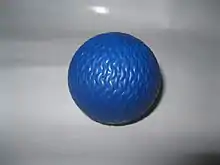 Ball used in the sport of rinkball. The ball color is blue | |
| First played | 1960's in Sweden |
|---|---|
| Characteristics | |
| Type | Team sport, winter sport |
| Equipment | Bandy ice skates, blue bandy ball, rinkball sticks, protective gear |
| Venue | Ice rink |
| Presence | |
| Country or region | Finland, Sweden |
| Olympic | No |
| Paralympic | No |
Rinkball, known as kaukalopallo in Finnish where the sport is currently played the most, was born in Sweden in the 1960s and from there landed in Finland in the 1970s. The sport was developed from both ice hockey and bandy and initially used as a practice drill for bandy players in Sweden who were using ice hockey rinks. Its largest organization, the Finnish Rinkball Federation,[10] has 1000 teams, including women, men and children. Play is divided into eight male divisions, two female divisions, and children's play is divided by age.[11]
The sport is one of the fastest team sports on ice, belonging to a small group of four ice skating team sports, irrespective of their associated variants, which now includes bandy, ice hockey, and ringette.
By the 1980s it had begun to emerge as an organized sport with its own rules and equipment which differed considerably from ice hockey. One significant difference between rinkball and its ice hockey predecessor is the fact that like in bandy, goaltenders use gloves but do not use any type of goal-stick. However, the gloves they do wear are catch gloves or "fins", are worn on each hand, and are like ice hockey trappers rather than the like the gloves used by bandy goaltenders.
The first Finnish championships were held in 1975. However, the sport didn't come to the attention of the wider public in Finland until the 1980s with the first Finland-Sweden national match played in 1984.
To date, the golden age for the sport is considered to have been during the 1990s when the best registration levels were estimated to be more than 100,000 and more than 1,000 teams.
The popularity of rinkball has been steadily declining in Finland since the 1990s. Reasons for the decline in the number of enthusiasts include the growing popularity of ice hockey and floorball in the 1990s, the lack of junior activity in the sport, and the differences between the sports federations which have continued well into the 2010s.
In the mid-2000s, it was estimated that 50,000 enthusiasts of the sport existed. However, by 2019, the number was only a few thousand and the sport's greatest popularity was in the age-old series.
Rinkball history
In the 1970s rinkball grew from being played in local tournaments by villagers around Finland to national-level competitions involving 100 teams or more. The sport first gained international attention in 1984 when teams from Finland and Sweden hosted one another. The International Rinkball Association was formed soon after, and in the late 1990s included Russia, Sweden, Kazakhstan, Estonia, Switzerland, Hungary, Finland and the United States.[12] The first World Championship Games for men was held in Omsk, Russia, in 1998.[12]
The Rinkball League in Finland publishes a magazine called Liiga Extra, which offers international coverage of tournaments, equipment, and tips. A national championship between the Finnish leagues is held annually (as of 2016).
Rinkball rules
Rules for rinkball are set in Finland and there are also separate rules for the Championship Series.
The playing time is 3 × 20 minutes of effective playing time, ie the clock is stopped with game breaks (men's league and 1st division). In the lower series, the playing time is 2 × 30 minutes of running time. In that case, the clock will only be stopped during overtime or a penalty shot, or if there is a longer delay in the game ie. due to an injured player. Even in running time, the clock will be stopped during the last 2 minutes of the match for all interruptions.
The team may have a maximum of 17 or 20 players on their roster and two goalkeepers (depending on the series) of which one goalkeeper and five field players may be on the ice at a time. The team has the opportunity to pull and replace the goalkeeper with another player.
Rinkball equipment
The ball is 6 centimeters in diameter and weighs about 60 grams and is blue in color.
Mandatory equipment for field players includes a helmet, neck guard, skates and a stick.
Mandatory equipment for the goalkeeper involves skates, a helmet with a face shield or mask, a neck guard, and goalkeeper shin guards or knee pads (width up to 28 cm). The goalkeeper has a catch glove or “fin” in each hand, the palm of which must be able to be spread completely open, so that its diameter must not exceed 28 cm at any point. The maximum width of the bracelet is 15 cm. The goalkeeper does not have a stick.
References
- Skelleftepolisens IF - Rinkbandy Archived 2004-01-21 at the Wayback Machine
- "Google Translate".
- Video of the 2nd half between Lokomotiv Orenburg and CSK VVS Samara in the 2011 Russian Rink Bandy Cup
- "Турнир по хоккею с мячом на призы Святейшего Патриарха Московского и всея Руси - 2017".
- "Google Translate".
- http://www.visitsodradalarna.se/en/ECSG-2012/Sports/Rinkbandy/
- European Rinkbandy Cup in Nymburk, Czech Republic
- Video from the whole 2017 European Rink Bandy Cup final
- "Information about the second international rink bandy tournament". Federation of International Bandy. 2013-07-04. Retrieved 9 August 2015.
- "Suomen Kaukalopalloliitto (Finnish Rinkball Federation)". www.kaukalopalloliitto.fi (in Finnish). Finnish Rinkball Federation. Retrieved 2 December 2021.
- Finnish Rinkball and Ringette Federation
- Rinkball history
External links
 (in Finnish) Finnish Rinkball Federation