Roberta Williams
Roberta Williams (born February 16, 1953) is an American video game designer and writer, who co-founded Sierra On-Line with husband and game developer Ken Williams. In 1980, her first game Mystery House became a modest commercial success, and became credited as the first graphic adventure game. She is also known for her role in creating and maintaining the King's Quest series, as well as designing the full motion video game Phantasmagoria in 1995. A few years after her company was acquired for $1 billion, she left the game industry in 1999, focusing on travelling and writing historical fiction.
Roberta Williams | |
|---|---|
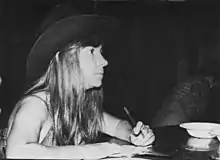 Roberta Williams at a celebration of On-Line Systems' first anniversary, 1981. | |
| Born | February 16, 1953 |
| Occupation | Video game designer, writer |
| Known for | King's Quest Mystery House Phantasmagoria |
| Spouse(s) | Ken Williams |
| Children | 2 |
| Website | sierragamers robertasbook |
Several publications have named her as one of the best or most influential creators in the game industry, with several calling her the "Queen of adventure games". She has received the Industry Icon Award from The Game Awards, and the Pioneer Award at the 20th Game Developers Choice Awards. In 2021, she announced her plans to return to game development, with a game called The Secret.
Early life
_-_On-Line_Systems_first_anniversary_celebration.jpg.webp)
Roberta Heuer was born February 16, 1953.[1] She grew up in rural Southern California, the daughter of an agricultural inspector.[2] A shy child with a vivid imagination, she often created fairy-tale adventure stories to entertain her family.[3] She would sometimes lie in bed and imagine fantastical situations, which she sometimes described as her "movies".[2] As a teenager she met Ken Williams, and the couple got married soon after.[4]
By 1979, the couple had two children, and Ken was working as a computer programmer and consultant, working on large IBM mainframe machines.[3][5] Ken embraced the early days of home computing by procuring an Apple II computer,[5][6] which strained the family's expenses.[2] Roberta began her interest in computers by playing several text adventure games.[3]
Career
Mystery House

Around 1979, Roberta Williams was an avid player of text adventure games on a teletype machine,[7] particularly Colossal Cave Adventure.[8] She was inspired to speak to her husband Ken Williams about her vision for what a video game could be,[7] drawing influence Agatha Christie's story And Then There Were None,[1] as well as the board game Clue.[8] At the time, Roberta's experience was in reading and storytelling, leading Ken to provide the technical knowledge to program the game.[7] Roberta drew the pictures using her Apple II and a graphics tablet,[8] a machine called a Versawriter that could be used to hand-trace a piece of paper and input the image into a computer.[5] Since no programs existed to read the Versawriter image, Ken had to write one,[7] eventually compressing nearly seventy images onto a disk.[8]
The result was Mystery House, an adventure game with black and white graphics for the Apple II computer.[9][10] At first, the game was distributed by mail order, advertised in the May 1980 issue of MICRO, under the name of Ken's computer consulting company, On-Line Systems.[2] The game quickly sold 10,000 copies,[6] with Roberta personally packing the discs and supporting materials in Ziploc bags, and answering her home phone to provide hints for the game's puzzles.[2] Ken began to personally distribute copies of the game to computer stores, leading him to quit his consulting job so that the couple could fulfill their dream of living in the woods.[2] Their second title, Wizard and the Princess (1980), added color graphics and dithering.[2][11] The game went on to sell 60,000 copies, and led them to hire additional employees for distribution and programming.[2] Encouraged by the success of their first two games, On-Line Systems switched its focus from consulting to game development.[11] Roberta's ambitions grew with the design of Time Zone, a time-travelling epic game spanning thousands of years, which was released on 12 discs in 1982.[2] That year, the company moved from Simi Valley, California to Coarsegold,[12] and changed its name to Sierra On-Line based on its location near the Sierra Nevada mountains.[13]
King's Quest breakthrough
Programmers, authors are going to be the future new entertainers ... It might be presumptuous to say they might be new Robert Redfords ... but to a certain extent [they will be] idolized. Tomorrow's heroes.
Roberta Williams[2]
Sierra's success started to attract investors, including venture capitalists.[14] Around this time, Jim Henson approached Ken Williams to create a game adaptation of The Dark Crystal, before the film's release.[2] Roberta was excited by the project, believing video games to be a facet of entertainment as much as film.[2] She laid out her vision for the game on a large white sheet of paper, and her game adaptation of The Dark Crystal was released in 1983.[15] The growth of the company attracted mainstream media attention, and Roberta hoped that the entertainment industry would not just recognize the value of games, but also the value of the artists who created them.[2]
Meanwhile, Sierra's new investors pushed the company to diversify into video game cartridges for platforms such as the Atari.[14] The video game industry experienced a severe crash, and the Williamses had to layoff the majority of their team, mortgaging their home to pay their remaining employees.[14] Around this time, IBM offered to invest in the struggling company, with hopes of creating a game that could showcase the technical capabilities of their upcoming IBM PCjr.[11] This led to the 1984 release of King's Quest,[12] conceived as a blend of common fairy tales that could be directly experienced as a game.[16] While the PCjr was considered a failure, King's Quest was ported to numerous other platforms and quickly rose to bestseller status.[11] The game was considered revolutionary for introducing pseudo-3D elements in an explorable world,[17] allowing the player character to move in front of, behind, or over other objects on the screen.[6][11] It was also the first computer game to support the 16 color EGA standard,[11] setting a new standard for future graphic adventure games.[17] Also in 1984, Sierra's board of directors began to push a merger with Spinnaker Software, an educational software company. While Ken Williams was amenable to the deal, Roberta strongly opposed, and the merger did not proceed.[14]
Meanwhile, Roberta continued her role as designer of the King's Quest series, which had become notable as one of the only series created and maintained by a female designer.[18] The series was also known for Williams' unique style of storytelling, as well its advancements in graphics and technology.[12] When King's Quest IV: The Perils of Rosella was released in 1988, it was one of the first games to receive sound card support,[19] and one of the first adventure games to support a mouse.[20] It was also one of the first games to feature a female protagonist.[19] While some of her peers cautioned that this might deter men from playing the game,[21] the game marked a dramatic increase in the series' commercial success.[20] She would recall that the female protagonist likely increased the audience for the series, a creative decision that she seeded by introducing Rosella in the previous game.[22] A post-release survey revealed that most men did not mind playing as a female protagonist, whereas many female players preferred the experience.[21] Sierra received registration cards for the game with a near 40% female audience, a gender dynamic that has been credited to Williams' voice as a female author.[18] King's Quest IV has been considered one of the most influential games created, with its impact felt on peers such as the Maniac Mansion and other LucasArts adventure games.[20]
Additional titles
Williams continued to design other titles, such as Mixed-Up Mother Goose in 1987.[9] In 1989, Williams released another mystery adventure game called The Colonel's Bequest, which iterated on ideas from her original Mystery House game with more detailed graphics and improved text parsing.[23] The game deviated from the traditional adventure game formula to become more of an interactive mystery.[24] Meanwhile, the 1990 release of King's Quest V became the first game to use an icon-based interface, continuing the series' innovations in game design.[25][11] The game was critically acclaimed, with Computer Gaming World remembering it among their greatest games of all time.[26] In the meantime, Sierra became a publicly traded company, and was generating one-hundred million dollars per year in revenue.[14]
Williams also lent her characters and concepts to The Dagger of Amon Ra in 1991, a sequel to The Colonel's Bequest that was less of an interactive mystery and more of a traditional adventure.[27] When King's Quest VI was released in 1992, it became recognized by several publications as one of the best adventure games, if not one of the best games overall.[28][29][30] By the mid 1990s, she was considered the company's most popular game designer, particularly for her success with the King's Quest series.[2]
With the rise of CD-ROM technology, Williams designed Phantasmagoria as a realistic horror adventure game, featuring graphic depictions of sex and violence.[17] Designed as mature title for adults, the game cost $4 million dollars to produce, with a team of nearly 200 people.[21] The game ultimately had a script of over 500 pages, and was published on seven CD-ROMs.[1] The full-motion video game was marketed as an interactive film,[11] and sold more than 1 million copies upon its release in 1995.[1] The game was considered a best-seller among adventure games, despite its mixed critical reception.[11] Roberta Williams recalls the game as her favorite achievement.[17]
In 1996, Sierra was sold to CUC International, in a transaction valued at more than $1 billion dollars in stock.[14][31] Roberta had opposed the deal, and several other high-ranking Sierra employees had felt there was something suspicious about CUC's financials.[14] But Roberta ultimately acquiesced, recognizing that the terms of the deal were too favorable to refuse, even recognizing that they could be sued by their shareholders for failing to maximize their value.[14] The company's management and decision-making dramatically changed under CUC,[13] leading Ken Williams to leave his role at Sierra and work directly for their new parent company.[14] Under CUC, Sierra experienced severe lay-offs.[11] Meanwhile, Roberta Williams took a sabbatical from the game industry,[32] as the company released The Roberta Williams Anthology, a compilation of 14 games that was also noted for showcasing a history of the adventure game format.[31]
Roberta Williams returned to game development in early 1997 to begin work on King's Quest: Mask of Eternity.[32] Her hope was to re-introduce some interactivity that was missing from Phantasmagoria,[33] and to update the game to embrace the advances in 3D graphics technology.[14] However, Sierra had changed significantly as a company, and its new management insisted on adding elements from popular role-playing games such as Diablo, to the detriment of the game's traditional adventure elements.[14][34] When she removed certain role-playing elements, the team would re-add them, leading to a power struggle with their management.[14] Meanwhile, Roberta's frustrations with her lack of control were coupled with suspicions of CUC, after allegations of financial fraud had surfaced about the company. She discussed with Ken about selling their stock before something happened.[14] Mask of Eternity was released in December 1998, the game was poorly received both commercially and critically, leading to further layoffs, and the sale of Sierra to Vivendi.[11] That year, CUC was convicted of financial fraud, having exaggerated their company's revenues by more than $500 million dollars.[14] The decline of Sierra had an emotional impact on Roberta,[14] who left the company in 1999.[35] The company was later acquired by Activision Blizzard.[17]
Retirement
After the release of King's Quest: Mask of Eternity, Roberta Williams described herself as taking a sabbatical from the game industry in 1999.[36] In hindsight, it became apparent that this was her retirement, after working on 20 games in the span of 18 years.[35] She has stayed away from the public eye and rarely gives interviews to talk about her past with Sierra On-Line.[37] In a rare 2006 interview, she expressed that her greatest achievement was creating Phantasmagoria, though she expressed her love of the King's Quest series for its influence on her early career.[16] Williams expressed that her role as a game designer was in the past, and she was focused on writing a historical novel.[16] She has also focused on travel,[35] becoming an avid sailer with her husband Ken.[12] Her family has homes in Seattle, France, and Mexico.[38]
In 2011, the video game website Gamezebo reported that she had returned from her sabbatical as a design consultant on the social network game Odd Manor.[39] By 2012, Replay Games had recruited Sierra veterans Al Lowe and Paul Trowe to return to the Leisure Suit Larry adventure game series, which led Trowe to try to persuade the Williams to return to the game industry.[40] Meanwhile, Activision hired Telltale Games to develop a new entry in the King's Quest series. Williams declined to work on the game, but did offer some advice.[41][42] The game was later cancelled in 2013.[43] Activision would attempt to revive the Sierra brand in 2014, leading developer The Odd Gentlemen to create King's Quest: A Knight to Remember.[44] According to the studio, they consulted with Roberta Williams "to make a game like they would make if they had continued making adventure games."[45]
In 2019, Vancouver Film School announced The Roberta Williams Women in Game Design Scholarship, in partnership with game studios The Coalition and Blackbird Interactive.[46] In 2021, Williams self-published her first novel Farewell to Tara, set in mid-1800s Ireland during the time of the Great Famine.[47] She and Ken announced plans to return to game development in June 2021 with the game The Secret, in collaboration with artist Marcus Maximus Mera.[48][49] In an interview that same year, she expressed caution that a veteran game designer could successfully return to the industry after an extended break, saying there are merits to ending your career at its peak.[34]
Legacy and accolades
In 1995, Next Generation listed Roberta Williams among their 75 list of power players in the game industry.[50] Computer Gaming World also included her as tenth on their 1997 list of the most influential people in computer gaming, praising her impact on the design of adventure games.[51] GameSpot likewise ranked her as number ten on their 1999 list of "the most influential people in computer gaming of all time" for "pushing the envelope of graphic adventures" and being "especially proactive in creating games from a woman's point of view and titles that appealed to the mainstream market, all the while integrating the latest technologies in graphics and sound wherever possible."[8] In 2009, IGN included her and Ken Williams in the 23rd position on the list of top game creators of all time, highlighting their role in co-founding Sierra Entertainment as "the company behind some of the best and most well known adventure games of the '80s and '90s."[17]
Computer Gaming World inducted Roberta Williams into their Hall of Fame in 2011.[52] Both Roberta and Ken were given an Industry Icon Award at The Game Awards in 2014.[7] She also earned the Pioneer Award at the 20th Game Developers Choice Awards in March 2020 for her influential work in the graphical adventure game genre with Mystery House, as well as her work role in creating the King's Quest series co-founding Sierra On-Line.[12][53]
Ken Williams has described her as a perfectionist, "extremely smart, intuitive and usually right. She can’t be managed."[4] Ars Technica has called her "one of the more iconic figures in adventure gaming", noting her as one of the first well-known female game designers, and praising her writing and design work on Phantasmagoria and the King's Quest series.[35] The Smithsonian Magazine has noted her as a pioneer of graphic adventure games, for creating the first home computer game to include graphics.[7] Multiple publications have referred to her as "the Queen of adventure games".[3][6][54][55]
Roberta Williams has personally inspired the characters and artwork of other games. She posed for the cover of the game Softporn Adventure by Chuck Benton, published by On-Line Systems.[35][56] She also posed much later with her children as Mother Goose for the cover photograph of Mixed-Up Mother Goose.[35] The end sequence of Leisure Suit Larry 3 features her as an in-game character.[57] She was also a source of inspiration for the character of Cameron Howe in the AMC television drama Halt and Catch Fire.[58] The Williams family donated a collection of design materials to the International Center for the History of Electronic Games.[46]
Works
Games
- Mystery House (1980)
- Wizard and the Princess (1980)
- Mission Asteroid (1981)
- Time Zone (1982)
- The Dark Crystal (1983)
- King's Quest I: Quest for the Crown (1984)
- Mickey's Space Adventure (1984)
- King's Quest II: Romancing the Throne (1985)
- King's Quest III: To Heir Is Human (1986)
- King's Quest IV: The Perils of Rosella (1988)
- Mixed-Up Mother Goose (1987)
- Laura Bow: The Colonel's Bequest (1989)
- King's Quest V: Absence Makes the Heart Go Yonder! (1990)
- King's Quest 1: Quest for the Crown (Remake) (1990)
- Mixed-Up Mother Goose Multimedia (1990)
- Laura Bow in The Dagger of Amon Ra (1992)
- King's Quest VI: Heir Today, Gone Tomorrow (1992)
- King's Quest VII: The Princeless Bride (1994)
- Mixed-Up Mother Goose Deluxe (1994)
- Phantasmagoria (1995)
- Shivers (1995)
- King's Quest: Mask of Eternity (1998)
- Odd Manor (2014)[59]
Novels
- Farewell to Tara (2021)
Awards
- Industry Icon Award (2014)[38]
- Pioneer Award - Game Developers Choice Awards (2020)[12]
References
- Fish, Charlie (May 30, 2021). The History of Video Games. White Owl. pp. 44–46. ISBN 978-1-5267-7900-7.
- Levy, Steven (May 19, 2010). Hackers: Heroes of the Computer Revolution - 25th Anniversary Edition. "O'Reilly Media, Inc.". pp. 241, 245, 253, 267, 288, 309, 316, 320, 357, 392. ISBN 978-1-4493-9374-8.
- Katz, Alan (August 6, 2019). Awesome Achievers in Technology: Super and Strange Facts about 12 Almost Famous History Makers. Running Press. ISBN 978-0-7624-6335-0.
- Bonner, Jerry. "The Rise of Sierra Online Wasn't Exactly a Fairytale". Wired. ISSN 1059-1028. Retrieved November 25, 2021.
- "Roberta Williams". Lemelson-MIT Program. Retrieved March 22, 2019.
- Sherman, Jill (August 2018). 25 Women Who Thought of It First. Capstone. p. 21. ISBN 978-0-7565-5852-9.
- Magazine, Smithsonian; Eschner, Kat (February 16, 2017). "The Pioneer of Graphic Adventure Games Was a Woman". Smithsonian Magazine. Retrieved November 24, 2021.
- "The Most Influential People in Computer Gaming of All Time". GameSpot. February 24, 1999. Archived from the original on May 17, 2005. Retrieved May 17, 2005.
- "Roberta Williams". Allgame. Rovi Corporation. Retrieved February 2, 2012.
- "Mystery House and Sierra On-Line". The Dot Eaters. Retrieved February 2, 2012.
- Moss, Richard (January 26, 2011). "A truly graphic adventure: the 25-year rise and fall of a beloved genre". Ars Technica. Condé Nast Publications. Retrieved February 2, 2012.
- "Adventure game trailblazer Roberta Williams to receive Pioneer Award at GDC 2020". Gamasutra. February 26, 2020. Retrieved February 26, 2020.
- Jong, Philip (March 28, 2006). "Ken Williams - Interview". Adventure Classic Gaming. Retrieved November 26, 2021.
- Fyfe, Duncan (October 29, 2020). "How Sierra Was Captured, Then Killed, by a Massive Accounting Fraud". Vice. Retrieved October 30, 2020.
- Anderson, John (March 1983). "The dark crystal". Creative Computing. p. 168. Retrieved September 13, 2008.
- Jong, Philip (July 16, 2006). "Roberta Williams Interview". Adventure Classic Gaming. Retrieved July 14, 2015.
- "Ken Williams & Roberta Williams". IGN. News Corporation. Archived from the original on March 10, 2009. Retrieved February 2, 2012.
- Mejia, Robert; Banks, Jaime; Adams, Aubrie (August 17, 2017). 100 Greatest Video Game Franchises. Rowman & Littlefield. ISBN 978-1-4422-7815-8.
- Andreadis, Kosta (May 25, 2014). "Revisiting King's Quest IV: The Perils of Rosella – IGN". Uk.ign.com. Retrieved November 6, 2015.
- GameSpot Staff (November 7, 2000). "The 15 Most Influential Games of All Time; King's Quest IV: The Perils of Rosella". GameSpot. p. 13. Archived from the original on May 25, 2005. Retrieved February 17, 2020.
- Staff, Newsweek (March 30, 1997). "Sierra's Queen Is Still On Top Of Her Game". Newsweek. Retrieved November 25, 2021.
- Marold, Abby (February 17, 2001). "Interviews - Roberta Williams". WomenGamers. Archived from the original on February 17, 2001. Retrieved November 25, 2021.
- Alexander, Leigh (October 9, 2014). "Lo-Fi Let's Play: The Colonel's Bequest". Rock, Paper, Shotgun. Retrieved November 24, 2021.
- Kalata, Kurt (November 22, 2010). "The Colonel's Bequest". Hardcore Gaming 101. Retrieved November 25, 2021.
- "NG Alphas: King's Quest: Mask of Eternity". Next Generation. No. 30. Imagine Media. June 1997. pp. 72–75.
- "150 Best Games of All Time". Computer Gaming World. November 1996. pp. 64–80. Retrieved March 25, 2016.
- Kalata, Kurt (November 22, 2009). "Laura Bow in: The Dagger of Amon Ra". Hardcore Gaming 101. Retrieved November 25, 2021.
- Gouskos, Carrie. "The Greatest Games of All Time: King's Quest VI: Heir Today, Gone Tomorrow". GameSpot. Archived from the original on April 10, 2006.
- Staff (August 1994). "PC Gamer Top 40: The Best Games of All Time; The Ten Best Games that Almost Made the Top 40". PC Gamer US (3): 42.
- Alexander, Jem (March 17, 2015). "The 10 Adventure Games That Everyone Must Play". Kotaku. Retrieved August 25, 2017.
- Staff, Newsweek (March 30, 1997). "Sierra's Queen Is Still On Top Of Her Game". Newsweek. Retrieved November 25, 2021.
- Senan, David (Fall 1997). King's Quest: Mask of Eternity. InterAction Magazine.
- "An Interview with Roberta Williams and Mark Seibert". Next Generation. No. 30. Imagine Media. June 1997. pp. 77–81.
- "A Video Chat with Roberta Williams". Adventure Gamers. March 12, 2021. Retrieved November 25, 2021.
- Kuchera, Ben (July 18, 2006). "Roberta Williams: After King's Quest, where did she go?". Ars Technica. Condé Nast Publications. Retrieved February 2, 2012.
- "Roberta Williams Interview". Gamer's Depot. 1999. Archived from the original on November 27, 1999. Retrieved April 14, 2007.
- Ribeiro, Ricky (May 11, 2012). "Mothers of Technology: 10 Women Who Invented and Innovated in Tech". BizTech. Retrieved February 2, 2017.
- "Where are they now?". Choicest Games. Retrieved February 2, 2017.
- Webster, Andrew (August 14, 2011). "Legendary King's Quest designer Roberta Williams working on Facebook's Odd Manor". Gamezebo. Retrieved February 2, 2012.
- Walker, John (April 10, 2012). "Replay Trying To Bring Back Space Quest, King's Quest". Rock, Paper, Shotgun. Retrieved November 24, 2021.
- "E3 2011: First King's Quest Details - IGN". Pc.ign.com. June 8, 2011. Archived from the original on August 29, 2011. Retrieved September 7, 2012.
- "E3: Roberta Williams advised Telltale on King's Quest". Archived from the original on July 7, 2012. Retrieved February 6, 2013.
- "Activision is planning something for King's Quest After Recovering the Rights From Telltale Games". Digital Trends. April 3, 2013. Archived from the original on April 5, 2013. Retrieved April 3, 2013.
- Corriea, Alexa Ray (August 12, 2014). "Geometry Wars and King's Quest return with revived Sierra label". Polygon. Retrieved November 24, 2021.
- "How King's Quest Creator Roberta Williams Helped King's Quest: A Knight to Remember". Siliconera. July 31, 2015. Retrieved November 24, 2021.
- Futter, Mike (June 26, 2019). "Roberta Williams' legacy honored with $250,000 scholarship and internship program". finance.yahoo.com. Retrieved November 24, 2021.
- "Farewell to Tara: Official Release Announcement". Retrieved March 14, 2021.
- Rousseau, Jeffrey (June 3, 2021). "Ken and Roberta Williams making first game together in over 20 years". GamesIndustry.biz. Retrieved June 3, 2021.
- Cassidy, Ruth (May 29, 2021). "Sierra Entertainment's original creators might be making something new". PC Gamer. Retrieved November 25, 2021.
- "75 Power Players". Next Generation. No. 11. Imagine Media. November 1995. pp. 53–54.
- CGW 159: The Most Influential People in Computer Gaming
- "Computer Gaming World – Hall of Fame". Computer Gaming World. August 5, 2011. Retrieved July 6, 2013.
- O'Connor, Alice (March 19, 2020). "Untitled Goose Game ran away with the GDC Awards game of the year trophy". Rock, Paper, Shotgun. Retrieved November 24, 2021.
- Craddock, David L. (August 26, 2021). Game Dev Stories Volume 2: More Interviews About Game Development and Culture. CRC Press. ISBN 978-1-000-43393-7.
- Lewis, Peter H. (December 20, 1992). "Sound Bytes; The Queen of Gaming Reigns at Sierra On-Line". The New York Times. ISSN 0362-4331. Retrieved November 25, 2021.
- Nooney, Laine (December 2, 2014). "The Odd History of the First Erotic Computer Game". The Atlantic. Retrieved November 25, 2021.
- House, Michael L. "Leisure Suit Larry 3: Passionate Patti in Pursuit of the Pulsating Pectorals". Allgame. Rovi Corporation. Retrieved February 2, 2012.
- Sirois, Justin. "Halt and Catch Fire: Cameron". Retrieved September 22, 2015.
- "Legendary King's Quest designer Roberta Williams working on Facebook's Odd Manor".
External links
Authority control  | |
|---|---|
| General | |
| National libraries | |
| Other | |