Rock tripe
Rock tripe is the common name for various lichens of the genus Umbilicaria that grow on rocks.[1] They can be found throughout northern parts of North America such as New England and the Rocky Mountains. They are edible when properly prepared (soaking for hours to remove bitterness and purgative properties).[2] They have been used as a famine food in extreme cases when other food sources were unavailable, as by early American northern explorers.[2]
| Rock tripe | |
|---|---|
.jpg.webp) | |
| Umbilicaria hyperborea | |
Scientific classification  | |
| Kingdom: | Fungi |
| Division: | Ascomycota |
| Class: | Lecanoromycetes |
| Order: | Umbilicariales |
| Family: | Umbilicariaceae |
| Genus: | Umbilicaria Hoffm. (1789) |
| Type species | |
| Umbilicaria hyperborea (Ach.) Hoffm. (1796) | |
Umbilicaria esculenta is commonly used as a food in Asian cuisine and a restorative medicine in traditional Chinese medicine. It is called shi'er (石耳 "rock ear") in Chinese cuisine, iwatake (岩茸 "rock mushroom") in Japanese cuisine, and seogi (석이버섯) in Korean cuisine.
Species
- Umbilicaria americana Poelt & T.H.Nash (1993)
- Umbilicaria antarctica Frey & I.M.Lamb (1939)
- Umbilicaria aprina Nyl. (1869)
- Umbilicaria arctica (Ach.) Nyl. (1859)
- Umbilicaria bigleri Frey (1949)
- Umbilicaria crustulosa (Ach.) Lamy (1879)
- Umbilicaria cylindrica (L.) Delise (1830)
- Umbilicaria daliensis (J.C.Wei) Davydov, Peršoh & Rambold (2018)
- Umbilicaria decussata (Vill.) Zahlbr. (1932)
- Umbilicaria deusta (L.) Baumg. (1790)
- Umbilicaria dura McCune (2018)[3] – North America
- Umbilicaria esculenta (Miyoshi) Minks (1900)
- Umbilicaria hirsuta (Sw. ex Westr.) Ach. (1794)
- Umbilicaria hispanica (Frey) Davydov, Peršoh & Rambold (2018)
- Umbilicaria hyperborea (Ach.) Hoffm. (1796)
- Umbilicaria iberica Sancho & Krzew. (2009)
- Umbilicaria isidiosa Krzew. (2009)
- Umbilicaria maculata Krzew., M.P.Martín & M.A.García (2009))
- Umbilicaria mammulata (Ach.) Tuck. (1848)
- Umbilicaria muhlenbergii (Ach.) Tuck. (1845)
- Umbilicaria multistrata McCune (2018)[3] – North America
- Umbilicaria murihikuana D.J.Galloway & Sancho (2005)
- Umbilicaria nodulospora McCune, Di Meglio & M.J.Curtis (2014)
- Umbilicaria nylanderiana (Zahlbr.) H.Magn. (1937)
- Umbilicaria phaea Tuck. (1869)
- Umbilicaria polyphylla (L.) Baumg. (1790)
- Umbilicaria polyrrhiza (L.) Fr. (1825)
- Umbilicaria proboscidea (L.) Schrad. (1794)
- Umbilicaria propagulifera (Vain.) Lano (1950)
- Umbilicaria pulvinaria (Savicz) Frey (1931)
- Umbilicaria rhizinata (Frey & Poelt) Krzew. (2010)
- Umbilicaria rigida (Du Rietz) Frey (1931)
- Umbilicaria robusta (Llano) D.J.Galloway & Sancho (2005)
- Umbilicaria sinorientalis (J.C.Wei) Davydov, Peršoh & Rambold (2018)
- Umbilicaria spodochroa Ehrh. ex Hoffm. (1796)
- Umbilicaria subglabra (Nyl.) Harm. (1910)
- Umbilicaria torrefacta (Lightf.) Schrad. (1794)
- Umbilicaria vellea (L.) Ach. (1794)
- Umbilicaria virginis Schaer. (1842)
- Umbilicaria xizangensis (J.C.Wei & Y.M.Jiang) Davydov, Peršoh & Rambold (2018)
Gallery
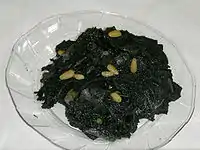 Rock Tripe (seogi) with pine nuts
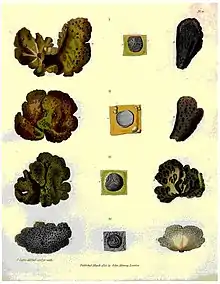 Lichens of the type eaten by John Franklin's men on their journey back from the Coppermine River
 Kishū kumano iwatake tori ("Iwatake mushroom gathering at Kumano in Kishu") by Hiroshige II
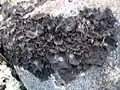 Umbilicaria havaasii
References
- Smith HB, Dal Grande F, Muggia L, Keuler R, Divakar PK, Grewe F, Schmitt I, Lumbsch HT, Leavitt SD. (2020). "Metagenomic data reveal diverse fungal and algal communities associated with the lichen symbiosis". Symbiosis. 82 (1–2): 133–147. doi:10.1007/s13199-020-00699-4.CS1 maint: uses authors parameter (link)
- Angier, Bradford (1974). Field Guide to Edible Wild Plants. Harrisburg, PA: Stackpole Books. p. 184. ISBN 0-8117-0616-8. OCLC 799792.
- McCune, B. (2018). "Two new species in the Umbilicaria torrefacta group from Alaska and the Pacific Northwest of North America". Graphis Scripta. 30 (6): 65–77.
This article is issued from Wikipedia. The text is licensed under Creative Commons - Attribution - Sharealike. Additional terms may apply for the media files.