Roger Woodward
Roger Woodward | |
|---|---|
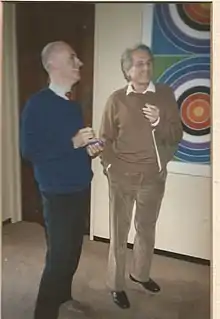 Roger Woodward (left) with Iannis Xenakis at Lincoln Center NYC for WP of Keqops performed with NY Philharmonic/Mehta | |
| Personal details | |
| Born | Roger Woodward 20 December 1942 Chatswood, New South Wales, Australia |
| Children | Asmira Tamara (née Page), Benjamin Auryn (Ludgate Woodward); Elroy Everton (Palmer) MBE |
| Alma mater | Sydney Conservatorium of Music |
| Occupation | Classical pianist, composer, teacher |
Roger Woodward AC [n 1][n 2]OBE (born 20 December 1942) is an Australian pianist in the top echelon of late-twentieth-century musicians, with an extensive repertoire embracing many periods and styles. Some of his performances of works by J.S. Bach[n 3][n 4] [n 5], Beethoven, Chopin, Debussy, Skryabin and Shostakovich have been described as redefining traditions although sometimes criticized for a tendency to modernize aspects of period style. Iconic[n 6]performances and recordings with Pierre Boulez, Jean Barraqué, Iannis Xenakis, Karlheinz Stockhausen, Sylvano Bussotti, John Cage, Morton Feldman and Toru Takemitsu provide a strong and original direction for their time.
Biography
Early life
The youngest of four children, Roger Woodward was born in Sydney, where he received first piano lessons from Winifred Pope.[1] His mother and second sister were amateur violinists and his father and eldest sister sang in the local Chatswood Church of Christ choir. On his first day at School, Roger sat next to a boy who had survived the train to Auschwitz four years before. The six-year olds became lifelong friends and, as he came to know Peter, his brother Paul, and the Kraus family, their deeply moving story impacted an emerging artist's vision and personal development.[2][3][4]
Early studies of Bach organ works with Peter Verco led to immersion in the cantatas, passion music, and a training in church music with Kenneth R. Long, Music Master, St Andrew's Cathedral, Sydney.[5] He performed for the Papal organist, Fernando Germani,[6] and Chief Conductor of the Sydney Symphony Orchestra, Sir Eugene Goossens,[7] after which he entered the Conservatorium in the piano class of Alexander Sverjensky[1][8] (a pupil of Sergei Rakhmaninov and Alexander Glazunov) and composition class of Raymond Hanson.[9]
In 1963, he graduated with distinction from the Conservatorium and Sydney Teachers' College.[10] In the same year, he founded and developed plans for the housing and funding of a competitive, international, quadrennial rostrum originally named the Sydney Piano Competition, together with the support of a wide circle of Sydney musicians and enthusiasts, which was achieved during 1973–76.[11]
Between 1963 and 1965, he continued organ studies with Faunce Allman,[12]while carrying out full-time duties as a choir director and secondary school teacher. During this period he mastered works by Australian composers and Toru Takemitsu,[13] John Cage[14] Olivier Messiaen and his pupils: Karlheinz Stockhausen,[15][16][17]Iannis Xenakis,[18] Pierre Boulez and Jean Barraqué.[19][20][21][22]
In 1964, he won the Commonwealth Finals of the Australian Broadcasting Corporation's Instrumental and Vocal Competition, the prize for which was to perform throughout Australia with the six ABC State Radio orchestras and in multiple radio and television broadcasts.[23]
Between 1965 and 1969 he pursued postgraduate studies at the National Chopin Academy of Music, Warsaw, with Zbigniew Drzewiecki[24]
During summer visits to London (1966–68), he prepared Chopin manuscripts owned by British musicologist Arthur Hedley[25]-before including them in recitals at the Wigmore Hall and South Bank.[26]Contrary to some reports, Woodward did not enter the International Chopin Piano Competition. In 1967, he played for Lina Prokofieva in Warsaw[27] and soon was invited to perform with the Warsaw National Philharmonic Orchestra then throughout Poland.[28] Two years later, he toured extensively with the Wiener Trio[29] performed in Cuba[30] as guest of Casa de las Americas and at the Paris Jeunesses Musicales where the UNESCO Rostrum's two principal jury members: Yehudi Menuhin and Jack Lang, noticed Woodward's performances of his own compositions[31] alongside works of J.S. Bach, Chopin, Skryabin, and Prokofiev. Soon after he made his debut with the Royal Philharmonic Orchestra[32] at the Royal Festival Hall, London and on Menuhin's recommendation,[31] his first four recordings for EMI. [n 7]
In 1971, Woodward performed his first recital at London's Queen Elizabeth Hall[33] with premieres of works by Richard Meale, Ross Edwards, Leo Brouwer, Takemitsu and Barraqué,[34] after which he was invited by Robert Slotover, CEO, Allied Artists Management, to co-found a series of new music concerts known as the London Music Digest [n 8][35][36][37][38][39][40]at the Roundhouse.
Digest performances with Barraqué[41] were followed by a collaboration with the composer on his Sonate pour piano[42] at the EMI Abbey Road Studios, then in Paris and at the Royan Festival. Woodward also collaborated with John Cage at the Roundhouse[n 9] for the British premiere of HPSCHD for ICES (International Carnival of Experimental Sound) and the BBC Proms. Further collaborations were undertaken with Stockhausen at the Festival Hall, London[43][17] and with Takemitsu at the Roundhouse[44], [45] London's Decca Studios and the Music Today Festival, Tokyo.[46]
A collaboration began with Boulez and the BBCSO at the Roundhouse,[47] the Cheltenham Festival, (Bartók First Piano Concerto),[48] and with Bernard Rands for the premiere of Mésallianz for piano and orchestra. His collaboration with Xenakis 1974–96 extended from France to the UK, Austria, Italy and the United States,[18] during which Xenakis dedicated three works to him, as did Rolf Gehlhaar[n 10], Takemitsu[n 11], Anne Boyd[n 12], and Morton Feldman[49][n 13].
Steeped in church music and traditional repertoire, Woodward trained throughout his early life to perform established works side by side with recent music [50] as part of a belief that music was the essential expression of an experimental process. His concerts reflected this belief even though such programming was widely considered unorthodox for the time. He placed new works by Anne Boyd and Meale alongside those of Skryabin, late-Beethoven and J.S. Bach at the Edinburgh Festival.[51] In Los Angeles, for the first half of three LAPO concerts,[52] he performed Liszt's Totentanz and Xenakis alongside J.S. Bach solo harpsichord concertos with the Tokyo String Quartet. In recital, he often programmed traditional eighteenth- and nineteenth-century repertoire with new, little known, or neglected works such as those he championed by experimental fin-de-siècle Russian and early Soviet composers: Aleksandr Skryabin, Aleksandr Mosolov, Nikolai Roslavets, Ivan Vyshnegradsky, Nikolai Obukhov, Aleksei Stanchinskiy.[53] His performances of the complete works of Skryabin attracted exceptional critical reviews[n 14].
Middle years
In 1974, Witold Rowicki invited Woodward on an extended tour of the US with the Warsaw Philharmonic,[54] during which he made his debut at Carnegie Hall with a performance of Bartók's Second Piano Concerto.[55] He began performing with the Cleveland Orchestra directed by Lorin Maazel,[56]and became a regular guest in Los Angeles with the Philharmonic directed by Zubin Mehta;[57] with whom he subsequently performed (1972–89) in New York, Tel Aviv, and Paris.[58] He appeared regularly at Festival d’automne à Paris, [59] [60][61][62] BBC Promenade Concerts,[26][63] at La Biennale di Venezia,[64] Warszawska Jeśien, Wien Modern[65] with Claudio Abbado; [27] at the New York Piano Festival,[66] Festival de la Roque d'Anthéron and at the Festival La Grange de Meslay, Touraine, at the invitation of its artistic director, Sviatoslav Richter;[67] at La Scala Opera House where he directed an all-Xenakis program,[68] throughout Central and Regional Australia[69] and at outdoor venues: the Hollywood Bowl,[63] Odéon of the Herodes Atticus, Athens,[70][n 15] Gulbenkian Gardens, Lisbon,[71] and Sydney Domain.[72] In 1986 he premiered Xenakis' Keqrops at the Lincoln Center NYC (with New York Philharmonic Orchestra directed by Mehta),[73] The following year, he premiered Áskell Másson's Piano Concerto in Reykjavik,[74]and in 1989 Rolf Gehlhaar's Diagonal Flying in Geneva.[75]
Between 1972 and 2003, he worked with the New York, Los Angeles, Beijing, and Israel Philharmonic Orchestras, five London Orchestras, the Hallé Orchestra, London Sinfonietta, London Mozart Players, London Brass, RTE Radio, BBC Northern and Scottish National Orchestras, the Leipzig Gewandhaus Orchestra and Berlin Radio Orchestra, L’orchestre de Paris and Budapest and Prague Chamber Orchestras with Charles Dutoit, Lorin Maazel, Edo de Waart, Sir Charles Mackerras, Kurt Masur, Nello Santi, Paavo Berglund, Georg Tintner, Tan Lihua, Erich Leinsdorf, Eliahu Inbal, James Judd, Walter Susskind, Herbert Blomstedt, Georges Tzipine, Arturo Tamayo, Lukas Foss and Eötvös Péter, Sir John Pritchard, Sir Roger Norrington, Willem van Otterloo, Hiroyuki Iwaki, Lamberto Gardelli, Colman Pearce, Elyakum Shapirra and Sir Alexander Gibson.
Throughout this period, he performed with the Arditti, Tokyo, Alexander, and J.A.C.K String Quartets and collaborated with harpsichordist George Malcolm and jazz pianist Cecil Taylor in Lisbon, Paris, for the Patras Festival, and for extensive tours of the UK Contemporary Music Network 1987–94. He worked with musicologists Charles Rosen,Paul Griffiths, H.C. Robbins-Landon, Richard Toop, Nouritza Matossian, Sharon Kanach; violinists Ivry Gitlis, Wanda Wiłkomirska, Philippe Hirschhorn, Ilya Grubert, cellists Rohan de Saram and Nathan Waks, Synergy Percussion, Chris Dench, Yuji Takahashi, James Dillon, James Morrison, Cathy Berberian, David Gulpilil and Frank Zappa.
He performed the cycle of Beethoven's thirty-two piano sonatas on eleven occasions, [27] [n 16] Beethoven's five piano concertos on six,[27] [n 17] and the complete works of Chopin[27] [n 18] to raise funds and public awareness of the Polish Trades Union Movement Solidarność.[76][77]
During the 1990s he toured China twice,[78] co-founded and directed the Kötschach-Mauthner Musikfest (1992–97),[79]the Joie et Lumière concert series at Château de Bagnols, Bourgogne 1997–2004[79][80] and an annual concert series—the Sydney Spring International Festival of New Music 1989–2001, when he collaborated with Arvo Pärt and Horatiu Radulescu. [81][27] In 1999, he completed the degree of Doctor of Music with the University of Sydney although he is also the recipient of four honorary doctorates [n 19]. He was chair of Music at the University of New England, Australia from 2000 to 2001, and from 2002 to 2004, chair of the School of Music, San Francisco State University where he is currently keyboard professor. [27] [50]
His performances as a conductor received wide critical acclaim: with the Adelaide Chamber Orchestra[n 20]; the Sydney Dance Company at the Sydney Opera House in a collaboration with its artistic director, Graeme Murphy in twenty-six performances of the Xenakis ballet Kraanerg[n 21]; the Shanghai Conservatory orchestra; in the UK for BBC2 Television[n 22]; at the Festival d'automne à Paris; with the Alpha Centauri Ensemble at: La Scala di Milano[n 23]; the Academia Santa Cecilia, Rome; at the Biblioteca Salaborsa, Bologna[n 24] and for the Sydney Spring Festival of New Music (1989–2001).[n 25] [27] His compositions have been performed in Poland, Australia, Cuba, the UK, the Netherlands, and France, where his work Sound by Sound—for live and recorded pianos, percussion and live electronics—was commissioned by the Festival d’automne à Paris for the bicentennial celebrations of the French Revolution.
Personal life
Roger Woodward has three children: Asmira, a concert violinist (mother, Prudence Page); Benjamin, director of Academy Tennis (mother, Patricia Ludgate, to whom Woodward was married from 1989 to 2009), and foster son, Elroy Palmer, MBE, who is director of the St. Giles Trust SOS Program, London.[27]
If misleading to label Woodward's dedication to compassionate causes and commitment to others that of a political activist, it is not unreasonable to take formative events into consideration: his founding and developing over a thirteen-year period of an international piano competition in Sydney, when still a student, to provide a bridge in the more isolated Australia of the time for peers to forge closer links with the international Music community; contribution as instigator and producer of the "Concert for Darwin" in the wake of Cyclone Tracey's devastation of that city; support of underprivileged children in regional and Oceanic communities; dedication to Poland's Solidarność Trades Union Movement throughout the 1980s, at considerable personal and professional cost; and his support of the injured on the streets of Brixton during the South London Riots of April 1981.
Principal awards
- 1980: Officer, Civil Division of the Most Excellent Order of the British Empire.[27] - 1981: Citation for Bravery, Greater London Metropolitan Police.[n 26] - 1992: Companion of the Order of Australia.[27] - 1993: Order of Merit, Commander class with gold medal, Republic of Poland.[27] - 1997: National Treasure, Australia National Trust.[27] - 2001: Centenary (Federation) medal, Australia.[27] - 2004: Chevalier dans l’ordre des arts et des lettres., Republic of France.[27] - 2011: Gloria Artis (gold class) medal, Republic of Poland.[27] - 2019: Fellow, Australian Academy of the Humanities.[82]
Publications
He is published by Routledge Press, Abingdon, UK,[83] HarperCollins,[84] Kindle, the Pendragon Press, NY, Praeger, New York[85] and the E.R.P. Musikverlag, Berlin.[85]
Recordings
He recorded for Polydor, BMG, CPO, Etcetera Records BV (Amsterdam), DG, Warner, ABC Classics/Universal and, upon the death of Dmitry Shostakovich, Woodward made the first complete recording (in the West) of the composer's Twenty-four Preludes and Fugues, Op. 87, for RCA Red Seal (UK).[86] His recordings for Celestial Harmonies 2006–15, won wide critical acclaim with awards of: Preis der Deutschen Scallplattenkritik 2007,[87][88] for performances of Bach's BWV 826, 830 and 903; Diapason d’or 1991,[89] shared with Ralph Lane, awarded by the critics of Le Monde de la musique for the solo piano music of Feldman; Ritmo prize, Spain, 1991, [90] for his Etcetera BV recording of Takemitsu piano music.
References
Notes
- List of Companions of the Order of Australia where List of Companions of the Order of Australia: https://en.wikipedia.org/wiki/List_of_Companions_of_the_Order_of_Australia
- Oficial virtual document from the Australian government: https://honours.pmc.gov.au/honours/awards/870280
- Dominy Clements wrote in Musicweb International about Roger Woodward’s Well-Tempered Clavier recording: "Even without these superb recordings, this release would be worth the asking price just for the extensive two-part booklet notes by Roger Woodward, “In Search of a Performance Practice”, and those autograph facsimiles of both Books. These are the kinds of CD releases which you feel you should bequeath separately in your will, such is the feel of worth and value they have. Is Roger Woodward’s well considered Well-Tempered Clavier perfect? I would dispute that there is any such thing, but nothing in this recording has made me go ‘?’ and most if not almost all of it has been a case of just absorbing absolute and easy splendour. For the first time in nearly 30 years I am faced with a conversion: the next time I am asked which recording of this music I want to take with me onto my desert island, I won’t instantly say Sviatoslav Richter, and I might not even mention him at all". Complete article at http://www.musicweb-international.com/classrev/2010/Mar10/Bach_Woodward_199225.htm
- Reinhard J. Brembeck wrote about Roger Woodward’s recording of the complete Well-Tempered Clavier the article "Shiva meets Bach" in the Süddeutsche Zeitung (Munich, 17 April 2010): "These recordings resulted in four-and-a-half stellar hours of the Bach discography. Because Woodward approaches the two cycles fluently and briskly as one unified work, because, as a graduate of the avant-garde he doesn’t need to shy away from any technical challenge, because he knows how to courageously take full advantage of the possibilities of the modern grand piano, because he relies less on interpretation than on fiercely incendiary presentation, Woodward removes anything historical, elitist or alienating from this music; he understands Bach as a contemporary of innovators such as Xenakis, Cage, Feldman, and Ligeti. No looking back, no nostalgia, no more educational high-browism, no more old Europe. Never before did Johann Sebastian have such a future ahead of him".
- Andy Gill wrote in The Independent (London, UK, 19 March 2010 ) "There has been almost as much of a glut of Well-Tempered Claviers recently as commemorative Chopin editions, including interpretations from Daniel Barenboim and Maurizio Pollini; but this 5CD set of both Books I and II by Roger Woodward may well be the most significant since Glenn Gould’s revolutionary completion of the sequence. The size of the set suggests unusually slow tempi, but Woodward is simply being scrupulously attendant to the demands of the music. Indeed, his thorough sleevenote In Search Of A Performance Practice, analysing the different approaches employed on various cembali, clavichords, organs, etc, may constitute the last word on this subject, as too may his performance. Remarkable."
- For decades Roger Woodward had been an icon of new piano music and had worked with practically all important composers of the day. Hans Otte characterized him as: ' He is sensitive but has power; a musical genius.' "Wilfried Schäper, Musikredaktion, Radio Bremen, Germany, January, 6th, 2007, review of live concert recording in the Sendesaal, Celestial Harmonies booklet 13324.
- OASD 7560, 7561, 7562, 7567 - EMI catalogue numbers of Woodward's first four commercial recordings released 1970 following Yehudi Menuhin's statement to the EMI Recording Co. shortly after hearing Woodward's Jeunesses Musicales performances in Paris, 1969: “Roger Woodward’s performances of contemporary music showed that there were just so many different ways that he was able to interest and fascinate the listener, not only with sounds freely produced at the keyboard, but with magical sounds that came from inside the piano, from under it; from every possible part of the instrument. In every context his playing was beautiful, sensitive and wonderfully musical; his approach personal and imaginative as was proved by his Scriabin and Chopin.” EMI subsequently printed the statement in full on each of the recordings.
- London Music Digest, The Roundhouse London, 1970s, https://www.discogs.com/Roger-Woodward-Jean-Barraqu%C3%A9-Sylvano-Bussotti-Leo-Brouwer-The-London-Music-Digest-From-The-Round-Ho/release/6479510.
- This collaboration is detailed in the 1972 BBC Promenade Concerts publication booklet (online) and involved David Tudor, Cornelius Cardew, John Tilbury, Frederick Page, Annea Lockwood, Richard Bernas, Frederick Rzewski, Roger Woodward, directed by John Cage.
- Worked together with Rolf Gehlhaar in Strangeness, Charm and Colour (1978), Diagonal Flying (1989), and Quantum Leap (1994).
- Worked together with Toru Takermitsu: Undisturbed Rest (1952-59), For Away (1973), and Corona—London Version (1973).
- Anne Boyd, Angklung (1974), The Book of Bells I, II, III, IV, Meditation on a Chinese Character (1996), and Last Songs of the Kamikaze (1997).
- Worked together with Morton Feldman, Piano and Orchestra (1975), Piano (1977), and Triadic Memories (1981).
- Woodward is considered one of the prominent performers of Skryabin's piano music: https://en.wikipedia.org/wiki/Alexander_Scriabin.
- Information found in Athens 1979 Festival https://iscm.org/wnmd/1979-athens; September 1979, Woodward played Liszt’s "Les jeux d'eaux à la villa d'este," Feldman’s Piano (1977), and premiered Rolf Gehlhaar's Strangeness, Charm and Colour with London Brass de.zxc.wiki/wiki/Rolf_Gehlhaar, at the Odeon Herodes Atticus at the 52nd International Society for Contemporary Music Festival (ISCM World Music Days).
- In National Library of Australia, Papers of Roger Woodward, Class 1, series programs and reviews of performances: Cardiff University Concert Hall (1977); Adelaide Festival Town Hall (1978); London Kenwood House Orangerie (1979); Sydney Festival Town Hall (1980); London Queen Elizabeth Hall (1981), Wellington NZ (1981); Hobart Town Hall (1983); Melbourne Uniting Church Toorak (1983, recorded with Greg Hocking; Sydney Regent Theatre (1983); Brisbane Queensland Performing Arts Centre (1983/4); and Brisbane QPAC second performance (1988 Silver Jubilee).
- National Library of Australia, Papers of Roger Woodward, Class 1, series programs and reviews of performances: Melbourne Symphony Orchestra with Georg Tintner (1982); Sydney Town Hall with Myer Freedman (1982); Queensland Theatre Orchestra with Georg Tintner (October 1982); Adelaide Chamber Orchestra with Elyakum Shapira at Adelaide Town Hall (1982); Queensland Theatre Orchestra with Werner Andreas Albert and George Tintner (1988 Silver Jubilee); and Perth WA ABC Studios with Albert Rosen.
- In National Library of Australia, Roger Woodward Papers, Class 1, series programs and reviews—Complete Works of Chopin project for Sydney Festival at Sydney Town Hall 1983, 1984, 1985, including works for piano and orchestra/SSO chamber musicians, and the complete songs (Marilyn Richardson), recorded in entirety by 2MBSFM.
- Doctor of Creative Arts, University of Wollongong (1992); Doctor of Music, University of Sydney (1996); Doctor of Letters, University of New England (1998); Doctor of Laws, University of Alberta, Canada (1998).
- The programs are in the NLA Roger Woodward Collection.
- Performance recording on https://www.youtube.com/watch?vxBMvJrdoFP4; the concert programme is in the NLA Roger Woodward Collection. Compact disc recorded in 1989 by Etcetera Records BV.
- Dench Planetary Allegiances recorded for BBC2TV, London; Grateful Dead/Rex Foundation (Dec. 1992); NLA Collection. Composer’s statement 1992 Sydney Spring program publication, p. 15; copy of MS in NLA.
- Festival d'automne à Paris—in the NLA Roger Woodward Collection. The all-Xenakis programme was recorded by Radio France at the Festival d'automne, December 1992, by the Alpha Centauri Ensemble in the presence of the composer.
- The program is in the NLA Roger Woodward Collection.
- The program is in the NLA Roger Woodward Collection.
- The award was shared with Patricia Ludgate and Jędrzej and Josie Wierbicki following the April 1981 Brixton riots in south London. 2 Citations—(a) Patricia Ludgate, "Butterflies of a Brief Summer," MoshPit Publishing, 2016, Kindle, Location 3608-3621; (b) Lord Scarman Report).
Citations
- Woodward 2015, p. 45.
- Clara Kraus 1987.
- Peter Kraus 2020.
- Paul Kraus 2015.
- Woodward 2015, p. 1-35.
- Woodward 2015, p. 61.
- Woodward 2015, p. 63-66.
- Woodward 2015, p. 80.
- Woodward 2015, p. 103-111.
- Woodward 2015, p. 79-100.
- Woodward 2015, p. 128.
- Woodward 2015, p. 114-115.
- Woodward 2015, p. 323-325.
- Woodward 2015, p. 313-320.
- Woodward 2015, p. 425.
- Woodward 2015, p. 435-436.
- Stockhausen 1973.
- Woodward 2015, p. 353-399.
- Barraqué 2019.
- Heribert 1997.
- Griffiths 2003.
- Hodeir 1961.
- Woodward 2015, p. 123-130.
- Woodward 2015, p. 138-140.
- Woodward 2015, p. 164-167.
- Woodward 2015, p. 163.
- Woodward 2018.
- Woodward 2015, p. 155-156.
- Woodward 2015, p. 209.
- Woodward 2015, p. 202-203.
- Woodward 2015, p. 208.
- Woodward 2015, p. 212.
- Woodward 2015, p. 210.
- Woodward 2015, p. 451-452.
- Woodward 2015, p. 211.
- Woodward 2015, p. 326-329.
- Woodward 2015, p. 334.
- Woodward 2015, p. 389.
- Woodward 2015, p. 419.
- Woodward 2015, p. 423-425.
- Woodward 2015, p. 400-404.
- Woodward 2015, p. 576-578.
- Woodward 2015, p. 423.
- Ohtake 1998.
- Woodward 2015, p. 327-330.
- 2015, p. 331-332.
- Woodward 2015, p. 416-417.
- Woodward 2015, p. 160.
- Feldman 2000, p. 152-154.
- Artist: Roger Woodward.
- Woodward 2015, p. 456-457.
- Woodward 2015, p. 354-355.
- Woodward 2015, p. 554(item 70).
- Woodward 2015, p. 498-500.
- Woodward 2015, p. 213.
- Woodward 2015, p. 496-497.
- Woodward 2015, p. 354.
- Woodward 2015, p. 361-362.
- Festival d'automne.
- Woodward 2015, p. 264-265.
- Woodward 2015, p. 308-309.
- Woodward 2015, p. 382.
- Woodward 2015, p. 358.
- Woodward 2015, p. 297-298.
- Woodward 2015, p. 383.
- Woodward 2015, p. 282.
- Woodward 2015, p. 317-319.
- Woodward 2015, p. 394.
- Woodward 2015, p. 216-217.
- Woodward 2015, p. 439-440.
- Woodward 2015, p. 217-218.
- Woodward 2015, p. 46.
- András Varga 1996, p. 182-183.
- 2015, p. 244.
- Woodward 2015, p. 442-443.
- Woodward 2015, p. 219.
- Woodward 2015, p. 232.
- Woodward 2015, p. 276-277.
- Woodward 2015, p. 278.
- Woodward 2015, p. 504.
- Woodward 2015, p. 476-481.
- humanities.org.au.
- Woodward 2015, p. 535.
- Woodward 2015.
- Woodward 2015, p. 536.
- Woodward 2015, p. 218.
- Woodward 2015, p. 283.
- Woodward 2015, p. 446.
- Woodward 2015, p. 308.
- Woodward 2015, p. 333.
Bibliography
- Ohtake, Noriko (1998). Creative Sources for the Music of Toru Takemitsu. Ashgate. ISBN 0859679543.
- Barraqué, Jean (2019). Sonate pour piano. Bärenreiter Urtext. ISMN 9790006567607.
- Heribert, Henrich (1997). Das Werk Jean Barraqués: Genese und Faktur. Bärenreiter. ISBN 3761813864.
- Griffiths, Paul (2003). The Sea on Fire. Bärenreiter. ISBN 3761813864.
- Hodeir, André (1961). Since Debussy: A View of Contemporary Music. Grove Press, Inc. LCCN 3761813864.
- Feldman, Morton (2000). Give My Regards To Eighth Street – Collected Writings of Morton Feldman. Exact Change. ISBN 1878972316.
- Kraus, Clara (1987). The Colours of War. Ten Uncertain Years, 1935-45. Spectrum Publications. ISBN 0867861223.
- Kraus, Peter (2020). Slow Train to Auschwitz. Memoirs of a Life in War and Peace. Ginninderra Press. ISBN 9781760418700.
- Kraus, Paul (2015). Fear No Evil. Ark House Press. ISBN 9780994194145.
- Woodward, Roger (2015). Beyond Black and White – My Life in Music. HarperCollins/ABC. ISBN 9780733323034.
- Stockhausen, Karlheinz (1973). Lecture 7 [Part 1/3] Karlheinz Stockhausen – MANTRA (1973) British Lectures (Video).
- Woodward, Roger (2018). "Papers of Roger Woodward". Trove. Retrieved 11 August 2021.
- "The London Music Digest From The Round House". discogs. Retrieved 4 August 2021.
- "Artist: Roger Woodward". ABC Music. Retrieved 4 August 2021.
- "Festival d'automne". Festival d'automne (in French). Retrieved 4 August 2021.
- András Varga, Bálint (1996). Conversations with Iannis Xenakis. Faber and Faber. ISBN 0571179592.
External links
- Roger Woodward Homepage
- Roger Woodward's YouTube channel: https://www.youtube.com/channel/UC-Qw2Pi_nR-BBbWA3Hw2YaQ
Authority control  | |
|---|---|
| General | |
| National libraries | |
| Other | |