Roma (airship)
Roma was an Italian built semi-rigid airship, originally designated the T-34. It was purchased by the United States from the Italian government for $250,000 in 1921. The dirigible was operated by the US Army until February 21, 1922, when it crashed in Norfolk, Virginia, killing 34 people aboard, with 9 survivors. Roma was the last hydrogen inflated airship flown by the US military; all subsequent airships were inflated with helium.
| Roma | |
|---|---|
.tif.jpg.webp) | |
| Role | Training airship |
| National origin | Italy |
| Manufacturer | Stabilimento Construzioni Aeronautiche (SCA) |
| Designer | Umberto Nobile |
| First flight | September 1920 |
| Status | Destroyed in crash 21 February 1922 |
| Primary user | United States Army |
| Number built | 1 |
Design and development
The Roma was designed by Celestino Usuelli, the engineers Eugenio Prassone, Umberto Nobile and Colonel Gaetano Crocco.[1] It was the first project of the Stabilimento Costruzioni Aeronautiche ("Aeronautical Construction Factory"), for the partnership of Nobile, Usuelli, Croce and Giuseppe Valle. The T-34 was designed for trans-Atlantic crossings carrying up to 100 passengers, though initially fitted for 25.[1] Roma was the largest semi-rigid airship in the world.
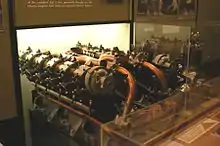
As a semi-rigid design it was built about a rigid keel - though the keel was partially articulated to allow some flexibility. The passenger spaces and control cabin were within the keel. The engines, 400 hp Ansaldo 4E-2940 V-12s,[2] were mounted outside, angled such that the slipstreams would not interfere with each other.[1]
Service
In September 1920, Roma made its first trial flight.[3]
The airship was purchased by the United States Army for $200,000[lower-alpha 1][5](over $3.3 million in 2020 dollars). In March, 1921, the Roma flew the 300 miles from Rome to Naples and back carrying the US Ambassador, his wife and several Army officers. The passengers were served lunch while flying over the island of Capri. [6]
The Army originally planned to fly the Roma to the United States, but instead the dirigible was dismantled, packed in several crates and transported by ship, arriving in the US in August, 1921. When the Army unpacked the crates after their arrival at Langley Field, they found the airship's fabric skin mildewed and weakened.[7] After being reassembled by US Army Air Service crews at Langley, Roma flew in America for the first time on November 15, 1921, with minor problems. On a subsequent flight, a propeller disintegrated, ripped open the envelope and slashed a gas bag; the airship managed to return safely.[8]
During a flight to Washington, D.C. on December 21, 1921, the Roma experienced several engine breakdowns due to the cold weather. After the return fight to Langley was made on only four engines, the original Italian Ansaldo engines were replaced with six Liberty L-12's.[9]
Crash
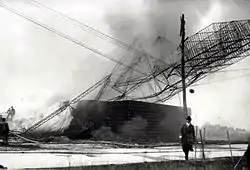
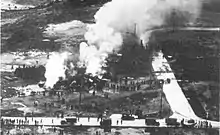
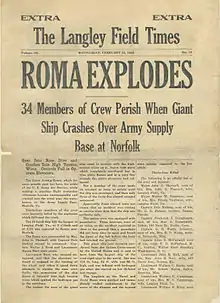
The Roma crashed in Norfolk, Virginia during a test flight on February 21, 1922. The airship left Langley Field shortly before 1:00 PM in the afternoon with 45 people onboard most of whom were US Army airmen. There were also a few civilians including mechanics and government observers aboard for the test flight. After lifting off, the pilot of the 410 foot dirigible set a course along the shore of Chesapeake Bay that took it over Buckroe Beach, and Fort Monroe, before crossing Hampton Roads and passing over Willoughby Spit en-route to the Norfolk Navy Base.[10] The crash of the Roma was caused by failure of the airship's box rudder system, which allowed it to maneuver over tight areas. Witnesses reported seeing the entire box rudder slip sideways and the uncontrollable airship flew straight into the ground at the Army's Norfolk Quartermaster Depot (now the location of Norfolk International Terminals) from an altitude of 1,000 feet. Just before the bow struck the ground, the Roma contacted high voltage power lines, and burst into flames. A total of 34 people were killed, 8 were injured, and 3 escaped unharmed. Among the dead was the airship's pilot, Captain Dale Mabry. The crash of the Roma marked the greatest disaster in American aeronautics history at that time.
Master Sergeant Harry A. Chapman earned the Cheney Award for his heroics during the crash. He was the first recipient of the award and it was presented by President Calvin Coolidge in 1928.
Although it was America's worst aviation disaster at the time, a century later the crash of the Roma has largely been forgotten, eclipsed by the Hindenburg disaster which occurred 15 years later and effectively ended the airship era. At Langley Air Force base, the spot where the massive hanger that housed the Roma once stood is now a parking lot but is still known as the "LTA" ("lighter than air") area, and the base's Roma Road is named in memory of the ill-fated airship.[11]
Specifications
Data from [12]
General characteristics
- Length: 125 m (410 ft 0 in)
- Diameter: 25 m (82 ft 0 in)
- Height: 28.04 m (92 ft 0 in)
- Volume: 33,810 m3 (1,193,000 cu ft)
- Empty weight: 34,500 kg (76,000 lb)
- Useful lift: 19,100 kg (42,000 lb)
- Powerplant: 6 × Liberty L12 , 300 kW (400 hp) each
Performance
- Maximum speed: 128 km/h (80 mph, 70 kn)
- Cruise speed: 90 km/h (56 mph, 49 kn) [13]
- Range: 4,800 km (3,000 mi, 2,600 nmi) [14]
References
- Notes
- Sheppard gives $184000, negotiated down from $475000 [4]
- Flight (1920) p1044
- Sheppard p31
- Flight 23 September 1920 p.1021
- Sheppard p32
- New York Times
- Flight 24 March 1921 p.202
- https://www.pilotonline.com/history/article_69a33ee2-c328-5b62-acd1-1697ec026cee.html
- Flight 29 December 1921 p.862
- New York Times February 22, 1922
- https://www.pilotonline.com/history/article_69a33ee2-c328-5b62-acd1-1697ec026cee.html
- https://www.pilotonline.com/history/article_69a33ee2-c328-5b62-acd1-1697ec026cee.html
- New York Times. 22 February 1922.
- Flight p1044
- Flight p1044
- Bibliography
- "The "Roma" Disaster", Flight, XIV (688): 140, 2 March 1922, archived from the original (pdf) on 6 March 2016, retrieved 20 August 2011
- "The New Italian Usuelli Semi-rigid airship", Flight, XII (614): 1044–1045, 30 September 1920, archived from the original (pdf) on 5 March 2016, retrieved 20 August 2011
- Tampa Times, February 22, 1922. Page 1.
- "Roma was Largest Semi-rigid Airship" (PDF). New York Times. 22 February 1922.
- Smith, Alfred Emanuel (December 7, 1921). "Photo: Trial Flight Of The Dirigible "Roma" At Langley Field, Virginia". The Outlook. Vol. 129. p. 554. Retrieved 2009-07-30.
- Smith, Alfred Emanuel; Walton, Francis (March 3, 1922). "The Destruction Of The Roma". The Outlook. Vol. 130. pp. 369–370. Retrieved 2009-07-30.
 |
Wikimedia Commons has media related to Roma (airship). |
- Nancy E. Sheppard (25 January 2016). The Airship ROMA Disaster in Hampton Roads. Arcadia Publishing Incorporated. ISBN 978-1-62585-669-2. OCLC 944247591.