Rottweil
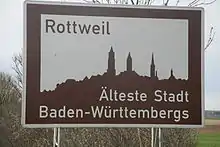
Rottweil (German: [ˈʁɔtvaɪl] ( listen)) is a town in southwest Germany in the state of Baden-Württemberg. Rottweil was a free imperial city for nearly 600 years.
Rottweil | |
|---|---|
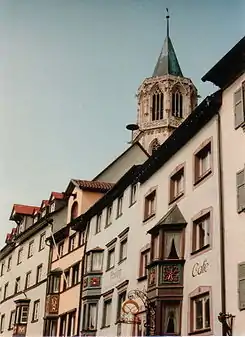 Main street | |
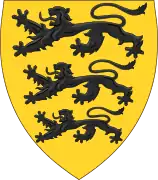
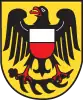
 Coat of arms | |
Location of Rottweil within Rottweil district 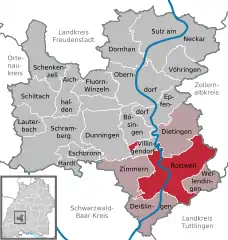 | |
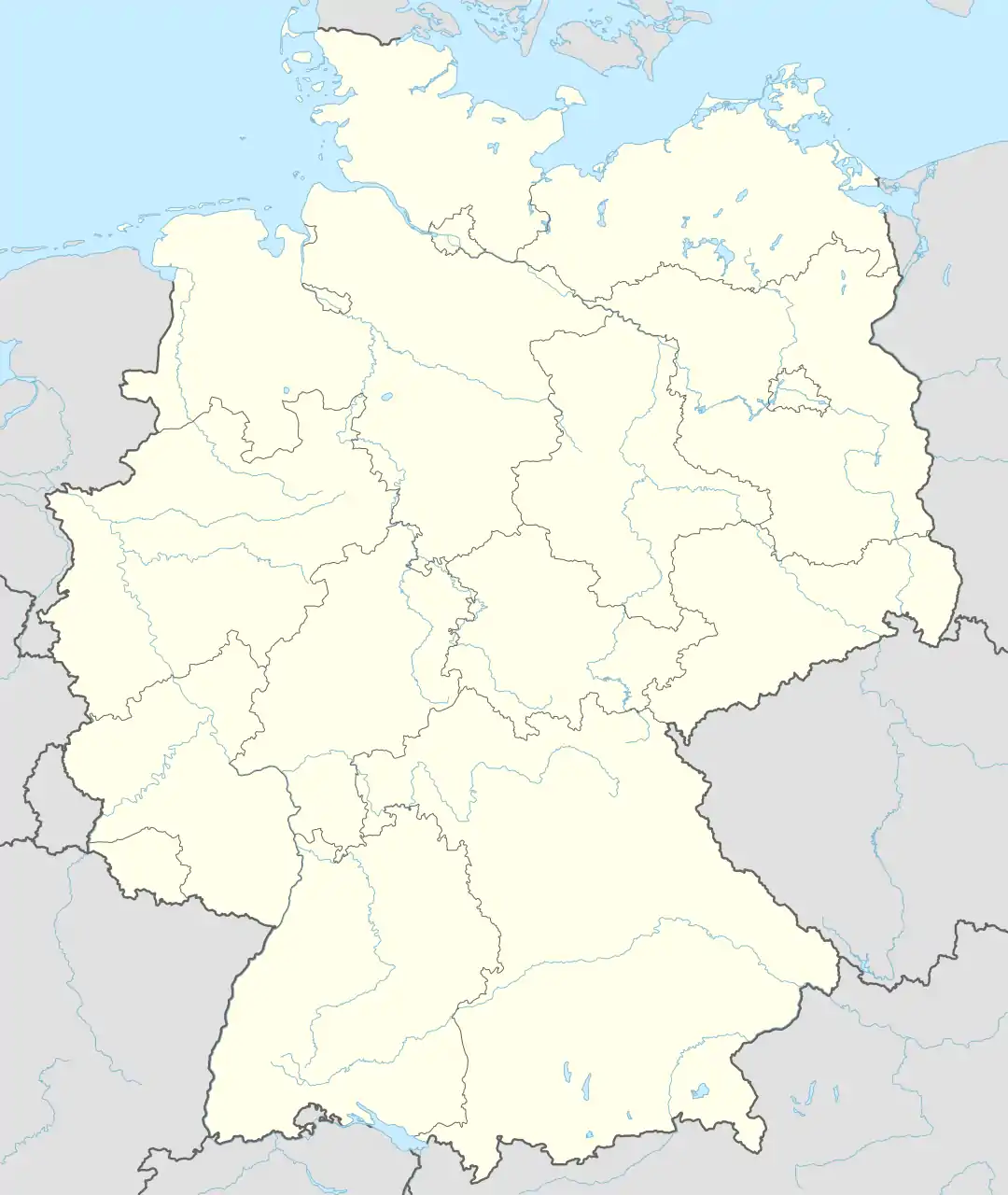  Rottweil 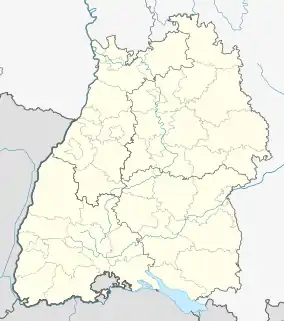 Rottweil | |
| Coordinates: 48°10′5″N 8°37′29″E | |
| Country | Germany |
| State | Baden-Württemberg |
| District | Rottweil |
| Government | |
| • Lord mayor (2017–25) | Ralf Broß[1] (Ind.) |
| Area | |
| • Total | 71.76 km2 (27.71 sq mi) |
| Highest elevation | 609 m (1,998 ft) |
| Lowest elevation | 557 m (1,827 ft) |
| Population (2020-12-31)[2] | |
| • Total | 24,975 |
| • Density | 350/km2 (900/sq mi) |
| Time zone | UTC+01:00 (CET) |
| • Summer (DST) | UTC+02:00 (CEST) |
| Postal codes | 78628, 78652 (Unterrotenstein) |
| Dialling codes | 0741, 07427 (Neukirch) |
| Vehicle registration | RW |
| Website | www.rottweil.de |
Located between the Black Forest and the Swabian Alps, Rottweil has nearly 25,000 inhabitants as of 2020. The town is famous for its medieval center and for its traditional carnival (called "Fasnet" in the local Swabian dialect). It is the oldest town in Baden-Württemberg,[3] and its appearance has changed very little since the 16th century.
History
Imperial City of Rottweil Reichsstadt Rottweil | |||||||||
|---|---|---|---|---|---|---|---|---|---|
| 1140–1802 | |||||||||
| Status | Free imperial city | ||||||||
| Capital | Rottweil | ||||||||
| Government | Republic | ||||||||
| Historical era | Middle Ages | ||||||||
• Founded | AD 73 | ||||||||
• Gained Imp. immediacy | 1140 | ||||||||
• Treaty with Swiss | 1463 | ||||||||
| 1519 | |||||||||
| 1802 | |||||||||
| |||||||||

Imperial Abbey of Rottenmünster Reichskloster Rottenmünster | |||||||||
|---|---|---|---|---|---|---|---|---|---|
| 1237–1802 | |||||||||
| Status | Imperial abbey | ||||||||
| Capital | Rottenmünster | ||||||||
| Government | Imperial abbey | ||||||||
| Historical era | Middle Ages | ||||||||
• Founded | 9 May 2018 | ||||||||
• Gained Imp. immediacy | 1237 | ||||||||
| 1643 | |||||||||
• Mediatised to Württemberg | 23 November 1802 | ||||||||
• Abbey abandoned | 1850 | ||||||||
| |||||||||
Rottweil was founded by the Romans in AD 73 as Arae Flaviae and became a municipium, but there are traces of human settlement going back to 2000 BC. Roman baths and an Orpheus mosaic of c. AD 180 date from the time of Roman settlement. The present town became a ducal and a royal court before 771 and in 1268 it became a free imperial city.
In 1463 Rottweil joined the Swiss Confederacy under the pretence of a temporary alliance. In 1476 the Rottweilers fought on the Swiss side against Charles the Bold in the Battle of Morat. In 1512, Pope Julius II gave the city a valuable "Julius banner" for its services in the 1508–1510 "Great Pavier Campaign" to expel the French.[4] In 1519, the Rottweilers left the old Swiss alliance. They joined a new one in which their membership was extended indefinitely – the so-called "Eternal Covenant".
Rottweil thus became a centre of the Swiss Confederation. The relations between the Swiss Confederation and Rottweil cooled rapidly during the Protestant Reformation. When Rottweil was troubled by wars, however, it still asked the Confederates for help.[5]
In the Rottweil Witch Hunts from 1546 to 1661, 266 so-called witches, wizards and magicians were executed in the imperial city of Rottweil. On April 15, 2015, they were given a posthumous pardon. An official apology was given by the City Council about 400 years after their violent death.[6]
Rottweil lost both its status as free city and its alliance with the Swiss Confederacy with the conquest of the region by Napoleon in 1803.
Lord mayors since the 19th century
- 1820–1833: Max Joseph von Khuon, Schultheiß
- 1833–1845: Max Teufel
- 1845–1848: Karl Dinkelmann
- 1848–1851: Kaspar Rapp
- 1852–1887: Johann Baptist Marx
- 1887–1923: Edwin Glückher
- 1924–1943: Josef Abrell
- 1943–1944: Otto Mann
- 1944–1945: Paul Fritz
- 1945–1946: Franz Mederle
- 1946–1965: Arnulf Gutknecht
- 1965–1985: Ulrich Regelmann, mayor, from 1970 Lord Mayor
- 1985–2001: Michael Arnold
- 2001–2009: Thomas Engeser
- 2009–present: Ralf Broß[7][8][9]
Main sights
- The late-Romanesque and Gothic–era Münster Heiliges Kreuz ("Minster of the Holy Cross"), built over a pre-existing church from 1270. It features a crucifix by Veit Stoss and noteworthy Gothic sculptures.
- Kapellenkirche (1330–1340), a Gothic church with a tower and with three statue-decorated portals.
- Lorenzkapelle ("Church of St. Lawrence", 16th century) in late Gothic style. It houses some two hundred works by Swabian masters and Gothic altarpieces from the 14th and 15th centuries.
- The town's museum, including a notable Roman mosaic with the legend of Orpheus.
- The late-Gothic town hall (1521).
- St. Pelagius, a Romanesque church from the 12th century. Excavations have brought to light Roman baths on the same site.
- Dominican Museum of Rottweil – local branch of the Landesmuseum Württemberg
- As of 2015, ThyssenKrupp was constructing a $45 million, 807-foot (246 m) tower, the Rottweil Test Tower. The tower is a research facility for the company and is to be used to test new elevator cars and technologies. When the tower was completed in 2017, it was the tallest elevator test tower in the world.[10][11] The windowless building is to have 12 elevator shafts.[12]
Twin towns – sister cities




Notable people
- Konrad Witz (1400/10–1445/46), painter
- Adam of Rottweil, 15th-century scholar and printer
- Franz Xavier Wernz (1842–1914), Superior General of the Society of Jesus
- Erwin Teufel (born 1939), politician (CDU), former minister president of Baden-Württemberg
- Rüdiger Safranski (born 1945), writer and literary scholar
- Matthias Hölle (born 1951), opera bass
- Anne Haigis (born 1955), musician and singer
- Wolfgang Stryi (1957–2005), jazz musician
- Andreas Schwab (born 1973), politician (CDU) and member of the European Parliament
- Johannes Erath (born 1975), opera director
- Christoph Burkard (born 1983), Paralympic swimmer
- Maximiliane Rall (born 1993), footballer
- Joshua Kimmich (born 1995), footballer
Trivia
- The Rottweiler dog is named after this town; it used to be a butcher's dog in the region.
- "Das Mädchen aus Rottweil" is a song by the German band Die Toten Hosen.
Gallery
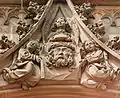 Depiction of St. Veronica's sudarium over the portal of the Minster of the Holy Cross
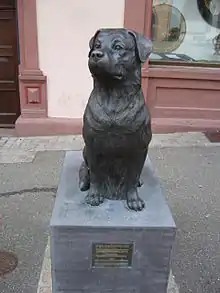 A statue for Rottweiler dogs in Rottweil
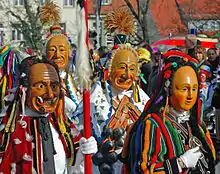 Rottweiler "Fasnet"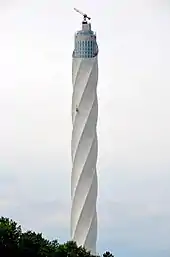
.jpg.webp) Rottweil station with ThyssenKrupp Test Tower in the background
Rottweil station with ThyssenKrupp Test Tower in the background
See also
References
- Aktuelle Wahlergebnisse, Staatsanzeiger, accessed 14 September 2021.
- "Bevölkerung nach Nationalität und Geschlecht am 31. Dezember 2020" [Population by nationality and sex as of December 31, 2020] (CSV). Statistisches Landesamt Baden-Württemberg (in German). June 2021. Retrieved 17 October 2021.
- Website of Dominikaner Museum Rottweil (retrieved May 22, 2014), on permanent display is a wooden table from August 4, AD 186 naming arae flaviae as municipium thus making Rottweil the oldest town in Baden-Württemberg Archived 2014-05-21 at the Wayback Machine
- Hecht, Winfried. "The Julius Banner of the Village of Rottweil". ETHZürich. Retrieved 2019-01-25.
- Hecht, Winfried. "Rottweil". Historical Dictionary of Switzerland. Retrieved 2019-01-25.
- Zeck, Mario (2000). "Im Rauch gehen Himmel geschüggt", Hexenverfolgung in der Reichsstadt Rottweil. Stuttgart. p. 43.
- "Oberbürgermeisterwahl 2009 - vorläufiges amtliches Endergebnis" (in German). Kommunale Informationsverarbeitung Reutlingen-Ulm. Retrieved 2 February 2017.
- "Ralf Broß - Oberbürgermeister - Stadt Rottweil" (in German). XING. Retrieved 2 February 2017.
- "Mitarbeiter: Broß, Ralf" (in German). Rottweil (official site). Retrieved 2 February 2017.
- Dillon, Conor (2015-06-26). "World's tallest elevator tower rises in Rottweil, Germany | DW | 26.06.2015". Deutsche Welle. Retrieved 2021-12-13.
- There are higher elevator test towers now, see List of elevator test towers.
- Brown, Eliot (September 15, 2015). "Elevators Elevate German City's Image". The Wall Street Journal. ISSN 0099-9660. Retrieved 2 February 2017.
- "Rottweil und seine Partnerschaften". rottweil.de (in German). Rottweil. Retrieved 2021-03-16.
External links
 |
Wikimedia Commons has media related to Rottweil. |
- Official website
 (in German)
 - Feast of Fools: Medieval Carnival Celebrations in Rottweil
- History and territory of the former Reichsstadt Rottweil
- Pictures and stories about Rottweil
.svg.png.webp)
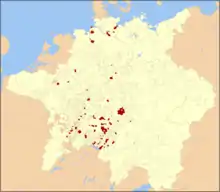
| Imperial abbeys and colleges (Reichsabteien, Reichsklöster und Reichsstifte) |
| 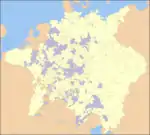 Ecclesiastical states of the Holy Roman Empire, 1648 |
|---|---|---|
| Imperial charterhouse (Reichskartause) | ||
| ||
Towns and municipalities in Rottweil (district) | ||
|---|---|---|
 | ||
Authority control | |
|---|---|
| General | |
| National libraries | |
| Other | |