Royal Prussia
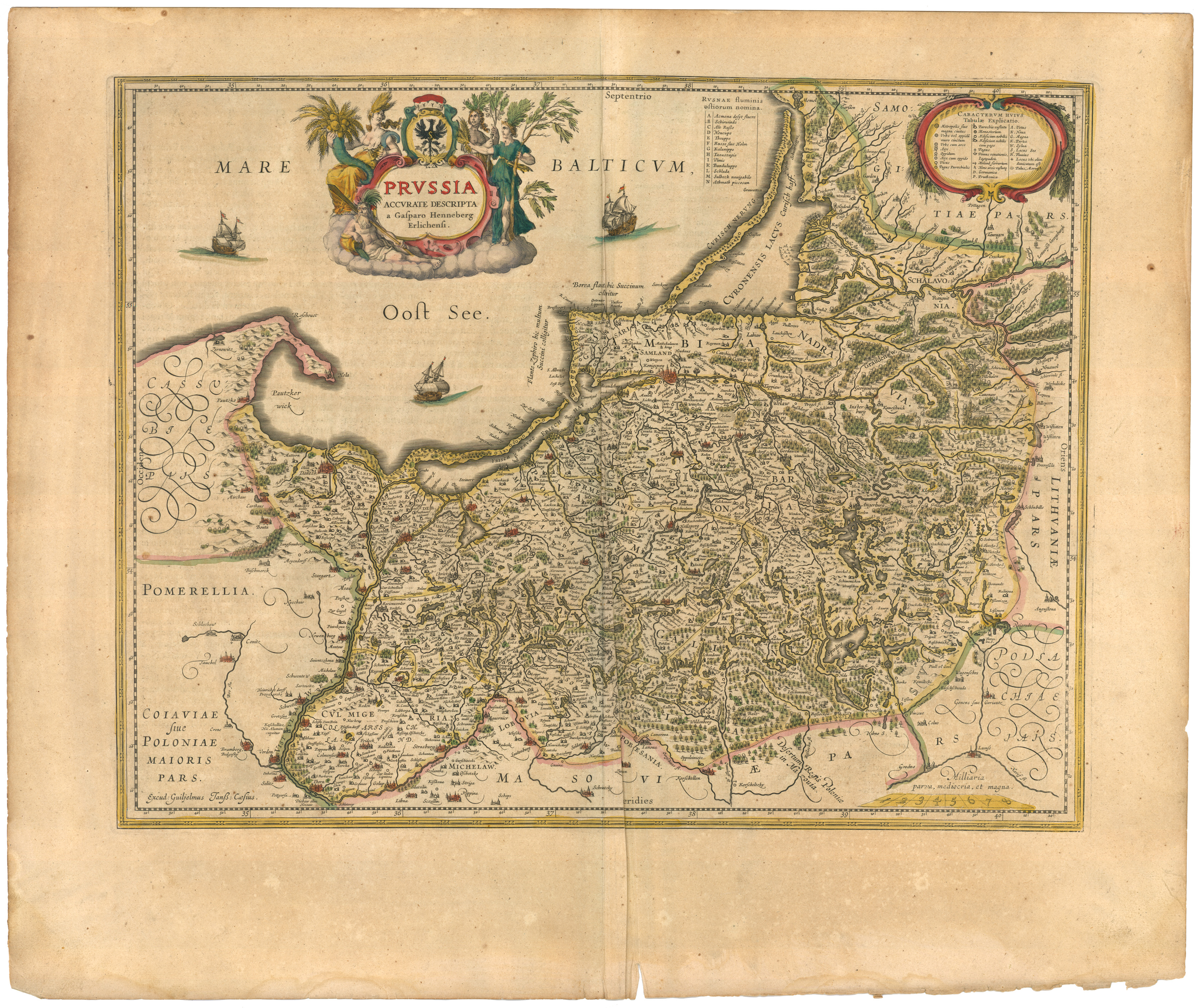
Royal Prussia (Polish: Prusy Królewskie; German: Königlich-Preußen or Preußen Königlichen Anteils, Kashubian: Królewsczé Prësë) or Polish Prussia[1] (Polish: Prusy Polskie;[2] German: Polnisch-Preußen)[3] was a province of the Polish kingdom that was created as a result of the peace treaty of 1466 between the Teutonic Order and Poland. Prussian lands of the Order were divided, western part became part of Poland and was known as Royal Prussia, eastern remained under the rule of the Order as a Polish fief. Royal Prussia was granted autonomy and a guarantee of preserving its rights and customs.[4] Ultimately, in 1569 Royal Prussia was fully integrated into the Kingdom of Poland.[5]
| Royal Prussia | |||||||||
|---|---|---|---|---|---|---|---|---|---|
| Autonomous dependency of the King of Poland | |||||||||
| 1466–1569 | |||||||||
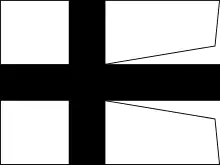
_Lob.svg.png.webp) Flag
| |||||||||
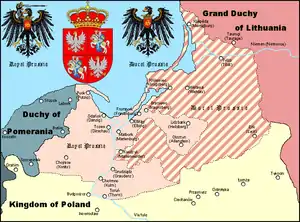 Map of Royal Prussia (light pink) | |||||||||
| Area | |||||||||
| • Coordinates | 54°N 19°E | ||||||||
| History | |||||||||
| History | |||||||||
| 19 October 1466 | |||||||||
| 1 July 1569 | |||||||||
| |||||||||
| Today part of | |||||||||
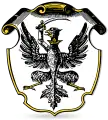
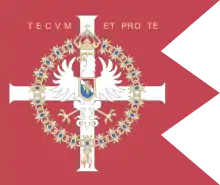

In 1772, the former territory of Royal Prussia, which by then was fully merged into the Kingdom of Poland and administered in the form of several voivodeships was annexed by Prussia and subsequently re-organized into the province of West Prussia. This occurred at the time of the First Partition of Poland, with other parts of the Polish-Lithuanian Commonwealth being annexed by the Russian Empire and Hapsburg Austria.
Geography
The area consisted of the following districts:
- Pomerelia and Danzig,
- Kulmerland and Michelauer Land and Thorn,
- the mouth of the Vistula with Elbing and Marienburg,
- the Bishopric of Warmia (Ermland) with Allenstein which were forcibly ceded from the Teutonic Order in the Second Peace of Thorn (1466) to the Kingdom of Poland.[6]
From the 14th century, in old texts (until the 16th or 17th century) and in Latin, the terms Prut(h)enia and Prut(h)enic refer not only to the original settlement area of the now extinct Old Prussians along the Baltic coast east of the Vistula River, but also to the adjacent lands of the former Samboride dukes of Pomerelia, which territory the Teutonic Knights had acquired from the king of Poland in the 1343 Treaty of Kalisz and incorporated into the Order's State.
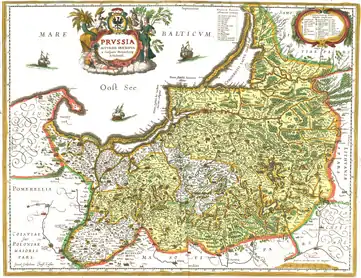
Pomerelia's Lauenburg and Bütow Land to the west was ruled by the Pomeranian dukes, enfeoffed to the king of Poland.
Royal Prussia is distinguished from later Ducal Prussia, the remaining (eastern) parts of Prussia around Königsberg, founded and governed by the Teutonic Knights. After secularisation in 1525, it succeeded to the Protestant dukes of the Hohenzollern dynasty. From 1618 this area was in personal union by the Electors of Brandenburg (Brandenburg-Prussia). In 1657 the titular monarchy devolved by the Treaty of Wehlau.
History
By 1308, the Pomerelian part of the region was conquered by the first Polish state, who granted them autonomy and their existing self-government.[7] During the rule of Władysław I the Elbow-high of Poland, the Margraviate of Brandenburg staked its claim on the territory in 1308, leading Władysław to request assistance from the Teutonic Knights, who had replaced the Brandenburgers and incorporated Pomerelia into the Teutonic Order state in 1309 (Teutonic takeover of Danzig (Gdańsk) and Treaty of Soldin (Myślibórz)). The burden of taxation and the arbitrary way of governing caused resistance among the people of Prussia. The burghers of the great Prussian cities began to organize themselves. The first organized body was the Lizard League founded by the Chelmno Land nobility.[8]
After being checked at the Battle of Grunwald, the Teutonic Knights's prestige declined, and by the 1411 Peace of Thorn they were forced to pay large contributions to the king of Poland, which became a financial burden on the citizenry. In 1440, as the tax burden rose, indigenous nobles and Hanseatic cities established the Prussian Confederation at Marienwerder (Kwidzyn) in resistance of the Order's domestic and financial policies. The Confederation was led by the citizens of Danzig, Elbing, and Thorn. The gentry from Chełmno Land and Pomerelia participated as well. Grand Master Ludwig von Erlichshausen demanded the dissolution and in 1453 searched for help from Pope Nicholas V and Emperor Frederick III. In turn, in February 1454, the Confederation sent a delegation, under Johannes von Baysen, to King Casimir IV Jagiellon of Poland, to ask him for support against the Teutonic Order's rule and for incorporation of their homeland into the Kingdom of Poland. In this treaty, Prussian delegates declared the Polish king the only true sovereign of their lands, justified by the historical fact that the king of Poland had earlier ruled them. After lengthy negotiation, on 6 March 1454, the Royal Chancellery issued the Act of Treaty formalizing the terms of the treaty establishing Royal Prussia's autonomy as a foreign dependency of the king.[9]
Prussian–Polish Alliance
After the Prussian Confederation pledged allegiance to Casimir on 6 March 1454, the Thirteen Years' War ("War of the Cities") began. King Casimir IV Jagiellon appointed Baysen as the first war-time governor of Royal Prussia. On 28 May 1454, the king took an oath of allegiance from the citizens of Thorn, and in June a similar oath from the citizens of Elbing and Königsberg was taken.[9]
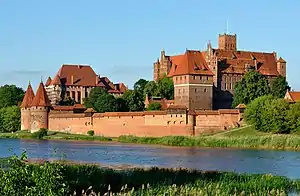
The rebellion also included major cities from the eastern part of the Order's lands, such as Kneiphof, later a part of Königsberg. Though the Knights were victorious at the Battle of Chojnice in 1454, they were not able to finance more knights in order to reconquer the castles occupied by the insurgents. Thirteen years of attrition warfare ended in October 1466 with the Second Peace of Thorn (1466), which provided for the Order's cession to the Polish Crown of its rights over the western half of Prussia, including Pomerelia and the districts of Elbing, Marienburg, and Chełmno.
Incorporation into the Polish Crown
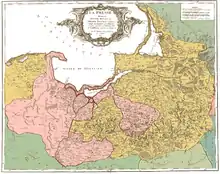
According to the 1454 treaty signed by King Casimir IV, Royal Prussia was incorporated into the Polish Crown and their elites enjoyed the same rights and privileges as the elites of the Polish kingdom.[10] At the same time Royal Prussia was granted a considerable degree of autonomy. Already instituted law codes were retained, only Prussians could be appointed on public offices (ius indigenatus), borders of the province had to remain intact and all decisions regarding Prussia had to be consulted with the Prussian parliament (Landtag).[11] Thorn, Elbing, Königsberg and Danzig (Danzig law) were to retain the right to mint coins, although with the image of the Polish king. [11]
The Bishop of Warmia had claimed Imperial Prince-Bishopric status, as mentioned in the Golden Bull of 1356 by Emperor Charles IV. Although the area was never directly under the Emperor's jurisdiction and the claim seems unsupported by any bestowal document, it was in wide use in the 17th century. The bishopric continued defending this status until the end of the Holy Roman Empire in 1806.
Integration into the Kingdom of Poland
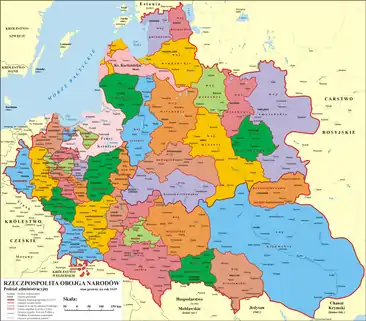
In 1569, as a result of the Union of Lublin, which created the Polish-Lithuanian Commonwealth, Royal Prussia was integrated fully into the Kingdom of Poland, and its parliament reduced to the status of a provincial assembly, also other separate Prussian institutions were dissolved.[5] The former territory was subsequently governed as Pomeranian Voivodeship, Culm Voivodeship, Malbork Voivodeship, and Prince-Bishopric of Warmia
  History of Brandenburg and Prussia | ||||
| Northern March 965–983 |
Old Prussians pre-13th century | |||
| Lutician federation 983 – 12th century | ||||
| Margraviate of Brandenburg 1157–1618 (1806) (HRE) (Bohemia 1373–1415) |
Teutonic Order 1224–1525 (Polish fief 1466–1525) | |||
| Duchy of Prussia 1525–1618 (1701) (Polish fief 1525–1657) |
Royal (Polish) Prussia (Poland) 1454/1466 – 1772 | |||
| Brandenburg-Prussia 1618–1701 | ||||
| Kingdom in Prussia 1701–1772 | ||||
| Kingdom of Prussia 1772–1918 | ||||
| Free State of Prussia (Germany) 1918–1947 |
Klaipėda Region (Lithuania) 1920–1939 / 1945–present |
Recovered Territories (Poland) 1918/1945–present | ||
| Brandenburg (Germany) 1947–1952 / 1990–present |
Kaliningrad Oblast (Russia) 1945–present | |||
Partitions
At the same time as the 1772 First Partition of Poland, the former lands of Royal Prussia were annexed by the Kingdom of Prussia, the successor state of the Teutonic Order. In 1793, the new Kingdom of Prussia participated in the Second Partition of Poland by temporarily annexing the neighboring regions, which were almost immediately returned to the Tsarist kingdom of Poland and incorporated into the Russian Empire.
Governors
- 1454–1459: Johannes von Baysen, war-time governor
- 1459–1480: Stibor (Tiburcius) von Baysen[12]
- 1480: Niklas von Baysen, who was only elected; he refused to swear allegiance to the king. He was also Voivode of Malbork.
In 1510, after several attempts to install another governor, the office was abolished.
See also
References
- Anton Friedrich Büsching, Patrick Murdoch. A New System of Geography, London 1762, p. 588
- Zygmunt Gloger (1900). "Volume 325". In Harvard Slavic humanities preservation microfilm project (ed.). Geografia historyczna ziem dawnej polski (Historical Geography of the former Polish lands) (in Polish). Wydawnictwo Polska. pp. 82, 144.
- (in German) Polnisch-Preußen ("State Constitution of Polish-Prussia") (see: Excerpt in the publication of 1764, p. 581)
- Friedrich 2000, p. 1-2, 22-23.
- Daniel Stone (2001). The Polish-Lithuanian State, 1386-1795. University of Washington Press. p. 64. ISBN 0-295-98093-1.
- Stone, Daniel. A History of East Central Europe. University of Washington Press, 2001, ISBN 0-295-98093-1. p. 30
- Frost, Robert, The Oxford History of Poland-Lithuania, Vol. I
- Friedrich 2000, p. 20.
- F. Kiryk, B. Ryś (red.) Wielka Historia Polski, t. II 1320-1506, Kraków 1997, p. 160-161
- Frost 2015, p. 218-219.
- Frost 2015, p. 219.
- Acten der Ständetage Preussens unter der Herrschaft des Deutschen Ordens: 5 vols., Max Toeppen (ed.), Leipzig: Duncker & Humblot, 1874–1886; reprint Aalen: Scientia, 1968–1974, vol. 5: 'Die Jahre 1458–1525', 1974. p. 90]. ISBN 3-511-02940-6.
Further reading
- Karin Friedrich, The Other Prussia: Royal Prussia, Poland and Liberty, 1569–1772, Cambridge University Press, 2000, ISBN 0-521-58335-7 on Google Books
- Robert Frost, The Oxford History of Poland-Lithuania, Vol. I: The Making of the Polish-Lithuanian Union, 1385—1569, Oxford 2015.
- Gerard Labuda (ed.), Historia Pomorza, vol. I–IV, Poznań 1969–2003 (also covers East Prussia) (in Polish)
- W. Odyniec, Dzieje Prus Królewskich (1454–1772). Zarys monograficzny, Warszawa 1972 (in Polish)
- Dzieje Pomorza Nadwiślańskiego od VII wieku do 1945 roku, Gdańsk 1978 (in Polish)
External links
Authority control  | |
|---|---|
| General | |
| National libraries | |