Army ranks and insignia of the Russian Federation
The Russian Federation inherited the ranks of the Soviet Union, although the insignia and uniform were altered slightly.
| Russian Federation Armed Forces |
|---|
.svg.png.webp) |
| Staff |
| Services (vid) |
| Independent troops (rod) |
| Special operations force (sof) |
| Other troops |
| Military districts |
| History of the Russian military |
.svg.png.webp)

The Russian Armed Forces have two styles of ranks: army-style ranks and navy-style ranks. The army and air force use only army-style ranks.
Ranks and insignia
The following is a table ranks of the armed forces of the Russian Federation. English translation is given first, followed by Russian version, then by English transliteration.
Officers
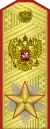
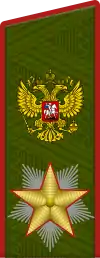
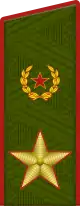
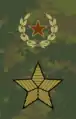
| Category | Troop ranks[1] | Dress uniform insignia[2] | Everyday uniform insignia[3] | Field uniform insignia[4] | NATO equivalent |
|---|---|---|---|---|---|
| Supreme and general officers |
Marshal of the Russian Federation[lower-alpha 1] Ма́ршал росси́йской федера́ции Márshal rossíyskoy federátsii |
 |
 |
 |
OF-10 |
| Army general Генера́л а́рмии Generál ármii |
 |
 |
 |
OF-9 | |
| Colonel general Генера́л-полко́вник Generál-polkóvnik |
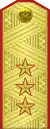 |
 |
 |
OF-8 | |
| Lieutenant general Генера́л-лейтена́нт Generál-leytenánt |
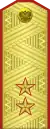 |
 |
 |
OF-7 | |
| Major general Генера́л-майо́р Generál-mayór |
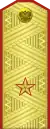 |
 |
 |
OF-6 | |
| Senior officers or field grade officers |
Colonel Полко́вник Polkóvnik |
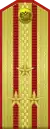 |
 |
 |
OF-5 |
| Lieutenant colonel Подполко́вник Podpolkóvnik |
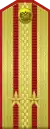 |
 |
 |
OF-4 | |
| Major Майо́р Mayór |
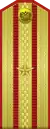 |
 |
 |
OF-3 | |
| Junior officers or company grade officers |
Captain Kапита́н Kapitán |
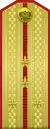 |
 |
 |
OF-2 |
| Senior lieutenant Старший лейтена́нт Stárshiy leytenánt |
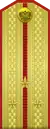 |
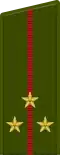 |
 |
OF-1 | |
| Lieutenant Лейтенант Leytenant |
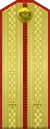 |
 |
 | ||
| Junior lieutenant Mла́дший лейтена́нт Mládshiy leytenánt |
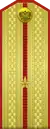 |
 |
 | ||
| Student officers | Officer cadet Курсант Kursant |
 |
-2010.svg.png.webp) |
|
OF-(D) |
Other ranks
| Category | Troop ranks[1] | Dress uniform insignia[2] | Everyday uniform insignia[3] | Field uniform insignia[4] | NATO approximate[5] |
|---|---|---|---|---|---|
| Praporshchik | Chief warrant officer Ста́рший пра́порщик Stárshiy práporshchik |
|
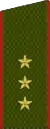 |
 |
OR-9 |
| Warrant officer Пра́порщик Práporshchik |
|
 |
 | ||
| Sergeants | Sergeant first class Старшина́ Starshiná |
 |
 |
OR-8 | |
| Senior sergeant/Staff sergeant Ста́рший сержа́нт Stárshiy serzhánt |
 |
 |
OR-7 | ||
| Sergeant Сержа́нт Serzhánt |
 |
 |
OR-6 | ||
| Junior sergeant Мла́дший сержа́нт Mládshiy serzhánt |
 |
 |
OR-5 | ||
| Soldiers and yefréytors |
Private first class Ефре́йтор Yefréytor |
 |
 |
OR-4 | |
| Private Рядово́й Ryadovóy |
 |
 |
OR-1–OR-3 | ||
Rank titles are sometimes modified due to a particular assignment, branch or status:
- The ranks of servicemen assigned to a "guards" unit or formation are preceded by the word "guards";
- The ranks of servicemen in the legal, medical and veterinary branches are followed by "of justice", "of the medical service", and "of the veterinary service", respectively;
- The ranks of servicemen in the reserve or retired are followed by "of the reserve" or "in retirement", respectively;
- The rank descriptor "of aviation" was officially abolished but is still commonly used.
Reforms
Insignia reform (2010)
On 11 March 2010, Law No.2010-293 of the President of Russia introduced a new set of rank insignia. Privates, airmen and seamen now wear plain shoulder epaulettes. Senior NCOs had their chevrons replaced by plain bars (small horizontal bars for corporals and sergeants increasing in number with seniority, large horizontal bars for staff sergeants, and vertical bars for master sergeants). These rank badges mirror the insignia of both the Imperial Russian Army and the Soviet Army in the 1970s. Warrant officers and officers received new shoulder rank epaulettes and all general officer insignia now reflect service affiliation in the duty dress uniform. The parade dress gold epaulettes have been retained. The insignia for a marshal of the Russian Federation retained the coat of arms of Russia and the marshal's star.
Rank and insignia reform (2013)
In 2013, the insignia of an army general now include the marshal's star, surmounted by a red star in a wreath. In Spring 2013, the warrant officer ranks, which had been removed as a result of the 2008 Russian military reform, were reinstated.[6]
See also
Notes
- The rank of marshal of the Russian Federation, the highest in the Russian Army, is not presently held by anyone in the modern armed of the Russian Federation. The only officer to hold the rank is the former Minister of Defense Igor Sergeyev, who was elevated from commander (army general) of the Strategic Rocket Forces. As it stands, marshal of the Russian Federation should be considered an honorary title equivalent to a field marshal, marshal or five-star general in other countries, created in the event of a major war or as the result of extreme military accomplishment (see marshal of the Soviet Union).
References
- Citations
- Law 293 2010.
- Law 525 2020, p. 316.
- Law 525 2020, p. 318.
- Law 525 2020, p. 319.
- NATO 2021, p. D-1.
- Guskova 2013.
- Bibliogrphy
- Guskova, Anthon (1 July 2013). "В российскую армию возвращаются прапорщики". 5-tv.ru (in Russian). Retrieved 15 September 2021.
- Приказ Министра обороны Российской Федерации от 09.10.2020 № 525 (Зарегистрирован 16.11.2020 № 60927) [Order of the Minister of Defense of the Russian Federation dated 09.10.2020 No. 525 (Registered on 16.11.2020 No. 60927)] (in Russian). publication.pravo.gov.ru/. 17 November 2020. Retrieved 15 September 2021.
- NATO (2021). STANAG 2116 NATO (7th ed.). Brussels, Belgium: NATO Standardization Agency.
- "Указ Президента Российской Федерации от 11 марта 2010 года № 293 "О военной форме одежды, знаках различия военнослужащих и ведомственных знаках отличия"". rg.ru (in Russian). Российской газеты. 12 March 2010. Retrieved 26 May 2021.
External links
- Federal Law No. 58-FZ from March 12, 1998 "On military duty and military service" (in Russian)
- Presidential Decree No. 531 from May 8, 2005 "On military uniform, rank insignia of the servicemen and state bodies' rank insignia" (in Russian)
Authority control: National libraries  |
|---|