Russian Orbital Segment
The Russian Orbital Segment (ROS) is the name given to the components of the International Space Station (ISS) constructed in Russia and operated by the Russian Roscosmos. The ROS handles Guidance, Navigation, and Control for the entire Station.
.png.webp)
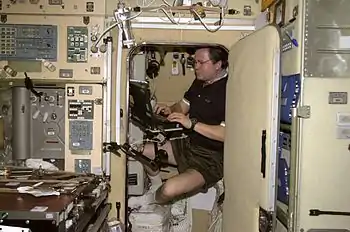
Current composition
.jpg.webp)
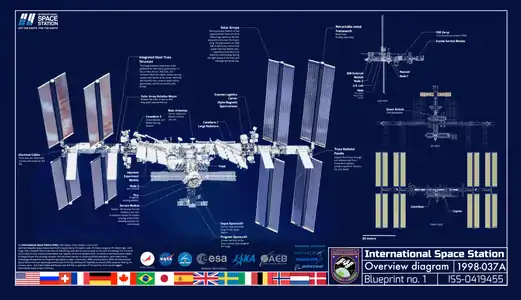
The segment currently consists of six modules, which together essentially comprise the base configuration of the cancelled Russian space station Mir-2.[2] The segment is controlled directly from Roskosmos's Mission Control Center in Moscow. The six modules are (in order of launch):
The first module, Zarya, otherwise known as the Functional Cargo Block or FGB, was the first component of the ISS to be launched, and provided the early station configuration with electrical power, storage, propulsion, and navigation guidance, until a short time after the Russian service module Zvezda docked and was transferred control. Zvezda contains the ESA built DMS-R Data Management System.[3] Now primarily used for storage, Zarya provides ports for Soyuz spacecraft, Progress (spacecraft) and the European ATV to dock to the station. Ships boosting the station's orbit dock to the aft port (the rear port according to the station's normal orientation and direction of travel). The FGB is a descendant of the TKS spacecraft designed for the Russian Salyut program. 5.4 tons of propellant fuel can be stored and transferred automatically to and from ships docked. Zarya was originally intended as a module for the Russian Mir space station, but was not flown as of the end of the Mir-1 program. Developed by Russia and the former Soviet Union, construction of Zarya was funded by the United States and NASA,[4] and Zarya remains a US-owned module.[5]
The second module, Zvezda, is the station's Service Module - it provides a living environment for the crew, contains the ISS's main engine system, and provides a docking port for Soyuz, Progress and Automated Transfer Vehicle spacecraft.[6]
The third module, Pirs, functioned as the ROS's airlock, storing EVA spacesuits and providing the equipment necessary for cosmonauts to exit the space station. It also served as a docking compartment for Soyuz and Progress spacecraft. It was decommissioned and undocked by Progress MS-16 on 26 July 2021, and blew up in the atmosphere, to make way for the Nauka module.[7]
The fourth module, Poisk, is similar to Pirs. Redundancy in airlocks allows one airlock to be repaired internally and externally whilst crew use the other airlock to exit and re-enter the station.
The fifth module, Rassvet, is primarily used for cargo storage and as a docking port for visiting spacecraft.
Future modules
Oka-T-MKS
The Oka-T-MKS was a planned companion module to the ISS. Reported as of December 2012 to be under construction, its development has been significantly delayed. The module would be free-floating most of the time as an autonomous orbital space laboratory for the conduction of experiments, and dock with the ISS for experiment maintenance about every 180 days. The Oka-T-MKS space laboratory was contracted to Energia by Roscosmos in 2012. Originally projected for a 2015 launch date, this has been pushed back indefinitely and some evidence suggests that, unable to locate significant development partnerships, its development has been abandoned.[8][9]
Proposed modules
On June 17, 2009, the Russian Federal Space Agency (Roskosmos) presented to NASA and the other ISS partners a proposal to add additional modules to the Russian segment to ensure its viability past 2016 or even 2020. To this end, a Nodal Module that would be attached to the nadir docking port of Nauka (MLM) would facilitate the attachment of two additional, larger modules that would be capable of providing an independent power source to the Russian segment should current plans to deorbit the US segment of the ISS after 2016 move forward. As proposed, the Nodal Module would be launched during 2013 by a Soyuz launcher in a similar fashion to how the Pirs and Poisk MRM-2 modules were lifted to orbit. The two larger modules, nominally referred to as Scientific and Power Producing Modules 1 and 2, would be lifted to orbit via Proton launchers in 2014 and 2015, respectively. These two modules would be attached to the port and starboard sides of the Nodal Module, leaving its aft docking port accessible for possible future expandability and its nadir port accessible for docking by Soyuz or Progress spacecraft. Because of the proximity of the Nodal Module to the planned attachment point of MRM-1 on the nadir docking port of Zarya FGB to facilitate docking of Soyuz and Progress spacecraft, the module's forward-facing port will be unusable. As of January 2010, neither Roskosmos nor NASA have provided further details of these modules or verification that they have been officially funded by the Russian government or added to the ISS launch manifest schedule.[10][11][12]
See also
- Orbital Piloted Assembly and Experiment Complex - proposed separation of parts of ROS into a separate space station
- Scientific research on the ISS
References
- "Mir-2". Encyclopaedia Astronautica. 31 July 2008. Retrieved 2009-01-29.
- "Exercising Control 49 months of DMS-R Operations" (PDF). Esa.int. Retrieved 2016-02-24.
- "Zarya | NASA". Nasa.gov. 1998-11-20. Retrieved 2016-02-24.
- "S.P. Korolev RSC Energia - ISS - ISS Russian Segment". Energia.ru. Retrieved 2016-02-24.
- "Zvezda Service Module". NASA. 14 October 2006. Retrieved 2009-01-29.
- "Pirs Docking Compartment". NASA. 10 May 2006. Retrieved 2009-01-29.
- "Russia to build autonomous space lab". SpaceDaily. 21 December 2012. Retrieved 22 December 2012.
- https://space.skyrocket.de/doc_sdat/oka-t.htm
- "Novosti Kosmonavtiki article, "Программа развития российского сегмента МКС" (ISS segment development program) [English summary of Russian technical article]". Kosmonavtka.
- "Russia Needs Billions More To Complete It's [sic] ISS Segment". Space-Travel.com. 14 April 2008. Retrieved 2009-01-29.
- Sergei Shamsutdinov (July 2008). "Program for Development of the Russian ISS Segment" (in Russian). Novosti Kosmonavtiki. Archived from the original on 6 June 2011. Retrieved 2009-02-15.
External links
- Science Research on ISS Russian Segment - S.P. Korolev RSC Energia

| Current |  | ||||||||
|---|---|---|---|---|---|---|---|---|---|
| Past |
| ||||||||
| Canceled |
| ||||||||
| In development |
| ||||||||
| Concepts |
| ||||||||
| Related |
| ||||||||
Notes: † Never inhabited due to launch or on-orbit failure, ‡ Part of the Almaz military program, ° Never inhabited, lacks docking mechanism. | |||||||||
| Launch sites |  | ||||||||
|---|---|---|---|---|---|---|---|---|---|
| Launch vehicles | |||||||||
| Human spaceflight programs |
| ||||||||
| Robotic programs |
| ||||||||
| Communications | |||||||||
| Concepts | |||||||||
| Images and artwork | |||||||||
| Related | |||||||||