Ruth Handler
Ruth Marianna Handler (née Mosko; November 4, 1916 – April 27, 2002) was an American businesswoman and inventor. She served as the president of the toy manufacturer Mattel Inc. In 1959, she invented the Barbie doll, which sold over a billion toys worldwide. She was the founder and president of the world's largest toy company, which at its peak had 18,000 employees and annual sales of over $300 million. In 1974, the Handlers were forced to resign from Mattel, and in 1978 Ruth Handler was convicted of false reporting to the Securities and Exchange Commission.[2]
Ruth Handler | |
|---|---|
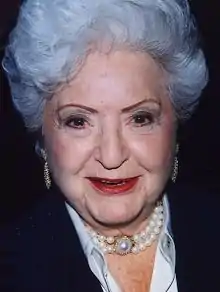 | |
| Born | Ruth Marianna Mosko November 4, 1916 Denver, Colorado, US |
| Died | April 27, 2002 (aged 85)[1] Los Angeles, California, US |
| Occupation | President of Mattel, Inc. |
| Employer | Mattel, Inc. |
| Successor | Robert A. Eckert |
| Spouse(s) | |
| Children | 2 |
Early life
Handler was born Ruth Marianna Mosko in Denver, Colorado, to Polish-Jewish immigrants Ida Mosko (née Rubenstein) and Jacob Mosko.[3] She married her high school boyfriend, Elliot Handler, and moved to Los Angeles in 1938.[4] Her husband decided to make their furniture out of two newfound types of plastics, Lucite and Plexiglas. Ruth Handler suggested that he start doing this commercially and they began a furniture business. Ruth Handler worked as the sales force for the new business, landing contracts with Douglas Aircraft Company and others.[4]
Formation of Mattel
Innovative Idea
Her husband Elliot Handler and his business partner Harold "Matt" Matson formed a small company to manufacture picture frames, calling it "Mattel" by combining part of their names ("Matt" and "Elliot"). Later, they began using scraps from the manufacturing process to make dollhouse furniture. The furniture was more profitable than the picture frames and it was decided to concentrate on toy manufacturing. The company's first big-seller was the "Uke-a-doodle", a toy ukulele.
Barbie
Ruth Handler claimed her daughter Barbara, pre-teen, played with paper dolls by pretending they were adults. Handler noticed that in such play, children would act out future events, rather than the present. Handler noted the limitations of the paper dolls, including how the paper clothing failed to attach well. She wanted to produce a three-dimensional plastic "paper doll" with an adult body and a wardrobe of fabric clothing, but her husband and Mr. Matson thought parents would not buy their children a doll with a voluptuous figure. While the Handler family was vacationing in Europe, Ruth Handler saw the West German Bild Lilli doll (which was not a children's toy, but rather an adult gag gift) in a Swiss shop and brought it home. The Lilli doll was a representation of the same concept Ruth had been trying to sell to other Mattel executives. This doll was different than the baby-like dolls the girls would play with during this time, and Ruth was inspired.[3] Up until that point, there was a lack of dolls for girls who were old enough to comprehend the basic concepts of being a teenager and adulthood. Barbie aimed to directly fill that gap in the industry.
Once home, she reworked the design of the doll and named her Barbie after the Handlers' daughter, Barbara.[5] Barbie debuted at the New York toy fair on March 9, 1959, but was not an immediate success. When Disney introduced The Mickey Mouse Club children's television show, Mattel invested heavily in television advertising. The TV commercials for the Barbie doll paid off and Barbie rocketed Mattel and the Handlers to fame and fortune. Subsequently, they would add a boyfriend for Barbie named Ken, after the Handlers' son, and many other "friends and family" to Barbie's world.
Later years
Handler was diagnosed with breast cancer in 1970. She had a modified radical mastectomy, which was often used at the time to combat the disease, and because of difficulties in finding a good breast prosthesis, she decided to make her own. With Peyton Massey, Ruth founded, Ruthton Corp., which manufactured a more realistic version of a woman's breast, called "Nearly Me". She personally fitted one for the then first lady, Betty Ford.
In 1974, Handler resigned from Mattel after investigations of producing fraudulent financial reports.[6] In 1978, Handler was charged with fraud and false reporting to the Securities and Exchange Commission. She pleaded no contest, was fined $57,000 and sentenced to 2,500 hours of community service.[7] She blamed her illness for making her "unfocused" on her business.
Though the Handlers took a more hands-off approach to their company's business practice after resigning, they continued to create new ideas. One project Handler took in the 1980s was Barbie and the Rockers. She was credited as a writer of the 1987 film Barbie and the Rockers: Out of this World. Handler was inducted into the Junior Achievement U.S. Business Hall of Fame in 1997. Barbie is still alive and prominent in today's youth as children around the US adore the set of dolls. Advertisements are still played by channels with a younger audience and the impact Barbie has had is immeasurable.
She died in California from complications of surgery for colon cancer on April 27, 2002, aged 85.[8] Her husband Elliot died nine years later at the age of 95.
Early Life and Career Path
Born on November 4th, 1916 in Denver, Colorado, Ruth Marianna Mosko married Elliot Handler who was her highschool boyfriend. She grew up as part of a Russian Jewish immigrant family, moving to Los Angeles in 1938. Once settled in California, Handler pushed her husband to start their own furniture business with Lucite and Plexiglas--two new plastics of the time. [1] From this, her career began, acting as her husbands’ salesforce, she helped to close a monumental deal with Douglas Aircraft to use their plastic products and furniture. In 1945, Handler and her husband developed the Mattel Corporation which would become an extremely lucrative toy business. As her career took shape, she would develop several innovations leading her to great wealth and success. In her later years, Handler developed colon cancer and passed away on April 27th, 2002 at age 85. Her vision and success was carried on by her husband who passed away in 2011.
Inventions and Innovative Contributions
First working with a man named Harold “Matt” Matson in 1945, Handler began a business from a garage which would become known as Mattel. As her and her husband let the business take form, they saw great potential in creating dollhouse furniture from old picture frame pieces--thus leading them to transition their business model to the making of toys exclusively. [2] Handler’s first major success with the Mattel company was a toy ukulele named the “Uke-a-doodle” and it would become the first of a long line of musical related toy products. [1] Later in 1955 after her corporation positioned itself in California, Handler was able to acquire the production rights of the world-renown Mickey Mouse Club product line. This cross-marketing acquisition idea brought her company into the spotlight and would popularize this concept for the toy companies of today. [1] It was in 1959 that Handler’s creation of the Barbie doll took form. Known as “Barbie’s mom”, Handler stumbled into this idea when observing her daughter Barbara and her friends playing with paper versions of dolls. Seeing how the current toys lacked a realistic and visually appealing aspect to them, Handler took action to develop a three dimensional version of these dolls--one which would better fuel young girls’ imagination when at play. On March 9th, 1959, the Barbie doll, a teenage fashion model toy, was created and released at the annual Toy Fair in New York. [4] Though receiving much skepticism from its target consumers, as it was unlike any of the baby and toddler dolls of the time, it would become an icon. Entering the Fortune 500 as a wardrobe changeable product, it had an initial value of $10 million, equating to roughly $60.3 million in 2003 dollars. [3] A few years later, the boyfriend of the Barbie doll, Ken Doll, was released in 1961. Her product has expanded further over the years, with some dolls appearing as a police officer, UNICEF volunteer, astronaut, and others. [2] While fighting breast cancer in 1970, Handler also developed a successful prosthetic product which had not been previously thought of.
Impact on Today
As the Barbie dolls gained popularity, original mint condition dolls have now been seen to go for thousands of dollars, some reportedly reaching $20,000 or more. What is most important however is how Barbie's figure has been viewed over the years and into the present. As people began to think about the doll’s figure in real context, controversy surfaced over the unrealisticness of its measurements. Concerns around the possibility of girls creating a false image of themselves became a widely debated issue.
Sources:
1. Bellis, M. (2020, January 28). Biography of Ruth Handler, inventor of Barbie dolls.
ThoughtCo. Retrieved December 8, 2021, from https://www.thoughtco.com/history-of-barbie-dolls-1991344.
2. Massachusetts Institute of Technology. (n.d.). Ruth Handler. Lemelson. Retrieved December
8, 2021, from https://lemelson.mit.edu/resources/ruth-handler.
3. Public Broadcasting Service. (n.d.). Who made America? | innovators | Ruth Handler. PBS.
Retrieved December 8, 2021, from https://www.pbs.org/wgbh/theymadeamerica/whomade/handler_hi.html.
4. Ruth Handler. Famous Women Inventors. (2008). Retrieved December 8, 2021, from
http://www.women-inventors.com/Ruth-Handler.asp.
References
- Ruth Handler, Whose Barbie Gave Dolls Curves, Dies at 85 - New York Times
- Dennis Wepman, "Handler, Ruthfree" American National Biography (2000) online
- Jewish Virtual Library: "Ruth Mosko Handler - (1916-2002) retrieved August 10, 2013
- "Who Made America?: Ruth Handler". PBS.
- "History: Ruth Handler". Mattel.
- Clair Winters (September 23, 2016). "Ruth Handler And Her Barbie Refashioned Mattel And The Toy Industry". Investor's Business Daily.
- Elaine Woo (April 29, 2002). "Barbie Doll Creator Ruth Handler Dies". The Washington Post.
- "Creator of Barbie dies at 85". USA Today. Associated Press. April 28, 2002. Retrieved January 12, 2013.
Further reading
- Forman-Brunell, Miriam. "Barbie in" LIFE": The Life of Barbie." Journal of the History of Childhood and Youth 2.3 (2009): 303-311. online
- Gerber, Robin. Barbie and Ruth: The Story of the World's Most Famous Doll and the Woman Who Created Her. Harper/Collins, 2008.
- Weissman, Kristin Noelle. Barbie: The Icon, the Image, the Ideal: An Analytical Interpretation of the Barbie Doll in Popular Culture (1999).
- Wepman, Dennis. "Handler, Ruth" American National Biography (2000) online
External links
- Ruth Handler at IMDb
- Ruth Handler Papers. Schlesinger Library, Radcliffe Institute, Harvard University.
- Ruth Handler, Barbie Doll Invention
- Altman, Julie."Ruth Mosko Handler." Jewish Women: A Comprehensive Historical Encyclopedia. 20 March 2009. Jewish Women's Archive. January 5, 2010

Authority control  | |
|---|---|
| General | |
| National libraries | |
| Art research institutes | |
| Other | |