Samoa–Tonga relations
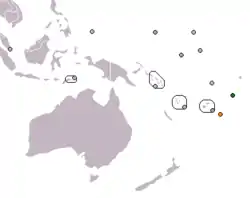
Samoa–Tonga relations are the bilateral relations between the Independent State of Samoa and the Kingdom of Tonga.[1] They also interact in multilateral relations, with both of them belonging to the United Nations, the Commonwealth of Nations, and the Pacific Islands Forum.[2]
 | |
 Samoa |
 Tonga |
|---|---|
History
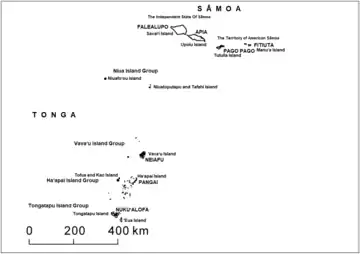
The Tongans in Samoa The Lapita people (Polynesians) settled both Samoa and Tonga from 3,500 years ago during the Austronesian expansion to the east. Developing similar cultural identities, the islands maintained strong relations with each other. The Tui Manuʻa Empire of Samoa, which originates from the Manuʻa Island Group of the Samoan Islands, ruled over all of Tonga during the eighth century when the empire's second king, Tui Manuʻa Tele (Fitiaumua), invaded and conquered Tonga and parts of Fiji by deploying 200 ʻalia (war canoes).
The Tui Manuʻa Empire was dominant over Tonga for 250 years until Tonga was able to free itself and the rise of the Tuʻi Tonga Empire of Tonga began.
The first king of the new empire was Tuʻi Tonga ʻAhoʻeitu, the son of Tagaloa Aitumatupua (known in Tonga as Tangaloa ‘Eitumatupuʻa), was a Samoan paramount chief from Samoa who married a Tongan noblewoman, ʻIlaheva Vaʻepopua.
In 1050, the second Samoan invasion of Tonga took place during a mass migration of Samoans to Tonga on Tongatapu at Lafonga during the rule of ʻAhoʻeitu (ʻAsoʻaitu in Samoan).
Samoa came into the sphere of influence of the Tuʻi Tonga Empire of Tonga in 950 as the Tui Manuʻa Empire of Samoa was declining. The Manuʻa Islands were excluded from the Tongan empire because they were considered sacred to the Tongan kings.
Many of the Tuʻi Tonga Kings married Samoan noblewomen.
In 1250, the Tuʻi Tonga Empire of Tonga began to decline during the reign of the 15th Tuʻi Tonga Talakaifaiki (known in Samoa as Tui Toga Talaʻaifeiʻi) who resided at Safotu on the Island of Savaiʻi in Samoa.
In ancient times the Samoans had a ruler over each District and although he was called a King, he was not in control of the whole of the Islands. It was during this time that the Tongans came to and gained the mastery of Samoa. Their leader was the King of Tonga who was named Tuʻi Tonga Talakaifaiki (Tui Toga Tala'aifei'i in Samoan). He came with a strong force and settled at Safotu in Savaiʻi. He sent instructions throughout Samoa that the Samoans must build him a stone road round a cape named Matauea on the eastern side of Safotu. The Samoans obeyed the instruction and during the making of the road the builders came across a huge boulder which hindered the work. Tui Toga Talaʻaifeiʻi had noted the energy of two brothers from Mulifanua, named Tuna and Fata and he conmanded them to remove the stone or forfeit their lives. They undertook to remove the stone although it seemed to be an impossible task. They first of all visited their family in Upolu and returned to Savaiʻi with a nephew named Ulumasui who would assist them in the task. Ulumasui lived in Falelatai and he landed at Matautu with his uncles when he accompanied them to Savaiʻi. From Matautu they walked to Safotu and on the way Ulumasui went to a swamp at the back of Manase and caught two eels which he placed with some mud under the stone blocking the road. He then went to the reef and caught an octopus and placed this also under the stone together with some salt water. The eels and the octopus burrowed under the stone and ultimately overturned it. Ulumasui and Fata and Tuna then rolled the stone out of the way to a spot indicated by the Tongan King. This stone may still be seen today.
The two brothers and Ulumasui now returned to their homes in Upolu. Shortly after this, Tui Toga Talaʻaifeiʻi paid a visit to Upolu with his followers. They landed at Sagafili, Aʻana District, and left their boat anchored. When Fata and Tuna noticed the anchored and empty boat they swam out and took away the pole by which it was anchored. This pole was made of the wood of the Toa tree and Fata and Tuna made two fighting clubs out of it when they returned to their homes at Falelatai. The place where the boys carved these clubs is still known as Asoto. When the clubs were finished the boys journed further along the coast testing the clubs. The spot where they tested them was and is still called Aso Alaala (testing day.) When the boys returned to their home and hung up their clubs the people crowded round to look at the weapons. Fata and Tuna told them to sit down if they desired to view the clubs and the place was from then known as Matanofo which means “to sit down and look at.”
The idea behind the actions of Tuna and Fata was the winning back for Samoa, the control of their own country. When they heard that the Tongan King was proceeding round Samoa towards the east, they followed and overtook him at Aleipata. When they arrived they buried their clubs on the Malae (open village space) and together with their nephew Ulumasui and another chief named Tapuloa they made arrangements for an attack on the Tongan King on the morrow. It was decided to give dances ostensibly as a welcome to the King and at a signal. During the dances, the Samoans were to fall on the Tongans and slaughter them. Tuna and Tapuloa were to fight along the north coast of Upolu, and Fata and Ulumasui along the south coast and they were to meet at Fatuosofia.
The following morning everything was done as arranged and during the dancing the dancers sang “Matamatame, Matamatame, lue le ulu, sae le vae, ia tele le ta ia Toga e (meaning nod the head, lift a leg, strike a heavy blow against the Tongans.) The Tongans were all watching them dancing when suddenly the Samoans recovered their clubs from the ground and fell on them. After furious fighting, the Tongans fled, some along the north coast and some around the south coast of Upolu. Tuna and Tapuloa who had been fighting along the north coast reached Fatuosofia first because Fata and Ulumasui were stopped by the ghost at Faleseela and could not cross the mountain while the sun was in the west. If they had attempted to do so they would have been unable to get past the ghost “Lema” who was pule of the mountains and was very merciless. Fata and Ulumasui slept the night at Saefu, Faleseela as they were warned to do by the ghost. They started out to cross the mountains in the morning and as the sun was behind them when they reached the mountain tops, their shadows were thrown before them. The ghost Lema mistook the shadows of Fata and Ulmaasui for the substance and aimed a tremendous blow at the shadows. The club falling on the ground split the mountains in two. Whilst this was happening Ulumasui slipped round to the back of the ghost and cut his head off. He threw the head over to a place in Falelatai and the proof of these happenings are still visible at the present time. When Fata and Ulumasui reached Fatuosofia, the Tongans were driven into the sea. Tui Toga Talaʻaifeiʻi stood on a rock opposite Fatuosofia and called out to the Samoans “Malie toa! Malie tau!” (well fought brave warriors.) He added that he would never again visit Samoa except as a visitor and this promise has been kept right down to the present day. The name of the rock on which the King of Tonga stood to give his parting message was named Tulatala and the words are still used by the Samoan orators. Shortly after this, the brothers Tuna and Fata quarreled as to who should be the holder of the title Malietoa, which had been adopted as the title of the leader in Samoa. The dispute developed into a fight with clubs and ultimately both men fell exhausted. A third brother Savea came forward and standing with a foot on each of the fallen brothers prayed for their restoration to consciousness. This came to pass hence the Samoan saying Talolua Tuna ma Fata (a prayer for Tuna and Fata) and also the saying Saveatuvaelua (Savea stands on both feet) Savea thus was appointed to be the first Malietoa and was known as Malietoa Savea.
In a civil war that erupted in Samoa on the island of Upolu, Ama Lele, a Samoan war chief from the village of Lotofaga who was leader of the Sa Ama clan, was defeated and left Samoa for Tonga with many of his warriors and followers.
Ama had a son named Peseta and a daughter named Tohuʻia Limapo, engaged to the 6th Tuʻi Haʻa Takalaua Moʻunga ʻo Tonga. Limapo traveled with a large wedding party, which consisted of the Ama family and warriors under the charge of Ama Lele. The king and Limapo had a son named Ngata (Gata in Samoan) whom the Samoans in Tonga, along with Tuʻi Haʻa Takalaua Moʻunga ʻo Tonga, installed as the king of Hihifo (Sisifo in Samoan) district on Tongatapu, on behalf of the Tuʻi Tonga. He was also installed as a sacred Samoan chief on Tongan soil - Tui Aʻano Upolu (Tu'i Kanokupolu - the flesh of Upolu, Samoa). His district became a separate kingdom in Tonga. The Samoans introduced and implemented their traditions into the Tongan culture such as the Samoan matai system (chief system)
The Tu'i Kanokupolu are the current rulers of the Kingdom of Tonga.
References
- Vai (October 26, 2010). "Tonga's Oral History ( Fiji / Samoa / Uvea / Futuna )". Matavuvale Network.
- "Pacific Islands Forum Secretariat Initiative". Asia Regional Integration Center.
| Americas |  | |
|---|---|---|
| Asia | ||
| Europe | ||
| Oceania | ||
| Americas |  | |
|---|---|---|
| Asia | ||
| Europe | ||
| Oceania | ||
| Former | ||
| Oceania | ||