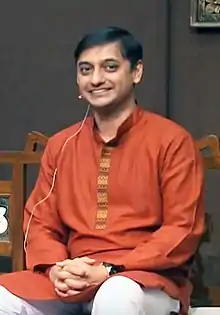
Sanjeev Sanyal
Sanjeev Sanyal is an Indian economist and popular historian.[1] Currently, he is the Principal Economic Adviser in the Ministry of Finance, Government of India.[2][3] A Rhodes Scholar and Eisenhower Fellow[4][3] He was Deutsche Bank's Global Strategist and a Managing Director till 2015.[4][5] He is the author of several books.
Sanjeev Sanyal | |
|---|---|
 | |
| Principal Economic Advisor, Department of Economic Affairs, Ministry of Finance | |
| Assumed office February 2017 | |
| Preceded by | Ila Patnaik |
| Personal details | |
| Born | 27 August 1970 Kolkata, West Bengal, India |
| Nationality | Indian |
| Alma mater | Shri Ram College of Commerce St John's College, Oxford |
| Occupation |
|
Early life
Sanjeev Sanyal was born in Kolkata to an aristocrat family, and studied at St. Xavier's School and St. James' School. Sanyal's great grandfather Nalinaksha Sanyal was the Chief Whip of the Congress Party in the provincial assembly of undivided Bengal. His granduncle Sachindra Nath Sanyal was one of the founders of Hindustan Socialist Republican Association. He went on to attend Shri Ram College of Commerce followed by St John's College (1992–1995), where he was a Rhodes Scholar.[6]
Career
Sanyal had worked in financial markets since the mid-nineties. He was the Managing Director and Global Strategist at Deutsche Bank till 2015.[7][4][3] In 2017, he was appointed Principal Economic Adviser to the Indian government in the Modi administration.[8] He also serves as the co-chair of the Framework Working Group of the G20.[9]
Views
Sanyal has been a vocal critic of Nehruvian socialism, which he deems to have stemmed from an "inward-looking cultural attitude".[1] Nehru and P. C. Mahalanobis are criticized for treating the economy as a "mechanical toy", leaving little scopes for the flourish of private enterprises, and ultimately throttling creativity.[1] Sanyal praises the 1991 liberalisation reforms as the harbinger of Indian Renaissance, and argues for the application of Complex Adaptive Systems framework to economic issues.[10]
Among his most-espoused views is that the historiography of India has been distorted with "Colonial, Nehruvian, and Marxist" biases — thus, requiring a rewriting of history by "revisiting" primary sources.[1]
In his book The Ocean of Churn, he accuses historians of "double standards" in their treatment of Ashoka and asks readers to "read local edicts": Sanyal claims that the primary sources used in painting a humane image of Ashoka can also be used to portray him as a genocidal tyrant.[1] According to Sanyal, Ashoka did not convert to Buddhism out of laments at the Kalinga War but due to political pressure exerted by the Jains.[11] A host of other sources are invoked to claim Ashoka as a "modern day fundamentalist", whose Dhaṃma Mahāmātās were "religious police"; the famed edicts about religious tolerance were all propaganda.[1][11]
He claims that it was the Nehruvian project which had established Ashoka as a "great king", a post-socialist reading of history is said to be the need of the hour.[1] In Sanyal's version of this reading, the central character is Chanakya, a "professor of Political Economy at Taxila university" who helped Chandragupta Maurya to establish a pan-Indian empire and went on to write Arthashastra about a centralised Mauryan economy.[1] Only when the Arthshastra is retrofitted to India's current political economy —by fixing the judicial system, investing in internal security, and simplifying taxation rules— among other things, we can return back to the "golden age" of India: a Hindu India, that had birthed “yoga, algebra, the concept of zero, chess, plastic surgery, metallurgy, Hinduism, [and] Buddhism.”[1]
Sanyal hypothesizes if the Rshis had "deliberately set up [...] Hinduism’s flexible, adaptive architecture."[1] He goes on to invoke Mahabharata and Puranic literature, to dismiss claims about Indian civilization being a modern construct.[1] Maha-bharata—translated to "Greater India"—allegedly sketched the worlds of Iron Age India; Sanyal wonders if "Sudas’ victory against the ten tribes [..] create[d] a dream of civilizational nationhood."[1] The nationhood which has now spent "twelve hundred years" in "servitude" to "outsiders" yet flows unabated since the Vedic era (dated to Bronze age).[1] The nationhood, which has been repeatedly bought with blood from Talikota to Saraighat.[1] He believes the Partition of India to have had happened due to a "fundamental divergence" in opinions about this nationhood.[1]
Reception
Meera Visvanathan, a historian of ancient India, mounts a sharp critique of Sanyal's works and notes him to be ignorant of methodologies in historical research.[1] Despite grand calls to rewrite history, his own citations seldom deal with primary sources and remain restricted to textbooks, popular histories, and newspaper articles by mainstream authors.[1] The success of his works primarily laid in his superior writing skills which presented a flamboyant history, before an audience that had hitherto considered the subject as one of rote learning, with a logical simplicity that was very appealing to majoritarian prejudices.[1] The usual disdain of academic historians in critiquing and contesting popular histories only added to Sanyal's fame.[1]
In deconstructing the narrative of Ashoka, Sanyal failed to apply source-criticism—subjecting contemporary edicts, Buddhist hagiographies, and Sri Lankan legends to the same treatment—and imposes a host of anachronistic categories.[1] When dealing with the Arthashastra, Sanyal remained oblivious of Trautmann's scholarship, which had conclusively proved the work to be drafted by multiple scholars, or that of Fussman/Sugandhi, who had emphasized the fuzziness of Mauryan economy.[1] He went on to misrecognize a shastra of political economy, as it developed in Early Historic India, as a manual of Mauryan statecraft.[1] Sanyal's analysis of Mahabharata was an exercise in speculation where he struck off whatever did not agree with his preconceived notions but without offering any reason; notwithstanding that Mahabharata translates to "Great War [of the Bharat clan]", he failed to understand the perils of treating Sanskrit itihasa as literal history.[1]
Manu Pillai, a popular historian, commends The Ocean of Churn for being a "delightful introduction to the world of the Indian Ocean" despite the possibility of professional scholars challenging his narrative and conclusions.[12] He welcomed Sanyal's command over a layered and complex past, his "accessible" yet "captivating narrative", and especially the reevaluation of Ashoka.[12] Shiv Visvanathan, a social anthropologist specializing in science and technology studies, praised the same work for being a feisty, combative, and comprehensive history of Indian Ocean aimed at a general audience but cautioned that "a professional historian might crib".[13] Like Pillai, he commends the "devastating" reconstruction of Ashoka and recovering figures from the margins of history.[13]
Honors
He has also been an Adjunct Fellow of the Institute of Policy Studies at the National University of Singapore, Fellow of and Senior Fellow of IDFC Institute (Mumbai).[14][9] In 2009, he joined the Board of Governors of AFPRO.[15] Till 2016, he was a member of the Future City Committee of the Singapore government that was tasked with creating a long-term vision for the city-state.[16]
Personal life
He is married to Smita Barooah and live in New Delhi.[17]
Works
Books
- The Indian Renaissance: India's Rise After A Thousand Years of Decline, World Scientific, 2008, 264 p.[18]
- Land of the Seven Rivers: A Brief History of India's Geography, Penguin, 2013, 192 p.[19]
- The Incredible History of India's Geography, Penguin, 2015, 264 p.[20]
- The Ocean of Churn: How the Indian Ocean Shaped Human History, Penguin, 2017, 324 p.[21]
- Life over Two Beers and Other Stories, Penguin, 2018, 232 p.[22]
- India in the Age of Ideas: Select Writings, 2006-2018, Westland, 2018, 318 p.[23]
Columns
Sanyal is an occasional columnist for the Hindustan Times,[24] Project Syndicate, The Times of India,[25] Live Mint,[26] Business Standard, and several other publications.[27][28]
References
- Visvanathan, Meera (1 October 2021). "Against History: Sanjeev Sanyal's attempts to rewrite India's past". The Caravan. Retrieved 3 October 2021.
- "Sanjeev Sanyal appointed principal economic adviser in Finance Ministry - Times of India".
- "How I made it: Sanjeev Sanyal". India Today.
- "Archived copy". Archived from the original on 2 April 2012. Retrieved 6 November 2011.CS1 maint: archived copy as title (link)
- "Sanjeev Sanyal - New Cities Summit 2016".
- "Archived copy". Archived from the original on 24 September 2016. Retrieved 11 September 2017.CS1 maint: archived copy as title (link)
- Chakraborty, Shrim (25 February 2015). "Modi's first full year Budget".
- https://dea.gov.in/whos-who?field_whos_who_category_tid=All&title=Sanjeev&field_email_feedback_email=
- http://icrier.org/G20/2018/assets/images/concept-note.pdf
- "A contrarian looks at world affairs". www.fortuneindia.com. Retrieved 4 October 2021.
- "At sea level". The Hindu. 20 August 2016. ISSN 0971-751X. Retrieved 9 October 2021.
- "Rim of Life". Open The Magazine. 17 August 2016. Retrieved 9 October 2021.
- "At sea level". The Hindu. 20 August 2016. ISSN 0971-751X. Retrieved 22 October 2021.
- Team, DNA Web (3 February 2017). "Sanjeev Sanyal appointed as Principal Economic Adviser: All you need to know about him". DNA India. Retrieved 30 March 2020.
- "Sanjeev Sanyal". IDFC Institute. Retrieved 30 March 2020.
- "Sanjeev Sanyal". 17 September 2013. Retrieved 29 July 2020.
- Sanyal, Sanjeev [@sanjeevsanyal] (11 August 2016). "@NilanjanS My wife :D" (Tweet). Retrieved 3 October 2021 – via Twitter.
- Sanjeev, Sanyal (18 August 2008). Indian Renaissance, The: India's Rise After A Thousand Years of Decline. World Scientific. ISBN 978-981-4470-76-6.
- Sanjeev, Sanyal (15 November 2012). Land of the Seven Rivers: A Brief History of India's Geography. Penguin Random House India Private Limited. ISBN 9788184756715.
- Sanyal, Sanjeev; Rajendran, Sowmya (28 November 2017). The Incredible History of India's Geography. Penguin UK. ISBN 978-93-5118-932-9.
- Sanyal, Sanjeev (10 August 2016). The Ocean of Churn: How the Indian Ocean Shaped Human History. Penguin UK. ISBN 978-93-86057-61-7.
- Sanyal, Sanjeev (15 May 2018). Life over Two Beers and other stories. Penguin Random House India Private Limited. ISBN 978-93-5305-024-5.
- Sanyal, Sanjeev (2018). India in the Age of Ideas: Select Writings, 2006-2018. Westland. ISBN 978-93-87894-57-0.
- "This excerpt from a book demolishes Ashoka's reputation as pacifist". 5 August 2016.
- "Why India needs to no longer be an Ashokan republic, but a Chanakyan one". 26 January 2016.
- Sanyal, Sanjeev (15 June 2015). "Our history books need rewriting".
- "Sanjeev Sanyal". Business Standard India – via Business Standard.
- "Archived copy". Archived from the original on 2 November 2011. Retrieved 6 November 2011.CS1 maint: archived copy as title (link)
External links
Authority control  | |
|---|---|
| General | |
| National libraries | |
| Scientific databases | |
| Other | |