Sartono
Sartono (5 August 1900 – 15 October 1968), was an Indonesian politician and lawyer from the province of Central Java, who served as the first Speaker of the People's Representative Council. A member of the Indonesian National Party (PNI), he served as a minister in the first Indonesian cabinet, and was a participant in the struggle for Indonesia's independence.
Sartono | |
|---|---|
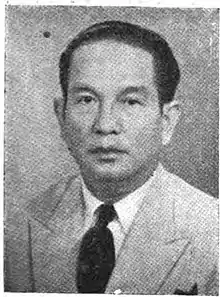 Official portrait, c. 1958 | |
| 1st Speaker of the People's Representative Council | |
| In office 22 February 1950 – 24 June 1960 | |
| President | Sukarno |
| Preceded by | Office established |
| Succeeded by | Zainul Arifin |
| Member of the People's Representative Council | |
| In office 22 February 1950 – 24 June 1960 | |
| Constituency | Central Java |
| Minister of State | |
| In office 19 August 1945 – 14 November 1945 | |
| Preceded by | Office established |
| Succeeded by | Rasjidi |
| Personal details | |
| Born | Sartono 5 August 1900 Wonogiri, Surakarta, Surakarta Sunanate, Dutch East Indies |
| Died | 15 October 1968 (aged 68) Jakarta, Indonesia |
| Nationality | Indonesian |
| Political party | Indonesian National Party (PNI) |
| Spouse(s) | Siti Zaenab |
| Children | 3 |
| Alma mater | Leiden University |
| Occupation | |
| Signature |  |
Originating from a noble ethnic-Javanese family, Sartono studied law at Leiden University. He opened a law firm in 1925, and was involved in the early struggle for independence. In 1927, he became a founding member of the Indonesian National Party (PNI). After the banning of the PNI by Dutch authorities, he founded the Partindo and Gerindo political parties. During the Japanese occupation, he became a member of the Investigating Committee for Preparatory Work for Independence (BPUPK). Following the proclamation of independence, he was appointed a state minister, and joined the Central Indonesian National Committee (KNIP).
After the establishment of the United States of Indonesia in 1949, Sartono became speaker of the People's Representative Council throughout three different iterations of the body – the People's Representative Council of the United States of Indonesia, the Provisional People's Representative Council, and the present People's Representative Council (DPR). He would remain as speaker until the body was dissolved by President Sukarno in 1960. As speaker, he served in multiple occasions as acting president. After a five-year stint in the supreme advisory body, he left politics in 1967, and died the following year.
Early life
Youth and family
Raden Mas Sartono was born in Wonogiri, near what is today Surakarta, on 5 August 1900.[1] Born to a noble ethnic-Javanese family, he was the second oldest of seven children. His father, Raden Mas Martodikarjo, was a civil servant who was a descendant of Prince Mangkunegara II. While his mother, was a noblewomen, who was also a descendant of Prince Mangkunegara III.[2] In 1906, he left Wonogiri and began his education at the Europeesche Lagere School (ELS) in Surakarta, a school only for children of noble descent. There, he graduated in 1913, with the highest grade. After graduating, he was easily accepted to the Meer Uitgebreid Lager Onderwijs (MULO) school also in Surakarta.[3]
He spent three years in MULO, from 1913 until 1916, and after graduating, he left for Batavia.[4] Sartono went to Batavia by train, and was accompanied by his father. He arrived in Batavia at Kemayoran Station.[5] In Batavia, he entered the School tot Opleiding voor Inlandsche Rechtskundigen, later known as the Rechts School, a law institute for the native Indonesian nobility.[6][7] At Rechts School, Sartono joined the Tri Koro Dharmo organization, a youth organization of Budi Utomo, which later evolved into Jong Java.[8] In 1921, Sartono passed in his law examination, and received the title of "rechtskundige" (jurist). After graduating, he became a civil servant at the District Court in Surakarta for around six months.[9]
In September 1922, Sartono left his job as a civil servant, and departed to the Netherlands, to study for a doctorate in law at Leiden University, along with his former classmate Iwa Koesoemasoemantri. He received the blessings of his parents, and departed from Surakarta to the port of Tanjung Priok, the main hub for transportation from the colony to Europe.[10] They arrived in Genoa, Italy, before taking the train to the Netherlands.[11] During his studies in Leiden, he joined the Perhimpoenan Indonesia association, and became the associations secretary from 1922 until 1925.[12][13]
Early career
.jpg.webp)
After completing his studies, Sartono returned to the Indies in 1925, and opened a law practice in the city of Bandung.[1] Together with his friends from Leiden, Iskaq Tjokrohadisurjo, Budiarto Martoatmodjo, and Soenario. The young advocates were quite successful in handling the legal actions of Dutch authorities.[14] One notable case they handled was the trial of a man named Jasin. Jasin was a train conductor from Tasikmalaya, who was accused of being part of the failed 1926 communist revolt. Jasin's punishment was lightened as a result of Sartono, but Jasin was still found guilty, and eventually exiled to the Boven Digoel, in West New Guinea.[15]
Sartono later participated in the founding of the Indonesian National Party (PNI) at Bandung on 4 July 1927.[16] A year later, in the first PNI congress in Surabaya, Sartono gave a speech on the freedom of association and press.[17] Following the 1929 PNI congress in Yogyakarta, Sartono was appointed as treasurer of the party.[18] Sartono also became the legal adviser during the second Indonesian youth congress in 1928 – which resulted in the Youth Pledge.[19] In 1930, the Dutch colonial government arrested four of PNI's leaders – who were sentenced to prison time.[20] Sartono himself was not arrested, and instead he became one of Sukarno's defense lawyers during Sukarno's trials in Bandung.[21]
In 1931, he founded the Partindo party, after the disbanding of the PNI. During his leadership of Partindo, he created a department for labor unions, which Sartono directly managed. Despite this, Sartono argued that labor unions should not engage in politics.[22] Sartono led Partindo until 1933, when the released Sukarno was elected the party chief and Sartono became his deputy.[23][20] During this period, he became an advocate for the Swadeshi movement, and also chaired a commission on the movement within Partindo.[24]
After Sukarno's election as leader, however, Sukarno's view that labor unions should be associated with political parties became dominant – and in 1933 the party's official position became that labor unions must be based on political parties.[25] Partindo was again disbanded in 1937, and Sartono further took part in the founding of another party, Gerindo, where he was deputy chief under Amir Syarifuddin.[12][26] Following the successful Japanese invasion of Indonesia, Sartono briefly left politics and handled rubber plantations in the Bogor region.[27] He was also head of the organizational section of the Japan-founded labor organization PUTERA.[12] In 1945, he was appointed as a member of the Investigating Committee for Preparatory Work for Independence (BPUPK).[27] For some time, he was also the adviser to the Japanese Department of Internal Affairs between December 1944 until June 1945.[12]
Political career
National revolution

Shortly after the proclamation of Indonesian independence, Sartono was appointed as one of five ministers of state (alongside Oto Iskandar di Nata, Mohammad Amir, Wahid Hasyim, and A.A. Maramis).[28] Sartono and Maramis were dispatched to Central Java's traditional monarchies (the Surakarta Sunanate and Yogyakarta Sultanate) to give assurances that the monarchies would remain in exchange for support of the new nationalist government.[29] On 19 August 1945, he took part in a meeting which resulted in the agreement to form the Central Indonesian National Committee (KNIP).[30] Sartono also rejoined the reformed Sukarno-led PNI.[31]
The party had significant internal issues due to personal and ideological differences of its members, with Mohammad Hatta remarking in an interview with Irish historian Benedict Anderson that Sartono and Abikusno Tjokrosujoso had internal conflicts "almost immediately".[32] In December 1945, he became chief of the political department of a further restructured PNI.[33] Sartono was a member of the KNIP and was part of its leadership until October 1945, when the leadership was replaced by a new group of younger members.[34] Later, he would return to the leadership positions, becoming deputy chair of the body's Working Committee (which ran day-to-day affairs) by January 1947.[35]
He was not elected for the position in April 1947, but was voted back in in July 1949.[36] He left the body in 1949, as he joined the People's Representative Council of the United States of Indonesia (DPR-RIS).[37] He had been appointed as the head of a good offices mission to the State of East Indonesia in December 1948, but the mission was cancelled.[1] During the Dutch–Indonesian Round Table Conference, Sartono was a general adviser.[38]
Post-independence
_di_Republik_Indonesia%252C_p6.jpg.webp)
Following the Dutch recognition of Indonesian sovereignty, Sartono joined People's Representative Council of the United States of Indonesia, and was elected as its speaker on 21 February 1950 after defeating Mohammad Yamin and Albert Mangaratua Tambunan in the leadership vote, taking office the following day.[39] Six months later, on 16 August, the body was dissolved as the United States of Indonesia was transformed into a unitary state, and all its members became members of the newly formed Provisional People's Representative Council (DPRS).[40]
Sartono was again elected speaker of the body on its 19 August leadership vote.[41] Sartono was appointed as formateur for the government cabinet on 28 March 1951, and he attempted to form a coalition government between the PNI and the Masyumi without success. His failure led to him returning his mandate after just 23 days on 18 April. The task was then assigned to Soekiman Wirjosandjojo and Sidik Djojosukarto – who managed to form the Sukiman Cabinet.[42][43] In 1956, there were proposals in the parliament to dissolve the Netherlands-Indonesian Union. A draft law was brought up during a 28 February 1956 meeting of the body, and following a vote it was accepted as agenda in the day's meeting.[44]
_di_Republik_Indonesia%252C_p83.jpg.webp)
Sartono, who disagreed with the draft's inclusion, declared his resignation from speakership and walked out of the building, followed by his deputy Arudji Kartawinata and the PNI faction. On 1 March, members of PNI, the Indonesian Islamic Union Party and the Indonesian Communist Party in addition to some members of the Nahdlatul Ulama submitted their resignations as members of the parliament.[44] Still in March, Sartono secured a seat representing Central Java in the new People's Representative Council (DPR) following the 1955 legsilative election.[1] Members of the body were sworn in on 20 March 1956, with the DPRS being dissolved, and Sartono again elected as speaker.[45]
Following the resignation of Mohammad Hatta from his post as vice president (leaving it vacant until 1973),[46] Sartono was legally second in the presidential line of succession, and he conducted presidential duties for three brief periods during his tenure - in December 1957, between 6 January and 21 February 1959, and between 21 April and 2 July 1959.[47]
On 23 July 1959, following President Sukarno's 1959 Decree, and the return to the 1945 Constitution, Sartono was sworn again as the speaker of the further renewed DPR.[48] The DPR was eventually suspended by Sukarno on 24 June 1960 (though it met last on 5 March), ending Sartono's tenure as speaker.[49] After the DPR was suspended, Sartono did not take public office for several years. Allegedly, he refused all positions offered to him, though in one occasion he implied to Foreign Minister Subandrio that he would accept an ambassadorship for an African country – with the condition that Subandrio himself and Mohammad Yamin were both also assigned to similar positions.[50]
Death and legacy

After several years of unemployment, he accepted an offer by Sukarno to serve in the Supreme Advisory Council (DPA), as the body's vice speaker in 1962.[51] Throughout his time in the parliament – and during his time at DPA – Sartono pushed with little success laws meant to strengthen the government's financial accountability. American scholar Daniel Lev wrote that Sartono's experience in the body "was a great disappointment to him".[50]
Sartono eventually resigned from the body and left politics entirely in 1967. He died in Jakarta on 15 October 1968, and was buried in Surakarta.[39] According to author and historian, Nyak Wali Alfa Tirta, Sartono was described as a quiet, but well liked person, by both his opponents and friends.[52] The city government of Surakarta, alongside with the Mangkunegaran family foundation, have campaigned to make Sartono a National Hero of Indonesia.[53] A street in the city of Malang is named after him.[54]
References
Citations
- People's Representative Council 1956, p. 83.
- Alfa Tirta 1985, p. 4.
- Alfa Tirta 1985, pp. 5–7.
- Alfa Tirta 1985, p. 10.
- Alfa Tirta 1985, p. 17.
- Alfa Tirta 1985, p. 11.
- Alfa Tirta 1985, pp. 15–16.
- Alfa Tirta 1985, p. 19.
- Alfa Tirta 1985, p. 20.
- Alfa Tirta 1985, p. 23.
- Alfa Tirta 1985, p. 24.
- Anderson 1972, p. 438.
- People's Representative Council 1999, pp. 33–35.
- Alfa Tirta 1985, p. 38.
- Alfa Tirta 1985, p. 39.
- Ingleson 2014, p. 122.
- Alfa Tirta 1985, p. 44.
- Alfa Tirta 1985, p. 55.
- Alfa Tirta 1985, p. 59.
- Alfa Tirta 1985, pp. 68–73.
- Djemat, Humphrey (27 August 2013). "The 'Officium nobile' of legal aid". The Jakarta Post. Archived from the original on 4 August 2019. Retrieved 4 August 2019.
- Ingleson 2014, p. 179.
- People's Representative Council 1956, p. 84.
- Ingleson 2014, p. 187.
- Ingleson 2014, pp. 223–224.
- Alfa Tirta 1985, p. 101.
- Alfa Tirta 1985, p. 102.
- Alfa Tirta 1985, p. 107.
- Anderson 1972, p. 115.
- People's Representative Council 1983, p. 6.
- Anderson 1972, p. 93.
- Anderson 1972, p. 98.
- Anderson 1972, pp. 227–228.
- Anderson 1972, pp. 174–175.
- People's Representative Council 1983, pp. 20–22.
- People's Representative Council 1983, p. 25.
- People's Representative Council 1983, p. 24.
- Alfa Tirta 1985, p. 108.
- Pringgodigdo, Abdoel Gaffar (1991). Ensiklopedi Umum (in Indonesian). Kanisius. pp. 981–982. ISBN 9789794135228.
- People's Representative Council 1983, pp. 117–118.
- People's Representative Council 1983, p. 140.
- People's Representative Council 1983, p. 148.
- Muttaqin, Fajriudin (2015). Sejarah Pergerakan Nasional (in Indonesian). Humaniora. p. 157. ISBN 9789797782696.
- People's Representative Council 1983, pp. 177–179.
- People's Representative Council 1983, pp. 189–192.
- Younce, William C. (2001). Indonesia: Issues, Historical Background and Bibliography. Nova Publishers. p. 65. ISBN 9781590332498.
- People's Representative Council 1983, p. 209.
- People's Representative Council 1983, p. 222.
- People's Representative Council 1983, p. 239.
- Lev, Daniel S. (1969). "In Memoriam: R. M. Sartono". Indonesia (7): 191–193. ISSN 0019-7289. JSTOR 3350809.
- "Keputusan Presiden Republik Indonesia No. 126 Tahun 1962" (in Indonesian). Cabinet Secretariat of Indonesia. Retrieved 4 August 2019.
- Alfa Tirta 1985, p. 112.
- "Mr. Sartono Layak Menjadi Pahlawan Nasional". jatengprov.go.id (in Indonesian). Central Java Provincial Government. 3 August 2018. Archived from the original on 5 August 2019. Retrieved 5 August 2019.
- "Jalan Sartono SH, Gerbang Masuk Pasar Comboran Malang". ngalam.co (in Indonesian). 27 October 2019. Retrieved 9 February 2020.
Sources
- People's Representative Council (1956). Hasil Rakjat Memilih Tokoh-tokoh Parlemen (Hasil Pemilihan Umum Pertama – 1955) di Republik Indonesia [Result of People Electing Parliamentary Members (Result of the First General Election – 1955) in the Republic of Indonesia] (PDF) (in Indonesian). Jakarta: Secretariat General of the People's Representative Council. pp. 83–84. Retrieved 7 December 2021.CS1 maint: date and year (link)
- Alfa Tirta, Nyak Wali (1985). Surjomihardjo, Abdurachman; Leirissa, R. Z.; Kartadarmadja, M. Soenjata (eds.). Mr. Sartono: Karya dan Pengabdiannya [Mr. Sartono: His work and dedication] (PDF) (in Indonesian). Jakarta: Ministry of Education and Culture. Retrieved 7 December 2021.CS1 maint: date and year (link)
- Ingleson, John (2014). Workers, Unions and Politics: Indonesia in the 1920s and 1930s. Brill. ISBN 9789004264762. Retrieved 8 December 2021.
- People's Representative Council (3 December 1983). Seperempat Abad Dewan Perwakilan Rakyat Republik Indonesia [A Quarter Century of the People's Representative Council of the Republic of Indonesia] (PDF) (in Indonesian). Jakarta: Secretariat General of the People's Representative Council. Retrieved 7 December 2021.CS1 maint: date and year (link)
- People's Representative Council (August 1999). Profil Ketua-Ketua DPR RI sejak tahun 1945 s/d Agustus 1999 [Profiles of the Chairmen of the Indonesian People's Representative Council from 1945 to August 1999] (PDF) (in Indonesian). Jakarta: Secretariat General of the People's Representative Council. pp. 33–39. Retrieved 7 December 2021.CS1 maint: date and year (link)
- Anderson, Benedict Richard O'Gorman (1972). Java in a Time of Revolution: Occupation and Resistance, 1944 – 1946. Cornell University Press. ISBN 9780801406874. Retrieved 8 December 2021.
Authority control  | |
|---|---|
| General | |
| National libraries | |
| Other | |