Satya Narayan (Hindu deity)
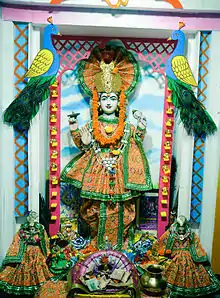
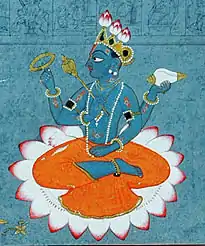
Satya Narayan is another name of Vishnu or Narayana, who is worshipped by Hindus, mainly in the Indian states of Andhra Pradesh, Gujarat, Madhya Pradesh, Maharashtra, Punjab, Haryana, Chandigarh, Uttar Pradesh, Chhattisgarh, West Bengal, Jharkhand, Bihar, Assam, Manipur and Tripura. His avatar is Krishna. Satya Narayan is part of a triad on the ratnavedi (jewelled platform).
| Satya Narayan | |
|---|---|
 | |
| Devanagari | सत्यनारायण |
| Affiliation | Deva, aspect of Vishnu |
| Mantra | Om Namo Bhagavate Vasudevaya (ॐनमोभगवतेवासुदेवाय) |
| Weapon | Sudarshana Chakra |
| Symbol | Banana tree |
| Mount | Garuda |
| Consort | Lakshmi |
| Part of a series on |
| Hinduism |
|---|
 |
|

Festivals
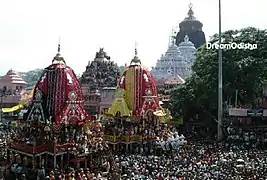
Satya Narayan is honoured at the Saty Narayan Ji Temple (mandir) in Nabha, at the Rath Yatra Nabha, and as part of the Holi festival. The large chariots of Jagannath (another aspect of Vishnu) which are pulled during a Ratha-Yatra form the etymological origin of the English word juggernaut.[1]
Puja
The puja is described in the Skanda Purana, a medieval era Sanskrit text. According to Madhuri Yadlapati, the Satyanarayana Puja is an archetypal example of how "the Hindu puja facilitates the intimacy of devotional worship while enabling a humble sense of participating gratefully in a larger sacred world".
The puja narrates the Satyanarayana Katha, which dictates the various worldly and spiritual benefits the puja brings to performers. The Katha states how the deity Narayana vows to aid his devotees during Kali Yuga, the last of the four ages in Hindu cosmology, in particular the performers and attendees of the Satyanarayana Puja. The Katha narrates that the performance of the puja is in itself a promise to God, and recounts the plights of characters who either fail to complete the puja or forget their promises.
The present puja to the deva originated in the syncretism of Hindu and Sufi traditions in Bengal during the Middle Ages, when the Hindu Satya Narayan became the Muslim Satya Pir.[2] The puja is also performed by some Buddhists in Bangladesh.[3]
Gallery


References
 |
Wikimedia Commons has media related to Thakur Shri Saty Narayan Ji. |
- "Juggernaut-Definition and Meaning". Merriam Webster Dictionary. Retrieved 28 November 2012.
- Yamin, Mohammed (2009). Impact of Islam on Orissan Culture. New Delhi: Readywirthy Publications. p. 59. ISBN 978-81-89973-96-4.
- Barua, Dilip Kumar. "A case study in the popular Buddhist belief in Bangladesh" (PDF). Society for the Study of Pali and Buddhist Culture: 96.
Hindu deities and texts | ||
|---|---|---|
| Gods |  | |
| Goddesses | ||
| Other deities | ||
| Texts | ||
| Forms | 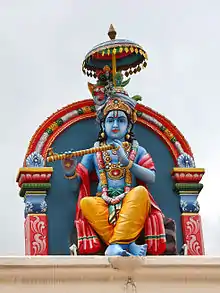 | |
|---|---|---|
| Consorts | ||
| Other relatives | ||
| Worship | ||
| Holy sites |
| |
| Epigraphy | ||
| Texts |
| |
| See also | ||