Second American Civil War
The "Second American Civil War" is an umbrella term used by some academics to reclassify historical eras of heightened political violence in United States, or more commonly to discuss the potential for a future second civil war in the U.S.
The phrase "second civil war" has also been used hyperbolically in political discourse, usually as a threat if certain actions are taken by the opposing political party (e.g. the removal of a sitting president; massive changes in federal laws perceived as unconstitutional). Occasionally, references to a second civil war by political leaders and commentators are intended to be more serious in nature. Discussion of a second civil war has occurred with varying degrees of frequency and sincerity since the first civil war ended in 1865.
In 2016, discussion of a possible second civil war entered the mainstream in earnest as a result of the polarizing effect of the election of Donald Trump. Concern increased dramatically after the first impeachment trial of Donald Trump, the economic and political fallout of the ongoing COVID-19 pandemic, social unrest sparked by the George Floyd protests, and the fallout of the highly contentious 2020 United States presidential election (which resulted in the 2021 United States Capitol Attack and the second impeachment trial of Donald Trump).
Following the capitol attack in 2021, an increasing number of pundits, political scientists, journalists, historians, government officials, intelligence officials, investors and politicians on both sides of the political divide have asserted that the United States is currently locked in a cold civil war between the political left and the political right. Those who foresee a civil war in the future cite a highly polarized citizenry, irreconcilable beliefs about critical issues, and a spike in civil violence as preludes to a possible civil war, with some claiming such conflict would look very different from historical civil wars.[1][2][3][4][5][6] Detractors claim talk of a civil war is alarmist and that the current political climate is a form of mostly nonviolent "culture war," which does not represent a risk to the integrity of the country. They assert that a second civil war is almost impossible due to certain modern conditions, citing a lack of two standing armies, a lack of homogenous geographical and cultural sides, a vastly nonviolent majority on both sides of the political divide, and significant disincentives to war (e.g. deeply shared economies across state lines).[7][8][9][10][11][12]
Some polling has found that a majority of Americans on both sides of the political divide believe the U.S. is in a cold civil war.[13][14] Other research indicates that between a third and a half of the country is anticipating a civil war in the coming years, particularly among young, rural Americans who identify as Republican or conservative.[15][16][17]
Reinterpretations of Past Events
Division among colonists during the Revolutionary War
Some historians name the 1861–1865 war the "Second American Civil War", because in their view, the American Revolutionary War can also be considered a civil war (since the term can be used in reference to any war in which one political body separates itself from another political body). They then refer to the Independence War, which resulted in the separation of the Thirteen Colonies from the British Empire, as the "First American Civil War".[18][19] A significant number of American colonists stayed loyal to the British Crown and as Loyalists fought on the British side while opposite were a significant amount of colonists called Patriots who fought on the American side. In some localities, there was fierce fighting between Americans including gruesome instances of hanging, drawing, and quartering on both sides.[20][21][22][23] As Canadian historian William Stewart Wallace noted:
It must be admitted that the Loyalists were guilty of some unpleasant atrocities during the war. But so were some of the Revolutionists. No one can take pride in tracing descent to the worst of the Green Mountain Boys, any more than to Bloody Bill Cunningham and his gang or to the raiders of Cherry Valley. And it is fair to remember that the Loyalists had been driven from their homes, that their property had been confiscated, and that they and their families had been subjected to persecution. They would have been hardly human had they not waged a mimic warfare. At the same time, it is no more surprising that after the war the victorious Revolutionists treated the Loyalists with scant generosity. They too would have been hardly human had they done otherwise.[24]"
As early as 1789, David Ramsay, an American patriot historian, wrote in his History of the American Revolution that "Many circumstances concurred to make the American war particularly calamitous. It was originally a civil war in the estimation of both parties."[25] Framing the American Revolutionary War as a civil war is gaining increasing examination.[26][27][28]
"War of Terror" during the Reconstruction Era
After the American Civil War effectively ended with the Ceasefire Agreement of the Confederacy, the federal government began a process called Reconstruction leading to the Reconstruction Era (1865–1877). The United States aimed to restore Southern states to the Union and update the federal and state governance in accordance with the Thirteenth, Fourteenth and Fifteenth Amendments to the United States Constitution. The post-war volatility created endemic violence in Southern states, including armed conflict. Due to the violence and severity of the social, political and constitutional challenges during the Reconstruction Era, this period in history is sometimes called the "Second Civil War".[29][30] Referring to Reconstruction as a "Second American Civil War" was established by the American Experience episode "Reconstruction: The Second Civil War"[31] and made its way to the school curriculum.[32]
White supremacy terrorist groups emerged in the South to oppose Reconstruction, including the foundation of the Ku Klux Klan, the White League, and the Knights of the White Camelia, which consisted primarily of Confederate veterans. These organizations attempted to oppose the United States government through assassinations, intimidation of black and white Republican officials, voter intimidation, and, at times, attempted coups and insurrections such as The Battle of Liberty Place in Louisiana in 1874. Historian Clarence Walker described this period as "a war of terror" aimed at black voters and politicians, as well as whites considered "race traitors."[33]
The Coal Wars
Some historians have interpreted the Coal Wars as constituting some form of a Second American Civil War and they also consider it to be the largest national revolt since the first Civil War ended.[34] Starting in 1890, the informal armed rebellion began when coal workers revolted against their employers due to poor working conditions. Attempts to unionize were met with police crackdowns, resulting in several revolts and even armed battles throughout the United States. Although they occurred mainly in the East, particularly in Appalachia, there was a significant amount of violence in Colorado after the turn of the century.
The largest conflict which occurred during the revolt was the Battle of Blair Mountain in 1921. That battle was the largest labor uprising in United States history and it was also the largest armed uprising since the American Civil War. Some 10,000 armed coal miners confronted 3,000 lawmen and strikebreakers (called the Logan Defenders) when tensions rose between workers and mine management. The battle ended after approximately one million rounds were fired and the United States Army, represented by the West Virginia Army National Guard led by McDowell County native William Eubanks, intervened by presidential order. Up to 100 people were killed, and many more arrested.
Discussion of a possible Second Civil War (2008–present)
Election of Barack Obama (2008)
There was no overt discussion of a Second American Civil War in response to the election of Barack Obama in 2008. However, former Texas Governor Rick Perry discussed secession at a 2009 rally while the crowd chanted "secede," but he later claimed that his remarks were rhetorical.[35]
Election of Donald Trump (2016)
The election of Donald Trump had a polarizing effect on American politics and speculation about a potential civil war entered the mainstream as a result. A number of political commentators from both the political left and right have asserted that the rise of Trumpism in America triggered an ongoing "culture war" between conservatives and liberals over conflicting cultural, moral and religious values (ranging from race relations and gun rights, to abortion and religious liberty, and more). Some commentators assert that this culture war constitutes either a form of nonviolent "Second Civil War," or a possible prelude to an actual civil war.[36][37] Trump's actions and rhetoric with regards to race, in particular, have been criticized for their capacity to spark a civil war.[38][39]
Early in Trump's presidency, fringe movements in California pushed unsuccessfully for secession from the rest of the country.[40] Though never legitimized in the mainstream, historian Richard Striner called the talk of secession and the aftermath of Trump's election "unprecedented" in American politics. Stringer asserted that the political climate after the 2016 election was similar to the climate preceding the first American Civil War, stating: "When Lincoln was elected in 1860, the defenders of slavery concluded that their time had run out. In the 1980s, Ronald Reagan and his supporters exulted in their vision of “morning in America.” In 2017, we might very well be moving toward the stroke of midnight."[41]
The COVID-19 pandemic, George Floyd protests, and the 2020 presidential election (2020 - )
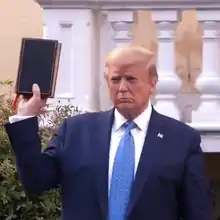
In 2020, the United States faced considerable social, economic and political challenges that exacerbated pre-existing divisions. These conflicts were driven primarily by the COVID-19 pandemic and the subsequent social and economic fallout, the contentious 2020 United States presidential election, and civil unrest related to the George Floyd protests. Several political analysts have suggested that the fallout from 2020 may trigger further social unrest and lead to a civil war in the future, and that the United States strongly resembles countries that experienced civil wars in the past.[42][43][44]
COVID-19 Pandemic and response to health mandates
In the early months of the COVID-19 pandemic, government-imposed lockdowns intended to stop the spread of the virus were met with protests from mostly right-leaning groups, including armed militias, that perceived the lockdowns as government overreach. The nationwide protests resulted in some state capitals being stormed, including in multiple times in Michigan[45][46] and once in Oregon.[47] Journalist John T. Bennett from The Independent said anti-lockdown violence constituted a form of "Second Civil War" that would escalate division between rural and urban areas in the United States.[42]
After the inauguration of Joe Biden, and later in opposition to Biden's COVID-19 vaccination mandates, some Trump supporters began flying solid black flags and black stylized American flags. These flags were historically used as a symbol of "no quarter," where a winning side of a battle refused to spare the life of a vanquished opponent (the opposite of the white flag of surrender). These flags were primarily flown by pirates in the 1800s and irregularly by Confederate troops during the American Civil War. Many commentators have interpreted these flags as an explicit threat of political violence and civil war.[48][49][50][51][52]
George Floyd protests and race relations in Trump's America
Nationwide protests and civil unrest erupted in America after the murder of George Floyd by a Minneapolis police officer, in which protestors called for police reform. Though the protests were widely nonviolent, several riots took place in major U.S. cities in the weeks after a video of Floyd's murder circulated via the social media and news outlets. Trump immediately characterize the movement as violent anarchism[53] and domestic terrorism,[54][55][56] pushing for a "crackdown" to restore "law and order."[57][58][59] According to administration officials, Trump was privately advocating for the military to attack protestors, including shooting them.[60][61] A draft proclamation invoking the Insurrection Act was drafted for Trump to deploy troops against protesters across the country, but was never used.[62] Trump later denied any intention of invoking the act.[63] Some former CIA analysts expressed fear that Trump's use of the military against peaceful protesters would trigger a violent national collapse.[43]
On June 1, 2020, Trump ordered the use tear gas against nonviolent protesters in Lafayette Square for a photo op at St. John's Episcopal Church. Many commentators saw this action as a strong indicator that the country was teetering towards a spike in civil violence. King University professor Gail Helt wrote, "I've seen this kind of violence.... This is what autocrats do. This is what happens in countries before a collapse. It really does unnerve me." Counterterrorism expert Marc Polymeropoulos compared Trump's response to protectors to the action of autocrats like Bashar al-Assad, Saddam Hussein, and Muammar Gaddafi.[43] Other analysts criticized the Trump administration for describing American urban centers as foreign war zones, as well as Trump's intent to declare the antifa movement a terrorist organization as a pretext for a crackdown.[43][64][65]
The demand for police reform created tension between protestors and several police departments throughout the country. In June 2020, a viral audio tape leaked wherein three police officers from Wilmington, North Carolina, were heard using derogatory remarks to describe black Americans, saying that they should be slaughtered and that "there should be another civil war to wipe them off the fucking map." The three officers involved were fired after an investigation. On his first day on the job, Wilmington Police Chief Donny Williams condemned the incident and advocated for police reform. It was later revealed that two of the officers had prior disciplinary issues, including some which occurred in the 1990s.[66][67][68][69]
Trump's refusal to concede the 2020 election
On numerous occasions throughout the 2020 presidential election, then-President Trump refused to commit to a peaceful transfer of power if he wasn't re-elected. Throughout the year, Trump began to cast doubt on the legitimacy of the election by claiming widespread voter fraud by Democrats would lead to an illegitimate Biden win.[70] Several commentators connected Trump's undermining of the election with increases in political violence by right-wing groups, commenting that the 2020 election could be a "fire-starter" for a politically destabilizing event such as a coup or civil war. Some commentators compared it to the election of 1860, which triggered the American Civil War.[71] Historian Richard Striner asserted that Trump's attempt to delegitimize the election was akin to a "fascist revolution" that could trigger a "chaotic civil war."[72]
Some American citizens began to purchase tactical gear, such as body armor, in preparation for the election and several suppliers of tactical gear saw a significant increase in sales.[73] The day prior to the election, Sky News reported a "run on guns" driven by many Americans from both sides of the political spectrum in preparation for civil unrest or a possible civil war.[74]
the 2021 U.S. Capitol attack and calls for civil war
_(retouched).jpg.webp)
After candidate Joe Biden was announced as the winner of the election, Trump refused to concede and attempted several times to overturn the election results in his favor, including reports of allegedly discussing martial law.[75] When Trump's legal efforts to overturn the election results failed, he held a "Save America" rally in Washington, D.C., which brought thousands of his supporters to The Ellipse park on January 6, 2021, during the time the election results were being certified by Congress. Trump repeated unproven claims of election fraud and said, "If you don't fight like hell, you're not going to have a country any more." The rally which resulted in an attack on the United States Capitol.
Discussion of civil war began to circulate on social media in the days leading up to the attack, including on right-leaning platform Parler.[76] According to trend analysis, the online conversation of civil war intensified during Trump's speech on January 6, moments before the Capitol attack.[77] Some participates in the attack wore shirts and carried signs that read "MAGA Civil War, January, 6, 2021."[78] These shirts were also sold online after the attack.[79] Calls for civil war also made their way into court filings for some of the capital rioters.[80]
Many observers viewed the attack on the Capitol as a watershed moment putting the country on track for further political violence, and a possible civil war.[2][3] Others, however, viewed the upholding of the election by federal institutions as evidence that any potential civil war was alarmist and the potential for armed conflict had "fizzled out."[7]
Attempts to spark a Civil War
Actual efforts to spark a civil war have been minimal, but not non-existent; for instance, in late 2020, 14 members of a group which called itself the Wolverine Watchmen were arrested for plotting to kidnap the Governor of Michigan in an effort to start a second civil war that would "lead to societal collapse".[81]
Limited digital efforts to spark or show support for a civil war have also occurred; the hashtags #CivilWar2 and #CivilWarSignup, for instance, trended on Twitter in support of comments which were made by United States President Donald Trump following his impeachment by the House of Representatives in December 2019.[82] "Civil War" trended again on Twitter in 2021 after a video of a Trump supporter predicting civil war at an Iowa rally went viral.[83][84] MSNBC reporter Gary Grumbach added that the supporter's call for civil war was echoed at several Trump rallies as a general consensus.[85]
A proliferation of conspiracy theories involving domestic actors, like the "deep state", have also been argued as factors that could spark a civil war. Former Secretary of Labor Robert Reich has argued that deep state theories could serve as an ideological justification for an insurgency supported by the U.S. Armed Forces.[86] Political scientist and specialist in civil wars Barbara F. Walter has argued that an increase in domestic terrorism (such as the 2018 Pittsburgh synagogue shooting) and a high rate of gun violence in the United States could be indicators of an impending second civil war.[87]
A U.S. intelligence report claimed that the Boogaloo movement, a far right extremist movement, was active in the George Floyd protests.[88] This movement included both radical antigovernmental activists and white supremacists who seek to undermine race relations in order to trigger a second civil war.[89]
Boston College professor Heather Cox Richardson suggested in 2021 that Biden could rally the divided country around his presidency by declaring "war on the authoritarians threatening our democracy, much the same as Abraham Lincoln did," with some interrupting the remark as comparing modern Republicans to slaveowners prior to the Civil War.[90][91]
Claims of a possible Cold Civil War
.jpg.webp)
Political commentators cite a plenitude of reasons to believe a cold civil war is already underway or a violent civil war could erupt in the future. Increasing political polarization is frequently cited as a primary cause for concern. Thomas E. Ricks, for instance, argued in a 2017 article for Foreign Policy that the current political tensions in the United States could escalate to asymmetric or irregular warfare with the help of increasing radicalization and digital propaganda, and speculated that "the likelihood of a second U.S. civil war in the next five years is between 20 and 40 percent but trending upward significantly".[92]
In March 2019, investigative journalist Carl Bernstein said the election of Trump had put the U.S. in a "cold civil war" and that Trump was every day bringing it closer to ignition.[93] Later that year conservative talk radio host Rush Limbaugh stated that the United States had entered a "cold civil war," after the start of a formal impeachment inquiry against President Trump during the 2019 Trump-Ukraine scandal.[94] During the Special Counsel investigation by Robert Mueller, Sean Hannity claimed on his radio show that an attempt to remove President Trump from office would result in a civil war "in terms of two sides that are just hating each other."[95]
Keith Boykin, co-founder of the National Black Justice Coalition, argues that white decline in the United States,[96] coupled with Trump's stolen election claims in the 2020 election, have created a fear among many White Americans that their political power is being destroyed, resulting in a "cold civil war" environment.[97] Meanwhile, Victor Davis Hanson blamed the aftermath of the Obama presidency, the so-called Digital Revolution, "campus radicalism," and globalization for bringing the United States to "the brink of a veritable civil war."[98]
Former U.S. National Security Council official Fiona Hill, who testified in the first impeachment of Donald Trump, said the January 6 riots were a clear indicator that the nation is taking "darker turns," and summarized the cold war concern by stating: "The United States is teetering on the edge of violence here. We're already, I think, in a cold civil war. We've got a chance now to turn this around. But if we don't take it, we're heading down that autocratic path that we've seen in other countries."[2] Hill later stated that a Trump victory in the 2024 Presidential Election has the potential of triggering an "open civil war."[99][100] Gregory Treverton, former chairperson of the National Intelligence Council, and Karen Treverton, former Special Assistant at the RAND Corporation, which further, stating: "it seems plain that a civil war is coming, and the only question is whether it will be fought with lawsuits and secessions or with AK-15s."[101]
Remarks about a Second Civil War by government officials
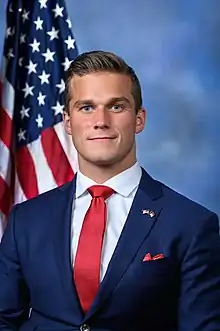
Some right-leaning politicians at the federal and state levels have suggested the possibility of a second civil war in America, with a handful calling for secession, a civil war, or both. These calls for violence have been primarily in response to the First Impeachment of Donald Trump, and later in response to Trump's loss in the 2020 election, which many conservative leaders claim was stolen despite a lack of evidence.
The Republican House Representative Steve King, for instance, posted a much-criticized Internet meme on March 19, 2019 reading, "Folks keep talking about another civil war. One side has about 8 trillion bullets, while the other side doesn’t know which bathroom to use".[102] After the opening of the impeachment inquiry in Sept. 2019, President Trump made a Twitter post paraphrasing an evangelical Christian pastor and Fox News contributor, Robert Jeffress: "If the Democrats are successful in removing the President from office (which they will never be), it will cause a Civil War-like fracture in this nation from which our country will never heal."[103]
In December 2020, after the Supreme Court refused to hear Texas v. Pennsylvania, a lawsuit regarding unproven claims of fraud in the 2020 elections, Texas GOP Chair Allen West criticized the Court's decision and suggested "law-abiding states" should secede. West faced widespread criticism, including from Republican Congressman Adam Kinzinger and Democratic Senator Brian Schatz.[104][105][106] The official Arizona Republican Party Twitter account went further, encouraging Republican voters to prepare to "fight," and asking them if they were ready to "die for something."[107][108][109][110] Around the same time, Kelli Ward, chair for the Arizona Republican Party, tweeted at Trump urging him to "cross the Rubicon," a reference to the Roman Civil War. Trump's former National Security Advisor Michael Flynn retweeted Ward's call.[111]
In May 2021, U.S. Representative Matt Gaetz told a crowd of Trump supporters at an "America First" rally that "we have a Second Amendment in this country and I think we have an obligation to use it... it's about maintaining within the citizenry the ability to maintain an armed rebellion against the government if that becomes necessary." The crowded applauded and cheered these remarks.[112] Gaetz later denied that he was encouraging political violence and that his words were taken out of context.[113] Later in August, Congressman Madison Cawthorn (R-N.C.), drawing on claims that the 2020 United States presidential election had been stolen by Democrats, stated that "if our election systems continue to be rigged and continue to be stolen, it's gonna lead to one place, and it's bloodshed."[114] Cawthorn also added: "And I will tell you, as much as I'm willing to defend our liberty at all costs, there's nothing that I would dread doing more than having to pick up arms against a fellow American."[115] Cawthorn later echoed this sentiment following the Kyle Rittenhouse verdict, using social media to call on his supporters to "be armed, be dangerous and be moral," which some interpreted as incendiary.[116][117][118] In October 2021, U.S. Representative Marjorie Taylor Greene tweeted a poll asking her followers if the United States was ready for a "national divorce" and the division of states based on political affiliation, which many commentators interpreted as incendiary and provocative of political violence and civil war.[119][120]
There have been no explicit calls for civil war from any other political party, though some have expressed concerns that increased polarization will lead to a civil war. Presidential candidate Andrew Yang, who ran in the 2020 Democratic primary, expressed his concerns for a second civil war, tweeting in October 2021: "Polarization is worse than ever and getting worse not better. There is a Civil War coming if we don’t stop dehumanizing those we disagree with politically."[121] He echoed the same concern that a second civil war is possible on the Making Sense podcast with Sam Harris, stating high polarization on both sides "could end up being a new civil war that ends up bringing down our democracy as it currently exists."[122] During his inauguration, President Joe Biden called on the country to end the "uncivil war that pits red against blue, rural versus urban, conservative versus liberal," referring to the high polarization of American politics. He later remarked that the country was facing "the worst challenge to our democracy since the Civil War" in response to new voting restrictions enacted by conservative political leaders.[123]
Perception of a forthcoming Second Civil War
There is considerable and growing concern among the general public that a Second American Civil War could erupt in the near future. Journalist Malcom Kyeyune summarizes the political climate by stating: "Talk of insurrection, secession, civil conflict and civil war is no longer the chatter of the gullible and the mentally ill. It’s entering the fringes of polite society."[124]
A 2018 Rasmussen poll, for instance, found that 31 percent of American voters feared that the intense partisanship following the 2016 presidential election and the victory of Donald Trump would cause a Second Civil War within five years,[125] while a 2019 poll by the Georgetown Institute of Politics and Public Service revealed that "the average voter believes the U.S. is two-thirds of the way to the edge of a civil war".[126] A Zogby Analytics poll in 2021 found that nearly half of likely voters (46 percent) considered a second civil war likely. Voters in the South felt a civil war was more likely when compared to other regions.[127] The University of West Virginia's Center For Politics found that roughly 41% of Biden voters and 52% of Trump voters at least somewhat supported splitting the country from the union into liberal and conservative states. The same polling found that most voters saw everyday Americans who strongly support the opposing political party as either somewhat or very much a danger to society, and the majority of voters viewed political leaders of opposing parties as very much a danger.[128] Research conducted by the University of Chicago in 2021 found that more than a fourth of adults agree that “the 2020 election was stolen, and Joe Biden is an illegitimate president" and approximately 9 percent of Americans felt that "use of force is justified to restore Donald J. Trump to the presidency."[129][130] Researchers also concluded that belief in the Great Replacement and QAnon conspiracy theories were fueling much of the insurrectionist movement, and extrapolated that approximately 21 million Americans are prepared for violent conflict with the federal government.[131]
Many Americans of both political parties saw the fallout of the 2020 election as a clear sign that "America is falling apart."[132] Political scientist Eliot A. Cohen summarized this research by stating that most Americans are living under "the specter of civil war and the collapse of American democracy," but argues that American political institutions are stronger than most people credit them to be, and likens the cultural tension to the interwar period.[133]
Research conducted in late 2021 by the Harvard Kennedy School found that a majority of young Americans (between the age of 18 to 29) viewed the United States in peril. The poll also found that a third of young Americans anticipated a Second American Civil War within their lifetime. Anticipation of a civil war was held mostly by young Republicans or young Americans who reside in rural or small town areas.[134][135]
Ryan Williams, president of the conservative Claremont Institute, stated in an interview with The Atlantic that he was worried about civil violence and a civil war, claiming the United States is "more divided now than we were [in the 1860s]." Williams added that "[civil war] should be the thing we try to avoid almost at all costs," but noted that "we underestimate the extent to which we can lower the temperature in America and move forward with a lot more unity." Williams said the "ideal endgame" is for conservatism to "effect a realignment of our politics and take control of all three branches of government for a generation or two."[136]
Several journalists have also warned that a civil war is possible in the coming decade. Robert Kagan, co-founder of neoconservative think-tank Project for the New American Century, wrote in The Washington Post that "the United States is heading into its greatest political and constitutional crisis since the Civil War." Kagan asserted that if Trump runs for re-election in the 2024 Presidential Election there is "a reasonable chance over the next three to four years of incidents of mass violence, a breakdown of federal authority, and the division of the country into warring red and blue enclaves."[137] Journalist Robert Evans, who investigates global conflict and online extremism for Bellingcat, has also warned that a civil war is imminent.[138] Roberts dedicated a podcast called "It Could Happen Here" where he speculates on possible scenarios of a Second American Civil War.[139]
After the Supreme Court improvidently granted abortion restrictions stemming from United States v. Texas, New York Times journalist Charles M. Blow compared the political fallout to pre-Civil War America and claimed the country was "on the verge of another civil war." Blow noted that a new civil war would likely have "spats of violence" rather than organized battlefields and would be "fought in courts, statehouses and ballot boxes" against anyone who stood up to a "white racist patriarchy."[140]
Writing for Foreign Policy, international relations scholar Monica Toft identified three elements that could lead to civil war in the United States in the coming years: the existence of a prior civil war, divided national identity on lines of "race, faith and class," and a "shift from tribalism to sectarianism." Toft states: "if one described them—fractured elites with competing narratives, deep-seated identity cleavages, and a politically polarized citizenry—without identifying the United States by name, most scholars of civil war would say, “Hey, that country is on the brink of a civil war.”[44]
Other political and social commentators acknowledge that extreme partisan politics on Capitol Hill, accompanied by related commonplace verbal and occasional physical acts of aggression in the streets, are tearing apart the fabric of American society,[141][142][143][144][145][146] but point to the fact that "culture wars cycles" are imminent to the process of replenishing American values, and the first such cycle started after George Washington's retirement,[147] and that Americans have to find "America's middle again and return to civility."[148] Terrorism expert Brian Michael Jenkins echoed this view by stating that a civil war is unlikely (though not impossible), and that a possible rise in political violence, such as assassination attempts and armed conflict, was not uncommon from other periods in American history, concluding that "the country has a high tolerance for [political] violence without breaking apart."[11]
Notably, there has also been some discussion of a civil war among financial investors on Wall Street. In 2021, Billionaire hedge fund manager Ray Dalio placed the chance of a civil war in America in the next 5 to 10 years at 30%, citing "bad financial conditions and intense conflict."[149][150] Dalio says there is a "dangerously high risk" of government breakdown between the state and federal levels that won't go through the "rulebook" of the The Constitution, creating a "power conflict that could take it's various forms."[151] Dalio said disagreement over the 2022 midterm election results could trigger a faceoff between the federal government and states or cities, adding: "It will be power that will determine how that goes down."[152] Dalio added that "What history has taught is that when the causes that people are behind are more important to them than the system, the system is in jeopardy."[153]
Fintan O'Toole, recalling discussion of an Irish Civil War during The Troubles, states that characterizing modern political violence in the U.S. as an emerging civil war is a "failure of historical perspective." O'Toole points to events such as frontier conflict with various American Indian and First Nation tribes, the Tulsa race massacre in 1921, and the Martin Luther King, Jr. assassination riots, and the 1992 Los Angeles riots as examples of heightened political tension that did not spark a civil war in America. O'Toole says modern violence is unlikely to rise to the level of a full-blown civil war and that the "dark fantasy" of civil war tends to distract from modern problems, stating: "The comforting fiction that the U.S. used to be a glorious and settled democracy prevents any reckoning with the fact that its current crisis is not a terrible departure from the past but rather a product of the unresolved contradictions of its history."[154]
Research
Sociologist Jack Goldstone of George Mason University and quantitative historian Peter Turchin, using a predictive model for political instability, concluded in 2020 that the United States is "headed for civil war."[155] The first prediction came in 2010 when Turchin cited stagnating or declining wages, income inequality, overproduction of young graduates with advanced degrees, and exploding public debt as indicators of future political instability, peaking in the 2020s and increasing the likelihood of civil war.[156][157] Turchin reaffirmed the model's predictions in 2016 after the election of Trump, concluding that political instability would peak in the 2020s.[158] As the model's predictions unfolded in 2020, Turchin said the predictions were vindicated and said that political trends in the U.S. are "strongly associated" with civil violence, summarizing the research by stating: "Our model shows there is plenty of dangerous tinder piled up and any spark could generate an inferno."[159]
Meanwhile, researchers at the Brookings Institution countered that the outbreak of a civil war would be limited by several factors: a strong national rule of law, a lack of government-sponsored violence, no clear regional split, and likely conflict resolution through elections or public policy. However, the researchers suggested an uptick in domestic terrorism and mass violence could occur and that a civil war was not entirely impossible, concluding: "we should not assume it could not happen and ignore the ominous signs that conflict is spiraling out of control."[8] Constructional historian Mark Graber summarized this argument by stating: "We are badly divided, but the divisions exist within states as well as between them."[9]
Writing for conservative think tank Manhattan Institute for Policy Research, Lee Seigel argues that the discussion of a second civil war is "hyperbolic" and essentially impossible given current conditions, claiming that America is facing an epistemological crisis and not an existential one. Seigel argues that because there are not two separate armies ready to wage war, and that no true existential threat actually exists against any group of Americans, the idea of a civil war is unlikely, but admits: "We should be careful how we use such a term, lest fears of political catastrophe become self-fulfilling prophecies."[160]
Lilliana Mason, a political scientist at John Hopkins University, stated that if a modern civil war breaks out it will likely grow out of a "dangerous" cycle of protest-counterprotest violence that is already established, rather than on battlefields analogous to the American Civil War, leading to an increase in deadly confrontations similar to the Kenosha shooting. Mason theorized that if a Republican state legislature rejects the results of a future elections it could trigger a snowball event. "The first violent event can precipitate a bunch of other violent events," she notes, "and so we can imagine a terrible cascade" that could lead to a "future in which we can't stop the violence."[161]
Some observers have noted that recent interstate migration, fueled on the basis of state laws around issues like abortion and COVID-19-related mandates, is helping to create a more homogenous blue versus red landscape that might help reinforce the perception of a forthcoming civil war or secession.[162]
In popular culture
Literature
- In the semi-satirical 1935 political novel by American author Sinclair Lewis, It Can't Happen Here, a second civil war breaks out due to the tyrannical policies of fictional President Berzelius "Buzz" Windrip. Published during the rise of fascism in Europe, the novel describes the rise of Windrip, a politician who defeats Franklin Delano Roosevelt (FDR) and is elected President of the United States, after fomenting fear and promising drastic economic and social reforms while promoting a return to patriotism and "traditional" values. After his election, Windrip takes complete control of the government and imposes a plutocratic/totalitarian rule with the help of a ruthless paramilitary force, in the manner of Adolf Hitler and the SS. The novel's plot centers on journalist Doremus Jessup's opposition to the new regime and his subsequent struggle against it as part of a liberal rebellion. Reviewers at the time, and literary critics since, have emphasized the connection with Louisiana politician Huey Long, who was preparing to run for president in the 1936 election when he was assassinated in 1935 just prior to the novel's publication.
- Philip K. Dick's 1974 novel, Flow My Tears, the Policeman Said is set in a futuristic dystopia, where the United States has become a police state in the aftermath of a Second Civil War. The story follows a genetically enhanced pop singer and television star who wakes up in a world where he has never existed.
- In Canadian author Margaret Atwood's 1985 dystopian novel, The Handmaid's Tale, a secretive group of religious fundamentalists called "The Sons of Jacob" stages an attack that kills the U.S. President and most of Congress. In the ensuing political and social upheaval, the group launches a hostile revolution and suspends the United States Constitution under the pretext of restoring order. Within this autocratic new system, the group is quickly able to curtail or take away human, civil, and in particular women's rights. Under their newfound authority, The Sons of Jacob declare the establishment of The Republic of Gilead — a theocratic military dictatorship within the borders of what was formerly the United States of America. The new regime moves quickly to consolidate its power and reorganize society with an Old Testament-inspired social and religious fanaticism, and enshrines in law a militarized, hierarchical system of newly-created societal classes and cultural castes. At the same time, the Gileadian army continues to fight a Second American Civil War against various factions who oppose the new regime. The novel primarily takes place 16 years after the events that occurred during the establishment of Gilead, and depicts a grim picture of society, where pollution caused by nuclear and biological issues have caused near-universal infertility and a sharp rise in birth defects, where women are subjugated and valued only for their reproductive capacities, and where minorities of every stripe are persecuted.
- In 1993, author David Aikman wrote When the Almond Tree Blossoms, a novel describing a second American Civil War. The book detailed an account of an East-West divide following a U.S. defeat and surrender following a battle in the Middle East. The two sides, The Constitutionalists and People's Movement are locked in a bitter fight. A sequel to the book is currently under development by Aikman.[163]
- In the 1995 alternate history/time travel novel ARC Riders by David Drake and Janet Morris, the United States is on the verge of collapse and possible nuclear civil war due to over two decades of harsh military rule as a result of the ARC Raiders meddling with the Vietnam War.
- In the 1997 alternate history novel Back in the USSA by Eugene Byrne and Kim Newman, a Second American Civil War and a Second American Revolution occur as a result of the corrupt presidency of Charles Foster Kane, who becomes the 28th president after former president and Progressive Party candidate Theodore Roosevelt wins the 1912 presidential election, but is assassinated on December 19, 1912 before taking office by the sharpshooter and exhibition shooter Annie Oakley when he personally attempts to break up a labor strike at the Chicago Union Stock Yards with the help of the Rough Riders. Due to his being Roosevelt's running mate, Kane becomes president on March 4, 1913. By 1917, the U.S. becomes unstable politically and socially. That year, the Socialist Party led by Eugene Debs gains increasing support and both a Second American Civil War and Second American Revolution (both based on the Russian Civil War and Russian Revolution, respectively) breaks out, following which Kane is ousted from the White House, overthrown, and executed for treason. The United States becomes the United Socialist States of America (USSA) with Debs as its president, surviving until his death in 1926.
- In the 2002 short story "Southern Strategy" by Michael F. Flynn that is collected in the anthology Alternate Generals II by Harry Turtledove, a shortened World War I leaves the German Empire a world power in the 20th century, while the United States all but collapses during a genocide-based second civil war.[164][165]
- In the 2002 novel A Disturbance of Fate by Mitchell J. Freedman, Barry Sadler gets elected President of the United States in 1984 and causes a second civil war due to his conservative politics. After much destruction of the nation, Sadler is arrested and a new Constitution is put into place, which abolishes the office of the presidency.
- In one of the timelines in the 2003 novel Fuzzy Dice by Paul Di Filippo, George McGovern is narrowly elected president in 1972 after incumbent Richard Nixon had undergone an assassination attempt and become completely paranoid, waging a crackdown on real and imagined domestic foes as well as a huge escalation of the Vietnam War, and setting off a huge explosion of countrywide riots. The riots continue and even increase after McGovern's election and a call by the new president for a return to calm proves completely ineffective. McGovern rejects a call in Congress to use the Army to quell the riots, leading to an attempted impeachment. Some military commanders try repression on their own, killing civilians and only adding to the ferocity of the riots. Eventually, the country is plunged into chaos, an all-out Second American Civil War, and eventually the total collapse of the Old Order. When the book's protagonist arrives some decades later, he finds a "Hippie-style" dictatorship presided over by the monstrous Lady Sunshine and with Hells Angels acting as the police, and the final fate of McGovern is unknown.
- Empire by Orson Scott Card is a 2006 novel set in a near-future US (implied to be 2008) where after the President and Vice President are assassinated, civil war breaks out. A left-wing group called the Progressive Restoration rises up, seeking to reverse change since George W. Bush's election, with the main characters becoming involved in the conflict. The novel is a tie-in to the Shadow Complex video game, with Hidden Empire following in 2009.
- In the 2012 novel by Billy Bennett titled By Force of Arms (part of a series by the author focusing on a victorious Confederacy), the United States (led by William Tecumseh Sherman) and the Confederate States (led by Robert E. Lee) fight "The Second American Civil War" in 1869 due to Confederate and French military involvement in Mexico, with fighting spreading across the two countries from ironclads firing at each other in the Gulf of California, trench warfare in the Confederate state of Virginia, Buffalo Soldiers fighting in the west, pro-Confederate bushwhacker partisans in the Union state of Missouri made even more deadly by the usage of the introduction of breech-loading rifles and Gatling guns.
- The 2013 novel Pulse by Patrick Carman depicts a Second Civil War, escalating into a nuclear disaster, leaving only one area of land habitable, divided into 2 states constantly at war.
- American War, the 2017 debut novel by Omar El Akkad, is told from the viewpoint of members of the Chestnut family who have experienced the War first-hand. The War begins in 2074, when anthropogenic climate change has led to a ban on fossil fuels, leading to the secession of several Southern states. The events of the novel themselves are influenced by widespread plagues, and culture wars over increased immigration of Muslims.[166]
- Tropic of Kansas, the 2017 debut novel by Christopher Brown, is told from the points of view of Sig, an orphan running from the law, and Tania, a government investigator forced to hunt him. The two are foster brother and sister. In this setting, the US has broken into warring factions, with most of the action taking place in a new wasteland in the Midwest.[167]
Film
- The 1996 film Barb Wire, based upon the 1994 comic book of the same name, is set in 2017 during the "Second American Civil War". Titular heroine Barb Wire (Pamela Anderson) owns the Hammerhead, a nightclub in Steel Harbor — "the last free city" in a United States ravaged by the civil war—and she brings in extra cash working as a mercenary and bounty hunter.
- The Second Civil War: a 1997 made-for-TV movie wherein the title conflict erupts over immigration, with the country having become inundated with immigrants and refugees, and the president attempting to settle more refugees in a resistant Idaho.
- The 2005 film adaptation of V for Vendetta mentions an ongoing civil war in the United States, with fighting said to be devastating the midwest. The war, combined with a plague, allegedly cripples the country to the point where its government petitions to the United Kingdom for medical supplies. However, both reports come from the fascist Norsefire regime's propaganda sources in the United Kingdom, leaving the existence of the war in question.
- The 2017 film Bushwick set in the New York City neighborhood of the same name, deals with mysterious invaders. It is later revealed that the invaders are mercenaries sent by a Texas-led coalition comprised by Southern states seeking to secede from the US.
- The 2019 film In the Shadow of the Moon set in Philadelphia is a sci-fi thriller about the death of several people at different points in time. It is later revealed that the deaths were targeted killings to prevent another civil war.
- The 2021 film The Forever Purge showed a United States of America in a state of civil war between the NFFA's military forces and the white supremacist group called the ''Ever After'' Purgers.
Television
- In season two of the 2006 TV series Jericho, a second American Civil War begins between the United States and the separatist Allied States of America.[168] Members within the US government conspire to bomb 23 American cities in order to kill the President and other heads of Government. After the power grid is knocked out, new leaders organize and make a new government called the Allied States of America, which occupy everything West of the Mississippi River, excluding Texas, which becomes independent. Everything east belongs to the remaining United States. The Allied States leaders frame Iran and North Korea for the attacks, and subsequently nuke the two countries. The new government gradually transforms into an oppressive and authoritarian fascist regime. Civil war begins when it is revealed that leaders within the Allied States of America were ring leaders of the previous attacks on American cities. In the sequel comic book series, the Allied States military launches a devastating invasion of Texas, presumably defeating the country. Despite this, the war against rebels within Allied territory and the United States continues.
- In the Family Guy episode "Back to the Pilot", Brian travels back in time to 1999 and tells his younger self to prevent the September 11 attacks. By doing so, George W. Bush is unable to exploit fears of terrorism and secure re-election. After losing the 2004 election, Bush reforms the Confederacy and declares war on the United States, resulting in a post-apocalyptic future.
- A pilot film for a proposed TV drama, Civil, about a disputed election that slides into civil unrest and eventually war, was optioned by TNT in 2016.[169] However TNT decided not to proceed as it was felt to be too close to home for the 2016 U.S. presidential election.[170]
Video games
- The Deus Ex video game series, first released in 2000, depict a United States reshaped by what is called the "Northwest War", where several states secede from the union due to an unpopular gun control law and increasing dissent with the federal government. The main antagonists for the first act of the game, the National Secession Forces, are descended from the Northwest Secession Forces who fought the United States during the war, although the newer NSF is more kin to a left-wing populist movement, and the original was more akin to a right-wing militia.
- Shattered Union, a 2005 video game published by 2K Games, depicts a civil war between six factions of the former United States and the European Union, following the destruction of Washington, D.C. in a nuclear attack.[171]
- The science-fiction, action-roleplaying, third-person shooter Mass Effect series, first released in 2007, has this subject in its backstory, spawning from the creation of the United North American States.[171]
- In Kaiserreich, an alternate history mod for the game Hearts of Iron 4, the US remains isolationist leading to a Central Powers victory in World War 1. This isolationism leads to the effects of the great depression being amplified, resulting in increased political polarization. After gridlock in the 1936 election the country collapses into a civil war between a military junta, socialist, right wing populist, and democratic remnants.[172]
See also
- American decline
- List of active separatist movements in North America
- List of fictional states of the United States
- Militia organizations in the United States
- Names of the American Civil War
- Neo-Confederate
- Origins of the American Civil War
- Patriot movement
- Political polarization in the United States
- Secession in the United States
- Second American Revolution
- Terrorism in the United States
References
- Fleming, Leah. "Author Keith Boykin: 'America Is In A Cold Civil War'". Georgia Public Broadcasting. Retrieved 2021-10-06.
- "Former White House Russia expert Fiona Hill warns the U.S. is on a path to autocracy". NPR.org. Retrieved 2021-10-06.
- "UC San Diego Political Scientist Warns Of A Second Civil War After Capitol Riot". KPBS Public Media. 2021-01-07. Retrieved 2021-10-06.
- Bernstein: There is a 'civil war of untruth' in America - CNN Video, retrieved 2021-10-06
- "Eddie Glaude on the moment the 'cold civil war' turned hot". news.rice.edu. Retrieved 2021-10-06.
- October 23, Ian Schwartz On Date; 2021. "Fiona Hill: A Trump Victory In 2024 Will Be Seen As "Illegitimate," Could Start An "Open Civil War"". www.realclearpolitics.com. Retrieved 2021-10-25.CS1 maint: numeric names: authors list (link)
- "The civil war that fizzled out". The Seattle Times. 2020-12-07. Retrieved 2021-09-27.
- West, William G. Gale and Darrell M. (2021-09-16). "Is the US headed for another Civil War?". Brookings. Retrieved 2021-09-26.
- Rodricks, Dan. "Dan Rodricks: Civil war unlikely, but the nation's present course could still be disastrous | COMMENTARY". baltimoresun.com. Retrieved 2021-10-27.
- book, Lee Siegel’s seventh; Matters, Why Argument; February, will be published in (2021-10-30). "It's Not Existential". City Journal. Retrieved 2021-11-11.
- "Opinion | Is America on the brink of a civil war?". NBC News. Retrieved 2021-11-16.
- O’Toole, Fintan (2021-12-16). "Beware Prophecies of Civil War". The Atlantic. Retrieved 2021-12-16.
- Kay, Grace. "A majority of Americans surveyed believe the US is in the midst of a 'cold' civil war". Business Insider. Retrieved 2021-10-06.
- Axelrod, Tal (2019-10-23). "Voters believe US two-thirds of the way to 'edge of a civil war': poll". TheHill. Retrieved 2021-10-06.
- "Fall 2021 Harvard Youth Poll". The Institute of Politics at Harvard University. Retrieved 2021-12-08.
- "31% Think U.S. Civil War Likely Soon". www.rasmussenreports.com. Retrieved 2021-12-08.
- "Zogby Analytics - The Zogby Poll®: Will the US have another civil war?". zogbyanalytics.com. Retrieved 2021-12-08.
- Eric Herschthal. America’s First Civil War: Alan Taylor’s new history poses the revolution as a battle inside America as well as for its liberty Archived 2017-06-26 at the Wayback Machine, The Slate, September 6, 2016.
- James McAuley. Ask an Academic: Talking About a Revolution Archived 2018-01-07 at the Wayback Machine, The New Yorker, August 4, 2011.
- Thomas Allen. Tories: Fighting for the King in America's First Civil War. New York, Harper, 2011.
- Peter J. Albert (ed.). An Uncivil War: The Southern Backcountry During the American Revolution. Charlottesville: University of Virginia Press, 1985.
- Alfred Young (ed.). The American Revolution: Explorations in the History of American Radicalism. DeKalb: Northern Illinois University Press, 1976.
- Armitage, David. Every Great Revolution Is a Civil War Archived 2013-12-03 at the Wayback Machine. In: Keith Michael Baker and Dan Edelstein (eds.). Scripting Revolution: A Historical Approach to the Comparative Study of Revolutions. Stanford: Stanford University Press, 2015. According to Armitage, "The renaming can happen relatively quickly: for example, the transatlantic conflict of the 1770s that many contemporaries saw as a British "civil war" or even "the American Civil War" was first called "the American Revolution" in 1776 by the chief justice of South Carolina, William Henry Drayton."
- William Stewart Wallace. The Text-Book Poison in Canadian-American Friendship, The Bookman: A Review of Books and Ideas, Vol. 48, September, 1918 – February, 1919, pp. 682–683.
- David Ramsay. The History of the American Revolution Archived 2018-07-27 at the Wayback Machine. 1789.
- Elise Stevens Wilson. Colonists Divided: A Revolution and a Civil War Archived 2016-10-17 at the Wayback Machine, The Gilder Lehrman Institute of American History.
- Timothy H. Breen. The American Revolution as Civil War Archived 2017-06-24 at the Wayback Machine, National Humanities Center.
- 1776: American Revolution or British Civil War? Archived 2018-07-27 at the Wayback Machine, University of Cambridge.
- Howell, Kenneth W. Still the Arena of Civil War: Violence and Turmoil in Reconstruction Texas, 1865–1874. Denton, Tex: University of North Texas Press, 2012.
- Smallwood, James, Barry A. Crouch, and Larry Peacock. Murder and Mayhem: The War of Reconstruction in Texas. College Station: Texas A & M University Press, 2003.
- Second American Civil War at IMDb
- Reconstruction (1865–1877): "The Second Civil War" Archived 2015-11-23 at the Wayback Machine, Bellows Free Academy
- "Southern Violence During Reconstruction | American Experience | PBS". www.pbs.org. Retrieved 2021-10-03.
- Robertson, Campbell (2021-09-06). "A Century Ago, Miners Fought in a Bloody Uprising. Few Know About It Today". The New York Times. ISSN 0362-4331. Retrieved 2021-09-27.
- "Texas Republicans have opted not to secede from the United States, after all". Washington Post. ISSN 0190-8286. Retrieved 2021-10-27.
- Perry, Louise (12 June 2020). "Could it really happen here?". The Critic. The Critic. Retrieved 20 July 2020.
- Dennis Prager. Yes, America Is in the Midst of a Civil War Archived 2017-06-11 at the Wayback Machine, The Daily Signal, June 6, 2017.
- Glasser, Susan B. (2019-07-18). ""I'm Winning": Donald Trump's Calculated Racism". The New Yorker. ISSN 0028-792X. Retrieved 2019-09-29.
- Smith, David (2019-07-21). "'It's a political civil war': Trump's racist tirades set tone for 2020". The Observer. ISSN 0029-7712. Retrieved 2019-09-29.
- "Californians are calling for a 'Calexit' in wake of Trump's win - Business Insider". Business Insider. 2016-11-11. Archived from the original on 2016-11-11. Retrieved 2021-10-27.
- "A Brief History of Secession". The American Scholar. 2017-03-06. Retrieved 2021-10-27.
- "Opinion: The second American civil war is underway. Only this time, it's not North vs. South". The Independent. 2020-05-01. Retrieved 2021-01-04.
- Greg, Miller (June 2, 2020). "CIA veterans who monitored crackdowns abroad see troubling parallels in Trump's handling of protests: For former U.S. intelligence officials, scenes of armed clashes and strongman poses are familiar signs of a fraying country". The Washington Post. Retrieved June 16, 2020.
- Toft, Monica Duffy. "How Civil Wars Start". Foreign Policy. Retrieved 2021-11-06.
- "Coronavirus: Armed protesters enter Michigan statehouse". BBC News. 2020-05-01. Retrieved 2021-11-16.
- Censky, Abigail (2020-05-14). "Heavily Armed Protesters Gather Again At Michigan Capitol To Decry Stay-At-Home Order". NPR. Retrieved 2021-11-16.
- Melendez, Winston Ross,Pilar (2020-12-21). "Heavily Armed Far-Right Mob Floods Oregon Capitol". The Daily Beast. Retrieved 2021-11-16.
- Bain, Ellissa (2021-08-28). "What does the Black American Flag mean on TikTok?". HITC. Retrieved 2021-10-16.
- "Black flag: Understanding the Trumpists' latest threatening symbol". Salon. 2021-10-12. Retrieved 2021-10-16.
- Postal, Leslie. "Threats, shouts and black flags: Anger about face masks leads to tense school board meetings". orlandosentinel.com. Retrieved 2021-10-16.
- "Transcript: The Last Word with Lawrence O'Donnell, 10/1/21". MSNBC.com. Retrieved 2021-10-16.
- columnist, John J. Dunphy Contributing (2021-10-22). "Black flags fly across America". Alton Telegraph. Retrieved 2021-10-25.
- "Trump complains about 'ugly anarchists' as police continue aggression on US protesters". the Guardian. 2020-06-11. Retrieved 2021-12-15.
- "Trump calls Portland protesters 'terrorists,' claims they 'hate our country'". NBC News. Retrieved 2021-12-15.
- Muller, Jordan. "Trump calls protesters 'terrorists,' pledges 'retribution' for tearing down statues". POLITICO. Retrieved 2021-12-15.
- "Trump visits Kenosha, calls protests for racial justice 'domestic terror'". France 24. 2020-09-01. Retrieved 2021-12-15.
- "Angry Donald Trump calls on governors to 'dominate' George Floyd protests". the Guardian. 2020-06-01. Retrieved 2021-12-15.
- CNN, Alex Rogers. "Trump's response to police killing threatens to further deepen unrest in America, Democrats and Republicans say". CNN. Retrieved 2021-12-15.
- "What's behind Trump's 'law and order' strategy and will it work?". the Guardian. 2020-09-01. Retrieved 2021-12-15.
- Snodgrass, Erin. "Trump told top military officials to 'shoot' protesters in the leg and 'crack their skulls,' new book claims". Business Insider. Retrieved 2021-12-08.
- Conradis, Brandon (2021-06-28). "Trump screamed at Milley over military crackdown on protests: book". TheHill. Retrieved 2021-12-08.
- Tiefer, Charles. "An Insurrection Act Proclamation Was Prepared For Trump By His Aides During D.C. Protests". Forbes. Retrieved 2021-12-08.
- Schmidt, Michael S.; Haberman, Maggie (2021-06-25). "Trump Aides Prepared Insurrection Act Order During Debate Over Protests". The New York Times. ISSN 0362-4331. Retrieved 2021-12-08.
- "Trump is spreading a dangerous conspiracy theory about antifa: Trump's attempts to blame violence on radical leftists are a way to justify military escalation". The Washington Post. June 10, 2020. Retrieved June 16, 2020.
- Zimmer, Ben (2020-06-04). "Why Trump Is So Obsessed With Antifa". The Atlantic. Retrieved 2020-06-16.
- "North Carolina officers fired over racist remarks, 89 incidents now under review". CBS News.
- Ingram, Hunter. "Three North Carolina police officers fired for racist comments calling for 'slaughtering' Black people". USA Today.
- Praats, Michael (June 24, 2020). "Fired Wilmington cop: "We are just going to go out and start slaughtering them f—— ni—–. I can't wait. God, I can't wait." [Free read]".
- McReynolds, Amanda. "Fired Wilmington police officers previously terminated, demoted". Wilmington Star-News.
- "US election: Trump won't commit to peaceful transfer of power". BBC News. 2020-09-24. Retrieved 2021-09-26.
- "US election: Is America on the brink of a second Civil War?". NZ Herald. Retrieved 2021-09-27.
- "Could Trump Overturn American Democracy? | History News Network". historynewsnetwork.org. Retrieved 2021-10-27.
- "Americans Are Frantically Buying Military Gear Before the Election". Bloomberg.com. 2020-10-23. Retrieved 2021-09-27.
- "US Election: Michigan militia preparing 'for civil war' - YouTube". www.youtube.com. Retrieved 2021-01-04.
- Porter, Tom. "Trump raised the idea of imposing martial law to overturn the election in a White House meeting, according to reports". Business Insider. Retrieved 2021-09-27.
- "On Parler, talk of "civil war" follow Ted Cruz-led plan to challenge electoral votes". Newsweek. 2021-01-02. Retrieved 2021-11-08.
- "When Trump started his speech before the Capitol riot, talk on Parler turned to civil war". www.usatoday.com. Retrieved 2021-11-08.
- George-Parkin, Hilary (2021-01-12). "Insurrection merch shows just how mainstream extremism has become". Vox. Retrieved 2021-11-08.
- Maheshwari, Sapna; Lorenz, Taylor (2021-01-19). "Why T-Shirts Promoting the Capitol Riot Are Still Available Online". The New York Times. ISSN 0362-4331. Retrieved 2021-11-08.
- Barber, C. Ryan. "A Capitol rioter who declared 'Civil War is coming' just avoided the prison sentence prosecutors wanted". Business Insider. Retrieved 2021-11-24.
- Bogel-Burroughs, Nicholas; Dewan, Shaila; Gray, Kathleen (2020-10-08). "F.B.I. Says a Michigan Militia Plotted to Kidnap Gov. Gretchen Whitmer". The New York Times. ISSN 0362-4331. Retrieved 2020-10-08.
- Gallucci, Nicole (30 September 2019). "If Trump's #CivilWar2 happens, we've got plenty of people offering to bring salads". Mashable.
- Suciu, Peter. "'Civil War' Trending On Twitter After Comment Made By Trump Supporter". Forbes. Retrieved 2021-10-25.
- Trump Supporter Warns Of CIVIL WAR, Senate GOP FEARS Trump 2024 Run Would SABOTAGE Midterm Elections, retrieved 2021-12-13
- "https://twitter.com/garygrumbach/status/1447208202756632585". Twitter. Retrieved 2021-10-25. External link in
|title=(help) - Reich, Robert B. "Robert B. Reich: Is a second American civil war possible?". The Baltimore Sun. Retrieved 2019-09-28.
- Hindmon, Jade (20 May 2019). "Is The US Headed For A Second Civil War?". KPBS Public Media. Retrieved 2019-09-29.
- "Explainer: Who are Antifa, the 'boogaloo' movement and others blamed in U.S. protest violence?". Reuters. 2020-06-05. Retrieved 2020-06-16.
- "The Boogaloo: Extremists' New Slang Term for A Coming Civil War". Anti-Defamation League. Retrieved 2020-06-16.
- Jong-Fast, Molly (2021-11-23). "Biden Needs an Enemy". The Atlantic. Retrieved 2021-11-24.
- Gillespie, Brandon (2021-11-24). "Liberal college professor suggests Biden 'declare war' on Republicans, compares them to Civil War slaveholders". Fox News. Retrieved 2021-11-24.
- Ricks, Thomas E. "What a new U.S. civil war might look like". Foreign Policy. Retrieved 2019-12-18.
- Williams, Janice (March 2, 2019). "Donald Trump Is Igniting a 'Cold Civil War' in U.S. and 'Every Day Brings it Closer to Ignition': Carl Bernstein". Nerwsweek. Retrieved 1 September 2020.
- "There Is No Whistleblower, Just a Leaker! We're in the Midst of a Cold Civil War". The Rush Limbaugh Show. Retrieved 2019-09-28.
- Staff, Media Matters. "Sean Hannity warns of civil war if Mueller goes after Trump". Media Matters for America. Retrieved 2021-10-19.
- Taylor, Paul; Cohn, D’Vera (2012-11-07). "A Milestone En Route to a Majority Minority Nation". Pew Research Center’s Social & Demographic Trends Project. Retrieved 2021-10-26.
- Fleming, Leah. "Author Keith Boykin: 'America Is In A Cold Civil War'". Georgia Public Broadcasting. Retrieved 2021-10-26.
- "The Origins of Our Second Civil War". National Review. 2018-07-31. Retrieved 2019-12-18.
- October 23, Ian Schwartz On Date; 2021. "Fiona Hill: A Trump Victory In 2024 Will Be Seen As "Illegitimate," Could Start An "Open Civil War"". www.realclearpolitics.com. Retrieved 2021-10-25.CS1 maint: numeric names: authors list (link)
- "Fiona Hill". Firing Line with Margaret Hoover. Retrieved 2021-10-25.
- "Civil war is coming". TheArticle. 2021-12-14. Retrieved 2021-12-15.
- "Steve King posts meme saying red states have '8 trillion bullets' in event of civil war". Los Angeles Times. 2019-03-19. Retrieved 2019-09-30.
- Stieb, Matt (2019-09-30). "Trump Quotes Ally Who Predicts a 'Civil War-Like Fracture' If He Is Impeached". Intelligencer. Retrieved 2021-10-19.
- Vlamis, Kelsey (December 11, 2020). "The Texas GOP had a fit after the Supreme Court rejected their bid to flip the election in Trump's favor, and now they're hinting at secession". Business Insider.
- Kinzinger, Adam [@RepKinzinger] (2020-12-11). "I believe @TexasGOP should immediately retract this, apologize, and fire Allen West and anyone else associated with this. My guy Abraham Lincoln and the Union soldiers already told you no. t.co/A9M8ePJUkJ" (Tweet). Retrieved 2021-01-04 – via Twitter.
- Schatz, Brian [@brianschatz] (2020-12-11). "The Texas Republican Party is officially in favor of leaving the Union. They have lost their minds. Biden will be President, but these people are deadly serious about secession and sedition. And this is the only question that media should ask any elected Republican tomorrow. t.co/8UAfGET88M" (Tweet). Retrieved 2021-01-04 – via Twitter.
- Roberts, Laurie. "Did the Arizona Republican Party just advocate a bloody overthrow of Joe Biden's election?". The Arizona Republic. Retrieved 2021-09-27.
- Kelety, Josh. "'Die for Something:' Arizona GOP Incites Violence Over Election Fraud Fantasy". Phoenix New Times. Retrieved 2021-09-27.
- Williams, Linda (2020-12-08). "Arizona GOP sparks controversy on Twitter as some fear recent post may incite violence". FOX 10 Phoenix. Retrieved 2021-09-27.
- Brewster, Jack. "Arizona GOP Asks If Republicans Are Ready To Die For Trump's Voter Fraud Crusade". Forbes. Retrieved 2021-09-27.
- "Arizona GOP chair calls for Trump to "cross the Rubicon" in tweet shared by Michael Flynn". Newsweek. 2020-12-20. Retrieved 2021-11-06.
- Matt Gaetz Tells Supporters Second Amendment Is For "Armed Rebellion Against The Government", retrieved 2021-09-27
- Solender, Andrew. "Gaetz Tells Supporters Second Amendment Is For 'Armed Rebellion Against The Government'". Forbes. Retrieved 2021-09-27.
- Quarshie, Mabinty (August 31, 2021). "Rep. Madison Cawthorn calls Jan. 6 rioters 'political prisoners,' warns of 'bloodshed' at GOP event". USA Today.
- Lutz, Eric (2021-08-31). "Madison Cawthorn Is Openly Talking About Civil War at This Point". Vanity Fair Blogs. Retrieved 2021-09-27.
- "GOP congressman urges supporters to be 'armed' and 'dangerous'". MSNBC.com. Retrieved 2021-11-24.
- "Outrage as GOP congressman says 'be armed, be dangerous' after Rittenhouse verdict". The Independent. 2021-11-19. Retrieved 2021-11-24.
- Lonas, Lexi (2021-11-19). "Madison Cawthorn offers Rittenhouse an internship". TheHill. Retrieved 2021-11-24.
- "People Think Rep. Marjorie Taylor Greene Is 'Calling For Civil War' With New Twitter Poll". news.yahoo.com. Retrieved 2021-10-13.
- "Marjorie Taylor Greene under fire for incendiary Twitter poll". The Independent. 2021-10-12. Retrieved 2021-10-13.
- "https://twitter.com/andrewyang/status/1447190903337230338". Twitter. Retrieved 2021-10-13. External link in
|title=(help) - "Making Sense Podcast #202 - A Conversation with Andrew Yang". Sam Harris. Retrieved 2021-10-13.
- "President Biden to say 'US democracy in worst peril since Civil War' in Philadelphia speech". The Economic Times. Retrieved 2021-09-27.
- "Would America survive a civil war?". UnHerd. 2021-11-12. Retrieved 2021-12-13.
- "31% Think U.S. Civil War Likely Soon". Rasmussen Reports. 27 June 2018. Archived from the original on 1 December 2020.
- "NEW POLL: Voters Find Political Divisions So Bad, Believe U.S. Is Two-Thirds Of The Way To "Edge Of A Civil War"". Institute of Politics and Public Service. Georgetown University. 23 October 2019. Archived from the original on 14 October 2020.
- "Zogby Analytics - The Zogby Poll®: Will the US have another civil war?". zogbyanalytics.com. Retrieved 2021-09-26.
- "New Initiative Explores Deep, Persistent Divides Between Biden and Trump Voters". Center for Politics. 30 September 2021.
- "UChicago CPOST". cpost.uchicago.edu. Retrieved 2021-09-27.
- "Understanding the American Insurrectionist Movement" (PDF). June 14, 2021.
- "Deep, Destructive and Disturbing: What We know About Today's American Insurrectionist Movement" (PDF). August 2021.
- https://www.axios.com/poll-america-falling-apart-4a13376f-f962-46e3-8e2c-174d396f25d1.html
- Cohen, Eliot A. (2021-10-06). "The Rot of Democracies". The Atlantic. Retrieved 2021-10-19.
- "Fall 2021 Harvard Youth Poll". The Institute of Politics at Harvard University. Retrieved 2021-12-08.
- Summers, Juana (2021-12-01). "Young Americans are raising alarms about the state of U.S. democracy in a new poll". NPR. Retrieved 2021-12-08.
- Green, Emma (2021-10-01). "The Conservatives Dreading—And Preparing for—Civil War". The Atlantic. Retrieved 2021-10-02.
- Kagan, Robert (September 23, 2021). "Our constitutional crisis is already here". Washington Post.
- "Investigative reporter Robert Evans: "We're on the edge of an authoritarian nightmare"". Salon. 2020-04-03. Retrieved 2021-10-16.
- "It Could Happen Here". iHeart. Retrieved 2021-10-19.
- Blow, Charles M. (2021-12-12). "Opinion | We're Edging Closer to Civil War". The New York Times. ISSN 0362-4331. Retrieved 2021-12-13.
- Alex Zakrzewski. A Second U.S. Civil War: Inevitable or Impossible? Archived 2017-10-19 at the Wayback Machine, HistoryNet.com, March 23, 1916.
- Kevin D. Williamson.From Americans to Americans: Cocooned by peace, some dream of a civil war Archived 2017-06-19 at the Wayback Machine, National Review, June 16, 2017.
- Marshall Connolly. How close is America to another civil war? Archived 2017-06-18 at the Wayback Machine, Catholic Online, June 15, 2017.
- Judson Phillips. Resist movement, violence are tearing America apart Archived 2017-06-29 at the Wayback Machine, The Washington Times, June 14, 2017.
- Another 'Civil War'? Pessimism About Political Violence Deepens In A Divided Nation, NPR, October 31, 2018
- Victor Davis Hanson. The Origins of Our Second Civil War, National Review, July 31, 2018
- Stephen Prothero. Why conservatives start culture wars and liberals win them Archived 2017-07-20 at the Wayback Machine, The Washington Post, January 29, 2016.
- Shooting shocks, but will it unite? Archived 2018-01-24 at the Wayback Machine The Columbus Dispatch, June 15, 2017.
- Ahuja, Maneet. "Ray Dalio Says America's Decline Will Upend Lives, Not Just Portfolios". Forbes. Retrieved 2021-12-13.
- Dalio, Ray. "Ray Dalio predicts there's a 30% chance the US will break out into civil war in the next 10 years". Business Insider. Retrieved 2021-12-13.
- "Ray Dalio on Possibilities of U.S. Civil War". MarketWatch. Retrieved 2021-12-13.
- Hough, Jack. "Why Hedge Fund Giant Ray Dalio Is Worried About China, Inflation, and a U.S. 'Civil War'". www.barrons.com. Retrieved 2021-12-13.
- "Ray Dalio on Possibilities of U.S. Civil War". MarketWatch. Retrieved 2021-12-13.
- O’Toole, Fintan (2021-12-16). "Beware Prophecies of Civil War". The Atlantic. Retrieved 2021-12-16.
- Purtill, James (2020-06-17). "This model forecast the US's current unrest a decade ago. It now says 'civil war'". triple j. Retrieved 2021-10-13.
- Turchin, Peter (February 2010). "Political instability may be a contributor in the coming decade". Nature. 463 (7281): 608. Bibcode:2010Natur.463..608T. doi:10.1038/463608a. ISSN 1476-4687. PMID 20130632.
- Wood, Graeme (2020-11-12). "The Next Decade Could Be Even Worse". The Atlantic. Retrieved 2021-10-13.
- "Social Instability Lies Ahead, Researcher Says". UConn Today. 2016-12-27. Retrieved 2021-10-13.
- "Welcome To The 'Turbulent Twenties'". NOEMA. Retrieved 2021-10-13.
- book, Lee Siegel’s seventh; Matters, Why Argument; February, will be published in (2021-10-30). "It's Not Existential". City Journal. Retrieved 2021-11-11.
- "Opinion | America is entering a deadly identity crisis". MSNBC.com. Retrieved 2021-12-13.
- "Civil war is coming". TheArticle. 2021-12-14. Retrieved 2021-12-15.
- "David Aikman's when the Almond Tree Blossoms reads as if it was written about 2016". 7 September 2016.
- "- Chapter 2". www.baen.com.
- "Uchronia: Southern Strategy". www.uchronia.net.
- Kakutani, Michio (2017-03-27). "A Haunting Debut Looks Ahead to a Second American Civil War". The New York Times. Archived from the original on 2018-05-16. Retrieved 2018-06-04.
- Sheehan, Jason (2017-07-09). "'Tropic Of Kansas' Rips Dystopia From The Headlines". NPR. Archived from the original on 2018-07-17. Retrieved 2018-07-16.
- As stated at the end of the final episode, "Patriots and Tyrants".
- Stanhope, Kate (2016-06-15). "Bradley Whitford, Courtney B. Vance Board TNT Drama Pilot 'Civil'". The Hollywood Reporter. Archived from the original on 2017-02-10. Retrieved 2017-05-08.
- Andreeva, Nellie (2016-12-13). "Modern-Day Civil War Drama Pilot 'Civil' Not Going Forward At TNT". Deadline Hollywood. Archived from the original on 2017-04-28. Retrieved 2017-05-08.
- Gryniewicz, Josh (July 7, 2020). "Coronavirus and the Culture Wars". PopMatters.
- "Kaiserreich, The Mod That Changes The World".
Further reading
- Hindmon, Jade (January 7, 2021). "UC San Diego Political Scientist Warns Of A Second Civil War After Capitol Riot". KPBS.