Battle of Anandpur (1704)
The Siege of Anandpur was fought at Anandpur, between Sikhs and Mughal vassal Rajas of the Sivalik Hills in May 1704.[2]
| Siege of Anandpur | |||||||
|---|---|---|---|---|---|---|---|
| Part of Mughal-Sikh Wars | |||||||
| |||||||
| Belligerents | |||||||
 Sikhs (Khalsa) Sikhs (Khalsa) |
 Mughal Empire Mughal Empire | ||||||
| Commanders and leaders | |||||||
|
Sher SinghNahar SinghUde Singh |
Wazir Khan *Rajas of the Sivalik Hills | ||||||
Cause
The hill Rajas were concerned about Guru Gobind Singh's rising power and influence in their region. Even the Mughal generals had failed to subdue the Guru in the First Battle of Anandpur. Consequently, the Rajas of several hill states (including Jammu, Nurpur, Mandi, Kullu, Guler, Chamba, Srinagar, Dadhwal, and Hindur) assembled at Bilaspur to discuss the situation. The son of Bhim Chand, Raja Ajmer Chand of Kahlur, suggested forming an alliance to curb the Guru's rising power. Accordingly, the Rajas formed an alliance, and marched towards Anandpur.
They sent a letter to the Guru, asking him to pay the arrears of rent for Anandpur (which lied in Ajmer Chand's territory), and leave the city. The Guru insisted that the land was bought by his father, and is therefore, his own property.
Duni Chand led five hundred men from Majha region to assist the Guru. Reinforcements from other areas also arrived to help the Guru.
The battle
Lohgarh and Fatehgarh were the two main forts under Gobind Singh's control. Sher Singh and Nahar Singh were asked to guard Lohgarh, and Ude Singh was appointed as chief to guard Fatehgarh.
The hill Rajas attacked the Guru's forces, but had to retreat. They held a brief council, and decided to launch a three-sided attack.
The Rajas again held a council, in which Ajmer Chand proposed reconciliation with the Guru. Many Rajas agreed, but Raja Kesari Chand of Jaswal opposed the proposal, and suggested a more determined fight next day, to oust the Guru from Anandpur.
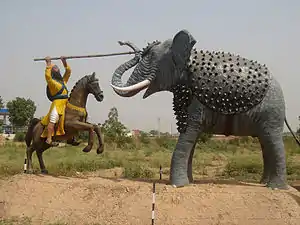
Next day, the Rajas' forces launched another attack and besieged the city. The Guru's men defended themselves successfully for weeks. Raja Kesari Chand then decided to send an intoxicated elephant to break the gate of Lohgarh fort. The body of the elephant was encased in steel, and a spear was projected from its forehead to break the gate. Guru's disciple, Vicihitar Singh (or Bachittar Singh) successfully chased away the elephant with his spear Nagni barchha.[3] Bhai Mohkam Singh cut its trunk with his sword. The wounded elephant went back in the Rajas' camp, trampling several men under its feet.[4] Meanwhile, Kesari Chand was killed by Ude Singh, and the Raja of Handur was severely wounded in a conflict with Bhai Sahib Singh. The Rajas' army had to retreat.
On the following day, the troops of Ghumand Chand of Kangra attacked Anandpur. The battle lasted till evening, and resulted in death of Ghumand Chand at the hands of Bhai Himmat Singh.[5]
Aftermath
Sometime after the battle, the hill Rajas negotiated a peace agreement with Gobind Singh, asking him to leave Anandpur temporarily. Accordingly, the Guru left for Nirmoh village (Nirmohgarh).[6] There, he was attacked by the Rajas' army, leading to the Battle of Nirmohgarh.
References
- Jacques 2006, p. 49.
- Fenech 2013, p. 18.
- Johar, Surinder Singh (1998). Holy Sikh shrines. New Delhi: M D Publications. p. 46. ISBN 978-81-7533-073-3. OCLC 44703461.
- Singh, Bhagat Lakshman (1995). Short Sketch of the Life and Work of Guru Govind Singh, The Tenth and Last Guru. Laurier Books Ltd. /AES. p. 96. ISBN 978-81-206-0576-3. OCLC 55854929.
- Singh, Prithi Pal (2007). The History of Sikh Gurus. Lotus Books. p. 146. ISBN 978-81-8382-075-2.
- Singh, Dalip (1992). Guru Gobind Singh and Khalsa Discipline. Amritsar: Singh Bros. p. 256. ISBN 978-81-7205-071-9. OCLC 28583123.
Sources
- Fenech, Louis E. (2013). The Sikh Zafar-namah of Guru Gobind Singh. Oxford University Press.
- Jacques, Tony (2006). Dictionary of Battles and Sieges. Greenwood Press. p. 49. ISBN 978-0-313-33536-5.